The Yankees have used at least five pitchers in ten straight games, which appears to be a record of pitching ineptitude unequaled in the history of baseball. What the team wouldn't do for John Wetteland now....or, for that matter, Roger Clemens?
There is even talk that George Steinbrenner will fire Joe Torre, which is bizarre on so many levels, not the least of which is that Steinbrenner's brain is supposedly turning into mashed potatoes, so how does he even know what's going on?
More seriously, how could you even think about firing a manager for the Yankees' current dilemma? Torre has had three hurt starters—Mike Mussina, Chien Ming-Wang, and Carl "Even My Girlfriend Thinks I'm a Wimp" Pavano. His ace reliever has an ERA around 10, and his set-up guys aren't doing much better. HIs hitters are also flailing. Bobby Abreu can't buy a hit, Hideki Matsui is ice-cold, Robinson Cano isn't hitting well, Johnny Damon is at .240-something, and even A-Rod has dropped off a bit.
So, let's see: no pitching, not much hitting. Definitely must be the manager's fault.
As for the Sox, they look very impressive...if their pitching can sustain its current level, and they can stay healthy, they're going to be tough to beat.
...after Yale expanded to its current size in the 1960s, there were roughly 4,000 to 5,000 applicants a year for 1,300 positions in the freshman class. The size of the freshman class has remained about the same, but now there are some 20,000 applicants, including a growing number of international ones, plus all the other desired niches of minority students, athletes, children of alums and the rest.
“Expansion could help relieve those pressures and create more opportunities for students who are just ordinary, extremely brilliant and talented students who don’t have any of those other connections,” Dr. Levin said. “We have astonishing educational resources here. If we can educate more students and give them exposure to the opportunities here, I think we can make an even more substantial contribution to the nation and the world.”
Applebome points out that Princeton too is enlarging the size of its undergraduate population, and the Yale Daily News has a nice piece about enlarging campuses at Yale*, Columbia, Princeton and Harvard. Surely increasing the size of the undergraduate population is being considered at Harvard, but is there any public debate about the idea? Not that I know of.Dr. Levin says there’s something perverse about the current system, where “prestige and reputation tend to depend on how many students you reject.”
This is true, of course, and good of Levin to say so. But a couple caveats: Yale had some opportunity to calm the application waters a bit by terminating its early admissions program, but has so far declined.
Moreover, isn't there a sense in which saying that more admissions will ease admission pressures is like Robert Moses saying that we need more highways to ease traffic? If you build it, they will come.
Nonetheless, what with this article and the implosion of MIT admissions chief Marilee Jones, I sense we're on the verge of a backlash against admissions insanity. This might be one backlash that Harvard wants to get in front of.....
________________________________________________________________
P.S. Incidentally, I recently met a current student at the Yale School of Organization and Management. We agreed that New Haven was becoming a very pleasant place in which to live....
Two of them were Harvard Crimson editors.
This is, of course, unprofessional and inappropriate behavior for a newspaper editor, who is supposed to be covering the news, not engaging in protest, and promoting free speech, not threatening it.
Nor is it the first time in recent memory that Crimson editors have behaved in ways that cast doubt on the paper's objectivity. A couple years ago, several Crimson editors threw a party to cheer up Larry Summers after his ouster. Given the high feelings at the time, and widespread concern that the Crimson was pro-Summers, it was exactly the wrong thing to do.
I wrote about that at the time and received a deluge of mail from Crimson folks explaining to me that the term "Crimson editor" doesn't actually mean that they are a Crimson editor, it's a blanket term referring to anyone who was at some point a Crimson editor. As in "Crimson editor David Halberstam...."
There are only two reasons I can think of for this bizarre usage. One is for the Crimson to associate itself with successful alumni. The second is to create bonds between current and former Crimson people, so that the alums will hire the current students.
But the policy does more damage to the paper than good. Two Crimson editors impinging on the free speech of a Kennedy School speaker? That makes the paper look awful.
There's a simple solution: the word "former." As in, "...former Crimson editor David Halberstam..." (Which, to be fair, the Crimson does seem to use.)
Of course, I don't actually know if the two students arrested the other night are former editors. But if they aren't, they should be.
Perhaps the ombudsman should weigh in?
And pretty high-level thinkin' it is, too. All those who say that Harvard professors would have to dumb themselves down to write a blog—an argument I've never understood, since a blog is essentially a big, blank sheet of paper—should take a look.
So far, the economists at Harvard are leading the way into the blogosphere. Rodrik is already engaging in a pretty good debate with Greg Mankiw. "Now, neither of Greg's arguments is exactly right..."
Which Harvard humanist will be first to blog? Hurry, folks, or you will confirm Larry Summers' suspicions about the superiority of his profession as compared to the humanities....
Professor Rodrik, just one suggestion: How about a name for your blog?

Doug Mirabelli now says he was being sarcastic when he said the "blood" was actually paint.
Johnny Damon, another 2004 teammate of Schilling’s, said, “As far as I know, it’s authentic.” Then, he smiled.
I do like that Johnny Damon.....
Looks to me like the blood is real. But then, I've always thought that, while Schilling deserved much credit for pitching a great game under tough circumstances, the business about the blood was over-hyped. So you bleed a little? Who cares? I once got kicked in the face playing soccer against, um, Harvard. I got a nosebleed but kept playing; my white shirt looked like a Jackson Pollock in red. It looked macho, but it wasn't really reflective of pain.
Now, football players whose uniforms get stained with blood—that's toughness.....
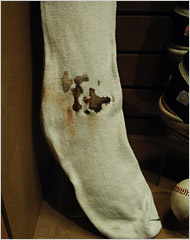
The Schilling sock:
Actually kind of nasty.
Is this conclusive proof that sex at Harvard is infrequent and does not last long?
The Times reports on a forthcoming book by former CIA director George Tenet:
“There was never a serious debate that I know of within the administration about the imminence of the Iraqi threat,” Mr. Tenet writes in a devastating judgment that is likely to be debated for many years. Nor, he adds, “was there ever a significant discussion” about the possibility of containing Iraq without an invasion.
The evidence that George W. Bush is the worst president in American history continues to build....
(A shout-out to the Crimson: You guys had a piece about the resignation posted hours before the MIT Tech.)
Jones' lies have obviously given her some psychological issues, and it's interesting to consider how her own lack of degrees have caused her to argue that we need to ease the vicious competition in college admissions.
As Zach Seward writes in the Crimson, in her book "Less Stress, More Success," Jones...
....warned students against “making up information to present yourself as something you are not.” She wrote, “You must always be completely honest about who you are.”
I know I should be outraged at Ms. Jones' deceit—and MIT certainly had no choice but to fire her—but I find myself feeling bad for her.
For one thing, her apology is pretty straight-up.
“I misrepresented my academic degrees when I first applied to M.I.T. 28 years ago and did not have the courage to correct my résumé when I applied for my current job or at any time since.... I am deeply sorry for this and for disappointing so many in the M.I.T. community and beyond who supported me, believed in me, and who have given me extraordinary opportunities.”
I can think of various Harvard evildoers—plagiarists, Russian rip-off-ers, manure-stealers, and so on—whose mea culpas were considerably less forthright than that.
Second, Ms. Jones was right about the insanity of college admissions, and this is not, frankly, the note one hears from Harvard, which uses students' mad desire to get into Harvard as a way to promote the brand.
Releasing the number of people who apply every year, for example, seems designed to show the world what a desirable place Harvard is....and attract ever greater numbers of moths to the flame.
Third, Ms. Jones did help increase the number of women at MIT from 17% of the student body to about half. That's a substantial achievement.
Fourth, Ms. Jones showed that, in fact, you don't always need a college degree to be a skilled, gifted, and hard-working person. As a result, she showed our society's obsession with the appearance of qualifications, rather than the reality of them.
Of course, you can't have a dean of admissions faking her resume. But doesn't the fact that she faked her curriculars and was still successful suggest the inherent absurdity of the whole college admissions game?
Some interesting quotes:
Thomas Cech gives his first interview about Harvard (that I know of) since the presidential search:
He says Harvard has not paid sufficient attention to undergraduate education. "Just like deferred maintenance on your buildings, you can live with it for a long time," he says. "When you are really that great, and have a great reputation, you don't pay much of a price for certain things – like undergraduate education – going downhill."
Former Princeton president William Bowen praises Faust:
"Her challenge will be to get people to work together, to think – and act – across traditional disciplinary lines," says Mr Bowen, a senior research associate at the Andrew Mellon Foundation, where Ms Faust is a trustee. "The power of persuasion is very important. She will need to encourage [the faculty], and to inspire. She will be good at that. She has a good sense of interpersonal relations."
Mr. Bowen, as I reported in 02138, did not support the choice of Drew Faust as president.
Also, some blogger pops off.
"Harvard needs to start a capital campaign because: one, it's overdue, and two, Allston is expensive," says Richard Bradley, author of Harvard Rules: The Struggle for the Soul of the World's Most Powerful University. Mr Bradley says that because Ms Faust is "not a celebrity academic, not a larger-than-life personality, or Harvard alumna", her appeal to donors is uncertain."
That's true, I did say that. Please note that I did not say she will not be good at it; my quote is purely a "remains to be seen" kind of thing.
Today the Times runs a story about a poll on global warming.
Americans in large bipartisan numbers say the heating of the earth’s atmosphere is having serious effects on the environment now or will soon and think that it is necessary to take immediate steps to reduce its effects, the latest New York Times/CBS News poll finds.
Ninety percent of Democrats, 80 percent of independents and 60 percent of Republicans said immediate action was required to curb the warming of the atmosphere and deal with its effects on the global climate. Nineteen percent said it was not necessary to act now, and 1 percent said no steps were needed.
Ninety percent of Dems, 80% of independents, and—and this surprises me somewhat—60% of Republicans think immediate action is required.If you polled the question, Is the sky blue?, you might not get such a level of consensus.
So what is the Times' headline?
Public Remains Split on Response to Warming
This is absurd. If you read the entire story, what you see is evidence of a landmark shift: the ascension of environmentalism to the forefront of the public consciousness.
I've been writing about the environment for years, and in my experience, politicians—even well-meaning ones—have all had the same mantra: "We want to do good things for the environment, but the public just doesn't care; when you ask people what issues are important to them at election time, the environment is always way down the list."
And for many years that was true.
This poll is evidence that, at last, there is a broad public consensus that the nation must act as a steward of the world's environment. Of course, people will always be split on how best to act. That's as it should be.
But this near-unanimity on the need to act? That's the story—and that's what the Times' headline should reflect.
Advanced Placement tests have become such a popular tool for students (and parents) desperate to increase their chances in the competitive admissions lottery — and for high-school administrators eager to raise their schools' academic profiles — that the phenomenon has taken on a life of its own. The arms race leading to more and more AP courses and exams is not likely to slow without a concerted effort on the part of American colleges and universities to rein it in. ...
It's an interesting piece from an interesting president.
The suicide bombings we see now in Iraq are an attempt to reverse these [American] gains: a deliberate, calculated counteroffensive led foremost by al-Qaeda, the same network of Islamist extremists that perpetrated catastrophic attacks in Kenya, Indonesia, Turkey and, yes, New York and Washington.
Indeed, to the extent that last week's bloodshed clarified anything, it is that the battle of Baghdad is increasingly a battle against al-Qaeda. Whether we like it or not, al-Qaeda views the Iraqi capital as a central front of its war against us.
Does Lieberman, who has been for the war since before it started, remember that Al Qaeda wasn't actually in Iraq until after we invaded that nation?The current wave of suicide bombings in Iraq is also aimed at us here in the United States -- to obscure the recent gains we have made and to convince the American public that our efforts in Iraq are futile and that we should retreat.
This logic leads one to a terrifying conclusion: The more "gains" we make in Iraq, the more bombings result. Therefore, every bombing is actually a sign of progress.
In other words, if there are no bombings, we're winning. And if there are lots of bombings, we're also winning.
Where is Joseph Heller when you need him?
And here's another dangerous piece of rhetoric:
Al-Qaeda, after all, isn't carrying out mass murder against civilians in the streets of Baghdad because it wants a more equitable distribution of oil revenue. Its aim in Iraq isn't to get a seat at the political table; it wants to blow up the table -- along with everyone seated at it.
So Al Qaeda is a nihilist organization that simply wants to blow up everything and everyone?
I'm no Al Qaeda expert, but this is not a serious argument. What would Al Qaeda do if the U.S. pulled out of the country? Lieberman would have us believe that the answer is bombing until Iraq is just one big pile of carnage. But even from my layman's perspective, Al Qaeda seems a terrorist organization with distinct political goals—getting the US out of lands it considers Muslim and holy.
I have no idea what Al Qaeda would do in Iraq if we pulled out. But it doesn't sound like Lieberman does either. And his construction—Al Qaeda wants "to blow up the table—along with everyone seated at it" is nothing but fear-mongering. If we're really going to fight Al Qaeda, we need a more sophisticated understanding of the organization than that.
But then, that's Joe Lieberman for you....
The sock itself is in the Hall of Fame. If Schilling really wants to put this matter to rest, he should advocate that an independent body test the red substance....
People would be pissed off, right? Letters to the Crimson...dark mumblings...shaking of heads at the Faculty Club.
But that's exactly what Drew Faust did yesterday, with the genders reversed.
Yesterday the Harvard College Women's Center gave Faust an award for "professional achievement." As the Crimson reports, in a subsequent q-and-a,
Faust shied away from talking business, declining to answer questions about her role in undergraduate life, and at one point asking Dean of the College Benedict H. Gross ’71 to answer a question about whether the recent focus on equal opportunity for young women had left undergraduate men neglected.
“It’s not a strategy on my part* to deflect these questions to someone else,” she said, “but Dick, is there a concern about boys?”
Boys?****
I wonder how Drew Faust would have felt, back when she was in college in the late 1960s, if an incoming male president referred to her as a "girl."
A president whose rise to power was predicated on her predecessor's gender-insensitive remarks ought to be more careful with her language. After all, men aren't the only ones who can be sexist.
_________________________________________________________________
Incidentally, this* is an interesting piece of rhetoric. As anyone who has followed Drew Faust over the past several months knows, it is exactly her strategy to deflect these questions to someone else.
There's nothing wrong with that. If Faust doesn't feel that it's appropriate for her to discuss substantive matters in public, that's her prerogative.
But when the double-speak begins—"it's not a strategy on my part," when clearly it is—that's when a leader's credibility starts slipping away. The erosion happens so subtly at first, you don't even realize it. But remarks like that start the process.
_______________________________________________________________
****A poster writes the following: Here's a classic case of: you had to be there. Faust was responding to a question about "boys." The person who asked the question used the term "boys" repeatedly, and when Faust referred the question to Dean Gross, she was asking him about research in that particular area of developmental psychology.
If that's correct, then I am wrong in faulting Drew Faust for using the term "boys," and I withdraw the criticism with apologies.
Consternation! Gnashing of teeth! Beating of breasts!
Peterson wants to talk to the governing board about calendar reform. Harvard students want the college to be more like Yale, which holds its undergraduate exams before Christmas, allowing students a little time off. As things stand, Harvard has its exams in January, and basically winds up blowing off the whole month.
Peterson puts the Corporation in an interesting position. It will either have to—gasp!—meet with someone other than its own seven members. Or it will suggest contempt for the reasonable petition of a student leader.
Which way will the Corporation go—in the direction of openness and transparency, or just more elitism and non-accountability?
Peterson's request exposes an interesting dilemma at Harvard right now: With Derek Bok wrapping up his interim presidency and Drew Faust declining to speak her mind, as well as a temporary FAS dean, there's a real power vacuum at the university.....
Is the university without a leader?
The body, floating, was in a billowing, once-white shirt. The toes were gone. The fingers were gone. The head, separated and floating next to the body, had a gunshot hole in the face.
To their credit, the soldiers decided that they needed to do something for the victim, whom they dubbed "Bob," as in, bobbing up and down. (You can understand the need for a little dark humor.)
The body, it was quickly decided, would have to be removed before the 120 soldiers could move in. "It's a morale issue. Who wants to live over a dead body?" [Army Major Brent] Cummings said. "And part of it is a moral issue, too. I mean he was somebody's son, and maybe husband, and for dignity's sake, well, it cheapens us to leave him there. I mean even calling him Bob is disrespectful. I don't know. It's the world we live in."
He paused.
"I'd like to put him in a final resting place," he said, "as opposed to a final floating place."
This is the kind of story Kurt Vonnegut, RIP, would understand. It's horrible almost beyond belief, but there is also beauty and courage in it.And, sadly, it is, of course, an apt metaphor for the war and America's involvement in Iraq.
Read the full story by David Finkel in the Washington Post—it will reinforce your admiration for our soldiers even as it breaks your heart over what has happened in Iraq.
Nonetheless, the details of the cover-up are truly disheartening. Yesterday, a former comrade of Tillman's described how he suspected at once that Tillman was killed by U.S. soldiers, but was forbidden to tell Tillman's own brother, who was in uniform and fighting nearby.
If the Administration lied about something so high-profile, imagine how many lies it has told about people and subjects less likely to attract the attention of the press?
Jessica Lynch also testified at yesterday's Congressional hearing, reiterating that she was not the hero the Pentagon made her out to be. (Some of us have believed this all along.)
The thing is that Pat Tillman, his brother, Jessica Lynch—they are heroes, and not just for their wartime service.
Kevin Tillman and Jessica Lynch are heroic for their determination to see the truth come out. They are heroes in in a way that this White House could not understand and certainly does not deserve.
Apparently I need an infusion of Tuesday Afternoon Zen.

Tampico, Mexico, by Claudia Zamorro
Here's the transcript!
Various websites would have you side with Alterman or Cox, depending on whether you're middle aged and stodgy or young and self-consciously obnoxious.
Me? As the names roll off the tongues—Michael Kinsley! Peter Beinart! Jim Kelly! John Huey! Rick Stengel!—I just wish we could drop them all into a lifeboat in the middle of some ocean and then wave buh-bye.
These people have convinced massive corporations to give them huge salaries to write for media that no one reads anymore. Several of them are supposed to be liberal, but they are all within such a narrow range of conventional opinion, their liberalism is about as threatening as throwing a Wiffle ball against the Washington Monument. (Although I do like Wiffle balls.)
When it comes to politics, the MSM truly does not realize how irrelevant its pundits have become...and the very idea of anyone arguing about the columnists in Time magazine as if it could possibly matter is enough to make you....well...not read Time magazine!
___________________________________________________________________
*Actually, at a brunch before the dinner.
As the Times puts it, Bush's vote of confidence in Gonzalez...
...indicated that Mr. Bush, at least for now, has concluded his attorney general can weather the challenge to his leadership at the Justice Department, barring any evidence of wrongdoing.
Maybe so. But does Bush realize that the real damage Gonzalez is inflicting is to him? In putting his credibility on the line for an incompetent apparatchik, the president makes himself look stupid, and gives Americans even less reason to respect him than we already have.
Of course, there's always the possibility that Bush figures we've lost all respect for him anyway, so what difference does it make?
Actually, that's not entirely nuts....
Would print editors permit their business sides to run ads superimposed over text? No. So why do they allow it online? Because online editorial is run either by tech geeks or by young "editors" who've never acquired the concept of church/state separation.....
In recent years, this hysteria has exacted apologies, resignations and other pounds of flesh...The sloppy, sexist remarks that former Harvard University President Lawrence H. Summers made about women and science deserved a reprimand, but they didn't justify the loss of his job, which came fast and furious last spring.
I know and like David, but he's wrong about something here—a mistake I want to point out since it's become so common, it's now conventional wisdom.
Most commentators who write about Summers' exit from Harvard now conflate it chronologically with the women-in-science comments, as if the former hastily followed the latter—it came "fast and furious."
The conflation creates a causality that isn't accurate.
In fact, as we on this blog all know, Summers left Harvard more than a year after "the troubles," and could very well have survived "women in science" had he not begun making more missteps.
This matters for two reasons.
One, the suggestion that Summers was fired for exercising his right to free speech makes him an unjustified martyr.
Two, it obscures the fact that there were many other issues involved in Summers' resignation, some of which are ongoing at Harvard. (Debates over centralization and executive power, for instance.)
I don't expect that pointing this out will make any real difference, since this conflation has now become the conventional wisdom about Summers' ouster. (As Michael Kolber might say, sometimes the media is lazy.)
Perhaps I will rename this blog "Tilting at Windmills"....
1) I saw Halberstam walking down the street a couple weeks ago, past the Cafe des Artistes on West 67th Street. He looked great—dapper, vigorous, elegant. I thought about introducing myself, then decided that I shouldn't bother him.
2) One of the reasons I thought about introducing myself is that I've been meaning to drop him a note; I recently read two of his baseball books, The Teammates and Summer of '49, and wanted to chat with him about baseball, the Red Sox, and the summer of '78. But I've been busy, and I put off writing the note. There's a lesson in that.
3) This paragraph, from Clyde Haberman's eloquent remembrance in the Times:
Mr. Halberstam was killed doing what he had done his entire adult life: reporting. He was on his way to interview Y. A. Tittle, the former New York Giants quarterback, for a book about the 1958 championship game between the Giants and the Baltimore Colts, considered by many to be the greatest football game ever played.
Halberstam and I were/are working on very similar projects.
My own feelings aside, this is a real loss. First Vonnegut, now Halberstam. Wherever you are, Norman Mailer, please look both ways.
Boris N. Yeltsin, Who Buried the U.S.S.R., Dies at 76
Several forces seem to be driving newspapers toward more accountability and transparency: the New York Times-Jayson Blair scandal, the ombudsman industry, and the growth of Internet media including a phalanx of bloggers and watchdogs focused largely on the foibles of the old media.
I have never read those thoughts before. You say these blogger things focus on the "foibles" of the old media?
It would be unfortunate if all this criticism enfeebled newspapers, but there’s a difference between fearlessness and recklessness.
So, so true. There is a difference between fearlessness and recklessness.
It may be premature, though, to say The Crimson does as good a job as it should.
This is verging on ombudsman self-parody.*
Forgive the sarcasm. It's just that, since Kolber's last column, there's been some very problematic stuff in the Crimson, most notably the reporting on Theda Skocpol. Lots of interesting issues there—anonymous sources, "news analysis," different versions online and in print, and so on.
Yet for some reason, Kolber writes his one-time-a-month column about corrections even though he admits that the Crimson promptly corrected the story in question and in general is pretty good about running corrections.
It may be premature, though, to say The Crimson does as good a job as it should.
A few weeks ago, Kolber's editor, Kristina Moore, said she would encourage him "to draw some stronger conclusions." Keep encouraging, Kristina.
And then Kolber becomes approximately the 100 millionth media commentator to say something not very interesting about Jayson Blair.
Let me put it this way: Do you think that even one person at the Crimson was made uncomfortable by this column?
_____________________________________________________________
* Speaking of ombudsman self-parody, I just noticed that Kolber's column is titled "On Corrections." Hilarious—just the right blend of earnestness and self-importance. Reminds me that back when I was a plebe at the New Republic, the magazine had a "most boring headline" contest. The winner? Flora Lewis' column titled "Worthwhile Canadian Initiative."
Knowledge of Knowles’s illness was closely held within the University, and it seemingly had no effect on his work. During the winter, however, his health worsened, acutely so in mid April, causing the initial announcement of his absence last week; at that time, as reported, Knowles hoped for a course of care that would lessen what Bok described as “acute and persistent pain,” enabling him to return to work in short order. Today’s announcement makes clear that that will not be possible.
It goes without saying—but let it be said regardless—that our thoughts and prayers are with Dean Knowles.
He wrote the faculty, “I'll be working from home for a week or so, trusting (and believing!) that I shall be fully re-harnessed thereafter. As Christopher Robin put on his door for Winnie-the-Pooh to read: ‘Bak Sun’!”
Dean Knowles, get well soon.
In the wake of the Virginia Tech shootings, Yale dean Betty Trachenberg just banned a student theater production from using swords and daggers as props.
Yale deans should not be in the business of censorship. Nor should they be idiots. When every newspaper and broadcast network is showing a photo of a campus killer waving a gun in each hand, she's worried about a swordfight on stage?
Perhaps this confirms the wisdom of her decision to retire....
And I am struck again by the question: What does it say about the greatest university in the world that there is no public forum where this kind of discussion can take place other than a single blog?
These books are out of copyright, so this move is a good one for both readers and writers.
But here's the worrisome part:
Although Harvard’s collaboration with Google currently only involves out-of-copyright books that are not too fragile to scan, [director of the University Library Sidney] Verba has said he hopes the project will eventually include all the books in the Harvard collection.
It's true: Verba has said this on several occasions, and that's alarming. Google's attempt to scan every book has profound and problematic implications for copyright and intellectual property issues. Those concerns have prompted publishers and authors to sue the octopus-like tech company.
But even though it is a move with huge public policy ramifications that will affect hundreds of thousands of authors, Verba's decision to cooperate with Google was never publicly discussed. It was, in fact, only announced after the decision had been made.
And just how did that decision get made? It followed a secret meeting between Verba and Sheryl Sandberg, a Google vice-president who just happened to be Larry Summers' chief of staff at Treasury. What a coincidence! Sandberg happened to meet with Summers before visiting with Verba.
Verba may not have known what he was getting into—or what he was being pressured to do. As he later told the Times, "It's become much more controversial than I would have expected. I was surprised by the vehemence."
This is why Harvard requires more transparency: to avoid, as the song says, dirty deeds done dirt cheap. The Google decision is one that will affect every professor at Harvard, but there wasn't a single meeting, forum, editorial or other means of public discussion that took place before the decision was made.
Instead, a single person at Harvard made this partnership with Google. I'm betting it wasn't Sidney Verba.

In New York, for example, Mayor Bloomberg introduced a 25-year "master plan" to help deal with expected growth in the city, and particularly the environmental toll that growth could take. A central part of the plan: "congestion pricing," in which drivers would be charged $8 for driving south of 86th Street in Manhattan.
This is a wonderful idea. Manhattan is a city of pedestrians, perhaps the only such city in the United States, and it is absolutely nuts for people to drive around the city just because they love to park their asses in their SUVs. Anything that can encourage the use of public transportation and leave fewer cars crawling around city streets sounds like a good thing to me. Not to mention the obvious energy savings it would provide....
Also yesterday, New York governor Elliot Spitzer announced that he'd be introducing a bill to legalize gay marriage in New York. Good for him—during his campaign, he said he would, and now he's keeping his promise. New York—well, New York City, anyway—is a place of diversity and tolerance, and we should affirm that by extending this right.
Some thoughts.
Would he be a good choice? This pick might run into fierce opposition. Obviously, Summers is more than well-versed in the issues...but I imagine that there are people there who never thought much of the draconian tight money policies he and Bob Rubin imposed on various nations during the 1990s.
Would he do it, though? I could argue it round or flat.... It's a high-profile job in the kind of work that Summers loves. But on the other hand, the second that he takes a new job, Summers will be held accountable for results in a way that he isn't now. Also, Summers is probably making much more money now than he would at the World Bank, where he couldn't rake in speaking fees and which would probably require him to step down from his hedge fund position.
Most interesting, though, this is more evidence of how Summers' reputation outside Harvard continues to rise like the proverbial phoenix.
Kind of cool, right? An approach to making music that fosters interactivity, democracy, creativity, individualism and collective effort, all at the same time.
So here's a suggestion: Why doesn't some Harvard professor post a paper online and allow contributors to create similar mashups? Wikipapers, if you will?
(What if, say, a professor did so with a class he or she was teaching?)
Of course, doing so would require someone with a high degree of intellectual self-confidence. You never know what might happen. But isn't that the fun part?
I'll be so busy writing about baseball this weekend that I won't have much opportunity to watch it, which is near-tragic, because it's Yankees-Red Sox time. Three games at Fenway, both teams at the top of their division, Manny Ramirez showing signs of coming out of his worst slump ever, A-Rod reminding people how awesome his talent is...(Is there a more graceful swing in baseball?)....
It's early yet, and there are lots more Yankees-Red Sox games coming up, including three at the Stadium beginning next Friday. (Perhaps the temperature will break 50 by then.) But this is not just baseball's best rivalry, it's baseball's best baseball.
My second pick of the week is radically different from the utopian optimism that is, despite everything, baseball.
Some years ago, I fell completely for a woman because—well, for many reasons—but one of them was that we both loved the Nine Inch Nails' song "Closer." We used to joke that if we ever got married, that would be our first dance, which, if you happen to know the song, would pose certain technical issues. (As it turned out, we didn't, so that was all right, then.) Closer had a bizarre combination of an absolutely addictive melody and lyrics of utter, primal desperation. (Romantic, eh?) The relationship didn't work out, but over the years Nine Inch Nails continued to make music that was simultaneously dark and beautiful.
Now Trent Reznor, the mastermind behind Nine Inch Nails, has come out with his first album
since 2005's "With Teeth." It's called "Year Zero," and it is brilliant. In my experience, it's almost impossible to praise a record without making a complete ass of oneself, so I will just throw out a few adjectives: ambitious, angry, complicated, anxious, mature, serious, catchy, beautiful, haunting.
And political. American musicians have, by and large, failed to address the politics of the Bush administration and the war, which is one reason, in my opinion, why the music business is slumping and irrelevant. But Year Zero is both explicitly political—in the song "Capital G," for instance—and implicitly so, in its consistent tone of loud desperation and relentless paranoia. This is a record about a country on the verge of extinction, which is an apt description of the United States in the twilight years of the Bush administration. (We will continue to exist, but everything we stand for, everything that makes the United States distinctive and uplifting and meaningful and special, is threatened.)
In the song "Zero Sum," for example, Reznor sings, "Shame on us/For what we have done/May God have mercy on our dirty little hearts/And all we ever were/just zeros and ones."
It's not easy to listen to; it's surprisingly easy to listen to.
A few more facts about Reznor and Year Zero:
You can hear the whole record online here.
Reznor has an astonishingly good website.
He creates most of his songs on a Macbook.
He gets it: You can download the song "Survivalism" in a format that allows you to remix the song with Garageband.
Reznor's song about drug addiction, "Hurt," was covered by Johnny Cash a year or so before Cash's death.
Check out "Year Zero." For all its gloom, the mere fact of its existence brings hope.
Because that's just what developing countries need—more bugs.
Two of the victims, for example, were an engaged couple who allegedly walked together in public.
On what grounds did the court free the murderers?
That they were acting "according to Islamic teachings."
Nice religion you got there, guys.....
Well...yes.
I remember all too well when that ostensible practitioner of limited government, Ronald Reagan, started forcing states to raise their drinking age or lose federal highway monies. I've never quite been able to reconcile the idea that you can send 18-year-olds off to war to kill people but they can't have a beer. And I've always thought that if you teach kids how to drink moderately—as, say, the French do—you can actually cut down on alcohol abuse and stupid drunken accidents.
McCardell thinks that, on campuses, a drinking age of 21 infantilizes students, encouraging immature behavior with alcohol and disrespect for law generally. Furthermore, an "enforcement only" policy makes school administrations adversaries of students and interferes with their attempts to acquaint students with pertinent information, such as the neurological effects of alcohol on young brains. He notes that 18-year-olds have a right to marry, adopt children, serve as legal guardians for minors and purchase firearms from authorized dealers, and are trusted with the vote and military responsibilities. So, he says, it is not unreasonable to think that they can, with proper preparation, be trusted to drink.
Just to repeat:
McCardell thinks that, on campuses, a drinking age of 21 infantilizes students....
Judging from the item below, he's either right, or that's just the way students like it....
Theda Skocpol makes her case for herself as dean true curricular reform.
The Crimson reports that some students are frustrated with the University for not publicly expressing its sympathy for the Virginia Tech victims and their families.
The University’s decision not to issue a letter immediately following the events left some students critical of the approach. Harvard officials yesterday posted a statement of sympathy online and announced a service to remember the victims at 10 p.m. tonight in Memorial Church.
...UC Representative Jon T. Staff V ’10 criticized the administration’s approach.
“Harvard certainly hasn’t done enough to respond to the tragedies that have happened in Virginia over the past week,” he said. “It is the responsibility of the administration to send some sort of message to the Harvard community and the Virginia Tech community about what happened.”
Um....why? Other than the fact that Harvard and Virginia Tech are both universities, Harvard has no connection to what happened. Why does the Harvard "community" need a statement that "Harvard" is sad? Of course people are sad. But Harvard is not Oprah; its job is not to hold its students' hands and make them feel better. Nor, frankly, would the Virginia Tech community give a damn if Harvard sends them "some sort of message."
This episode suggests two things. First is how completely modern students have embraced the concept of in loco parentis, in which the university is supposed to play the role of parent to today's youth.
This infantilizing relationship between university and student, so challenged by students of the 1960s and 1970s, has come back in full force. It is only challenged when students lament alcohol restrictions during The Game. Now they want the University to give them a hanky. You can't have it both ways.
The second lesson of this episode is that it is a display in the narcissism of the young. What is so singular about this tragedy that the university must publicly nurse its charges through their grief? The fact that the gunman killed (primarily) students. Yet yesterday 171 Iraquis were killed in a car bomb explosion in Baghdad. Do any Harvard undergrads care? Where, as Bob Dole once said, is the outrage?

Oh, and President Bush, who opposes gun control, also went to the campus yesterday.....
_____________________________________________________________
P.S. In a comment below, I mentioned that Facebook would be an appropriate forum for the expression of grief. Someone else had the same idea.
Discuss.
What's wrong with this sentence?
1) No Democratic governor should be driving around in an SUV that is not a hybrid. (Corzine's Suburban was not.)
2) ...wasn't wearing his seat belt...even though SUVs are notoriously unsafe at high speeds.
3) ...91 miles an hour. That put not only Corzine at risk, but everyone else on the highway.
New Jersey troopers driving the governor around are apparently allowed to break the speed limit when necessary because of "security concerns."
(The extension of "security concerns" to virtually every elected official in American life, no matter how plebeian, is a great unreported story. It's really just an excuse for assuming anti-democratic privileges such as bodyguards and the right to speed.)
Why was Corzine rushing so? He had to get to a meeting with the Rutgers women's basketball team.....
In Harlem—which is, coincidentally, my neighborhood.
As the Times reports, the pace of gentrification is astonishingly fast in Harlem. I have mixed feelings about the prevalence of national chains in the mix, but make no mistake: This is a good thing. These businesses aren't forcing out interesting local shops. They're taking over underutilized and empty spaces, and putting dreary, dirty and depressing shops out of business. And they're bringing a new energy and vibrancy to 125th Street. And make no mistake—the people who've lived here for some time need shops such as Staples and Old Navy. For too long, they've had to travel south to 96th Street or thereabouts in order to purchase some basic goods.
Now, if Columbia would just start building its new campus...this is going to be the hottest neighborhood in the city.
So many facets of society have become so hypersensitive to such matters that we seem to be losing our ability to discern between legitimate issues of sexual violence and overblown or exaggerated circumstances... We’d do well to keep that in mind at Harvard this week, as the annual Take Back the Night events kick off. Take Back the Night, which began in the seventies, consists of candlelight vigils, rallies, and informational events aimed at promoting awareness of sexual crimes. This all sounds fine enough—preventing sexual violence is a laudable goal. The trouble is that much of the dialogue of events such as Take Back the Night ignores the fact that in many cases, preventing sexual violence hinges on sexual responsibility.
Hoo, boy. Prepare to get flamed, Lucy. (Not by me—I give you credit for guts, though I think your column lets men off the hook too easily.)
Now, this is an interesting idea:
As for Take Back the Night at Harvard, I suggest that at their closing candlelight vigil, they light a candle for the other victims of sexual violence politics—the ones who find themselves unfairly accused of serious sexual misjudgment. To acknowledge those victims—now that would be seizing the night.
There's about as much chance of that happening as there is of Al Sharpton apologizing for his role in the Tawana Brawley fiasco....
This is sad news. Let's hope that this is minor and quickly remedied. Our best wishes for a speedy recovery go out to Dean Knowles.
Meanwhile, on the front page of its website, the Times boldly displays something called "Interactive Feature: The Victims."
The paper continues to strike the wrong note..."victims" are not an interactive feature. They are victims.
If the Times had some special connection to this campus and/or these students, maybe. But it doesn't—and as a result, these special sections feel creepy and voyeuristic to me. Like crashing the funeral of someone you don't even know while other people pour out their grief...all so that the Times can drive blog traffic.
Yuk.
It is going to be so interesting when Summers returns to Cambridge! He has done an impressive job of rebuilding his reputation everywhere outside 02138 (and, to some extent, inside it). He goes to Davos, to the Aspen Institute, to Washington—all places that play to his strengths. His column in the FT seems to be well-liked. He may or may not be writing a book.
I can't help but think that his presence at Harvard is going to be tricky for Drew Faust, who has many merits of her own but can not match Summers in terms of ability to make news and sheer intellectual firepower.
I saw Dominguez speak recently in Toronto, and he's certainly good with a crowd: calm, witty, polished. He's also specializing in an area—internationalization—that's of huge importance to the university.
Would he make a good dean? You tell me.
Standing Eagle raises a good point in a comment below: Even as the nation is rightfully transfixed by this obscenity, we pay little attention to the everyday horror that is life in Iraq. Yesterday, for example, 34 people were killed in Baghdad alone. What would our reaction be if that was a typical day here in the United States?
There's surely no literal connection between violence in Iraq and violence in Virginia, but I wonder if there isn't some more abstract one. The Bush administration has for years operated on the cynical premise that it could export violence to another country without disturbing the peace—the culture of entertainment and greed—that placates the U.S. citizenry.
Perhaps those chickens are finally coming home to roost.....perhaps the violence of a war based on lies can not be limited to the country in which it first occurs, but carries throughout the world, to land back at its source.....
Can we really practice violence around the globe and not expect it to infect us here at home?
Theda Skocpol and others suggest that the shortfall is due to increased competition from other universities for international students.
And second is a thoughtful editorial by Joshua Patashnik (the middle initial monopoly is breaking up!) called "Is Harvard American Enough?".
This is an issue that Harry Lewis first raised at a Morning Prayers talk early in the Summers era, and even though it's not widely discussed, it's a central question as Harvard prepares to take over the world. Even as Harvard searches for the best students from every country, should the university remain somehow fundamentally American? If so, why and how?
As Patashnik writes,
Harvard is indeed in peril of losing its American identity, but the problem is not one that can or should be fixed by a majority vote of the Faculty of Arts and Sciences (FAS). At its root, this is a problem of emotion, rather than academics. The danger is not that future generations of Harvard students will lose the ability to study American labor markets, read Whitman’s “Leaves of Grass,” or write essays about the Atlanta Compromise. It is that they will no longer understand, on a gut level, why they are doing those things.
This is the kind of issue that Larry Summers would have raised, then squelched. Let's hope that Drew Faust has both the time and the inclination to pursue the question of what is evolving and what should be constant about Harvard's identity in a shrinking world.
This young woman was tied up and raped by her attacker, who then set fire to her apartment and fled. She survived by using the fire to burn through the rope, or whatever it was, that her attacker had used to tie her.
After all that I've said about the Duke case, I can't imagine any reason for printing this woman's name in the newspaper.....
Which leaves us where? With the idea that one should also avoid printing the names of the accused? Or the idea that, if an accusation turns out to be clearly false, then it's appropriate to name a false accuser?
There was some heat, but there was also some light...and perhaps more questions raised than answers proposed. Such as:
1) What are the qualities that the next FAS dean ought to have, anyway?
2) Is there any possibility of a non-FAS candidate, such as, well, former Ed School dean Ellen Lagemann, becoming dean?
3) As one alumni contributor pointed out—and welcome to the site!—would it be such a bad thing if someone who actually went to Harvard College were considered for the deanship?
4) Does the FAS dean require a vision?
5) What kind of personality makes a successful dean? And how does one define success in the job, anyway?
6) What will be the challenges for the next dean?
With those questions in mind, let us consider a second candidate: Theda Skocpol, the current dean of the graduate school of arts and sciences.
Skocpol is a figure about whom there has already been some debate, thanks largely to two Crimson pieces suggesting that the possibility of her deanship has divided the faculty and created a "wave" of opposition to her.
There appear to be several schools of thought about this, including:
1) It's true.
2) It's BS manufactured by people advocating another candidate.
3) While the word "wave" may be too strong, Skocpol does have her critics.
4) Every candidate who's actually done something is going to have critics; this is actually a good sign.
5) Her candidacy is dead.
6) Her candidacy is not dead.
Well...what's the truth?
I leave it to you, kind people. I ask only one favor: Since these discussions revolve around real live people, who have feelings just like the rest of us, write as though your name were attached...even though it isn't.

Let me explain.
I have, from the beginning of this particular case, felt that it did not feel right. The story of three men simultaneously raping a woman in three different orifices...no. I didn't buy it.
If I sounded passionate about the imbalance of naming the falsely accused but not naming the false accuser, it's because I am passionate about it. I think it is an injustice.
But that alone is not reason enough to publish the name of a rape accuser.
As we all know, newspapers and other media tend not to publish such names because, it is feared, doing so will discourage other rape victims from coming forward. At the time that these media policies were implemented, there was a powerful stigma to having been raped, and many women would rather suffer in silence than risk being tarred with that stigma.
It is my feeling that several things have changed which should prompt reconsideration of these policies.
One, the stigma of being a rape victim has declined. Two, we now know more about false accusations of rape—the numbers are argued, but various social science suggests that this a real phenomenon, and the numbers of men freed from prison because new DNA evidence shows that they did not commit the rapes for which they were convicted, backs it up—and its prevalence.
Given these facts, I am troubled about the fact that the media prints the names of the accused but not the names of the accuser.
While the intent of that policy is to protect women from stigma, it invariably carries the suggestion that the newspaper is giving credence to the accuser's charges.
And this is particularly worrisome if the charges turn out to be false, as with the Duke rape case, because the stigma of being an alleged rapist is greater than the stigma of being an alleged rape victim. (As, of course, it should be.)
In the Duke case, we've read the names of the accused and seen their faces countless times. Until a day or so ago, the identity of the false accuser was protected by the media—the mainstream media, anyway. Is that fair?
There is no perfect solution here; it's a very tough issue. But I think the Duke case should prompt a reconsideration of the media's policies on naming alleged rape victims—or, perhaps, alleged rapists.
I would suggest that, as soon as an accusation of rape prompts the filing of legal charges, the the media should run the name of the accuser. The filing of charges shows that the system is taking her case seriously, thus diminishing some stigma. Moreover, it would prevent the problem of an alleged rape victim feeling so much public pressure before public charges are filed that she chooses not to go ahead with her case. Yet it also shows fairness towards the accused, who may be innocent, whether because they are wrongly identified or because the accuser is lying.
That's one proposal. Another would be to name neither the alleged victim nor the alleged rapist until the courts have decided the matter. In practical terms, that would be difficult. But it recognizes the fact that just as there is a stigma to being an alleged rape victim, there is an even greater stigma to being an alleged rapist.
An analogy: We know that the stigma of being an accused child molester is horrific, and also that there are plenty of false accusations. I understand from media friends that many newspaper and television stations do not automatically run the names of accused child molesters for just this reason. So why is it different with rape?
So let's get back to that, shall we?
A proposition.
Thanks to the work of this blog and the Crimson and various faculty sources and posters, about ten names have surfaced as decanal candidates. There may be others, of course, and if you know who they are, please either post them or e-mail me. Your e-mails will, of course, be kept anonymous unless you explicitly instruct me otherwise.
Meantime, let's work with the names we know.
Every day until we run out of names, I'd like to highlight one of the decanal candidates in a way that is straightforward but, one hopes, informed. You folks can help with that by, if you'd like, e-mailing me about various candidates beforehand with your thoughts. Let's try to keep the conversation as elevated as possible, so that this blog really becomes a case study in blogging at its most valuable—a clearinghouse for serious discussion and consideration of an important issue for Harvard, the question of who should be the next FAS dean. There's no other public forum where this can take place...but imagine what a healthy precedent it would be if a blog could prove a useful forum for a serious discussion such as this. As many of you know, I'm a great advocate of transparency. Let's put it to the test. If it doesn't work, I'll cancel the experiment. But let's give it a shot.
Today, let's start with Jeremy Bloxham.
Here's what little I know about Professor Bloxham.
He's a physicist, chair of the department of earth and planetary sciences, and a Harvard College professor.
Bloxham is said to be well-liked by people who know him, but doesn't seem to be a widely-known figure in the faculty, nor one of outsized standing—certainly no Spence, Bundy, Rosovsky or Knowles.
It's also my impression that Jeremy Knowles is the most vigorous proponent of Bloxham's candidacy.
I have heard from several sources a concern that Bloxham may not be a forceful enough personality to make a good leader as dean—that he's quiet, modest and reserved. All of which are commendable qualities in an individual, but not necessarily the right mix for the FAS deanship.
And of course he is a scientist, which some people think the FAS dean ought to be; others suggest that having Steve Hyman stay on as provost has obviated the need for a scientist in the FAS deanship.
The Corporation, it is my impression, has strongly suggested to Drew Faust that she consider a scientist for the post.
Your thoughts?
And again, please—let's be civil. We saw from the Crimson piece on Theda Skocpol how ugly it can get when anonymous sources spread ad hominem rumors. From what I hear, the suggestions that there was a "wave" of opposition against Skocpol, and that Drew Faust had expressed concern about Skocpol, have been entirely discredited.
Okay. Onward and upward.
Memo to Katie Couric: Give it a try. You might like it.
During a bout of insomnia last night, I was watching Greta Van Susteren interview the parents of one of the players, and Van Susteren consistently named the woman without making a big deal about it.
Her name, as the New York Post reports, is Crystal Gail Mangum. Her life is truly a sad, pathetic story.
Now, if newspapers, radio, and tv stations run that, say, once a week for a year, then they will have run it about as frequently as they did the names of the falsely accused players.
As this Times article and other news accounts illustrate, it's hard to imagine a more patently false accusation of rape than this one. And in the Washington Post, Howie Kurtz writes about how poorly the media has covered the case.
But the Times and WashPo still won't name Mangum. Why? What does it take?
This is a simple question of journalistic fairness. You can argue all you want about printing the names of alleged rape victims before their case is decided—there are good arguments on both sides, and reasonable people can disagree.
But if the overwhelming evidence shows that the accusation was a lie, why protect the false accuser?
I'd genuinely like to hear an answer, because I can't think of one. Not one that I'm comfortable with, anyway.
But there's something about this story that feels a little odd to me.
Perhaps it's the headline, which portrays Drew Faust as heroic for meeting with donors in a snowstorm.
Perhaps it's the fact that Corporation member Nan Keohane gives a quote.
Perhaps it's the fact that people have been volunteering the same information to me—what a fantastic job Faust did at a meeting of the Committee on University Resources.
Perhaps it's the fact that all the quotes praise Faust in general terms, but no one has anything specific to say.
Maybe it's that this story comes a day after Columbia announced a $400-million gift.
Maybe I'm just paranoid...but it feels like there's a whole lotta spinning goin' on.
What this story really suggests to me is that the Harvard development people—and the Corporation—are nervous about Faust's ability to fundraise. I emphasize that I base this on nothing tangible. It's just a hunch....
If you have a nervous stomach, don't click the link.
—Diane Bailey, head of the Brigham Young University College Democrats, instructing students protesting Dick Cheney's upcoming commencement speech not to get carried away.
Those names look familiar.
Oh, wait—I know why. Because eight of the ten appeared on this blog two weeks ago—a few nominated by you readers, but a few, such as Bloxham, Huth, Michael Smith and Allan Brandt, were initially reported by yours truly. (And one, Skocpol, the Crimson kinda-sorta admits is still a candidate, despite the paper's best efforts to knock her out of contention.)
Not that the Crimson bothers to mention that.....
Hey, Johannah and Daniel, I'm not asking you to cite this blog as gospel. On the other hand, when serious candidates for the deanship are reported on here two weeks before your story, I do think a tip of the hat is in order. With the exception of Skocpol, those names hadn't publicly surfaced in the decanal context anywhere before they did here.
(What happened to that ombudsman of yours, anyway?)
Incidentally, Barbara Grosz is a close advisor to Drew Faust, part of her kitchen cabinet. But I think it's unlikely that we'll see a president and an FAS dean from Radcliffe.....
________________________________________________________________
*That insomnia takes its toll; I originally wrote Johannah Cornblatt's name as "Goldblatt." My apologies, Johannah.
I never knew this about Kurt Vonnegut, which only makes me admire him more:
From 1947 to 1950, Mr. Vonnegut worked as a publicist for
Clearly, no overnight success....but what a fascinating life! It was easy to take Kurt Vonnegut for granted, because he was prolific. And his last book wasn't very good. (We should all have this problem, at age 82.)
Still, he was truly a singular American genius, wasn't he?
And, in the kind of move that makes the head spin, the Washington Post reports that....
In a separate announcement, CBS Radio said former Boston Globe columnist Mike Barnicle would replace Imus during his suspension. Barnicle, who left the Globe in 1998 after questions were raised about the existence of his sources, has his own troubled broadcast history. In 2004, while hosting a radio program in Boston, he described the interracial marriage of Janet Langhart and former defense secretary William Cohen as "Mandingo," a reference to a 1975 movie in which a black male slave and a white woman have sex. After the NAACP protested, Barnicle apologized on the air.
Of course, Barnicle may also have picked this up from his local roots: "Mandingo" was also a joking nickname some Red Sox players had for teammate Jim Rice. Except they were really referring to a different Mandingo.
Plagiarism? Nah. Just two bloggers struck by the same thing. But since Andrew is so good at this, it's a pleasure actually to have beaten him to something...
Again, here's a difference between Imus and Howard Stern: While Stern makes fun of everyone, you can tell he has a good heart; he likes people. And he probably makes fun of himself more than he does anyone else.
Imus is just mean as dirt.
Bleh.
Except, apparently it's only kinda-sorta her "notebook." Yesterday, a CBS producer was fired for having plagiarized from the Wall Street Journal an item she posted on (in?) Katie's Notebook.
Which is pretty much, of course, how all television news gets written—by plagiarizing newspapers.
America is under no illusion that Katie Couric writes her own TV copy. But blogs, the most intimate of published discourse? Ones that are called "Katie's notebook"? Wouldn't you think that was written by Couric? It certainly is advertised as such.
In defense of high ethical standards, CBS fired the producer for this heinous act.
"We were horrified," CBS News spokeswoman Sandra Genelius said. "It was almost verbatim."
So let me see if I understand this: It's a firing offense for a 20-something kid to claim something that someone else has written as her own...but it's A-okay for Katie Couric to claim something someone else has written as her own.
Perhaps the producer, seeing how bogus "Katie's Notebook" was, simply thought that everything was as corrupt as the creation of that blog....
...thousands of students and alumni at Brigham Young University have signed a petition protesting their commencement speaker, Dick Cheney.
Let me repeat that: Thousands of students and alumni at Brigham Young University.
“The problem is this is a morally dubious man,” said Andrew Christensen, a 22-year-old Republican from Salt Lake City. “It’s challenging the morality and integrity of this institution.”
Meanwhile, Rudy Giuliani defends Don Imus and hedges on the question of the Confederate flag....
...while, asked to name the price of a gallon of milk, Giuliani replied that the last time he remembered buying milk, it cost about $1.50.
The average price of a gallon on milk in the United States is $3.21. Here in New York, it's closer to $5. If you buy organic milk, it's more like $7-8.
Did I mention that Giuliani and his wife have been married six times?
John McCain, meanwhile, admits that it's actually not that safe to walk in downtown Iraq, but plans a major speech—at my grandfather's* alma mater, by the way—talking about how great the war is.
And finally, Democrats are outfundraising Republicans. Yes, that giant cracking sound you just heard was indeed hell freezing over.
History is full of ironies: George Bush and Karl Rove, the men who seemed so likely to cement Republican superiority for decades, will leave their party in a shambles.
______________________________________________________________
* The grandfather in question....also a Harvard alum, by the way.
Sexual violence, the behavior of athletes, race and class in Durham or anywhere else—these are all important topics. But this case has been so painful, so damaging, it is truly hard to find a silver lining. These topics could easily have been considered without the trauma of a false accusation of gang rape.
To me, this farce invites reconsideration of the media's policy of not naming the names of rape accusers. Even in the Times piece linked to above, the three Duke athletes who had been charged are, of course, identified. But the false accuser—who is actually the only person who has, so far as we know, done anything wrong in this matter—is identified only as "the woman who had accused them," and so on.
Why did she do it? Maybe she felt mistreated by the men. Maybe she thought this would be an easy way to make some money. Maybe she wanted the attention.
But this case has inflicted enormous damage upon the lives of the accused—there will always be some people who refuse to accept their innocence, on the "where there's smoke..." theory—and probably done more harm than good to race relations.
Yet all of this is done under the cover of anonymity.....
“I’d rather by far invest in people than buildings,” he said. “If I can infuse a mind to improve itself, that’ll pass on to their children, and to their children’s children.” He also reflected on the financial aid he received at Columbia: “If it hadn’t been for Columbia, my path in life would have been completely different.”
It's Columbia's largest gift ever, and one of the largest in the history of American education, and it does show the challenges facing Drew Faust and Harvard as a capital campaign looms: These sorts of gifts take time to develop....
Lee Bollinger, by the way, could have been Harvard's president, and indeed, wanted to be Harvard's president—but the Corporation bypassed him for Lawrence Summers, in part because, after one interview at a New York hotel, Bollinger declined to sneak out through the service entrance in order to avoid two reporters from the Crimson....
That's right, Orioles fans—Cal Ripken.
Meanwhile, the Rutgers coach called Imus' comment "despicable and unconscionable."
...Let's talk about advising at Harvard--there's an article about the Advising Fortnight just begun, and indeed I noticed yesterday's freshmen carrying out what seemed a glossy pizza take-out card that was, in fact, the fortnight's schedule.
What I found most weird about it is the new bureaucratic requirement for an "Advising Conversation" (capitals theirs), which students are meant to report online. This seems the sort of thing administrators dream up & congratulate themselves about (Record as many as you want! All on our website!), but I don't see what it has to do with actually helping students understand the choices before them and the university's resources. I'm aware I'm reacting more to the form or convention than the actual content or purpose. But what do others think?
Amaker would become just the second Crimson basketball coach in the last 16 years, after former Harvard coach Frank Sullivan was fired on March 5 after posting a 12-16 record overall and a 5-9 mark in the Ivy League.
This was obviously a late-night game of catch-up for the Crimson, which got scooped by the Globe on the story; it's posted at 12:32 A.M.
Still, you'd think that even at that hour, the Crimson could have noted what may be the most salient fact about Amaker's reported hiring: He will become the only black head coach at Harvard, a situation spotlighted by a recent story in the Boston Globe.
But that fact goes unmentioned in the Crimson piece....
To his credit, Imus gave an on-air apology that couldn't have been easy to deliver and sounds sincere.
But here's one thing that I'd like Imus or Michael Richards or any of us to admit: It is virtually impossible for white Americans not to carry some racist thoughts, because we grow up in a culture that is infused with racism in hundreds of subtle ways. These vile thoughts can lay dormant and unacknowledged, even unknown, and then show themselves in unexpected, freewheeling moments, like when being heckled at a comedy club or in the frat-house atmosphere of a talk radio show.
I'll never forget an experience I had with my own racism. As a freshman in college, I hung a Confederate flag in the living room of my suite. Half my family is from the South, I'd spent some time with them, and I really hadn't thought much about the flag's implications. Like the kid fresh out of high school that I was, I just thought it was, well, sort of cool. (Consciousness about this sort of thing was considerably lower back then.)
Until one day about two weeks into the school year when an African-American classmate walked into our suite—he's now a high-ranking officer at an Ivy League university, obviously not Harvard—and said something like, "I can't believe you would hang that on your wall."
I can't remember his words exactly, but I'll never forget his tone of genuine shock and the pained look on his face, as if someone had slapped him unexpectedly.
Any flag that would produce that reaction wasn't a flag I wanted to endorse, and I quickly took it down. I still regret that my thoughtlessness and/or ignorance so hurt someone else (though I imagine that he, like any African-American in the United States, has probably had to deal with far worse).
So good for Imus for apologizing, and good for NBC and CBS for showing that they take this sort of thing seriously. The people who come out worst in this matter are, in my opinion, the guests on his show who are so determined to flog their books and stay in Imus' good graces that they compromise their better natures.
According to the San Francisco Examiner,
Students bring their rejection letters to class. The most rejected student gets a prize, but the real competition is for the “worst letter” colleges. Harvard is running head and shoulders above the rest in the “most obsequious while maintaining utter insincerity” category. Harvard lets students know how “very sorry” they are to reject them. They then bestow three wishes, none of which they grant. First, Harvard wishes that they were writing with a different decision. Second, they wish that it was possible to admit the rejectee. Finally, they hope the student they deny will accept their best wishes.
Other awards include the "least number of words before you know you are rejected" category, and the "most emphatic rejection" category....
Is this the beginning of a backlash against admissions insanity?
Imus' guests include good liberals like Evan Thomas, Tom Oliphant, and John Kerry. (And not-so-good liberals such as the odious Joe Lieberman.)
All of Imus' guests—really the definition of inside-the-Beltway Washington—are quick to forgive him.
“He should not have said what he said, obviously,” said Mr. Thomas of Newsweek. “I am going on the show, though. I think if I didn’t, it would be posturing. I have been going on the show for quite some time and he occasionally goes over the line.”
What kind of bullshit rationale is that?
It would be "posturing" not to go on the show after someone makes a racist (and hardly his first such) comment?
That's like saying it would be posturing to insist on sitting in the front of the bus.
Two points: One, these liberals who refuse to call Imus what he is—a racist—lose their credibility when criticizing Rush Limbaugh or Ann Coulter for similar remarks.
And two, why does anyone listen to Imus when they can listen to Howard Stern, who is both politically progressive and much, much funnier than Imus? Stern is really quite brilliant; Imus is just an old crank.

She deserves to be parodied. It's excruciating.
Plus, she writes extensively about her daughter, who is now 38 months old, and posts on the main page alone about half a dozen pictures of her.
Frankly, that's kinda creepy. Your kid doesn't have any say in whether she wants her baby pictures out there for the whole world to see...
As the Times reports,
Last week, Tim O’Reilly, a conference promoter and book publisher who is credited with coining the term Web 2.0, began working with Jimmy Wales, creator of the communal online encyclopedia Wikipedia, to create a set of guidelines to shape online discussion and debate.
The two men want to create guidelines for blogs to follow; those that did would post little seals of approval, like the American flag stickers you used to get on your papers in first grade.
Harvard blogger David Weinberger sounds like he's on board with the plan, telling the Times, “The aim of the code is not to homogenize the Web, but to make clearer the informal rules that are already in place anyway."
Possible guidelines might include banning anonymous comments and the right to delete harassing or threatening comments.
The latter seems obvious to me; as newspapers don't have to run every letter they get, blogs don't have to publish every comment someone leaves. But banning anonymous comments entirely is a mistake. In my opinion, it's generally a healthy thing when people comment by name, but on the other hand, sometimes people don't want to, and that's fine too, as long as they're not hiding behind anonymity to be malicious.
The Times cites several examples of bad behavior behind this drive for a web code of conduct. One woman who writes frequently about her family now has to live with a website parodying her which incorporates copied photos of her daughter. One female blogger was threatened with death. Another woman was e-heckled during a public speech in which the audience was allowed to post simultaneous commentary. She lost her temper.
Death threats are, obviously, unacceptable. But these other things, unpleasant though they may be, seem predictable. Don't want someone to make fun of your daughter? Don't post pictures of her in a public space. Can't handle a little heckling? Don't give lectures.
(On a side note, I do think it's deeply unfortunate that so much of the anger out there seems directed at female bloggers. Clearly, some guys have issues. This is a longer conversation.)
Seems to me that these bloggers are finding out what journalists have always known: There are always a few crackpots out there, and more than a few nasty, unhappy people. Deal with it.
I think of this because last night Harvard grad and Simpsons writer Mike Reiss gave a talk at the University of Rhode Island. Sounds like it was pretty funny.
Some of the better lines:
Asked if it took infusions of drugs to write the Simpsons, Reiss said, "You can't write The Simpsons on drugs. You can write Spongebob Squarepants on drugs."
(Sounds about right to me.)
Asked to create oxymorons similar to "Simpsons family values," Reiss responded, "McDonalds food, Fox News, and President Bush."
He also added that "President Bush is like Satan with a learning disorder."
Which, to me, is unfair to Satan and people with learning disorders.
Most intriguingly, Reiss spoke about the value of a Harvard education:
Reiss, a 1981 alumnus of Harvard University, compared a Harvard education to burning $150,000 in your backyard. He quickly corrected that statement, saying it was more like $180,000.
Unfortunately, the URI article doesn't go into more detail. But it goes to the question we were talking about yesterday: Is it worth it?
Stingley sounds like he was a good and gracious man; I'm not sure you could say the same about Tatum.
The Sox may very well have invested that $100 million wisely.
Meanwhile, the Yankees stunk last night, losing to the Devil Rays (aargh) 7-6. It was 38 degrees at the Stadium, which is absurd, but then, the Devil Rays had to play under the same conditions....
Here's one bad sign: Alex Rodriguez popped with the bases loaded to end what could have been a game-winning rally. That's not so bad; it happens. What's bad is that he slammed his bat to the ground and kicked first base as he ran past it.
Part of Rodriguez's problems last year was due to the fact that he was too critical of himself. You could see A-Rod grow tense at the bat, feel the negative thoughts in his head. His play suffered predictably. To see A-Rod throw his bat down in just the second game of the season is not encouraging....
_________________________________________________________________
*Due to a late night last night with staff and advertisers from 02138—have you ever seen Sambuca poured into a 12-ounce glass before? I haven't—my brain is not entirely functional this morning.
Last night's game, as some of you have pointed out with probably more restraint than I would have shown, was in Kansas City. Which makes sense, seeing as how it was, well, the third of three games the Sox played in KC....

I saw this handy-dandy shop at a Florida mall on my recent trip to interview Carl Yazstremski, and couldn't resist snapping a picture.
The fine print in blue, by the way, reads, "A Dignified Alternative," which suggests a certain lack of self-awareness....
It was the most selective spring in modern memory at America’s elite schools, according to college admissions officers. More applications poured into top schools this admissions cycle than in any previous year on record. Schools have been sending decision letters to student applicants in recent days, and rejection letters have overwhelmingly outnumbered the acceptances.
A few factoids:
Harvard accepted nine percent of its applicants, the lowest in its history.
Columbia, accepting 8.9%, was even more selective than Harvard
With 23, 956 applicants, Stanford attracted about a thousand more potential students than did Harvard.
The cliche, of course, is true: Those of us of a different generation would almost surely not get in to these schools were to be judged by current standards.
But the question is, How much pressure can modern kids handle? How many extracurriculars can they perform? And are they sacrificing their childhood in the process?
I wonder if there won't be some kind of a backlash coming, or if the pressure to do more and more earlier and earlier will just continue to build. Anyone checked out teen suicide rates lately?
In just two short years under her leadership, she has accomplished much, the Crimson writes, somewhat awkwardly.
Then, after one sentence in her favor, the Crimson follows with three paragraphs detailing how controversial she is.
The paper brings up her long-ago tenure fight and mentions that she once called Harvard "the most arrogant university in the Western world," a characterization that seems so self-evidently true, it can hardly be considered controversial.
And then, having established that she had a "penchant for controversy" from the get-go, the Crimson jumps ahead 20 years to her public opposition to Larry Summers. And, just as its reporters did in their earlier hatchet job, the paper quotes Jeremy Knowles describing her leadership style as "gently unambiguous." One suspects that Knowles did not intend his little joke to buttress the argument that Skocpol manifests—wait for it—"the strong-willed tendencies [sic] of Summers' tenure."
A couple of points.
First, the Crimson has now twice compared Skocpol's leadership style to that of Summers. (In its news analysis piece, it said that she came to mirror the controversial president that she once opposed.)
Two comparisons to Summers, which we all know is like asking someone when he stopped beating his wife. And yet...one searches in vain for a single example from the Crimson of Summersian behavior. Surely if so many professors are riding a "wave" of discontent, there must be one anecdote, one story of a dust-up, one example of imperious behavior that the Crimson could use to support its analogy?
I'm waiting....
Point two. For the second time, the Crimson frames Skocpol's tenure fight as primarily important because of its "controversy." That is its least important quality, and to suggest the opposite is simply lazy. She won, folks. How often does that happen? (Has it ever otherwise happened?) Don't you think that for Derek Bok to overrule a denial of tenure, something egregious had to have happened? This is like saying that if a woman truthfully accuses someone of rape, then the woman is "outspoken." It's called blaming the victim.
And was it controversial for Skocpol to speak out against Summers? Certainly not among the anonymous professors now criticizing her. She reflected a sentiment that a clear majority of FAS professors felt, but not all wanted to say. Maybe with a little historical revisionism, speaking out against Summers becomes controversial. It wasn't at the time—not within FAS, that's for sure.
It's troubling the way this editorial uses anonymous assertions from the news analysis piece to justify its portrayal of Skocpol. Was there a "wave of uncertainty" about her candidacy? In the original story, two anonymous professors said so. In the editorial, this becomes "by many accounts."
In the original "news analysis," anonymous sources told the Crimson that president-elect Drew Faust has expressed skepticism [about Skocpol as FAS dean]...perhaps sensing professors' wariness.
Huh.
To whom did Faust express this skepticism? (The Crimson doesn't say whether it asked Faust for comment.) To Skocpol? Or to the professors to whom she may just have been listening sympathetically, appearing to agree? (This is a thing that leaders sometimes do.) And what exactly did she say? These professors couldn't give a quote, a paraphrase, of her words? After all, they were there when she expressed her skepticism...weren't they?
The Crimson should have pushed for more specificity before printing such a damning assertion from anonymous sources who may have been hearing only what they wanted to hear.
Nonetheless, there it is again in the editorial, which has University President [sic] Drew G. Faust voicing doubt about Skocpol's bid for the deanship...
Finally, after all this, we get to a more level-headed consideration of Skocpol's achievements as dean.
Let me be clear: Everything the Crimson posits about discontent with Skocpol and her leadership style may be true.
But in relying upon anonymous sources, omitting evidence for its assertions, and negatively characterizing Skocpol's history at Harvard, the Crimson fails to establish the veracity of this argument. Moreover, by printing a "news analysis" and an editorial without first running a straight news piece about Skocpol's tenure as dean, it has failed to establish a factual record upon which to base its analysis and opinion.
Both in its earlier news analysis and in this editorial, the Crimson has fallen below its usual high standards of accuracy and fairness.
The candidate in question is conservative, and is backed by conservative alums who disagree with President James Wright on the college's direction.
Rather than welcoming this as healthy debate, the Dartmouth administration is reacting defensively. In short, it is freaking out.
Here is one salient paragraph:
The petition trustees say they are learning much more about what happens on campus because of the Internet. Online campus newspapers and blogs allow them to circumvent "the clumsy propaganda in alumni magazines," Robinson wrote in a Wall Street Journal op-ed piece last fall.
Harvard Magazine is far better than "clumsy propaganda"—I think it's pretty balanced—but there is certainly plenty of propaganda coming out of other Harvard orifices. All paid for by alumni giving and student tuition money!
But now there's this blog, and the Crimson online, and Gadfly, and 02138 magazine....
Let me say that I'm an A-Rod booster. When he's playing well, he is just a joy to watch. When he's not playing well, he is fascinating to watch. There's a lot going on in this man's head. But his work ethic is impressive, his talents rare, and his honesty admirable. No one is tougher on A-Rod than he is on himself. I'm a huge Derek Jeter fan, but has the man ever said anything interesting? A-Rod makes baseball more human, and therefore more compelling.
And as for that $250 million contract—what, you would turn down $25 million a year?
In any case, A-Rod definitely seems like a player who is wounded by criticism and boosted by support. Yankee fans should cheer him; let him feel the love. I'll bet he'd respond with a fantastic season.
Meantime, how worried should Red Sox fans be about Curt Schilling?
Our conversation ranged from whether humanists are less collegial than scientists (very possibly), whether blogging is a good use of professors' time, and what aspects of Harvard culture (whoops, typed "vulture" by mistake) might be resistant to blogging.
I could write a long essay on this—and be careful, or someday I will—but in brief, here's why I think academics should blog.
1) Blogs disseminate information.
2) They create a community of people with similar interests, and they attract people who might not otherwise have become interested in a particular topic.
3) They provide a casual forum in which a writer can lay out raw or untested thinking and invite feedback and constructive criticism.
4) They democratize and invigorate the relationship between teacher and student.
5) They democratize academic knowledge.
6) They have consequences that we can not predict but challenge us to think and learn in new ways.
7) They pressure their creators to think about how to make their work relevant and accessible to interested audiences.
Here are some theories about why Harvard humanists don't blog:
1) Humanists don't get the Net.
2) Harvard has a profoundly hierarchical culture, and those who work at Harvard buy into it almost always. Blogs break down barriers and challenge hierarchies, and as such they present a threat to the professional status of an academic cohort that is already feeling insecure.
3) Harvard is conservative and doesn't like change and innovation, particularly within the FAS.
4) Harvard profs spend more time writing for journals, which have more tangible consequences for professional advancement—even if far more people read blogs than read journals.
5) Harvard profs worry that their writing on blogs may not be as polished and sophisticated as their published writing, and the idea of easy access to the rough drafts of their histories unnerves them.
6) Harvard has a conservative, conformist culture which does not reward people who take chances and speak their mind, but punishes those people.
7) Blogs require time, and Harvard profs already feel over-scheduled.
I thought about these theories, especially #s 3 and 6, last night as I had insomnia and was reading the latest issue of Wired.
Two articles in the magazine talk about how corporations are experimenting with unprecedented levels of transparency in their businesses—and how their candor is paying off in better customer relations and intellectual excitement within the corporations.
"The See-Through CEO" talks about this concept of "radical transparency" in a way that made me wonder how much Harvard could benefit from such an experiment.
Radical forms of transparency are now the norm at startups - and even some Fortune 500 companies. It is a strange and abrupt reversal of corporate values. Not long ago, the only public statements a company ever made were professionally written press releases and the rare, stage-managed speech by the CEO. Now firms spill information in torrents, posting internal memos and strategy goals, letting everyone from the top dog to shop-floor workers blog publicly about what their firm is doing right - and wrong. Jonathan Schwartz, the CEO of Sun Microsystems, dishes company dirt and apologizes to startups he's accidentally screwed. Venture capitalists now demand that CEOs be fluent in blogspeak. In February, after JetBlue trapped passengers for hours in its storm-grounded planes and canceled 1,100 flights, CEO David Neeleman tried to deflect the blast of bad publicity by using YouTube to air his own blunt mea culpa. Microsoft, once a paragon of buttoned-down control, now posts uncensored internal videos - and encourages its engineers to blog freely about their projects (see page 140). The very process of developing ideas, products, and messages is changing - from musing about it in a room with your top people to throwing it out on the Web and asking the global smartmob for a little help. That's how this article was written: I've been blogging about it since I started, and some of the reader input I received is reproduced on these pages.
And I think of Harvard's instinctive hostility to the press, its circle-the-wagons mentality whenever something "bad" happens, the secrecy it promulgates in a hundred different ways. Yet such values are contrary to the spirit of the university; imagine the burst of knowledge, discussion and debate that would be sparked if Harvard tried some experiments in radical transparency.
An example: I understand that trying to turn lectures into Podcasts—not that many humanists would even think of this—requires navigating through horrendous bureaucratic red tape.
I'll bet you it doesn't at Stanford.
And here's a little experiment: Do a search for "Yale" in iTunes podcasts, then search for "Harvard." One of these universities gives away most of its podcasts, one makes you pay for them. Guess which makes you pay?
Another example: Why couldn't Drew Faust start a blog? Lots of university presidents already do. (Harvard minds will instinctively think of reasons why this is a bad idea. That reflex alone is telling.)
Perhaps Commencement speaker Bill Gates could shed some light on this. Another article in Wired, Operation Channel 9, talks about how the company created a website on which it aired video of internal deliberations. At first, lawyers and some executives freaked out about it. Now Channel 9 (read the article, the origin of the name is pretty cool) is admired in the business world as one of the most progressive and exciting new business strategies in a company that could really use them these days.
Why couldn't Harvard create such a website upon which it posted, say, the faculty meeting deliberations over curricular reform? A preliminary meeting of an admissions committee? Even—gasp! shock!—a meeting of the Corporation?
Again, Harvard minds will think of reasons to say no. But here are two good reasons to say yes. One, other places will do it if you don't, and Harvard will be left behind.
And two, Harvard humanists, let's face it: You folks are in trouble. Your disciplines are being marginalized, you're not getting any money, no one's reading books any more, the sciences are getting a whole new campus! Are you feeling anxious? You should.
I happen to think that such experiments—blogging, webcasting, podcasting, and so on—will help spread your important work and increase your professional status. But even if it doesn't, hell, what have you got to lose?
The article demonstrates how the business of whaling is maintained by government subsidies aimed at propping up a fading way of life for whale hunters.
The whale boats consistently have trouble meeting their numbers, and Norwegians don't even want the meat that the hunt produces. Because of fuel costs, the whale boats asked for and received permission to hunt coastal whales, but that brings them conflict with a growing whale-watching trade. Last year, a whaler harpooned and killed a minke whale in front of a horrified whale-watching boat.
In the past, minkes, which grow to about 30 feet long, were considered too small to be worthwhile to hunt. But the larger species have now grown so rare, whalers have turned their guns to this species....
When I reflect on the Core classes that dot my transcript, the problem as I see it had little to do with what I was learning, and everything to do with how it was taught, an error of method, not of content. In this light, the Task Force’s report seems too erudite and abstract for the dilemma at hand, like trying to fix a broken down car with a new theory of locomotion. The proposed shift from “ways of knowing” to “real-world context” will do little to address the Core’s real problem, which is that it promotes an atomized, individualistic type of learning while rarely encouraging undergraduates to take a meaningful role in each other’s educations.
Hartnett focuses on ways in which students can engage each other in education; I would put the emphasis on trying to integrate Theda Skocpol's report on teaching into the Gen Ed discussion.
A truly bold reform at Harvard would say, we need to reconsider not just what we are teaching, but how we are teaching—and we cannot separate the two.
Do the Red Sox have the most "star power" in baseball? Dan Shaughnessy thinks so. Will Dice-K live up to the hype? Will J.D. Drew prove as underwhelming as I suspect? (One 100 RBI season in nine years in the majors?) Will Curt Shilling's blog inspire one (one!) Harvard humanist to start a blog?
As for the Yankees...holy cow, where to start? Is George Steinbrenner sentient? Will Carl Pavano last a month before he gets hurt? Will he survive being dumped by his girlfriend, poster girl Gia Allemand? What in the hell is going on with the Yankees' ownership? Will A-Rod rebound from a miserable season last year?
Welcome to Opening Day, folks. It took a little while, but finally, it's here. Play ball!

To an audience of present and future educators, he said, “You need to be a little cooler. When you’re a teacher, get to know what the kids know … Get into their zone, communicate with them.”
Sounds like something that would get Cornel West driven out of Harvard!
But wait...there is a serious point here. As Harvard is trumpeting its admissions stats—97% rejected! 98 %! Pretty soon, Harvard will boast that it rejects every person who applies—the university is, theoretically, inviting more applications from poor and minority students.
A significant influx of such students would probably pose greater demands on advising and teaching methods. Is anyone at Harvard thinking about this?

