| |
Stanford has posted dozens of lectures, interviews, speeches, performances and more on iTunes.
And they're all free....
It's this kind of exciting initiative that shows why the chaos at Harvard matters: It's not just a getting of what isn't happening at Harvard, but what is happening at other universities. I'll bet that no one at Harvard has even considered such a move. And with a new dean in the works, I'd say that Harvard—if it even were able to do such a thing—is at least a year behind Stanford.
Which makes me repeat my suggestion to the Harvard community: If you don't stand and fight, the Summers presidency—a time of scandal and controversy, anger and frustration—may prove to be the years during which Harvard loses its foremost spot in American education.
Welcome to the new world, Harvard. There's no room for complacency....
Well, what if—and bear with me here for a moment, as I speculate—what if Shleifer had something on Summers that, if it were publicly known, would topple the Harvard president? And the disclosure, or non-disclosure, of this information were in some way linked to a satisfactory resolution of Shleifer's awkward situation?
Might that explain why Larry Summers has not only refused to take action against his fellow economist, but has repeatedly intervened on Shleifer's behalf?
It might.
What could such potent information be?
Perhaps it could be that Summers knew that Shleifer was investing in Russia in violation of Harvard and federal ethics rules. And did nothing about it.
I emphasize that this is just speculation on my part, an attempt to explain a sequence of events that seems otherwise inexplicable; I have no insider information, no secret facts. There are other possibilities: friendship. A belief by Summers that Shleifer did nothing wrong. Who knows?
But this scenario does make a certain sense...and David McClintick hinted as much in his excellent piece for Institutional Investor, "How Harvard Lost Russia"....
I quote, and add italics:
Some thoughts.
1) As embarrassing as it is to Kirby, this craziness is also embarrassing to Summers, who lost control of this story. The Crimson broke the story on Friday night, publishing its web article about half an hour before Kirby and Summers released their statements of pap.
Even I can not believe that Larry Summers really wanted this to happen while he was off in Davos...although I have heard some feedback suggesting that he likes that idea, because it means he's busy getting adulatory press for sitting on panels and being pithy about India while the Kirby mess erupts back home in cold Cambridge.
2) The Crimson is becoming a real problem for Larry Summers, and the reasons why should worry the Harvard president. In its tick-tock of last January's events, the Crimson found people inside Mass Hall willing to talk. And in its Kirby scoop, the Crimson found sources close to the Corporation willing to talk.
What does this mean? That people in Mass Hall and close to the Corporation are no longer covering for Summers. No, even stronger, I think: That people very close to Summers have turned against him.
Larry Summers can no longer assume that his innermost councils are safe from disclosure. That makes governance a very difficult proposition.
3) Who will be the next dean? Summers has learned that putting in a weak figure can create more problems than it solves. But what strong figure would want the job? One would have to ask the Corporation for guarantees of independence from Mass Hall...and, of course, once that person took office, those guarantees would be unenforceable and, therefore, worthless.
One possibility: Summers appoints a strong figure who happens to be already close to him. But would the faculty work with/trust such a figure?
Another scenario: scientist Jeremy Knowles comes back for a year to try to rescue the curricular review and position himself as a possible replacement for Larry Summers...but would Summers really want the crafty Knowles back in power?
4) The curricular review has already had a pretty tepid base of support. That is instantly weaker. After all, the passage of that review would depend on deals cut with the dean, promises made, barters agreed-upon. All of those are now dead letters, as any incoming dean would never agree to honor promises made by his predecessor in exchange for votes.
Since Bill Kirby was essentially the only person who had a self-interest in pushing for the curricular review, who will be its advocate now?
It is impossible not to conclude that this review—one of Larry Summers' highest and most publicized priorities for Harvard—is dead. And the really sad thing is, given the quality of the review, that is probably a good thing.
5) Whither Benedict Gross? The dean of Harvard College isn't much present these days... Would any incoming dean want to keep him on when he's barely there anyway?
6) It is also hard not to conclude that Bill Kirby's tenure as FAS dean has been an unmitigated disaster for the Harvard faculty. During his term, Kirby agreed to allow Mass Hall to solicit FAS alumni for their gifts and redirect those gifts to other parts of the university, a huge loss of power; sold Mass Hall to the central administration in a secret deal; committed to building projects that have created a deficit that's soaring toward nine-figures; and overseen a tragically inept curricular review that even its authors seem disinclined to defend. It's hard to take much positive out of this.
7) Of course, the ultimate responsibility for the Kirby fiasco lies with the man who hired him and constantly worked to subvert his authority: Larry Summers.
I believe that one test of leadership is the fate of the people who work for the person in the seat of power. Does the president of Harvard make the people who work for him look good? Does working for him benefit their reputations and careers?
Could anybody find me one person—honestly, just one—whose public reputation and professional career have benefitted from a close working relationship with Larry Summers? (And no, Lisa New doesn't count.)
Because at Harvard, Summers is making everyone who works for/with him (Lucy McNeil, Bill Kirby, Dick Gross, Steve Pinker, Bob Rubin) look bad.
You certainly have to think that Bill Kirby's dream of becoming a university president is now dead.
It's something the next crop of decanal candidates might want to consider......
Further down in the article, some of book publishing's top editors explain why they can't afford to hire fact-checkers.
As Wyatt reports: "There are absolutely going to be instances where you see it necessary to hire a fact checker or researcher," said John Sterling, the president and publisher of Henry Holt & Company. "But I don't see in the foreseeable future that any publishing house is going to hire a full-time fact checker to go through every single book published." Whether or not fact checkers are hired, is not the relevant point, Mr. Entrekin said. Many memoirs are already scrutinized by a publisher's legal department in order to make sure that no one is defamed or libeled. As part of that process, "questions inevitably come up," Mr. Entrekin said, adding, "If the author can't answer those questions, it sends up a red flag, and a good editor will know to ask the questions."
This is sort of true. Both of my books were lawyered by their respective publishers (one of whom was John Sterling; American Son was published by Henry Holt). And, especially with Harvard Rules, HarperCollins' lawyer did a good job of pushing me for factual back-up of any potentially libelous material.
But two points.
First, the publishing biz is far more concerned about libel than accuracy, and that's essentially what these lawyers do. James Frey's book, for example, was lawyered...and it's obviously complete nonsense. The reason? Everyone's name was changed (well, invented), so no one had legal standing for a lawsuit. Boom—the lawyer did his job.
And two, I don't believe that a publisher can't afford to pay some smart twenty-something $35,000 a year to check facts. The truth is—and I leave John Sterling out of this, because he's an honorable guy—publishers don't want to check facts.
Again: Some stories are too good to check...and while the Frey affair might be damaging to Frey and Nan Talese, Doubleday has made millions of dollars off the book.
You can bet that, knowing what they know now, they'd still do it all over again.
(Well, according to the Crimson, which broke the story, Kirby was "forced to resign." Same difference.)
Below are his statement of resignation and Larry Summers' de riguer but patently disingenuous statement of praise. I'll write later about what this all means, in my opinion, but now, it's a beautiful Saturday morning...
Bill Kirby:
Dear Colleagues,
I am writing to let you know that after four years of serving as Dean,
I have decided to return to the Faculty at the end of the current
academic year.
I do so in the belief that, together, we have set a strong foundation.
First, we have invested heavily in the Faculty: by expanding our
ranks in every division and discipline; enhancing time for research
and discovery; appointing younger colleagues, who, with our support,
will flourish here as scholars and teachers; and committing ourselves to
a Faculty as diverse as it is strong. Second, we have invested in the
architecture and infrastructure that give form to our ambitions in the
sciences, international studies, and the arts: the laboratories, centers,
studios, and theaters that are now permanent parts of our collective
future. Third, and most important, we have recommitted ourselves to
our students: by processes of curricular review and renewal; increased
financial aid for undergraduate and graduate students alike; and expanded
educational opportunities for them across Harvard and around the world.
For our continued growth in all these domains we have developed a strong,
long-term, financial plan.
The events of the past year have posed serious challenges. Yet we have
continued to focus on the essential business before us. As we look to
the future, it will be important for the President and the Dean to work
closely together, in collaboration with the Faculty, toward our common
objectives. I feel confident that my successor, President Summers,
and the Faculty as a whole will have a solid basis on which to build.
Meanwhile, there is work to be done, and we have a full agenda before
us this spring.
For myself, the allure and the increasingly dynamic nature of my field
of study -- modern and contemporary China -- have made my decision a
timely and compelling one. I look forward to working with colleagues
and students as we extend our study of China's past, present, and future
role in the world.
No one can serve in this office without being grateful for the privilege
of working with this stellar faculty, no small number of whom I have
had the honor to recruit; of being supported by the dedicated staff that
serves us all in FAS; of meeting and befriending our wonderful alumni;
and -- above all -- serving the students for whom, at the end of the day,
this University exists.
Thank you.
Sincerely yours,
William C. Kirby
Larry Summers:
Dear Members of the Harvard Community,
As he announced earlier today, Bill Kirby has decided to step down as
Dean of the Faculty of Arts and Sciences and return to the faculty at
the end of the 2005-06 academic year. Starting this summer, he will
take the lead in guiding Harvard's growing array of initiatives focused
on China, his longtime field of scholarly expertise, as director of the
Fairbank Center for East Asian Research. I want to express my
gratitude, personally and on behalf of the Harvard community, for
Bill's imaginative and dedicated leadership of the FAS these past
several years.
As Dean, Bill has guided the Faculty with remarkable foresight,
openness to change, and deep devotion to the University's highest
values and purposes, during what I believe will prove to have been a
transformative period in the life of the FAS.
* He has shown a deep commitment to assuring the best possible
experience for students at Harvard College - both by launching and
leading the first comprehensive review of Harvard's undergraduate
curriculum in a generation, and by pursuing innovative ways to enhance
residential and extracurricular life.
* He has stimulated and steered the ambitious growth of the FAS faculty -
now more than 700 strong - through intensive recruitment efforts and
with special attention to charting new scholarly directions, improving
our faculty-student ratio, and bettering the tenure prospects of
outstanding junior faculty members.
* He has worked creatively with colleagues to expand opportunities for
study abroad and to spur closer student-faculty engagement -- including
a dramatic rise in freshman seminars and the advent of faculty-led
junior seminars in several of the largest concentrations.
* He has pursued essential enhancements in financial aid for both
undergraduate and graduate students, to keep Harvard's doors open to
outstanding and diverse students from across the economic spectrum.
* He has initiated critical large-scale investments in the Faculty's
facilities, in the sciences and beyond, that will augment Harvard's
academic capacities for decades to come.
* He has undertaken to strengthen the administrative structure of the
FAS, both to involve more faculty members in planning and
priority-setting and to ensure responsiveness to student concerns.
To these and other initiatives -- and through what has been a
not-uncomplicated time in the life of the University -- he has brought
a consistent commitment to the best interests of the FAS and its
faculty, students, and staff, and to fruitful collaboration with
Harvard's other faculties and schools.
With Bill, I look forward to a productive spring semester for the FAS,
which will be an important one for the curricular review and in other
key areas. I look forward, as well, to supporting Bill's leadership in
guiding Harvard's efforts to deepen and widen our scholarship and
teaching about China in the years ahead. We are fortunate to have
someone of his experience, collaborative outlook, and deep knowledge of
China to shape our thinking about creative new ways to engage with the
most populous nation on earth, at the start of a century whose defining
developments seem sure to include China's rising influence around the
globe. Few areas of academic interest hold greater promise for the
University in the decades ahead, and Bill is exceptionally well
positioned to help Harvard move forward.
The search for Bill's successor as Dean will begin promptly. After
consultation within the faculty, I plan to invite a broad-based faculty
advisory group to work with me on the search, in line with customary
Harvard practice. As the search proceeds, I also intend to consult more
widely with members of the faculty, including the FAS Faculty Council
and the department chairs, and to seek the perspectives and counsel of
students, staff, and alumni. Meanwhile, members of the Harvard
community are strongly encouraged to offer their advice and
nominations, in confidence, by writing to me in Massachusetts Hall or
by e-mail, starting January 30, to [email protected].
For now, I hope you will join me in thanking Bill Kirby for his
farsighted and devoted service to the Faculty of Arts and Sciences and
to the University as a whole, and in helping to ensure both a
productive final semester of his deanship and a smooth transition in
the time ahead.
Sincerely,
Lawrence H. Summers
Oh, all right, I have two quick things to say. One, the curricular review is now DOA. And two...the search for a new dean is going to be very interesting. Who would take the job now?
News from
Doubleday & Anchor Books
The controversy over James Frey’s A MILLION LITTLE PIECES has caused serious concern at Doubleday and Anchor Books. Recent interpretations of our previous statement notwithstanding, it is not the policy or stance of this company that it doesn’t matter whether a book sold as nonfiction is true. A nonfiction book should adhere to the facts as the author knows them.
It is, however, Doubleday and Anchor’s policy to stand with our authors when accusations are initially leveled against their work, and we continue to believe this is right and proper. A publisher’s relationship with an author is based to an extent on trust. Mr. Frey’s repeated representations of the book’s accuracy, throughout publication and promotion, assured us that everything in it was true to his recollections. When the Smoking Gun report appeared, our first response, given that we were still learning the facts of the matter, was to support our author. Since then, we have questioned him about the allegations and have sadly come to the realization that a number of facts have been altered and incidents embellished.
We bear a responsibility for what we publish, and apologize to the reading public for any unintentional confusion surrounding the publication of A MILLION LITTLE PIECES.
We are immediately taking the following actions:
• We are issuing a publisher’s note to be included in all future printings of the book.
• James Frey is writing an author’s note that will appear in all future printings of the book.
• The jacket for all future editions will carry the line “With new notes from the publisher and from the author.”
• Although demand for the book remains high, we are not currently reprinting or fulfilling orders until we make the above changes.
• The publisher’s note and author’s note will be posted prominently on the randomhouse.com website.
• The publisher’s note and author’s note will promptly be sent to booksellers for inclusion in previously shipped copies of the book.
• An advertisement concerning these developments will appear in national and trade publications in the next few days.
David Drake
VP and Director of Publicity
Doubleday Books
[email protected]
212/782-XXXX
Russell Perreault
VP and Director of Publicity
Anchor Books
[email protected]
212-572-XXXX
What's missing from this? Any acknowledgement that the folks at Doubleday, especially Nan Talese, bear any responsibility for the fraud of this book. Was there no one at this company who read the manuscript—originally shopped as a novel—and said, hey, guys, wait a minute here....? Did they really care if Frey had cooked a few details in the book? I suspect they didn't. As the old saying goes, some stories are too good to check.
Yesterday on Oprah's show, Washington Post columnist Richard Cohen made a good suggestion. Publishers operate on the cheap even though they're now part of huge multinational corporations, he said. Hire a friggin' fact-checker.
Of course they should; it's absurd that publishers expect writers to pay for their own fact-checking. Frankly, they can afford it far more than we can, and many writers, faced with paying $5,000 or so for a decent fact-check of their book, will simply blow it off. Publishers know this and don't much care. As long as they won't get sued over a mistake, they don't care much about its existence.
Oh, and as long as Oprah doesn't destroy them on national TV for it.
As the show went on, Frey said less and less, but just sat on Oprah's couch looking silently miserable.
The irony is, he still isn't telling the truth. Here's what he should have said:
"You know, Oprah, I wrote this book as a novel, but nobody wanted to buy it in that form. Then Nan Talese, an editor at Doubleday, the woman sitting on the couch next to me, suggested that it be published as a memoir, because memoirs sell more copies than novels do, and that's how she bought it. Nan knew that I had presented it as fiction, and so when the change to memoir didn't seem to bother her, I went along with it. Hey, she's the expert, right? I was just happy to sell the book and make some money. I should have known better, but my ambition and greed got the better of me, and I'll regret that for the rest of my life."
But Frey, who turns out to be not such a tough guy after all, didn't have the cojones to tell that truth. Instead he sat there--completely alone, though there were four other people on the couch--while everyone else excoriated him. It made me wish that, for once, for real, James Frey would fight back.
Because some of the blame should go to Nan Talese. She took a manuscript that was presented to her as fiction (though she has since denied this, it appears to be one case where Frey really is telling the truth) and peddled it to the world as a memoir.
On Oprah, she claimed otherwise. "If [I] had any inkling of this..." she said breathily.
Well, receiving a manuscript labeled "novel" is usually a pretty good sign that something isn't true. And Oprah should have put her on the spot and said: "Nan, you claim that you had no inkling that this wasn't true. Yet James has repeatedly said that he first tried to sell you the book as a novel. Is he lying about that, or are you lying now?"
Talese also claimed that she too had a root canal without Novocaine.
Oh, bullshit.
Can you people just stop lying? Please?
 12 is a pretty good average, January 25, 2024
| Reviewer: | Jon Swift - See all my reviews |
Genius.
I'm going to watch the show myself later, but for now, here's Gawker's take—so embarrassing to Frey, it's almost painful to watch.
I can't wait to watch it....
Here's the network's big news today: To replace aging conservative windbag Robert Novak, CNN has just signed up aging conservative, perhaps even-greater windbag William Bennett.
Snooore.....
Paging Jonathan Klein: William Bennett hasn't been relevant in twenty years....
Ms. Guinier is a fan of Harvard dean Elena Kagan, but not Harvard president Larry Summers, and the offer to start a civil-rights law center sounds like it tempts her.
"I am interested," she says....
In yesterday's NY Post, Liz Smith had a hilariously bitchy item about Dowd. Rather than navigate the Post's horrific website—which, along with the Boston Globe's and Major League Baseball's, is one of the worst on the web—I'm just going to reprint it.
Maureen was spotted at Seattle locales recently with the Starbucks honcho Howard Schultz. She was in town for a noon gig at Starbucks headquarters pitching her bestseller, "Are Men Necessary?" Warmly introduced by Howard himself, Maureen went on to charm the caffeine-loaded crowd with her banter.
She told them she'd had a t-shirt custom-made for the coffee man. It bore the question on the front "Is Howard Necessary?" and on the back it read, "Oh, yes!"
[RB: Oh, no.]
The coffee-ist and columnist met at a dinner soiree in the Seattle home of Michael Kinsley, ex-Slate editor, and Patty Stonesifer, CEO of the Gates Foundation. That Maureen travels around in high cotton while pretending to be just another ink-stained wretch.
Ouch!
I don't know why Liz Smith dislikes Dowd, but she clearly does, because Liz Smith is never that pointed. But I couldn't agree more. There's just something about Maureen "Oh, yes!" Dowd that is so clearly fake—including, I have a feeling, some of her facial structure. And it's true: She's the first to haul in her working class roots (she's Irish, Dad was a cop) when it's convenient. But she doesn't seem to have much interest in the little people these days....
Why is it that the New York Times, for all its clout and access and supposed sophistication, lacks a single writer of this wit? And don't even mention Maureen Dowd; she hasn't been funny since she stopped reporting.
(Which is also another way of asking why the NYT is so damn humorless. Which is another way of asking if anyone reads that egregiously bad "Funny Pages" section in the New York Times Magazine. But I meander.)
James Frey will be on Oprah today. Should be interesting.
To which one can only say: If this is the best they can do, the Times really ought to shift A Million Little Pieces over to the fiction side of the bestseller list.
Consider the two sources. One, as the Times puts it, is Alan J. Green, "a state judge in Louisiana who in June was convicted of mail fraud." Green is facing up to 20 years in prison.
The second is "a man named Richard, who said he was a Houston lawyer and accountant but who would not disclose his last name."
Hmmmmmm. Did anyone check where Jayson Blair was during this phone call?
What do the men say? That Frey's descriptions were "pretty much" accurate.
On the other hand, neither one recalls any fighting, vomiting of blood, or gambling among patients during lectures—the very details that elevate Frey's story above a run-of-the-mill rehab diary. In fact, both men strongly suggest that such incidents never happened.
And remember—these are people who are supposed to be supporting Frey.
Frey issued a statement that said: "It appears that my fellow patients in treatment have essentially corroborated my account, and any differences are incidental."
Argh.
No, James, it doesn't appear that way at all. The differences are not incidental; they are fundamental.
I think Mr. Frey's addiction to lying is far more serious than his alleged addictions to drugs and alcohol ever were. It's certainly lasted longer.
Well, now they do. And so do French men. And French kids.
Because according to the Times, France has a fat problem. Adult obesity is rising at a six percent annual rate, and the increase in the annual obesity rate among children is a bleak 17 percent. Soon, the French will be as fat as Americans—and that's fat!
Since the French are so snotty about all this stuff, let us all pause for a moment of schadenfreude. Made only more enjoyable by the fact that we're using a German word to make fun of the French.
It's fascinating to see how demographic changes in the French population are forcing that country to reevaluate its traditional, change-resistant, oft-infuriating (to outsiders) culture...or to consider the ways in which that culture is honored more in the breach. Did you know, for example, that McDonalds makes more money in France than in any other European country? That must be a national scandal there....or at least enough to make half the populace go on strike.
And while a few years back, Laetitia Costa was named the new "Marianne," or symbol of the French republic—a wise choice, I thought at the time—today fat women are showing up in fashion shows.
Of course, all this does have a serious side. While we can all enjoy a little chuckle at France's comeuppance, there are real health issues associated with obesity, and that's no fun for anyone in any language.
Below, a fat French woman.
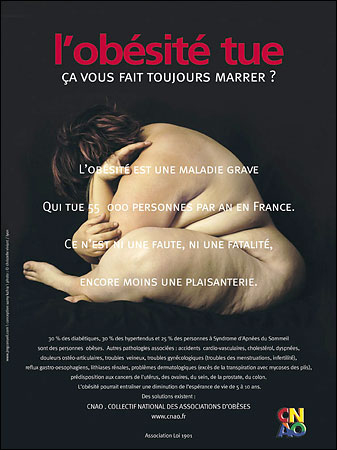 |  |
| www.cnao.fr |
A fat American:
And Laetitia Costa:

Today's Thrillist contained an interview with former Olympic skiier Johnny Mosely which I found amusing. I've always wanted to be the television producer for the Olympics, even though I have absolutely no relevant experience, because I never feel like I'm really getting a good explanation of what's going on there. NBC takes it so seriously! It's as if we're eavesdropping on church.
Mosely's q-and-a, some of which I've excerpted below, provides a lighter take. Okay, borderline juvenile. But...it does sound true.
So, what are we supposed to watch this Olympics?
Well, I'll be watching the freestyle moguls, and the downhill's going to be interesting with Bode and Daron [Rahlves]. With Shaun White, the halfpipe's going to be sick too.
Right. Anyway, what event has the most potential for spectacular crashes?
The downhill, no doubt. You're guaranteed to see a good NASCAR-style wreck. Although border cross can be more interesting -- you've got four snowboarders competing at once, and so guys take each other out.
Is there any particular Olympic sport that produces more sluts?
Loose chicks? I'd definitely say the skiing/snowboarding crew are the ones to just shack up with. They're more reckless. For the long-term, probably biathlon, or cross country. There's a reverse correlation between the duration of the event and the sluttiness of the girl.
Which national team has the reputation for being the biggest dicks?
The French. Hands down. It's weird, but of all the countries, they speak the least English -- or at least they pretend they can't.
If you got in a drunken brawl with the French, which national team would you want backing you up?
The Russians. The pre-Putin generation guys really like fighting. They grew up when you could bribe your way out of anything, so they have no conception of law and order.
Russians are scary....
RB: If you enjoy such stuff, you can find Thrillist here.
According to an AP report, "'Davos is an opportunity to discuss issues and solutions that really matter to the global community,' says James Turley, chairman and chief executive of Ernst & Young. And the avarice and woes of the rich and famous are a hot topic...."
Hmmmm. Perhaps someone might raise a question about trying to profit off insider knowledge of a transitional, say, Russian economy while on contract to the United States government to give advice to that economy?
I suspect that's a case study that really mattered to the global community....
The professor corrected me, saying that I was wrong and that the faculty cared very much—it just wasn't sure what to do. After all, the faculty had gone public last spring in the no-confidence vote, and look what had happened? Nothing. In fact, public opinion was divided between supporting the faculty and trashing them as irresponsible, spoiled, left-wing nutjobs. So where was the good in going public?
But it seems to me that, from a strategic point of view, it makes far more sense to go public on the Shleifer matter...simply because there is absolutely no good argument for keeping him on the faculty. How would Larry Summers argue that there is virtue in retaining a criminal who stole taxpayer money and cost the university $35 million?
(I mean, Summers might try...in which case, you just sit back and let him machine-gun himself in the foot.)
This is not a public relations war that any Shleifer defender could possibly win; there are no merits from which to argue his position. How would it look for the president of Harvard to be compelled to explain his inaction on the matter? (Much less his repeated interventions on Shleifer's behalf.) The second a New York Times reporter called Mass Hall for comment, Shleifer's fate would be sealed.
So here's a suggestion: Forget about the internal mechanisms for dealing with such a problem. They've all been subverted, corrupted, and negated. Instead, do that most American of things—circulate a petition.
It could read something like this:
"As a member of the Harvard community, I believe that Harvard University should stand for truth, excellence, and honesty. I also believe that Harvard should strive to guide its students in moral behavior. Professor Andrei Shleifer, who has long enjoyed the active support of President Lawrence Summers, has admitted that he conspired to defraud the United States government. As a result, Harvard has been forced to pay fines and legal fees totalling over $30 million—money that could have been used to provide scholarships for thousands of students.
"Professor Shleifer's actions damage the reputation of Harvard University, violate the high standards of integrity we expect from a member of the Harvard faculty. The ongoing inaction on the part of the Harvard administration sends the message to our undergraduate students that one can break the laws of the United States yet still remain a member of the Harvard faculty in good standing.
"Therefore, I call upon University president Lawrence Summers to cease his actions on behalf of Professor Andrei Shleifer, and Dean of the Faculty of Arts and Sciences William Kirby to take immediate action regarding Professor Shleifer's employment at Harvard."
E-mail the thing around, and then, when you get a few hundred signatures, shoot it over to Marcella Bombardieri at the Boston Globe and Patrick Healy at the New York Times.
The Harvard faculty is only inert if it chooses to be....and I think it has more power than it realizes. But that power is collective...and this is not a group that frequently or readily acts in concert. Now would be a good time to do just that.
Like me, Warsh finds McClintick's story an impressive piece of reporting. Unlike me, he thinks it will have a significant impact around the 02138 zip code.
Here is one of Warsh's conclusions: "When Summers returns to Cambridge from Davos, it will be to a university more determined than ever to understand the history of its failed Russia project. McClintick's article will circulate hand to hand. The frustration among the faculty that McClintick details will only grow. Some fellow economist may yet come forward to defend Shleifer publicly (instead of grousing anonymously that he has been treated unfairly), but that hasn't happened yet."
As much as I'd like to agree with Warsh, this is wishful thinking. In the past five years, the Harvard faculty has shown a remarkable talent to bury their heads in the sand and pretend that what's happening on campus—the moral emasculation of their university—isn't really happening at all. By the time they lift their heads into the air, the change will have been effected, and they can pretend that they never had a choice.
After all, how many faculty members have had the guts to say something publicly about the fact that Andre Shleifer—whose illegal behavior has cost the university between $30 and $40 million—is still a member of the Harvard faculty in good standing?
A grand total of two: Harry Lewis and Richard Thomas.
Meanwhile, FAS dean Bill Kirby refuses to take action on the Shleifer matter and sells Mass Hall to the president because, the Crimson says, he had "little choice."
Sometimes, I can understand why Larry Summers doesn't respect the professors who work for him.
Bush's answer—which is, truth be told, sort of charming—is here.
Well, what if the healing part of A Million Little Pieces is all made-up, too?
That's what folks at the Hazelden Clinic, where Frey ostensibly stayed, are saying...Frey's description of the treatment he received there strikes them as wildly implausible, and very likely fictional.
Well...yes. I have a feeling that if anyone wanted to try to check the rest of Frey's book, it would all collapse in a heap of pathetic, greedy little lies.
Moreover, it seems that you can't even defend Frey's handiwork on the grounds that it inspires people to get treatment, because the Hazelden folks say it could well have the opposite effect.
"Mic Hunter, a psychologist who worked for four years at Hazelden-related treatment centers in Minnesota, said Mr. Frey's book made him angry. 'It's hard enough for people to get accurate information about treatment because of all the confidentiality rules,' he said. 'So many people have negative feelings about treatment to begin with. Why would anybody want to send anyone to a treatment program where they would be treated like this?'"
The most interesting part: Folks from Hazelden told Oprah's producers this before she announced that she was choosing the book for her book club....
Perhaps Oprah would like to explain more about why that message of healing still resonates with her.....
Is it real? Or is it cautionary? Or both?
(Before everyone gets mad, I'm just kidding!)
I was actually more worried that I'd find it hard to take the movie seriously, as it's become such an object of cultural discussion that it's hovering on the verge of self-parody.
(Michael Musto, the very bitchy—and I mean that in the nicest way—and very gay columnist for the Village Voice went to the Golden Globes parties and asked the actors what they thought of "Bareback Mountain." He cornered Phillip Seymour Hoffman and asked him who was sexier, the guys in "Bareback Mountain" or Truman Capote. Hoffman didn't quite know what to say. He then asked Hoffman who was sexier, Capote or the Memoirs of a Geisha crew. "I have no idea," Hoffman said, "looking horrified." Pretty funny.)
Anyway, I found myself drawn into the movie, which is a beautifully-told story of a doomed love affair. The essential decency of both men involved, and the tragedy of the situation in which they find themselves, is heartbreaking, and I really do think that the film could be a watershed in the long, slow march toward civil rights for gays. It was a stroke of genius on Annie Proulx's part to embed a gay narrative within the most classically macho American myth, the cowboy. No one can call Jack Twist or Ennis Del Mar sissies.
I did have a couple of thoughts about the film. One is to question whether these characters are actually gay, or whether their relationship is a one-off, a unique result of their particular backgrounds, emotional needs, and the bonding experience of a summer on Brokeback Mountain. My answer: Jack yes, Ennis, I'm not so sure. Ennis, to my mind, is so emotionally limited that it would make a certain cultural sense that the person he bonds most closely with would be another man. Ennis just doesn't have the emotional self-knowledge to have many deep relationships, and you wonder if, if Jack hadn't happened along, he'd have had a loving relationship with anyone, male or female.
I also wonder why everyone is talking about Heath Ledger's performance at the expense of Jake Gyllenhall. (Also: Why is Gyllenhall pronounced with a soft "G"? But I digress.)
It seemed to me that Gyllenhall's was the braver of the two performances. Ledger gets to be all smoldering and conflicted; I suspect that, for professional actors, those are not different traits to manifest. (Grunt a lot, surround yourself with beer bottles, maintain a stony facial expression....)
Gyllenhall, on the other hand, knows what he wants and gives voice to his desires. He initiates the sex between the two men, and, in a choice that is surely not accidental, is the, um, recipient of it. His desires are more transparent...which is why, I think, his performance is so good. If he'd gone too far, Gyllenhall could have been incredible, laughable. He strikes a remarkable balance. I keep thinking of the scene in which he tries to buy a beer for a fellow rodeo performer, and the man, suspecting that something is up, rudely turns him down. Was Jack really hitting on the guy? Or just reaching out to him in a friendly, non-macho way which was, by itself, enough to run afoul of the cowboy code? It could have been either, and Gyllenhall plays the scene so subtly, he doesn't tip his hand...which, I imagine, is precisely what you would do if you were a gay man forced to live in the closet.
Finally, a friend and I had a discussion about how graphic was the sex that's shown in the film. She was surprised by how much was actually shown; I thought that, if director Ang Lee had shown any less, he'd have been pilloried for copping out.
In some ways, I wonder if the film didn't err on the conservative side. What would have been more shocking than what was shown, in my opinion, would have been to show one of the characters fellating the other. (My friend insisted that these two men would never do that; I disagreed.)
But I wonder if audiences really could have handled the sight of two men in love going down on each other. There's something about rough anal sex that's not so shocking; we've seen it to one degree or another in Deliverance, Oz, and other film scenarios of violent sex. It conforms to our expectations of the way men behave when giving in to a taboo desire—contradicting the implications of the sexual act by infusing it with violence.
But tender gay sex...I have a feeling that would have made people much more uncomfortable than the rough-and-tumble coupling that occurs between Jack and Ennis.
Regardless of all this, Brokeback Mountain is really a powerful and moving film, a serious work of art. I'm glad I finally saw it.
The symbolism here is pretty powerful, largely because it's so dead-on: FAS, in desperate need of cash, is giving up its ownership of the university's center; the Summers bureaucracy is growing larger and more powerful; the students are getting screwed as a result.
Here's what I think is especially curious: The Crimson's Zachary Seward writes, '''two sources said that Dean of the Faculty William C. Kirby was given little choice in approving the sale or the sale price....”
That sentence begs parsing. Follow up please, Mr. Seward. Who initiated the deal? Who told Kirby that he had little choice? And why? And what would have been the outcome if (the horror! the horror!) he'd actually stood his ground.
Surely Kirby could have said no if he wanted to, or had the guts to. What's the worst that could happen—he'd be fired? That would be the easiest departure to spin since Elliot Richardson resigned from the Nixon Administration.
The very idea that the once-powerful dean of the Faculty of Arts and Sciences at Harvard "was given little choice" tells you all you need to know about the shift of power at the world's most powerful university.
Teddy is denying the story—his spokeswoman, Melissa Wagoner, called it "irresponsible fiction"—but the Enquirer stands by it.
Who to believe? Well, it's hard to imagine that if Teddy really were the boy's father, he'd outright deny it; that'd be pretty low. On the other hand, the Enquirer doesn't usually make claims this dramatic unless it's really got them nailed down. (Of course, Teddy's not likely to sue, as the discovery process would be a gauntlet for him.)
Interestingly, the Boston Herald has run with the story—in its gossip column—while the Boston Globe, as far as I can tell, hasn't printed a word about it. Admirable restraint, or protecting the Kennedys? What a small town Boston really is. If Hillary Clinton had allegedly had a love child (or even Chuck Schumer), it'd be on the front page of both tabloids... I'm not sure if that's a good or a bad thing, but the differences between the cities are dramatic.
“Who would name their kid Jack with the last words ‘off’ at the end of your last name?" Clooney said. "No wonder that guy is screwed up."
There's lots of good reasons to slam Abramoff, but making fun of his name is childish, and the fact that the room responded with laughter shows how easily supposedly mature adults can revert to schoolyard behavior, especially when it comes from someone as "cool" as George Clooney.
I guess Jack Abramoff's father, Frank, agrees with me; he tells the Palm Springs Desert News that Clooney is an "idiot" and his words were "pure, unadulterated stupidity."
Jack Abramoff was named after his grandfather, Frank says. “We’ve gone through quite a bit in our family. But the political end of it and the media end of it and all the other areas are one thing. When you see something like that on a show for 500 million people, it was not only a slap in my son’s face but in my father’s.”
As someone who used to be named "Blow," I can't help but empathize, and I know exactly what Frank Abramoff means. A few years back, when I was working at George, I went on Fox News to do some commentary about the Monica Lewinsky scandal. I was greeted, on air, by anchor Shepherd Smith, who said something like, "Our next guest is George magazine editor Richard Blow, and what an appropriate name that is for a discussion of Monica Lewinsky."
It was humiliating and infuriating at the same time—and unfortunately not something you can really respond to on national TV. ("Fuck you, Shep," would have been satisfying, but probably not helpful.) I was later told that Smith was dressed down by Fox News head Roger Ailes for the comment, but that didn't help me much; the joke had been broadcast to millions, the rebuke was virtually unknown.
All of which, I suppose, is a way of saying that even rogues like Jack Abramoff, when they are faulted, should be faulted on civilized terms, not by making vulgar jokes about their names and masturbation. I know such an appeal for manners and restraint is wildly improbable given the tenor of our popular culture, but still...Clooney is generally an elegant man, and you'd think that he'd be on board with the idea.
George's father, Nick Clooney, a former candidate for Congress, certainly seems to agree. “I understand what it is like to have one's son criticized in a very public way,” Clooney told the Desert News. “It's very painful and it's very difficult."
George Clooney's rep declined, of course, to comment on Frank Abramoff's words. I think that's cowardly; you use a podium seen by hundreds of millions to mock a man, and then you decline comment later.
Jack Abramoff is far from the world's most ethical man...and yet, somehow, George Clooney owes him an apology.
In Michael Mann's fantastic film, "Collateral," Tom Cruise plays an assassin at work in Los Angeles, a city he doesn't much like. Everyone's too isolated here, he tells Jamie Foxx, the cabdriver he is forcing to do his bidding, and relates the story of a man who died on the LA subway and goes undiscovered for days. The unspoken suggestion: In a city where human life is so little valued, what does it really matter if he kills a few people?
Well, yesterday it happened in New York: A man died on the Q train on his way home from work, and his death went unnoticed for six hours.
Just for the record, let us note that Eugene M. Reilly of Brooklyn was a USPS mail handler and had been for 35 years. He had a wife and three kids, two sons and a daughter. He worked at the Morgan mail processing center, which is on 9th Avenue between 28th and 30th streets, a massive but strangely lonely building; I know it because I sometimes drive by it in taxis late at night, headed back uptown on the West Side Highway. Mr. Reilly was also an Army vet who spent two years in Vietnam as an M.P. According to his neighbor, Yosef Y. Zaklikowsk, "He kept his property very clean." He was overweight and had had heart surgery a decade ago, so foul play is not suspected.
Somewhere within the circle of those few, scant details lies the story of a man, whose death may have gone unnoticed but whose life, I hope, will not go unremembered.
I've written about this phenomenon before for two reasons: One, I'm fascinated by what is clearly an enormous shifting paradigm, the end of the movie theater era. (The social and economic consequences are going to be really interesting.)
And two, I can't wait. Every time I go to the theaters these days, I hate myself for doing so—kind of like the way I feel on those rare occasions when I eat fast food.
Among some recent movie theater experiences I've had are these:
1) A guy who sat in a seat behind me and repeatedly coughed without putting his hand over his mouth, which had the effect of a gentle but intermittent disease-carrying breeze on my hair, until eventually I turned around and asked him to stop.
2) An older couple who sat down behind me and proceeded to pull out a series of Tupperware containers containing their plentiful, and odiferous, dinner.
3) Moviegoers who laughed and cheered at the most hideously violent scenes in Hostel, a not-particularly-good film about the dangers of globalization and hormones, especially when combined.
There's an interesting dynamic here: The more people who care about manners stop going to the movies, the more the only people left who do go are the ill-mannered, which means that people who do care will be even less likely to go...and so on and so on. In this way, the movie theater is a reflection of our national public culture generally. Forgive me for sounding like George Will, but manners and civility are beating an increasingly hasty retreat into pockets of isolation...it's a cultural flight, not unlike the post-World War II exodus to the suburbs. The beneficiaries are Netflix and the makers of plasma TV sets, multimedia stands, couches, and gourmet foods. But I suspect that we're all losing something.....
I know: crummy me. But I'm fascinated by the whole thing—the medical technique, which I still haven't seen well-explained; the ethical issues involved; the murky circumstances of the woman's facial damage (she took too many sleeping pills and her dog, trying to wake her up, ate her face?).
Apparently she took a walk in Lyon the other day. Where are our best paparrazzi when we need them? Come on, guys. Do we really need yet another photo of Lindsay Lohan?
According to the Boston Globe, the trip was paid for by a group called the Congressional Economic Leadership Institute, which is funded by big business.
(But don't expect to find that out on its website; if you click on the link that says "Funding," you get this — "The requested URL /mission.htm. was not found on this server."—which is the web equivalent of a middle finger.)
Capuano, a Democrat*, was accompanied by lobbyists on every stage of the trip, from Sao Paulo to Brasilia to Rio.
Asked if that was a problem, David M. Klaus, executive director of the Congressional Economic Leadership Institute, answered, "'We have an unofficial rule that you leave your lobbying hat at the door."
Don't you just love it when people say things that are so blatantly false, you wonder if they're not kind of giggling when they say it?
Capuano was also accompanied by his wife, which was probably a good thing for his marriage—trust me, I've been to Brazil—but, ethically speaking, seems a bit problematic.
When asked about the substantial price of the trip—essentially a $20, 000 bribe—Capuano told Globe reporter Michael Kanish, ''My reaction was the same as yours: What the heck cost so much?"
Capuano added that he was surprised that his business-class airline seats were so expensive. ''I had no clue," he said. ''I didn't pay for it."
Well...yes. That's the point.
________________________________________________________________
* Thanks to those who pointed out that Capuano is a Democrat and not a Republican, as I had originally posted.
Hello to the Friends and Supporters of James Frey -
Unfortunately the BigJimIndustries site is down right now because of the enormous amount of traffic it was getting. There were over 300,000 unique visitors in the past week, his bandwidth was up around 3200kb/s, and most importantly it was affecting access to other clients who share the same network connection as BigJimIndustries.com. As you probably saw in the first few days during the heat of the controversy the site was still up, so it is not down now b/c of the criticism or detractors. We basically forced James to take the site down, and for that we apologize to his friends and fans. As the controversy and resulting traffic dies down, I'm sure the site will go back up.
Thank you for your understanding and patience.
Is it true? The "essential truth"? "Some form of journalistic truth"? Who the heck knows? I guess that's what happens when you lie like a cheap rug.
(Although the fact that the "we" who "basically forced James to take the site down" go unidentified does make one wonder....)
Hey, folks, come on over to Shots in the Dark...I won't lie to you: I have never been arrested.
___________________________________________________________________
P.S. For you young folks out there, the title of this blog entry is a play on an old ad for Memorex cassette tape. (Don't you just love that company name? Memorex!)
Cassette tape was...oh, never mind.
If you really, really like and support James Frey, you won't read it, because you are making your decision based on emotion rather than reason. Which is your prerogative.
If you think that what he did is appalling, as I do, then you should read this piece, just...well, because you'll feel even more that way.
Knowing as we now do that James Frey never went to jail for hitting a cop with his car, here's my favorite part of Scocca's story:
...the copyright page of My Friend Leonard informs readers: “Some names and identifying characteristics have been changed. Some sequences and details of events have been changed.”
Fine. Then comes the opening sentence: “On my first day in jail, a three hundred pound man named Porterhouse hit me in the back of the head with a metal tray.”
In other words: “On my first day in jail*, a three hundred pound man** named Porterhouse*** hit me in the back of the head**** with a metal tray*****.”
*The author never went to jail.
**Weight is an estimate; also the author, not being in jail, never met such a person.
***Not his real name; also the author never met such a person.
****Because the author’s head was not present in jail, such a blow did not actually land.
***** The composition of the tray is a guess, because the author did not actually get hit by it, because the author was never in jail.
Frigging brilliant.
I admire Teddy quite a bit, particularly for his courage at the funeral of my old boss, but sometimes he can frustrate. "I'm not a member; I continue to pay about $100," Kennedy told the Boston Herald, which then added, "He then said of being a member in a club that discriminates against women, 'I shouldn't be and I'm going to get out of it as fast as I can.'"
Um...Senator...if you're not a member, you don't have to "get out of it." So, obviously, you are.
I doubt this will happen, but Kennedy's resignation could reinvigorate the conversation about Harvard final clubs.
Here's the bottom line: Gentlemen, if Skull and Bones can go co-ed, so can—and should—you.
A couple of particularly interesting tidbits emerge.
One is the makeup of Summers' inner circle: Bob Rubin, Jeremy Knowles (what a crafty fellow that Knowles is—he'd have made a great spy), David Gergen (not so much crafty as craven; Gergen doesn't care who's in power, as long as that person gives Gergen access), and Sidney Verba.
(You will remember that it was Verba who singlehandedly okayed Google's project to digitize Harvard's libraries, a project which was pushed by Larry Summers' former chief of staff, Sheryl Sandberg. We know what's in it for Google: the legitimizing effect of Harvard's participation in a very controversial matter. Who knows what's in it for Verba?)
(Also, check out David Gergen's website, with its hilarious picture of Gergen superimposed on an image of the White House, as if he were Abe Lincoln or something. The "latest news" section is a collection of Gergen media soundbites. Sheesh. And people gave Cornel West a hard time.)
The second interesting factoid from Zachary Seward's article is the suggestion that Corporation senior fellow James Houghton pressured Summers to release the transcript of his remarks, and that Houghton's role was decisive in the decision to do that.
I don't know if Seward is running a third piece, but the article that I'd really like to read would detail the inner workings of the Corporation during this period. What the hell was going on inside that bizarre little group? I'd love to know. Tough story to report, but Seward's sources seem to be pretty good.....
____________________________________________________________________
P.S. Here's a small-world, full-disclosure tidbit for you: After my mother read Harvard Rules, she casually mentioned to me that, almost half a century ago, she used to date Jamie Houghton rather seriously...until the man who would be my father came along.
Mom, you could have told me that before I finished the book...
Which is kind of bad enough...but since the site doesn't actually give you a way to register, what it means is that you can't access it at all.
You know, for a guy who says he's so tough, constantly wanting to "kick the crap" out of people, enduring a full root canal without anaesthesia (uh-huh, I'm sure), James Frey is kind of a wuss.
I have some personal feelings related to having written a memoir myself and also my training in the craft of journalism. But mostly, I believe that truth does matter, and I worry that our culture is stumbling down a slippery slope of reality TV, presidential spin, academic corruption and made-up memoirs in which truth is becoming malleable, obsolete and irrelevant.
Michiko Kakutani writes about this phenomenon in a similar, more eloquent vein in today's Times. Frey's book, she argues,
...is not, however, just a case about truth-in-labeling or the misrepresentations of one author: after all, there have been plenty of charges about phony or inflated memoirs in the past, most notably about Lillian Hellman's 1973 book "Pentimento." It is a case about how much value contemporary culture places on the very idea of truth. Indeed, Mr. Frey's contention that having 5 percent or so of his book in dispute was "comfortably within the realm of what's appropriate for a memoir" and the troubling insistence of his publishers and his cheerleader Oprah Winfrey that it really didn't matter if he'd taken liberties with the facts of his story underscore the waning importance people these days attach to objectivity and veracity.
Kakutani smartly places Frey in the context of other cultural trends, such as postmodernism, which suggest that all truth is relative and, indeed, there may be no such thing as objective truth.
The Bush White House has used similar arguments to try to discredit the mainstream press and its watch-dog role, suggesting that there is no such thing as truly independent reporting or even a set of mutually agreed upon facts, that there are no distinctions between willfully partisan hacks and reporters who genuinely strive to deliver the best obtainable truth.
This relativistic mindset compounds the public cynicism that has hardened in recent years, in the wake of corporate scandals, political corruption scandals and the selling of the war against Iraq on the discredited premise of weapons of mass destruction. And it creates a climate in which concepts like "credibility" and "perception" replace the old ideas of objective truth - a climate in which the efforts of nonfiction writers to be as truthful and accurate as possible give way to shrugs about percentage points of accountability, a climate in which Ms. Winfrey can declare that the revelation that Mr. Frey made up parts of his memoir is "much ado about nothing."
Now you know why James Frey matters—because truth matters, and the skepticism that objective truth exists doesn't stay confined to the genre of memoir, but creeps into historiography, politics, the law, and every other aspect of society. If you don't believe me—if you think that James Frey's book helped millions, and so whatever he did is acceptable—let's turn this around:
You weren't really alcoholic, you just say you were.
Are you sure you were raped? Maybe you just have a different perspective on a sexual encounter?
It doesn't matter if there weren't weapons of mass destruction in Iraq—there could have been.
Patrick Tillman died a hero's death.
Despite what Elie Wiesel says, the Holocaust didn't really happen. After all, his book is just a memoir.
You see? James Frey's game isn't hard to play. Anyone can do it, and if no one objects, soon everyone will. And the resulting cynicism, corruption, historical revisionism and violence is far more damaging to society than even the very painful—and real—problems of alcoholism and drug abuse.
Stephen Levitt, writing on his Freakonomics website, doesn't think so....
I don't really have the time to check out any of Frey's claims myself, and I don't feel the need to; to my mind, what's already been disproved about the book undermines its veracity so fundamentally that there's no need to continue.
But I will go on record as venturing that the book contains far more lies than facts. If Frey lied about things like his criminal record—things that could be checked out—why wouldn't he lie about things that would be virtually impossible to check?
Answer: Of course he would, and surely did.....
Because of my unfortunate experience with fabulist Stephen Glass, I keep thinking about why Glass was drummed out of journalism and Frey's book continues to sell by the barrelful.
What's the difference between them? Morally, none. But Frey has at least two powerful institutions with a self-interest in propping him up—Random House and Oprah—not to mention all those self-deluding readers who feel that Frey helped them "get back on their feet," or some such self-help claptrap.....
Respected journalist David McClintick, author of Indecent Exposure, reports that fact for his story, "How Harvard Lost Russia," reported in this week's Institutional Investor. (You may have to sit through an E-bay ad to get to the story.) McClintick's article is a lengthy, exhaustively-reported, and utterly damning account of Shleifer's corruption—and it doesn't make Larry Summers look so great either.
Shleifer, as you may know, was found liable for conspiracy to defraud the United States government; Shleifer, some of his associates, and Harvard were compelled to pay $31 million to make restitution.
It would appear from McClintick's story that Shleifer got off easy.
McClintick's article, as the magazine describes it, "chronicles Shleifer's role in the university's Russia Project and how his friendship with Summers has protected him from the consequences of that debacle inside America's premier academic institution."
Boy, does it ever. The chronicle of Shleifer's unbridled greed, arrogance and deception is incontestable and sickening—and Summers is deeply implicated in trying to cover it up.
A few things, with some italics on my part.
1) McClintick writes that Summers "knew [Shleifer and Zimmerman] were investing in Russia" even while they were on government contract to help build Russian economic institutions. "Summers had heard enough to caution the couple," McClintick points out.
Larry Summers, a former Treasury secretary, surely knew the federal conflict-of-interest laws surrounding such work, and as current Harvard president, he must have known that, by investing for personal gain, Shleifer and Zimmerman were breaking both federal law and Harvard regulations.
I don't know if this makes Summers legally culpable as some sort of accomplice (though he certainly wasn't charged with any crime)—but if you know someone is committing a crime and you do nothing about it, what does that make you? Does it make you fit to lead a university filled with young people? A university with the motto "Veritas"?
2) And what if you do more—what if you actually work on behalf of your friends' illicit interests? In a deposition, McClintick writes, "Summers hinted [that]...he felt his friend Shleifer might have been unfairly accused—that there was nothing necessarily wrong with 'providing advice on a financial issue in which one had an interest.'"
Let us remember the specifics here. Shleifer was giving advice about U.S. investments in Russia event though he had made secret financial investments in specific companies; he had not disclosed his financial interests, because he was legally forbidden to have them in the first place.
If Larry Summers doesn't think it inappropriate to give financial advice without disclosing a financial interest in the matter at hand, the possibility for corruption on the Harvard Corporation is significant. Let us not forget that one of the reasons Jack Meyer left the Harvard Management Corporation is because Larry Summers and Bob Rubin were trying to compel him to make specific financial decisions. Members of the Board of Overseers should immediately ask whether Summers and Rubin have given advice on any matters in which they have financial interests.
3) What if you not only knew of your friends' illicit activities, not only tried to cover them up, but actually promoted the wrongdoer?
Here's McClintick, again with italics added, on the quid-pro-quo between Summers and Shleifer:
"[When] it became known in early 2001 that Summers was on the short list of candidates to succeed Neil Rudenstine...Shleifer and Zimmerman began campaigning for Summers to get the Harvard post, giving meet-and-greet parties for him at their home. Summers stayed with them when he visited Harvard...
"Having his close friend as his boss would turn out to be quite helpful for Shleifer. Summers asserted in his deposition that he recused himself from any involvement in the university's handling of the Shleifer matter, but the new president stayed involved anyway. [R.B.: Is this perjury?] Early in his presidency [Summers] told the dean of the faculty of arts and sciences, Jeremy Knowles, to keep Shleifer at Harvard... Not long after Summers says he intervened on the professor's behalf, Knowles promoted Shleifer from professor of economics to a named chair, the Whipple V.N. Jones professorship....
"Shleifer's legal position changed on June 28, 2004, when Judge Woodlock ruled that he....had conspired to defraud the U.S. government.... Still, there was no indication that the Summers administration had initiated disciplinary proceedings. To the contrary, efforts were seemingly made to divert attention from the growing scandal."
Even after Shleifer was convicted, Summers kept the professor close. "The Summers-Shleifer friendship flourished. They spoke on the phone more than once a day, on average. Two months after the court ruling against Shleifer, he hosted Summers at a break-the-fast dinner on Yom Kippur."
And when a number of professors tried to initiate disciplinary proceedings against Shleifer, they became convinced that Summers was blocking any such action.
The decision whether to take any action regarding Andres Shleifer is, ostensibly, before Bill Kirby, but there's circumstantial evidence that he, too, has been intimidated by Summers. On two occasions, when pressed by faculty members to do something, Kirby "turned red in the face and angrily cut off discussion."
Does Bill Kirby have a spine? And if so, could someone find it for him?
Two concluding thoughts.
It is a moral embarrassment to Harvard that a crook—a man hired to help a new democracy take flight who instead plundered its emerging riches, and defrauded the United States government in the process—is still a member of its faculty, sheltered under the wing of its president.
And second, Larry Summers has consistently argued that Harvard must take a broader and more proactive role in international affairs. If the Shleifer matter, and Larry Summers' role in it, are any indication of what a greater overseas presence for Harvard would look like, then his argument must be rejected. Because Harvard's international presence can only be as moral as the men and women who are involved in it.
Hmm....
Actually, it's a pretty good question. You could argue that Teddy's membership is actually more incriminating than Alito's.
Such incidents might make all those ambitious young Harvard men realize that the final clubs might one day come back to haunt them...
She writes so well when she's not trying to be glib; I wish she'd do it more often.
—Yevgenia Peretz writing on Lindsay Lohan in the February Vanity Fair
"I just sold coke to..."
—a man who claims he just fed the jones of Lindsay Lohan and Kate Moss, on this Internet site...
Here's part of the statement from the Yale Senior Class Council:
His domestic and international journalistic experience will provide unique insight to seniors as they transition out of college. As an alumnus of Yale College, his address will be particularly relevant.
Hmmm. I won't even mention the dubious usage of the word "unique." Perhaps certain Yalies need to learn what a misplaced modifier is before they graduate in May.... Because that should read, "As an alumnus of Yale College, he will be particularly relevant."
A small point, I know. But if you can't hold Ivy Leaguers to minimum grammatical standards, who can you?
The vote over whether to take the trip was a slam-dunk—unanimous, as it should have been.
But not everyone at Columbia was so ethical. The dean of Columbia's School of International and Public Affairs, Lisa Anderson, did go on the trip. Anderson subsequently sat on Columbia's five-member committee abjudicating the matter of alleged anti-Israeli professors in Columbia's Middle Eastern studies department. As the Sun puts it, "The five member committee for the most part cleared the professors, and its report was criticized by some as a whitewash."
I don't know whether Anderson's trip had any influence on her committee work, but it certainly doesn't look good, and she shouldn't have taken it.
I'm pretty tough on a lot of journalists on this blog, and sometimes I forget to mention that one of the things I like about journalism is that we journalists at least think about such matters, even if we sometimes drop the ball. (Don't get me started about travel writers, entertainment writers, and so on.)
In so many facets of American professional life, a trip like this wouldn't even prompt a raised eyebrow.
I'd be very curious to learn more about junkets in the academic world. Did anyone from Harvard go on this trip, for example? And did it have any connection to the $20 million that Harvard just received from a Saudi prince to pursue Middle Eastern studies?
As we journalists know, there's a fine line between a donation and a bribe....
Seward's piece is a fascinating tick-tock of the internal deliberations on how to handle the burgeoning controversy over Summers' indelicate speech.
Summers used the word "bullshit" in various conversations with people both inside and outside of Mass Hall. He also told diners at at least two dinner parties that the episode "has not increased my faith in humanity."
Seward's reportage reinforces a report in the New York Observer last year to the effect that a tipsy Summers had told a reporter at an after-party for the White House Correspondents' Dinner that he wasn't going to be bothered by "whiny professors."
I'm not surprised that Summers didn't want to apologize, nor am I surprised by his insults of the faculty and his crude language. I reported both in Harvard Rules (although I got the feeling that some readers found the truth hard to believe). I remember Summers referring to Zayed Yasin, the 2002 commencement speaker, as "the little shit."
What strikes me is the vast gap between the Larry Summers who likes to gladhand with students at a freshman dance and the (more true?) character who refers to them as "shit" in private, or insults his professors in equally crude ways.
Will the real Larry Summers please stand up?
—Yevgenia Peretz writing on Lindsay Lohan in the February Vanity Fair
"Scarlet is a bloody cunt."
Lindsay Lohan writing on Scarlet Johannsen on the ladies' room wall at Dark Room, a New York City bar
That Lindsay Lohan—she sure is genuinely fun to be with!
I'll just say that it's way, way older than me....
By the way, there's a fascinating back-and-forth in the article—nice going, reporter Edward Wyatt—on the subject of whether Frey's actions are acceptable. Writer Gay Talese says they are not; Doubleday publisher Nan Talese, who happens to be both Frey's publisher and Gay Talese's wife, says they are.
Here's Gay: "Nonfiction takes no liberty with the facts, and it should not," Mr. Talese said. "I think all writers should be held accountable. The trouble with book publishers is that they don't have the staff or they don't want to have the staff to ensure the veracity of a writer. You could argue that they had better, or they're going to have more stories like this one. My wife is going to hate me for this, but that is what I believe."
Here's Nan: "Nonfiction is not a single monolithic category as defined by the best-seller list," she said yesterday when asked to comment on her husband's remarks. "Memoir is personal recollection. It is not absolute fact. It's how one remembers what happened. That is different from history and criticism and biography, and they cannot be measured by the same yardstick."
Nan's response is weak. To her, "how one remembers what happened" is the relevant standard for inclusion in a memoir. That's a pretty broad standard. I could remember that, oh, the Holocaust never happened, and write that in a memoir, and according to Nan Talese, that would be a-okay.
Moreover, Frey didn't just misremember what happened; he invented things that never happened, like a three-month stay in jail for hitting a policeman with a car. That's not a case of getting the details slightly wrong. That's a case of making something up to make your story more dramatic. The intention is not to try to remember as best one can; the only possible intention is to mislead.
Good for Gay Talese. He and William Bastone, editor of The Smoking Gun, deserve to be recognized for telling the truth about a con.
Frey didn't have much of a defense of his behavior, it has to be said. He certainly never admitted to making anything up, instead repeatedly referring to the fabrications as being "in dispute" or "the disputed material." The argument he raised again and again was that he stands by the "essential truth" of the book.
My impression? James Frey is a fundamentally dishonest man, and I would bet my right arm that the book is filled with many more fabrications than just the ones that The Smoking Gun was able to prove.
Throughout the interview, Frey equivocated, fudged, hemmed and hawed, changed the subject, refused to give a direct answer to questions, and attempted to blur the nature of his fictions, suggesting again and again that they were limited to changing names in order to protect the privacy of people mentioned in the book. But his physical mannerisms gave him away: he licked his lips, his eyes darted back and forth, and every time he said something you could tell he really didn't believe, he prefaced his answer with "ums" and "I means."
But perhaps it's best just to let Frey speak for himself. Below, a sampling of the show, with some occasional italics added to denote remarks that struck me as egregious b.s. and some asides from yours truly.
After an introductory report, Larry King asked: "What's your side, James?"
JF: Um, I mean, my side is that I wrote a memoir. I never expected the book to come under the kind of scrutiny that it has. A memoir—the word literally means my "story." A memoir is a subjective retelling of events.
LK: But they're supposed to be factual events.
JF: Yeah, a memoir is in the genre of non-fiction. I don't think it's necessarily appropriate to say (unintelligible) to anyone. You know, the book is 432 pages long. The total page count of disputed events is 18, which is less than five percent of the total book. That falls comfortably within the realm of what's appropriate for a memoir.
(RB: According to whom? I missed the panel where they said that seven percent was too much, but five percent, well, that's okay.)
LK: ...why embellish anything?
JF: Um...I've acknowledged that there were embellishments in the book. I've changed things. In certain cases, things were toned up. In certain cases things were toned down...
(RB: "Toned up"? Is that kind of like a liar's way of saying, "made up"?)
...That names were changed. That identifying characteristics were changed. You know, there's a great debate about memoir, and about what should be most properly served, the story or some form of journalistic truth. Memoirs don't generally come under the type of scrutiny that mine has.
(RB: I like that: "some form of journalistic truth"... I'll have to use that the next time I'm caught fibbing. As in, "What do you want from me? Some form of journalistic truth?")
LK: People read a memoir expecting it to be the true story....
JF: It's an individual's perception of what happened in their own life. This is my recollection of my life.
(RB: Let's be clear: Frey says he spent three months in jail for hitting a police officer with a car. Didn't happen. That's an interesting "recollection.")
JF: ...a lot of the events took place while I was under the influence of drugs and alcohol. You know, I still stand by my book. I still stand by the fact that it's my story, and that it's a truthful retelling of the story. ...I've acknowledged changing things.
LK: Did you tell Oprah that?
JF: Um, I don't remember specifically what I told Oprah....
LK: ...there's a story around that you originally shopped the book as fiction....
JF: Um, we originally shopped the book as a novel. It was turned down by a number of publishers as a novel or as a non-fiction book. Um, when [Doubleday editor] Nan Talese purchased the book, I'm not sure what they knew what they were going to publish it as. ...They thought the best thing to do was to publish it as a memoir.
LK: Why did you shop it as a novel if it wasn't?
(RB: Good question!)
JF: I mean, I think of the book as working in a long tradition of what American writers have done in the past, people like Hemingway and Fitzgerald and Kerouac and Charles Bukowski.
LK: But they all said fiction.
JF: Yeah! They did. And at the time of their books being published, the genre of memoir didn't really exist.
(RB: That is too funny.)
LK: (asks whether it's true that Frey hit a cop with a car.)
JF: ...again, we're dealing with a very subjective memory....
LK: ...was [the book] fact-checked?
JF: Um...I don't know how specifically it was fact-checked. When you're changing names and changing identities to protect people, the publisher usually considers that good enough. I can't necessarily speak specifically for what their policies are.
(RB: I can: Frey's just flat-out lying here. There's no way he doesn't know whether his book was fact-checked or not. [Believe me, if it were, he'd remember.] The answer is no. As I've previously written on this blog, one of the problems of modern book publishing is that publishers won't pay for fact-checkers. Some writers, such as myself, pay for their own; I hired fact-checkers for both my books, one of which was a memoir. Of course, as the old saying goes, some stories are too good to check.)
Asked if he would do anything differently, Frey said no, and added, "I take responsibility for my life.... That's what I've always done, and I would be a liar if I didn't."
Even generously interpreted, nothing in Frey's interview with Larry King could be described as "taking responsibility." The man is, in his own words, a liar, and his book is a con.
That's a fine start. But Random House can do even better by dropping its insistence that refunds can only go to people who bought the book directly from the publisher and still have their receipt. Come on, guys—if you're going to do the right thing, don't take half-measures.
Frey's response, posted on his website: "I stand by my book, and my life, and I won't dignify this bullshit with any sort of further response."
That must be why he's going on Larry King tonight.....
As thesmokinggun.com, which broke the story, puts it:
Police reports, court records, interviews with law enforcement personnel, and other sources have put the lie to many key sections of Frey's book. The 36-year-old author, these documents and interviews show, wholly fabricated or wildly embellished details of his purported criminal career, jail terms, and status as an outlaw "wanted in three states."
In addition to these rap sheet creations, Frey also invented a role for himself in a deadly train accident that cost the lives of two female high school students. In what may be his book's most crass flight from reality, Frey remarkably appropriates and manipulates details of the incident so he can falsely portray himself as the tragedy's third victim.
When TSG asked Frey about the fabrications, Frey responded, "There's nothing at this point can come out of this conversation that, that is good for me."
I'd like to return to that quote in a minute.
The response from Doubleday, Frey's publisher, has been less than candid. Here it is, as printed in the Times:
"Memoir is a personal history whose aim is to illuminate, by way of example, events and issues of broader social consequence," said a statement issued by Doubleday and Anchor Books, the divisions of Random House Inc. that published the book in hardcover and paperback, respectively. "By definition, it is highly personal. In the case of Mr. Frey, we decided 'A Million Little Pieces' was his story, told in his own way, and he represented to us that his version of events was true to his recollections.
"Recent accusations against him notwithstanding, the power of the overall reading experience is such that the book remains a deeply inspiring and redemptive story for millions of readers."
Translation: Fact, fiction, who cares? We sold 3.5 million copies.
Well, as an author of a memoir, I care. The challenge of writing a memoir is to be both literally true and to try to impart some larger truths. In fact, I'd argue that a memoir is, by definition, literally true. That's what gives it its power—the authenticity of the experience, and the significance of those true events.
That may be an old-fashioned opinion. But as a writer, I think you also have an obligation with your audience to tell them the truth. Millions of people didn't buy Frey's book because they thought it was a pastiche of fact and fiction and they were okay with that. They bought it because they believed it was a true story and something about that truth inspired them, or moved them, or even just entertained them.
Consider this paragraph from the Times story I linked to above:
In an interview with The Times last month, Mr. Frey said that he originally envisioned "A Million Little Pieces" not as a memoir but as a novel. "We were in discussions after we sold it as to whether to publish it as fiction or as nonfiction," he said. "And a lot of those issues had to do with following in a legacy of American writers." Mr. Frey noted that writers like Hemingway, Henry Miller and Jack Kerouac had written very autobiographical books that were published as fiction.
The paragraph raises a host of questions. Think about that sentence, "We were in discussions after we sold it as to whether to publish it as fiction or as non-fiction."
What an odd thing to say! Something is either fiction or non-fiction; it can't be both. The fact that "discussions" were held about whether to publish this as a novel suggests that the parties involved knew all along that it wasn't true.
So why publish it as a memoir, then? Because as a "true" story about drug addiction and recovery, A Million Little Pieces is infinitely more marketable than as a novel. (After all, how many novels are there on the subject?) As a work of fiction, it's a first-time novel, and we all know how hard it is to promote first-time novels. The power of the memoir stems from the fact that the events contained within it actually happened. That's why, in our self-help oriented culture, memoirs sell; that's certainly why Oprah Winfrey decided to promote the book.
Consider next Frey's point that Hemingway, Henry Miller and Jack Kerouac had all published heavily autobiographical works as fiction.
Well, yes. Because they were honest and Frey isn't. Their experiences infused their works, but when they took artistic license and added fiction to fact, they knew they couldn't/shouldn't publish the books as non-fiction. What Frey has done is taken a heavily autobiographic novel and published it as fact...which is pretty much the opposite.
And that brings us back to Frey's earlier remark, "There's nothing at this point can come out of this conversation that, that is good for me."
What an unintentionally revealing comment! It's all about Frey, isn't it? Even though he's already made millions of dollars from his dishonest book, he's still just looking out for number one.
To my disappointment but not surprise, Random House is sticking by Frey. What a shame that the publishing company didn't say something like: "We didn't know about the inconsistencies in this book, or we might have done things differently. But we still believe it's a powerful story that can inspire readers all over the world."
Except that perhaps that isn't true—perhaps Random House did know, and didn't care.
I hope that other people do care, and that honesty hasn't become an old-fashioned concept. But I'm not all that optimistic. Today, A Million Little Pieces is #3 on Amazon; yesterday, the day the news broke, it was #1.
James Frey would appear to be lying all the way to the bank. I wonder, though, how he sleeps.
So Debbie Dingell, a lobbyist for General Motors and wife of congressman John Dingell, decided to do something about it. She drove up to Friedman's home in Bethesda driving a silver Hummer H3, marketed as the "small" Hummer.
The H3 gets—ready?—a whole 16 to 19 miles per gallon. Wow! Way to go, GM!
"What bothers me is that he's not taking the time to understand what we're building in Detroit," Dingell told the Post. "I get so mad."
That's funny. Because I get kind of mad every time I see one of those things barreling down the streets of New York like some kind of armored assault vehicle, usually carrying one passenger, who usually happens to work on Wall Street. In fact, I get so mad.
I know lobbyists are paid to say things they don't believe, but how could anyone defend the Hummer on anything other than short-term profit grounds? It's the most socially irresponsible product since the Pinto. And at least the Pinto's problems weren't on purpose.
Now comes news from the Times that "four out of every five new sport utility vehicles and pickup trucks do not adequately protect occupants from whiplash in low-speed rear-end collisions."
"People see S.U.V.'s and they think of them as being much safer than cars," said Adrian Lund, president of the Insurance Institute for Highway Safety. "Certainly with regard to head restraints, what our study is showing is many of them don't provide good protection from whiplash, which you might expect."
It's unclear to me what SUVs do provide good protection from.... We know that they're dangerous for people driving cars that get hit by them; we know they're dangerous for people who get hit by them; we know they're dangerous for passengers, who are often killed when SUVs rollover; we know they're dangerous for children; and now we know they're dangerous for drivers.
But hey, at least the kids can watch dvd's and drink from their cupholders while the SUVs roll over and give them whiplash.....
—The cover of Us Weekly, the same week that Vanity Fair's cover story on Lindsay Lohan reveals that the actress struggled with bulimia....

In the piece, McGrath explains that a "Gang of Four" of professors involved in the review pushed for a greater prescriptive general education program, but were defeated by Lilliputians on the faculty.
"We would have been happy with a bit more structure," Steve Pinker, a member of the cadre, says wistfully. But alas, the heroic Gang of Four was beaten down.
Well, now, hang on a minute, here....
First of all, who is this gang? According to McGrath, it's Pinker, English professor Luke Menand, Michael Sandel, "a historian," and philosopher Alison Simmons (who happens to bear a striking resemblance to Judith Miller).
I don't know much about Simmons, but the other three are all Summers' boys, professors either recruited by Summers or/and upon whom Summers has bestowed advancement and high status at the university. They are his spear carriers. Pinker is even quoted as saying that "it's necessary in understanding a scientific discussion to know the difference between a gene and a chromosome"—an oft-used line from the standard Summers stump speech.
Which is important for two reasons. First, these are not helpless martyrs. If they really wanted more structure, they had the clout and connections to push for it. After all, they wrote the curricular review report.
(Although there's a little historiographic problem here: according to the Crimson story linked to above, the Gang of Four was once the Gang of Five. Pinker was not a member of the Gang of Five. Scientist Andrew Knoll and historian Charles Maier were. Maybe there was a purge....)
Second, McGrath was surely right to interview this group; they're important players in this drama. But it's a little weird that the only professors with whom he appears to have spoken are Larry Summers' favorites. My guess is that McGrath went through the Harvard public relations office, and they set up these interviews for him. Curricular review dissidents were, apparently, not on the list of people Harvard thought McGrath should interview, and so he didn't. Sigh. Sometimes the MSM is so predictable.
I think this partly because it's the nature of Times reporters to make their first call to the public relations people, and secondly because McGrath also landed an interview with Larry Summers, so the Harvard president obviously sanctioned cooperation with the Times. Summers helped himself by cooperating. He takes a mild hit for the women-in-science speech, but McGrath strongly implies that the review would have been better had Summers not absented himself from it, when all the evidence suggests that Summers' involvement was making the review less coherent and more fragmented, and that by the time he disengaged it was obvious the thing was already a bust.
Summers tells McGrath that "there is a great appetite for science courses when they're well taught. We think that will happen."
(To my mind, a very open question, as getting scientists to teach general ed courses is a notoriously difficult problem.)
He continues: "There's very little appetite here for great books"—by which Summers means a great books curriculum such as Columbia's—"but we think we can give students attractive choices in courses that will impart broad foundational knowledge."
Plus, Harvard students are already learned when they get there. "For all the bashing of American hgh schools, the students coming in now are better prepared than ever."
That's a curious statement, since some of that bashing has come from Summers himself and his early speeches regarding curricular review clearly suggested that American high schools had not prepared students for the world around them.
But I think the more important point is the general laissez-faire tone of Summers' remarks. He no longer wants to make students take certain courses—in science, for example—and no longer wants to make them study abroad. Instead, he wants to make courses "attractive," like flight attendants or Swedish furniture.
Pardon me for being crude, but it sounds very much like Larry Summers no longer gives a damn about the curricular review. He has checked out.
Don't believe me?
Check out this hilarious video, which takes the soundtrack from the Microsoft presentation and...well, you'll have to see it to believe it.
McGrath takes a look at the curricular review report released last fall "to a certain amount of fanfare in the non-academic press." (By which he means the New York Times and its subsidiary, the Boston Globe.) But, McGrath rightly reports, "inside the ivory towers it landed on many desks not so much with a thud as a rustle."
That was because, both literally and figuratively, the report was not weighty enough to land anywhere with a thud.
As George Washington University president Stephen Joel Trachtenberg put it, the report "is old wine in new bottles."
Ouch. You know it hurts Harvard when its curricular review is dissed—accurately dissed—by the president of GW.
McGrath adds that "in 2003, for example, Yale issued a report, four years in the making, that winds up in more or less the same place as Harvard's but is far more eloquent and detailed."
Having read Yale's report, I can tell you that this is very true; in reading it, you can feel the passion for education, the acquisition of knowledge, and yes, teaching. Then-Yale College dean Richard Brodhead, now president of Duke, did an excellent job building consensus and shepherding the Yale review along the road to completion.
McGrath's larger point is that it's extremely difficult to create a system of general education because no one can agree these days on what every student should know. He writes: "The Harvard experience suggests that though the goal of general education is as attractive as ever, the idea of prescribing it or enforcing it, instead of just holding it out as an ideal, is probably a losing battle."
I'd agree with the first point: building a modern prescription for general education is a real challenge. (McGrath's article does not ask why anyone even considers such an education a good thing, but that question is the beginning of the process, and it was never asked in the Harvard review.)
On the second point—what we can learn from Harvard's experience—I beg to differ.
McGrath has fallen into what I call the "Harvard trap"—the logical fallacy that because Harvard is the world's most famous university, and certainly one of its best, what happens at Harvard will determine what happens everywhere else.
That's lazy thinking, usually a signifier that the reporter either went to Harvard or has children who did. (In McGrath's case, I believe it's the latter. McGrath himself went to Yale, class of '68, I think—judging from this column in the Yale Alumni Magazine. Whatever the case, his essay should disclose these connections, and of course does not. The Times always considers itself above such disclosure.)
In fact, the curricular review at Harvard has been wrought with specific issues and challenges specific to that university, and is essentially irrelevant to a broader educational discussion.
First, as McGrath himself later points out, is the problematic role of Larry Summers. The Harvard president first talked up the curricular review endlessly, then tried to control it, then tried to have its minions control it, and then—when he sensed it was going to be a bomb—distanced himself from it. (McGrath puts it differently.)
Second is the lackluster roles played by Bill Kirby and Benedict Gross. New to their positions, appointed by Summers, neither Gross nor Kirby have impressed in their roles as stewards of the curricular review. But of course, since the review process was corrupted by Summers' involvement from the beginning, it's hard to know where to put the blame for their halfhearted engagement with it.
Third—again, as McGrath points out, further contradicting himself—the review process at Harvard is challenging because its students are "spiky, choosy, and don't like taking direction."
(Spiky?) Harvard promotes an atmosphere of individualism—something McGrath doesn't quite get—which makes it difficult to then turn around and say, We want you all to take some of the same courses, learn some of the same things.
Fourth, it's particularly tough to fashion general education courses at a university where professors are famous for not wanting to teach, and not having to. This is nowhere more true than at Harvard.
So I think McGrath is wrong: You really can't draw any universal conclusions about the viability of a general education curriculum from the Harvard experience. As is so often the case, Harvard is exceptional.
It's worth pointing out that, back when Harvard dean Henry Rosovsky ushered the Core Curriculum into existence, he never claimed that the Core would have applicability to other universities. It was designed for Harvard, he said, and other schools wouldn't have the resources to create courses as the Core would, or the professors who could teach them as well. Harvard was doing its own thing, and what was wrong with that? As an educational leader, it should do exactly that.
The current curricular review suggests that, at least in this context, Harvard is no longer an educational leader.
But the trailer did make me think again of how incredibly brave those passengers on that plane were—could anyone say for sure that he would have had the courage to storm that cabin?—and I guess that's a good sign for the movie. I just don't know if I'll be able to bring myself to see it. The pain of that day isn't so far off....
I'm curious to hear your thoughts. Could you watch a two-hour film about the hijacking of Flight 93?
Palley mentions Ben Bernanke, Alan Blinder, Gregory Makiw and Lawrence Summers as examples. "All four got their Ph.D.s from Harvard or MIT. No doubt, all four are virtuous people, but virtue is not the issue. The issue is that all share the same invisible hand paradigm...."
Interesting. It's informed arguments like these that make me smile when people refer to Harvard as a "liberal" university. The economics department is probably the most powerful at Harvard, and as Palley rightly suggests, it is deeply conservative.
Pareles writes: "Voting with its dollars, the public ignored the esoteric favorites championed by critics and went for music that offered a little comfort and dance beats. Entertainment, not ambition, was the priority."
Critics like me, Pareles should probably say.
He adds: "Compare 2005 with 2004, which yielded albums like U2's 'How to Dismantle an Atomic Bomb' - full of compassionate songs that grappled with faith and science, fame and family - and Green Day's 'American Idiot,' which was nothing less than a rock opera about 21st-century alienation. Those albums continued to sell through 2005 because there was little to supplant them."
Other artists whom Pareles says made profound statements with their music: Madonna, Alicia Keys and Michael Jackson.
I think Pareles is looking through rose-colored glasses here, distorting the past. I don't know Alicia Keys' music well enough to speak to it, but no one ever thought Madonna or Michael Jackson were doing anything of great seriousness, other than pushing the boundaries of sexual and racial identity a little bit. (To claim otherwise is critical revisionism.) What was truly revolutionary about both singers was not their music, but their business talents. As far as the music goes—well, people did/do like to dance to Michael Jackson and Madonna, and Madonna's terrific new record is basically one long dance mix. It's not exactly political. Sample lyric: "I don't like cities/but I like New York/Other places/make me feel like a dork."
Moreover, it's generally the case with rock critics that they shy away from the commercial and the mainstream (exactly what Pareles does with Coldplay—but more on that later), partly because they don't find it interesting, partly because it's their job to point out little-known gems, and partly because rock critics are snobs. So Pareles' article is essentially circular. Of course the public didn't buy the critics' choices; the critics made their choices partly to highlight music that people weren't buying.
Moreover, Pareles has consistently been wrong about "How to Dismantle an Atomic Bomb." He's been calling that record U2's best ever since, coincidentally, the band gave him exclusive pre-release access. Truth is, it's far from U2's best—"Boy," "War," "The Unforgettable Fire," "The Joshua Tree," and "Achtung Baby" are all better—and no one bought "Bomb" for its lyrics. Mostly they bought the record because U2 is a consistently excellent band that markets itself really well, in this case pairing the song "Vertigo" with an iPod campaign. Vertigo is a fantastic rock song with a great guitar riff. Its lyrics—"uno, dos, tres, catorce...yeah yeah yeah yeah yeah yeah yeah yeah"—are less than deep.
Pareles has also been consistently wrong about Coldplay, whom he trashed in an article that felt like a heavyhanded ploy to be the instigator of a backlash (one that never arrived). Their sin: They want to be as big as U2, but they're not political. He complains, "Like a cheesy self-help guru, Coldplay inflates listeners' vague fears and insecurities, then offers itself as a panacea: 'I will fix you,' Chris Martin vowed."
Any rock critic who prides himself on his analysis of lyrics should be fairer than that. "Fix You" isn't offering itself as a panacea to anyone. It isn't directed at Coldplay's audience, but at one half of a relationship; it's a love song.
Second, the lyric isn't "I will fix you," but "I will try to fix you," which is considerably different; it links the singer to his audience in mutual uncertainty, which doesn't seem inappropriate for the times. Coldplay singer Chris Martin connects with people because he comes across as an everyman character. He doesn't have the answers any more than the rest of us do. If any singer portrays himself as a savior figure, it's Bono.
I agree with Pareles that Coldplay's next step in its evolution should focus on more ambitious lyrics, but don't trash the band for things they don't say. And Martin has done quite a lot on the fair trade issue—as Mother Jones puts it, "Chris Martin doesn't sing about fair trade, [but] that hasn't prevented him from becoming the cause's most visible front man"—so it's also unfair to chastise the band for being insufficiently political.
Don't get me wrong: Pareles has a legitimate point to make, that in a time of war it's a little weird that popular music isn't striving for greater meaning. He and I would both like to see that happen. But I wonder if it's the musicians who are to blame, or the public....because most people just don't seem to want to hear about the war, no matter how good is the art it has inspired.
Some thoughts for today:
Did you read the story in the Times about the West Virginia miner's farewell note?
As he lay dying, 51-year-old Martin Toler Jr., a grandfather, took an insurance form—an insurance form!—from his back pocket and a pencil and wrote, "It wasn't bad, I just went to sleep." And then: "I love you."
It occurs to me that this act is not just exceptionally moving, it could be truly selfless—I don't think that suffocating to death is quite the same as just going to sleep, and Toler seems to have been doing his best to make sure that his loved ones were not haunted by his death. The handwriting on the note is heartbreaking: crude, fragmented, unpunctuated. (I would guess that the miners were in complete darkness when it was written.) It's signed "Jr.".
Compare that act of bravery to Microsoft's act of cowardice: After the Chinese government complained about a blogger's coverage of a newspaper strike, Microsoft pulled the plug on the blogger's MSN account.
Again, from the Times: "Microsoft drew criticism last summer when it was discovered that its blog tool in China was designed to filter words like 'democracy' and 'human rights' from blog titles. The company said Thursday that it must 'comply with global and local laws.'"
A flack for Microsoft says: "This is a complex and difficult issue," said Brooke Richardson, a group product manager for MSN in Seattle. "We think it's better to be there with our services than not be there."
I'm sure that's true. And yet, Microsoft doesn't seem to be putting up very much of a fight, does it? Much better to talk about its pathetic new music service, "Urge," which looks bound to be a flop, or its desire to integrate TV and the Internet.
Just so long as you can't talk about important stuff like "human rights" and "democracy."
I will return when things have improved.
Plus, did a radio interview for a Farmington, CT, station this morning. If you happened to miss that, I'll be on "Daybreak USA," with hosts Al Lerner and Richard Stevens, from 7:35 to 7:45 tomorrow morning. (It's based out of Dallas, but apparently it's a national show.)
I know there's lots of competition for your morning air time, but tune if you can. I may not have Katie Couric's legs, but...it's radio!
I had a dream last night that Johnny Damon was looking for a baseball in a swamp when a duck came along and swallowed the baseball. Then another, larger bird came along and swallowed the duck. But it was still alive, and opened its wings in the big bird's throat, and they both died.
Interpretation, anyone?
Now a new study reports that SUVs don't protect children any better than cars do, and may be worse....
As the Philadelphia Inquirer puts it, "Children are no safer riding in sport-utility vehicles than in passenger cars, largely because the doubled risk of rollovers in SUVs cancels out the safety advantages of their greater size and weight, a study has found."
So how about that Honda Odyssey instead? Or a Passat wagon?
I was checking out the NBC show "Surface," a guilty pleasure. On tonight's episode, two characters, Rich and Laura, are trying to spread word that they've discovered a sea monster. They show a videotape of the monster to a reporter who works at what appears to be an NBC affiliate in San Francisco.
Not only can we put this on the air, the reporter declares, we can put it on our website. Rich and Laura say they've already uploaded it to the web. "But have you posted it on MSNBC.com?" the reporter says breathlessly. Rich and Laura are instantly won over.
(NBC, of course, owns MSNBC and partners with Microsoft in MSNBC.com.)
After the reporter interviews Laura, the entire segment is aired on—you guessed it—"Countdown with Keith Olberman," on MSNBC. Olberman introduces the segment and closes it. We hear lots of his show's music, and then, for no apparent reason, the theme from NBC Nightly News. It's an eight-minute ad for an NBC news show tucked jarringly into the middle of a program produced by the entertainment division.
Meanwhile, MSNBC has returned the favor by plugging "Surface": Back in September, Joe Scarborough introduced videotape of a giant squid by saying, "It's an underwater sea monster straight from the TV show 'Surface.'"
And over on MSNBC.com, there's this rapturous essay, posted December 30th, on how the monster from "Surface" is the "show's breakout character."
(Which is hilariously untrue, incidentally. Have you ever heard anyone talking about the monsters from 'Surface'? Me neither.)
Nonetheless, MSNBC.com contributor Brian Bellmont, identified only as "a writer in Minneapolis," just loves "Surface." He writes: "What makes 'Surface' different from some of the other monster-of-the-week stories that have haunted the airwaves is its singular focus.... Unlike the recently cancelled 'Threshold,' Lake Bell isn’t taking detours to little towns to investigate strange stuff only marginally connected to the monsters....."
Threshold, by the way, happened to be on CBS.
Bellmont happily notes that Surface has been picked up for another season, which means that "we'll likely see plenty more opportunities for Bell to strip down to her skivvies...."
A first-time novelist, Bellmont is described on his publisher's website as a "freelance writer and public relations consultant"— a combination which most news organizations would find compromising—who has "written everything from restaurant reviews to product packaging copy."
MSNBC.com omits that part of Bellmont's bio.
It also omits the fact that on Bellmont's own website he lists among his recent clients the Canadian Peat Moss Association, the Minnesota Building Trades, and, um, Microsoft. Writing articles for MSNBC.com while doing PR for Microsoft is a pretty big journalistic no-no, whether the articles are about politics, business or entertainment.
The debate about whether appearing in entertainment programs or movies diminishes a news organization's credibility has been going on for a few years now—I remember it dating back at least to CNN's role in the movie "Contact" back in 1997.
But NBC doesn't seem to care whether MSNBC and MSNBC.com have any credibility. They just want you to watch the sagging cable channel and visit the website. Whether you trust what you see and read—they'll worry about that later.
I haven't seen "Brokeback Mountain," nor do I have any intention of seeing it. In fact, cowboys would have to lasso me, drag me into the theater and tie me to the seat, and even then I would make every effort to close my eyes and cover my ears.
And I love gay people. Hey, I've got gay acquaintances. Good acquaintances, who know they can call me anytime if they had my phone number. I'm for gay marriage, gay divorce, gay this and gay that. I just don't want to watch two straight men, alone on the prairie, fall in love and kiss and hug and hold hands and whatnot. That's all.
Before everyone gets upset...he's joking, people. Making fun of himself. Just like, um, certain bloggers I know....