The Times, showing that it still doesn't know how to use the Internet for online journalism, doesn't bother to link to Clinton's statement, so I will. It's here.
Here's Hillary's nut graf:
I do not believe that we should allow this to be an open-ended commitment without limits or end. Nor do I believe that we can or should pull out of Iraq immediately. I believe we are at a critical point with the December 15th elections that should, if successful, allow us to start bringing home our troops in the coming year, while leaving behind a smaller contingent in safer areas with greater intelligence and quick strike capabilities. This will advance our interests, help fight terrorism and protect the interests of the Iraqi people.
But to my mind, there's a crucial step missing. What exactly are the elections going to change that makes it plausible for us to start withdrawing troops? Will they somehow make the U.S.-trained Iraqi army more viable? Seems unlikely.
Mrs. Clinton spends the vast majority of her letter Bush-bashing. But near the end, she does return to her own prescription.
If these elections succeed, we should be able to start drawing down our troops, but we should also plan to continue to help secure the country and the region with a smaller footprint on an as-needed basis. I call on the President...for such a plan....
Two points: What is success? And why call on the president for a plan? Why not come up with your own?
Sooner or later, Senator Clinton will have to, if she expects to lead the country. ¶ 9:26 AM 2 comments


Here's the nut graf:
"That set up a struggle that stretched over the first half of 2004, delaying crucial AIDS work for five months. Though this battle would get far less publicity than other Summers skirmishes—the odd fight he picked with the Afro-American studies profesor Cornel West, for example, or the contrvoersy he ignited with comments suggesting that genetics might explain the paucity of women in science—its ramifications would be infinitely more severe. The casualties would not be limited to the ego of a star academic or the march of social progress. The unversity denies it adamantly, but well-informed critics say the victims this time would be hundreds of impoverished, AIDS-stricken Africans who died waiting for Harvard to deliver the life-extending treatment it had been given public money to provide." (Emphasis added.)
The mind reels.
As it does from the rationale provided by Harvard spokesman B.D. Colen, which—well, you'll just have to read it for yourself. Let's just say that Colen's response is cynical, cavalier, and, frankly, cruel. (Or, if you're feeling gentle, it's just deeply ignorant.) It's on page 116 of Wolfson's story.
But really, you should read the entire article. Unfortunately, it's not (yet?) online, so you might have to buy the magazine. It's worth the $4. ¶ 2:55 PM 0 comments
Most of her post isn't so nasty, but it is, in its way, quite devastating.
(And not just because she agrees with me that the reason Woodward trashed Patrick Fitzgerald in public was to pressure Fitzgerald into cooperating with him.)
You know, if I were a newspaper editor—or, say, editor of a national magazine devoted to cuture and politics—I might just think about signing up Nora Ephron as a columnist. She covers the same turf as Maureen Dowd, and to my mind, she's a better writer.... ¶ 9:21 AM 0 comments
What I find truly remarkable is that the show's only averaging about 568,000 viewers. By TV standards, you can't get much smaller. I'll bet the Robyn Bird Show doesn't do much worse (and I don't even know what channel it's on any more).
I understand that in promoting Cooper ad nauseum, CNN is just trying to figure out how to stop the bleeding. I've got an idea. Journalism? I'd like to see CNN focus more on the news and stories it's reporting, rather than the people who are doing the reporting.... ¶ 9:08 AM 5 comments
I'm not Catholic (though half of my extended family is)...but if I were, I'd be struggling with the idea that the man elevated to my church's highest position appears to be a bigot. ¶ 8:57 AM 0 comments
It's a good thing that the Democrats are finally showing signs of life. But ultimately, Hillary Clinton et al are going to have to do more than say that the was has been botched, or that it was a mistake from the get-go. (Tough for Hillary to say, since she voted in favor of it.) Regardless of whether the war was a mistake, it happened, and it's happening. Democrats are going to have to say what they would do now.
And that seems an impossible question. As Fallows writes: "The crucial need to improve security and order in Iraq puts the United States in an impossible position. It can't honorably leave Iraq—as opposed to simply evacuating Saigon-style—so long as its military must provide most of the manpower, weaponry, intelligence systems, and strategies being used against the insurgency. But it can't sensibly stay when the very presence of its troops is a worsening irritant to the Iraqi public and a rallying point for nationalist opponents—to say nothing of the growing pressure in the United States for withdrawal."
It's a terrific article. ¶ 8:45 AM 2 comments
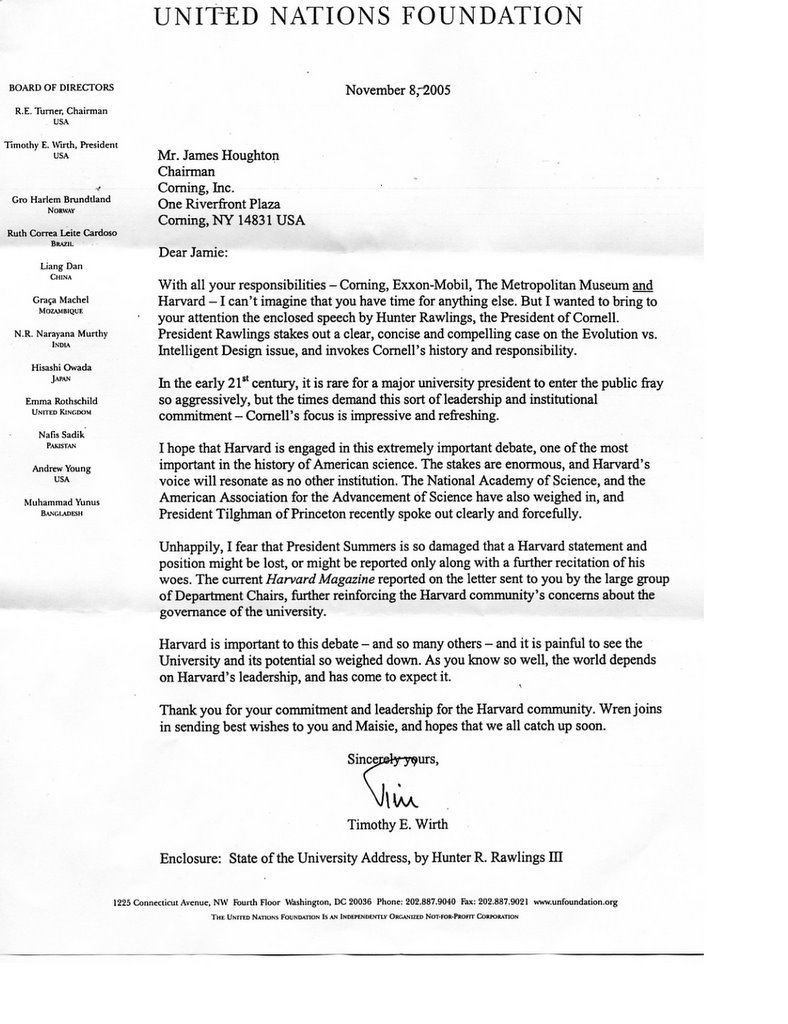
Here's the letter former U.S. senator Timothy Wirth wrote to Corporation senior fellow Jamie Houghton.... Click on the letter to enlarge it.
¶ 6:15 PM 2 comments
As usual with Silber, some of his remarks sound extremely sensible, and some of them sound borderline nutty.
Silber's bottom line: "Summers has done nothing to be ashamed of, and that's why he shouldn't apologize. Once he apologizes, then you wonder whether he's done something naughty." ¶ 9:10 AM 0 comments
Even before its issue has hit the stands, Boston has published documents related to the scandal on its website.
If you have a high tolerance for bureaucratic doublespeak, I encourage you to read them. Or wait till the article comes out, then read the documents.
To my mind, this is the most important and disturbing story of Larry Summers' tenure at Harvard, because it was a matter of life and death, and death won. ¶ 8:59 AM 2 comments
The author of the letter is former Colorado senator Tim Wirth, a Harvard alum; he graduated from the college in 1961 and received a master's degree from the school of education in 1965.
In the letter, which is addressed to Corporation senior fellow Jamie Houghton, Wirth praises a public attack on intelligent design delivered by Cornell president Hunter Rawlings. Harvard's president should have the same public profile, Wirth says. "Unhappily, I fear that President Summers is so damaged that a Harvard statement and position might be lost, or might be reported only along with a further recitation of his woes."
(Which is, I think, an accurate prediction.)
Wirth doesn't explicitly call for Summers' resignation, but he clearly implies that Summers' exit would be the best way for Harvard to retake the leadership status that "the world...has come to expect."
John Longbrake, Summers' spokesman, dodges the larger issue by saying that Summers has spoken out against intelligent design, "as recently as November 12 at a large gathering in New York City." A speech [presumably] at the Harvard Club was not exactly what Wirth had in mind.
An irony of this situation is that the Harvard Corporation chose Larry Summers precisely for the role Wirth envisions of the Harvard president. But some of Summers' public statements on matters of public debate have been so hamhanded that he is now effectively gagged.
Wirth is a former senator, so it will be hard for Mass Hall to discredit him. (It would if it could.) The question is now, will other alums follow Wirth's lead? And what kind of impact will Wirth's letter and similar sentiments have on Harvard fundraising?
___________________________________________________________________
* Thanks to the poster below who reminded me of Bombardieri's piece. ¶ 8:23 AM 0 comments
Yesterday, though, I visited Times Square with my brother-in-law and six-year-old nephew. (He happens to be my only nephew, and so I happily call him my favorite nephew in the world...but lately, he has wised up, and points out, "I'm your only nephew!")
The three of us braved the Toys-R-Us store in Times Square, an experience I won't willingly repeat. The store was packed with clutching, grabbing, consuming Americans; one couldn't move without bumping into someone happily snapping up a DVD of The Incredibles, picking up a handheld Nintendo device, or checking out the new Xbox. There's actually an in-store Ferris wheel there. Naturally, you had to buy tickets. And naturally, there was an hour wait, which meant that you'd have to shop for an hour before it was your turn to ride.
I get a little nauseous in such situations, so I left quickly.
It was the second time I'd become somewhat alarmed about the way we Americans approach Christmas. On Thanksgiving night, I watched The Polar Express with my nephew and my two nieces, who, coincidentally, happen to be my two favorite nieces in the world. For those of you lacking children or favorite nieces and nephews, it's an animated film about a little boy who doesn't believe in Santa Claus. On Christmas Eve, he boards a train to the North Pole and visits the huge metropolis where Santa and the elves manufacture Christmas presents.
It's kind of a weird film. The largely-deserted North Pole turns out to be an unintentionally scary place, filled with ominous conveyor belts and pneumatic tubes and tunnels and trapdoors. It looks like a Soviety city that's been hit by a neutron bomb—an impression that is only slightly lessened by a huge midnight rally at which all the elves cheer the imminent appearance of Santa Claus, who is first seen as a monstrous shadow.
(At which point I turned to my mother and whispered, "Do you think Robert Zemeckis [the director] is familiar with the work of Leni Riefenstahl?")
Our little boy protagonist is finally convinced that Santa exists when the Great Man chooses him to receive the first present of Christmas.
What kind of message does this send to children? There's not a hint of spirituality in the film.
Well, let me take that back. There is spirituality, just not as one would normally think of it in a Christmas context. Nothing about Jesus, or being thankful, or family, or helping others.
Instead, the material has been elevated to the level of the spiritual. The act of receiving a gift has been transformed into a quasi-religious ritual. Santa Claus is a combination of Jesus and Hitler.
In Dickens' A Christmas Carol, we learn that there is no greater gift than the present. In The Polar Express, we learn that there is no greater gift than a present.
In Dickens, we learn that the greatest joy is giving. In The Polar Express, the greatest joy, the ultimate satisfaction, is receiving.
And in the United States, this "holiday season," as we have dubbed it, the greatest joy is buying...which was not unlike President Bush's advice to the nation after 9/11: Go shopping.
Doesn't the United States mean more than this? Isn't there some way to retake Christmas from the materialistic orgy of our vapid capitalist culture? Or are we really nothing more than what we buy? ¶ 9:34 AM 6 comments
It's a fascinating story, involving a secret tribunal that expelled a number of Harvard students for suspected gay activity. But Helms suggests that the telling of it is deeply flawed, including a number of factual mistakes, unattributed quotations, and occasional dips into fictionalization.
(The Crimson review said much the same.)
Concludes Helms, "Wright has been so ill served by his editor that perhaps it's time for a new purge."
A couple of points here.
First, Wright shouldn't need an editor to point out factual mistakes or to tell him that interspersing fact and fiction in a work of history is a bad idea.
But second, as is more and more true in publishing, Wright probably didn't have much of an editor. Well, let me rephrase; Wright's editor probably didn't do much actual editing. His publisher, St. Martin's Press, is known as a commercial house (as opposed to one with a highbrown reputation).
(St. Martin's publishes the paperback of American Son, so I don't say that as a slight; nothing wrong with being commercial.)
But I'll bet that St. Martin's was concerned that the publication earlier this year of Harvard Rules and Ross Douthat's Privilege had tapped out the market for books about Harvard, and consequently made a decision not to put a lot of resources into Wright's publication. That, and the fact that it's aimed at a very specific niche—gay people interested in Harvard—probably meant that Wright didn't receive a lot of editorial attention.
And since publishers don't pay for fact-checkers, Wright would have had to hire someone himself. (I did, for both of my books, and I consider it money well-spent.) It sounds like Wright chose not to.
I don't say this as a criticism of Wright; it's tough to write a book about a small subject and have the resources to do it just as you'd like to. At some point, you have to perform a cost-benefit analysis: If I have to spend $2500 on fact-checking, and that's, say, five percent of my advance after taxes and a 15% agent's commission, and the fact-checker catches ten small mistakes...is it worth the money?
Rather, I'm suggesting that some of the perceived failings of Wright's book may reveal telling changes in the publishing business. It's not easy to sell a book about a small chapter of Harvard history.... ¶ 9:12 AM 1 comments
Here's what the Times has to say about CAP:
"The group had been founded in 1972, the year that Judge Alito graduated, by alumni upset that Princeton had recently begun admitting women. It published a magazine, Prospect, which persistently accused the administration of taking a permissive approach to student life, of promoting birth control and paying for abortions, and of diluting the explicitly Christian character of the school."
CAP also protested the number of minority students at Princeton, relative to the number of alumni children.
Again, from the Times: "A brochure for Princeton alumni warned, 'The unannounced goal of the administration, now achieved, of a student population of approximately 40 percent women and minorities will largely vitiate the alumni body of the future.'"
A couple of thoughts.
It's hard not to see such sentiments as racist. There doesn't appear to be any argument why a student body of 40 percent women and minorities would be wrong for Princeton. (In fact, it's hard to imagine such an argument that wouldn't be racist and sexist.) But the implication that such a student body composition is, on its face, a bad thing reeks of racism.
It may also be possible to throw anti-Semitism into the mix. That phrase, "diluting the explicitly Christian character of the school," is alarming. But to be fair, it's possible to imagine an argument in behalf of a Christian tradition that isn't anti-Semitic, and the Times doesn't delve into this aspect of the story.
This article does remind one of how nasty the Reagan conservatives of the 1980s really were. Such extreme sentiments were hardly rare, and they were fueled by the Reagan administration. That's one reason why Alito listed his membership in CAP in a 1985 appplication for promotion when he was working in the Reagan administration.
Yes, this happened a long time ago. But Alito's membership in the group is relevant to his judicial philosophy, and senators should question him about it during his confirmation hearings. ¶ 8:36 AM 0 comments
Now George has gotten the book published. It's called Master Classes: The Evolution of the Golf Swing, and it looks terrific. If you're a golfer, or you know a golfer—and who doesn't, really?—this is a great Christmas gift. ¶ 9:00 AM 2 comments
It's a shame when any marriage doesn't work—although my fellow Groton alum Curtis Sittenfeld thinks that there's some pleasure in the implosion of celebrity marriages—so I guess I'm sorry to hear that. But here's what makes me laugh: Their statement to the press, which reads, in part, "We hope that you respect our privacy during this difficult time."
This from the couple which starred in a reality television show about their new marriage....
Well, I don't think that the press is going to respect their privacy. But then, since Nick and Jessica don't respect their own privacy, why should it?
I happened to see the Johnny Cash film, "Walk the Line," last night—Joaquin Phoenix is terrific, Reese Witherspoon perhaps even better—and it presented a fascinating counterpart to the Simpson-Lachey story. Cash's early years as a singer were remarkable: Imagine recording at Sun Studio, then touring small-town America in a rock 'n' roll show with Jerry Lee Lewis, Carl Perkins, Elvis Presley, and June Carter...with virtually no one paying attention. Now, up and coming artists are chronicled from their first steps.
I'm sure that something is lost without the omnipresent video and aural recording. But something is lost with it, too—the ability to develop under the radar as an artist and as a person without the self-consciousness effected by an ever-present video camera. Because as Nick and Jessica have learned, once that camera makes its way into your private life, you can never erase those images.
_________________________________________________________________
P.S. I also laugh a bit that they released this statement the day before Thanksgiving, in an attempt to borrow a Washington trick and bury the news. As if. Moreover, I think there's an argument to be made that this trick just doesn't work any more....and all it does is make us media types work on holidays. Which we don't like one bit. ¶ 8:25 AM 0 comments
I hope that you all have a wonderful time with your families. And a special nod to the men and women in the military overseas. We're grateful for your service, and we haven't forgotten you. Stay safe, and come home soon. ¶ 11:53 PM 0 comments
He begins by saying, "Last January, Harvard University president Lawrence Summers offered a few mild, off-the-record remarks about innate differences between men and women in their aptitude for high-level science and mathematics, and was treated by Harvard's faculty as if he were a crank."
(Italics added.)
An observation here: Ever since Larry Summers' infamous speech, conservatives have rushed to his defense by pointing out that his remarks were off-the-record.
It's a curious logic. The stipulation that one's remarks not be reported—which is what "off the record" means—has no bearing on their merits or demerits. If someone says something incredibly brilliant, it would be no less so for being off the record. And if someone says something incredibly offensive—used the "n" word, for example, or an anti-Semitic term—the fact that it was not intended for publication would not diminish its offensiveness. If a liberal called Rush Limbaugh a fat piece of human waste, and then said, "What are you so upset about, it's off the record?", conservatives would rightly disregard that caveat.
Charles Murray is welcome to defend President Summers' remarks on countless other grounds. That's a healthy debate. But the fact that they were off the record is irrelevant. ¶ 2:51 PM 3 comments
After four years and two books, the old iBook was just running out of steam—not to mention hard drive space. I suppose 2700 songs in iTunes will do that to a computer. But it served me well, and it will eventually be put into the closet, along with my clamshell iBook and my Powerbook 3400, neither of which I have any idea what to do with but can't bear myself to toss/recycle.
Problem was that in transporting files from the iBook, with OS 10.3.9, to the iMac, with OS 10.4.3, things went a little haywire, leading to no less than five hours on the phone with four different Apple reps. Adam, I apologize again for saying that my computer was FUBAR. Devon, it took 118 minutes and fifteen seconds, but we finally got those addresses imported. (1066 of them, to be precise.)
Now can I say that this computer is a thing of beauty?
Yes, I can. Let's just say that if this blog were written as well as this computer is engineered.... Well, it's something to shoot for. ¶ 12:12 PM 3 comments
Although this was not Ms. Hafner's intention, the article raises questions about whether the deal between Harvard and Google was made not on its merits, but because of a close relationship between Larry Summers and a top Google executive.
Hafner's piece romps along for some time, rather sympathetically to Mr. Verba. Hafner suggests that Verba was well aware of the implications of Google's project—which many authors believe constitutes copyright violation on an unprecedented scale—but at the same time, she quotes Verba saying, "It's become much more controversial than I would have expected. I was surprised by the vehemence."
Given that the Google project could one day allow readers to search every book in existence online, without authors receiving a penny, one wonders how much Verba had truly considered its implications. Google vows that it won't allow readers to read whole books online...but once the scanning is done and the books are posted, that genie will be out of the bottle. Either Google will change its mind...or hackers will write programs, much like peer-to-peer file sharing networks, that allow users to download entire books from Google, all free of charge.
Moreover, there's a local angle for Harvardians: President Larry Summers is profoundly skeptical about Harvard's libraries—how much they cost, and whether all of their resources are really necessary—and during his tenure, Harvard's libraries have come under steady pressure to cut hours and staff.
So how did Verba decide to support this initiative? That's where Hafner's article gets really interesting.
She writes, "When Sheryl Sandberg, a Google executive, first visited Harvard two years ago and put forth the idea of digitizing millions of books spread out over Harvard's more than 90 libraries, Mr. Verba was skeptical. The sheer magnitude of the task seemed staggering."
Hafner then discusses Google's awesome scanning abilities.
But wait—there's a critical fact about Sheryl Sandberg that Hafner either doesn't know or doesn't mention.
True, Sheryl Sandberg is a Google executive; she is the vice-president of global online sales and operations.
"In this role," according to Google's website, "Sheryl is responsible for online sales of Google's advertising and publishing products. She also runs sales operations and support for Google's consumer products and for Google Print."
Huh. No mention of any work with university libraries. So why was Sandberg chosen to propose this project to Harvard?
Turns out that Sandberg has some pretty tight Cambridge connections. She's a 1991 graduate of the college, an economics major who graduated summa cum laude and was awarded the John H. Williams prize for the top graduating student in economics. And she's a 1995 graduate of HBS.
But perhaps most important was this: Prior to joining Google, Sandberg was chief of staff to none other than Treasury secretary Larry Summers.
From all I hear, the two of them were close at Treasury and have remained good friends. So Google's decision to send Sandberg to Harvard—never previously disclosed, as far as I can tell—would seem to have something to do with her relationship with Harvard's president.
All of which makes one wonder: Was Harvard's decision to join the Google project influenced by the relationship between Larry Summers and Sheryl Sandberg?
In Washington, from whence Summers and Sandberg came, this is called lobbying. It's illegal to leave the government and immediately start lobbying your former employer, because your close connections to that employer could inappropriately influence that employer's decisions. But no such restrictions apply to the non-profit world.
Nonetheless, since the Google decision could affect the livelihoods of every Harvard professor who's published a book—presumably all of them—and since it will have a profound effect on writers everywhere, it behooves the faculty to start asking questions about how the Harvard-Google relationship was forged, and whether the process was corrupted by the relationship between Sandberg and Summers. After all, this deal between a non-profit university and a private sector company was made in the utmost secrecy, with absolutely no discussion among the people affected—those who write the books that are in Google's libraries.
At the next faculty meeting, Harvard's professors should ask questions such as:
Why was there no public discussion about a deal involving the entire Harvard faculty?
Did Sandberg and Summers discuss the Google deal before any decision was made?
When Sandberg came to Harvard to see Verba, did she also visit Summers? After she met with Verba, did she subsequently contact Summers?
Did Summers and Verba discuss the deal before a decision was made?
Did Verba feel any pressure from Larry Summers to play ball with Google?
Did Verba have any incentive to try to please the president by going along with the Google deal?
Was it really Verba who made the decision to go along with Google, or was it Larry Summers' decision, for which Verba is the front man?
If Larry Summers were to leave the Harvard presidency—not an insane proposition—could he ever profit financially from a relationship with Google—by, for example, serving as a member of Google's board? And would he now take a public oath to avoid any such financial relationship?
Harvard's participation in Google's project is a hugely valuable endorsement, one that is surely having a broad impact. You can imagine librarians at many universities saying to themselves, "Well, if Harvard is doing it, then it must be a good idea."
(I'd say that Google couldn't buy that kind of publicity, except that may be exactly what Google has done: Was Sandberg was hired precisely because of her connections with Summers?)
But it isn't a good idea if the real reason why Harvard joined forces with Google is the tight relationship between the university's president and his former closest aide. ¶ 8:21 AM 0 comments
Are conservatives hypocrites when it comes to sex?
Well, yeah. Just ask "Hot Tub Tom" DeLay.
Does it matter?
I think so...and in this piece for TomPaine.com, I talk about why, when Scooter Libby writes a novel about a ten-year-old girl who repeatedly has sex with a bear, it's a problem not just for Republicans, but for the country as a whole. ¶ 9:24 AM 1 comments
The article doesn't contain a lot of new information, but it does update the Globe piece in a couple of bemusing ways.
First, vice-president for finance Donella Rapier seems to have learned that it's not wise to concede that President Summers' image problems may be hurting alumni giving, as she did in the Globe.
“A number of people have been incredibly supportive of the president and all he is trying to do, and some have asked questions,” she told the Globe.
President Summers was apparently none too pleased by this display of...well...admitting the obvious.
Now, Rapier tells the Crimson of her “strong sense...that our alumni are highly supportive of the President and his vision for Harvard’s future.”
(Where is Global Language Monitor when you need them?)
In the Globe article, Rapier also suggested that many alumni were hard to reach because they only had cell phones, an assertion about which this blogger was skeptical; I suggested that the presence of e-mail should more than compensate for the miniscule number of alums who don't have landlines.
Perhaps Ms. Rapier reads this blog, because now the Crimson reports that "in their attempts to contact alumni, Harvard fundraisers now face e-mail spam filters...and overflowing e-mail inboxes."
Too funny.
Look, there probably is some correlation between President Summers, who is obviously a divisive figure, and alumni giving. But there may also be more credible explanations that have nothing to do with "e-mail spam filters."
(I mean, come on, people—you are Harvard. If your fundraising is dependent on not being considered spam, then you've got a serious problem.)
How about the fact that, since 2001, the stock market has either been declining or in the doldrums, and people just don't feel as rich as they did in the 1990s? Or the fact that 2001 marked the departure of a president who'd just completed a huge capital campaign?
If I were trying to explain away declining rates of alumni giving, I'd throw out those explanations, instead of talking about what a challenge cell phones are.
One word of caution to the Crimson: It's time to treat last year's alleged $590 million raised—ostensibly a record—with skepticism. Do you really think that there was no pressure on the relevant parties not to make it look like fundraising was down during Larry Summers' annus horribilis?
From what I hear, these numbers are more cooked than a chicken in China.... ¶ 8:59 AM 0 comments
"Intrinsic aptitude" was, of course, the phrase Summers used to explain why he thought women are less gifted at science and mathematics than men are.
In fairness to President Summers, many people thought the phrase was politically incorrect. So he's sort of getting it coming and going here.
Also on the list were "deferred success" (for "failure") and "misguided criminals" (terrorists). ¶ 8:53 AM 0 comments
Yesterday he announced that he was made privy to Valerie Wilson's CIA identity a month before Bob Novak was. (Typical Woodward; he always has to be first.)
Yet for months, he has been disparaging the importance of Patrick Fitzgerald's leak investigation.
As Howie Kurtz reported today in WashPo, Woodward "said on MSNBC's 'Hardball' in June that in the end 'there is going to be nothing to it. And it is a shame. And the special prosecutor in that case, his behavior, in my view, has been disgraceful.' In a National Public Radio interview in July, Woodward said that Fitzgerald made 'a big mistake' in going after Miller and that 'there is not the kind of compelling evidence that there was some crime involved here.'"
This is not rocket science; this is journalism 101. If you have a conflict of interest in a matter, you must disclose it while writing or talking about it. Woodward's criticism of the investigation now looks like nothing more than protecting a source. And, for that matter, himself.
I don't think you could find another reporter, for example, who ever thought that Fitzgerald's behavior was "disgraceful." That's strong language—and it sounds much more like the White House than like an independent, non-partisan commentator.
Perhaps Woodward felt free to call Fitzgerald "disgraceful" because the independent counsel wouldn't talk to him....whereas everyone who does talk to Woodward gets the kid-glove treatment.
Woodward has humiliated his employer. By placing his own story and his own source above the interests of the Washington Post, Woodward shows that his true loyalty is not to the paper, but to himself. And yet, managing editor Len Downie does nothing but say that there was a miscommunication, and that everything is cleared up now.
I think it'd be a better move for Downie to say that he's going to reevaluate the nature of Woodward's relationship with the Washington Post—not to fire Woodward, but to create a clearer relationship so that the paper's priority is primary and this kind of embarrassing incident never happens again. ¶ 8:32 AM 3 comments
Whoops! ¶ 8:26 AM 0 comments
Funnily enough, that's what Dick Cheney did in his speech yesterday.
For example:
What we’re hearing now is some politicians contradicting their own statements and making a play for political advantage in the middle of a war. The saddest part is that our people in uniform have been subjected to these cynical and pernicious falsehoods day in and day out. American soldiers and Marines are out there every day in dangerous conditions and desert temperatures – conducting raids, training Iraqi forces, countering attacks, seizing weapons, and capturing killers – and back home a few opportunists are suggesting they were sent into battle for a lie.
It takes some chutzpah, saying that opponents of the war are guilty of "cynical and pernicious falsehoods"....because doesn't that pretty well describe the Administration's case for war? And isn't that the reason those soldiers and Marines are out there every day, in dangerous conditions and desert temperatures, etc., etc.?
Five more killed and eleven wounded yesterday, by the way....(a story that doesn't even make the front page of NYTimes.com.). We're getting from 2000 to 2100 pretty fast. ¶ 8:19 AM 0 comments
Weirdly enough, Maloney was encouraged in his dream of becoming a documentarian by Michael Moore, who is not known as a campus conservative.
And following the more typical path of a young conservative, he found a rich sugar daddy, Stuart Browning—described by the Chronicle of Higher Education as a "multimillionaire interested in politics"—to fund him....
Apparently in the film, Maloney does things like wander onto various college campuses and ask where the "men's center" is. (Which is kind of amusing, actually.) Sounds like Larry Summers might like this documentary....
___________________________________________________________________
* ¶ 8:11 AM 0 comments
"Dear Colleagues:
I write to share with you the text of a message I sent Tuesday in response to a statement reported in that day's Crimson from a group of current and former department chairs:
'I share your dismay at the irresponsible and misguided speculation reported in last Thursday's Crimson regarding my relationship with Dean Kirby, and I agree that these kinds of rumors are unhelpful and counterproductive as we work to achieve our common goals. Dean Kirby has my confidence and support as he leads the Faculty of Arts and Sciences in a series of critically important activities designed to advance the Faculty's academic priorities. I have been very much encouraged by the progress he and the faculty as a whole have made recently in curricular reform and other matters, and I look forward to our continued work together.'
I very much appreciate your ongoing commitment to our common goals.
Sincerely,
Larry Summers
Huh.
Couple of things. First, why exactly was the Crimson story "irresponsible" and "misguided"? (Note that Summers does not describe it as "wrong.") Seems to me that the paper was merely doing its job...and I haven't seen anyone question the accuracy of the story. And you'd better believe that, if they could, they would.
Dean Kirby has my confidence and support....
Yes, fine. But does he also plan to step down from his position at the end of the year, and has he negotiated this option with President Summers?
Or does he now find himself in a position of unanticipated strength?
¶ 11:19 PM 0 comments
This isn't quite at the New York Times' level of attention...yet. But it's getting there.... ¶ 11:13 PM 1 comments
Document Says Oil Chiefs Met With Cheney Task Force
Wednesday, November 16, 2005; Page A01
According to the website ContactMusic.com, "The 2007 project will focus on the gritty themes covered in 50 Cent's music. 'These tales will tell the truth about The Life; the sex, guns and cash; the brutal highs and short lives of the players on the streets.'"
As the Times puts it, "Louise Burke, the publisher of Pocket Books, said the stories would be written by authors recruited by the publisher in collaboration with 50 Cent."
In other words, they'll be publishing books not written by their authors for an (MTV) audience that doesn't read.
They're going to make a bundle... ¶ 8:11 AM 1 comments
Boy, this war just gets better and better, doesn't it? And isn't it strange that all the people who once couldn't wait to crow about our success in Iraq—Wolfowitz, Rumsfeld, Cheney, Rice—have now moved on or gone underground?
The obvious point to make here is that we don't exactly have the moral high ground. When our vice-president is secretly lobbying Congress to kill a measure banning torture, it's a little tough to crack down on Shiite Iraquis torturing their Sunni enemies..... ¶ 7:57 AM 0 comments
Bombardieri reports that the letter was signed by 17 department chairs and seven former department chairs.
Summers' spokeswoman John Longbrake tells the Globe that Summers sent a quick response. "''He expressed his confidence and support for Dean Kirby, and said he looked forward to continuing to work together."
But Longbrake did not release the text of the letter.
(Incidentally, kudos to Longbrake, whom I'm told is a good guy. He seems to be doing his best to maintain a cordial and open atmosphere between Mass Hall and the press in what must surely be a delicate situation.)
The professors should release the letter...because I'd like to see if there's any language in it ensuring that Kirby will remain as dean. My hunch? That the language it contains is carefully crafted, so that there will be no contradiction when Kirby departs as dean at the end of this school year...
...which I still think will happen. Although he is clearly in a stronger position now than before the Crimson broke the news that Summers had planned to fire him. If he's smart, he'll use this leverage to get a larger golden parachute out of Mass Hall.
(Note to Crimson: How about an article adding up how much Summers' various faculty payouts, severance packages, and controversies have cost the university? You can start with the $1 million donation directed to Skip Gates' DuBois Institute, as reported in Harvard Rules. Perhaps you can make it the fourth part of the your imminent series on Harvard's financial fortunes.)
By the way, multiple sources tell me that Summers offered Kirby's job to Drew Faust, dean of the Radcliffe Institute, during the last school year. Faust declined...but Summers told a number of professors that he planned to make Faust dean of the FAS. ¶ 7:31 AM 0 comments
—seen on the electronic billboard over Fairway Market, at 128th Street ¶ 7:27 AM 0 comments
As InsideHigherEd.com puts it, "In contrast to many diversity plans in higher education, Yale set out actual quantitative goals. The e-mail sets the bar at 30 new minority faculty members over seven years – which would be about a 30 percent increase – and 30 new female faculty members in departments where they are underrepresented, which would be a 20 percent increase overall, and an 83 percent increase in the targeted departments, notably physical sciences."
I don't know enough about the situation at Yale to comment on this extensively, but there does strike me as something troubling about this. These numbers are, simply, quotas. And while I think there is great importance in having a faculty with ethnic and gender diversity, by stipulating a specific number to be hired, Yale concedes—it's arguable, I know, but I think this is true—that the identies of those professors are more important than their talents.
(As opposed to, say, saying that Yale plans to increase faculty diversity, but without setting quotas.)
And setting specific targets like this will, of course, raise the usual suspicions about the merits of those who are hired.
Don't get me wrong: I'm highly supportive of finding excellent female and minority professors to teach at Yale, and of the general goal of making academia more diverse. I'm just not sure that this is the right way to go about it. ¶ 8:53 AM 0 comments
Now, of course, ghostwriters are so taken for granted, they are not even remarked upon.
I know it's curmudgeonly to insist that there's something weird about this...
...but how can the New York Times write an entire piece about Nicole Richie and her new novel, "The Truth about Diamonds"—yes, that's her on the cover—without even mentioning the word "ghostwriter"?
Okay, the Times does include the clause, "which Ms. Richie said she wrote herself." But who could possibly believe that? A little more skepticism would be in order...except that the reporter clearly doesn't think the issue is important.
Almost as bizarre to me is the adoration her young fans, waiting in line to have their books signed, manifested.
As one teenage boy told the Times, "Her body is perfect, her hair is perfect, her outfit is perfect, her makeup is perfect. I love everything about her."
"Her outfit is perfect?" This, from a teenage boy?
We live in strange times.... ¶ 8:09 AM 5 comments
But if I were a paranoid man, I'd wonder....
Anyway, things should be okay now. Thanks for your patience. ¶ 8:03 AM 1 comments
Referring to the Crimson's scoop that Summers planned to fire Kirby last year, before his own troubles arose, the statement reads: "We think it is highly improper if, as reported, the President of Harvard has been expressing to members of the faculty his ‘deep dissatisfaction’ with the Dean of Arts and Sciences. It undercuts the work and the morale of colleagues within FAS [the Faculty of Arts and Sciences] and damages the institution as a whole.”
Seventeen professors have signed the statement so far; some of the signatories—Cynthia Friend, Mary Waters, Richard Thomas—were among Summers' most vocal critics during last spring's controversy.
What are we to make of this?
On the one hand, I've heard numerous stories of Summers criticizing professors he doesn't like when he's with professors he does; I've even heard of him criticizing specific professors in front of students. (Richard Thomas, for example.) Summers also has a habit for giving unflattering nicknames to professors of whom he's not fond.
Which is, indeed, unprofessional.
On the other hand, Summers certainly has the right to fire Bill Kirby if he thinks Kirby's not working out.
And on a third hand, since Summers appointed Kirby, the buck does need to stop somewhere, doesn't it?
File this statement under the heading, "Continuing Dissatisfaction with Summers' Leadership." ¶ 7:43 AM 0 comments
Called "The Ground Truth—The Human Cost of War," the film traced the soldier's arc, from being recruited to being transformed into killing machines to returning to the United States.
It's not a pretty picture. These men and women are trained to kill, but in Iraq, they find themselves killing people who either may not be enemies, or definitely are not enemies.
One soldier tells of shooting a woman approaching his Humvee. He didn't know if she was a threat, and so his training took over. He fired, and then other Americans pumped a fusillade of bullets into her.
As the woman fell to the ground, her hands fell outward to reveal that she was carrying a white flag.
Another soldier tells of seeing a little girl, standing a few feet in front of him, getting her head blown off.
These are memories from which one can not escape.
When they return to the United States, these soldiers face an immensely difficult transition. Nonetheless, they are getting little help from the army, which doesn't want to acknowledge how horrific the Iraq experience is, and the Veteran's Administration, which has been hit by severe funding cutbacks. Meanwhile, most Americans are oblivious to their problems.
It is all disturbingly analogous to Vietnam. Watching the film, I couldn't help but think, "How can this be happening again?"
This film should be mandatory viewing for President Bush, Vice-President Cheney, Paul Wolfowitz, Donald Rumsfeld, and all the other non-combatants who thought that preemptive war was a great idea.
Check out the film website above. We must do better this time. ¶ 9:44 AM 3 comments
"Has the president regained his stride?" Bombardieri asks. Or "are Summers critics just waiting for a new gaffe on which to pounce?"
Well, of course the low profile is a deliberate media strategy on Summers' part. I don't think one could say that Summers has regained his stride until he feels he can start appearing in the press again....
Meanwhile, let's play a little Harvard trivia game.
1) In addition to Bill Kirby, which Harvard dean wouldn't be at all surprised to be fired before year's end?
2) Which mega-rich Harvard donor is said to be so pissed off about the potential Larry Ellison donation, he may be the primary reason Harvard has been holding off on accepting Ellison's proffered $120 million?
3) What magazine article is Massachusetts Hall so concerned about that it's volunteered preemptive press briefings?
4) Which Harvard governing board has become increasingly frustrated with the president and assertive of its own power? (Hint: It's not the Corporation.)
5) What university's ranking in a certain national magazine annual list will be adversely affected by falling percentage rates of alumni giving?
6) Which university vice-president is in President Summers' doghouse, and why?
7) Which university's capital campaign could best be described as "on-again, off-again"? ¶ 9:01 AM 1 comments
As Andrew points out, this isn't the first time one website has purchased a blog; Slate did it with Kausfiles.
But since Slate was always an online venture, and Time is the definition of MSM, this feels like a moment.... ¶ 8:49 AM 0 comments
Good for Carr (who, full disclosure, once wrote about me, though not particularly flatteringly) to call out Gawker, something everyone should be doing.
A lot of people read Gawker; a friend in magazine publishing told me that it's become a must-read for everyone in that business. But magazine writers can be a homogenous crowd whose immaturity can be self-perpetuating. (I mean, just look at Radar magazine...which just happens to have a weirdly hostile but mutually dependent relationship with Gawker.)
Gawker's courageous response to Carr?
Silence.....
__________________________________________________________________
P.S. Gawker has now taken note of Carr's piece, dismissing it as "meta-media analysis" whose point is that "blogs are insensitive, as we are wont to be," which of course makes it fine then.
Nonetheless, do I detect a subtle shift in Gawker's writing about Peter Blaustein? A little more, um, maturity? ¶ 8:19 AM 4 comments
According to the Daily News...
1) Pedestrians are twice as likely to be killed when they're hit by an SUV than when they're hit by a car.
2) While the total number of pedestrian deaths in NYC has falled by 18% in the last five years, the numbers of deaths by SUV have surged 27%.
3) SUVs made up about 15% of the cars in New York last year—but caused 26% of pedestrian deaths from passenger vehicles.
4) When a car and an SUV collide and someone dies, 81% of the time the victim is the car driver.
When is someone going to take the logical and urgent next step, and file a class action lawsuit against the manufacturers of SUVs? Irresponsible and dangerous, they have degraded the quality of all our lives. ¶ 7:57 AM 0 comments
Williams died of cancer after a three-and-a-half year illness earlier this year.
I know Tim slightly, from various journalism things, but I met Marjorie just once, at a friend's wedding. In just a few minutes of conversation, I was struck by her aura of kindness. She made you feel like an old friend. I wouldn't have wanted Marjorie to write about me—I would have told her everything, and the resulting portrait would probably have been more honest than I would have liked to read.
Tim spoke about the book for a few minutes—how it came to be, how it was structured. Then Katha Pollit, columnist for the Nation, and Jill Abramson, Washington bureau chief for the New York Times, read from two pieces: a Washington Post essay Williams wrote about the Washington snipers, and a famous Vanity Fair profile of Barbara Bush called simply "The Wife."
The readings reminded me that Williams really was a lovely writer, with a keen eye for detail and a great talent for letting people reveal themselves through the meticulous chronicling of their own words and actions.
Tim took some questions afterward, which I thought was extremely brave of him. At every reading, there's always someone who asks a question that's not quite appropriate, or pushes the envelope a little. And so it was last night, when one woman stood up and asked Tim, "As a caregiver, can you talk about what surprised you about the experience of your wife's illness?"
Imagine getting a question like that in front of a crowd of about 75 people.
To his great credit, Tim handled it gracefully. He answered that he didn't want to get too deeply into that, but that he was surprised by the fact that, though the years of Marjorie's illness—all the hospital visits, the treatments, the changes in his wife—were incredibly hard, losing her was still much, much more difficult—the feeling of being without her was much more painful. That's the power of grief, I guess, he said.
Which I thought was a terribly eloquent and quite courageous answer.
Two other things: I loved that Tim included a piece in the collection that was Marjorie's first piece for the Washington Post Style section. It had sentimental value for him, he said, because he called her up to compliment her on the piece, and that phone call led to their first date.
And I appreciated the fact that Tim declined to sentimentalize his wife. He told a slightly mordant story about his wife's integrity as a journalist. Washington is a town, he said, where there's great emphasis on social fakery. If someone writes a hatchet job about you, standard procedure is too call them up the next day and ask them to lunch.
After Marjorie died, he said, only one of her subjects had sent a note of condolence. Which was to say that her writing cut so deeply, Washington animals could not even fake their regrets.
It was a tough story, but an honest one, and I suspect that Williams wouldn't have had it any other way.
After leaving the reading, I bumped into a friend on the subway, and told her about the event. I guess I was slightly quiet about it, because she asked why I'd gone, when it seemed to have made me sad.
I had to think about the answer for a minute.
Partly for Tim and Marjorie, I said. But partly because journalism is a community of sorts. Often it's not a very nice community, filled with jealousies and rivalries and sniping and backstabbing. (That's what happens in a competitive field where there aren't a ton of jobs to go around and not everyone in it is that, um, balanced.)
But Tim and Marjorie were nice, and they brought a lot of people together. (The packed crowd last night was evidence of that.) They represented some of the most positive qualities of the journalism community—friendship, continuity, supportiveness.
And now Marjorie is gone. And as part of that community, I wanted to pay my respects. ¶ 8:26 AM 0 comments
After watching 50 Cents' "Get Rich or Die Tryin'," 30-year-old Shelton Flowers was shot several times in the movie theater men's room. He staggered out and collapsed near a bank of video games.
In a mini-tragic sort of way, this is quite a loaded cultural moment.
No pun intended. ¶ 8:12 AM 0 comments
According to InsideHigherEd.com, business school dean Terry Maness explained, “Recently, I asked a member of our advisory board to step down because of his alternative lifestyle. We must be sensitive to the position of our affiliated denomination, the Baptist General Convention of Texas, which has, on previous occasions, stated that a homosexual lifestyle is incompatible with most Baptist interpretations of scripture.”
I'm not gay, but if I were, I'd be infuriated by that trvializing and demeaning term, "alternative lifestyle."
Heck, I'm not gay, and I'm still infuriated by it.
Smith, by the way, was a graduate of the Harvard Business School who had given $65,000 of his own money to Baylor and raised about another $60,000, in addition to speaking at the school annually for the past five years.....but because he is gay, none of that matters. ¶ 9:00 AM 0 comments
I wish we were hearing more about Marjorie Williams. ¶ 8:47 AM 0 comments
As Evan H. Jacobs and Anton S. Troianovski report—I ask, again, why every Crimson reporter feels the need for a middle initial? How many Anton Troianovski's* can there be?—
Several sources expressed concern that the news of Summers’ plans was intentionally divulged to gauge Faculty sentiment for Kirby’s possible departure.
“I would hope that what we are seeing here is not a leak intended to see which way the wind blows,” said another FAS chair who wished to remain anonymous.
A trial balloon? I love it. Where would such a tactic come from? Washington, of course. And the fact that several professors suspect such a maneuver shows that they have grown savvy to the elements of Washington political culture Summers has brought to Cambridge.
It's an argument I made in Harvard Rules. In a chapter called "Washington on the Charles," I wrote that "Summers had come to Cambridge after a decade in Washington, and he carried the culture of his former city with him"—and that it did not go over well.
Now, it sounds as if the rest of Harvard has come to understand the role of politics—and politicking—in the presidency of Lawrence Summers.
Jacobs and Troianovski quote one professor as saying, “'Some professors, even some who want Kirby to go, have said he is a scapegoat for the more fundamental problem, which is Summers.”
In Cambridge, the national media may have gone away, but the turmoil continues.
_________________________________________________________________
P.S. I will go farther than the Crimson, and suggest that not only is Kirby's ouster looming, it's already a done deal—and both Kirby and Summers know it. Watch their comments carefully over the next days and weeks. If either says something that flat-out denies that Kirby is leaving by the end of the school year, I'll eat my hat...and then I'll suggest a follow-up question.
___________________________________________________________________
* Mr. Troianovski, one reader suggested that I was having fun at the expense of your name. Not so! (Far be it for me....) Quite an elegant name, in fact.
For some reason—and this may be just me—I've always found the use of middle initials in bylines pretentious. But I'll admit that there are more serious problems in the world.
¶ 8:17 AM 2 comments
But I think Arianna's getting carried away....
In blogging about the relationship between Miller and Cheney aide Scooter Libby, Arianna says:
"We are far more concerned about their political entanglement. The kind where agendas intertwine, and fiction gets massaged into fact. Far worse than sexual entanglements, political ones fuck with your head."
I've had quite a few conversations with Arianna over the years, and I have to say, this doesn't sound like her at all. (She's not a swearer, for one thing.)
Arianna, if you're using a ghostwriter, you need to monitor him—for this sounds like a man—more closely.... ¶ 8:11 AM 0 comments
(I must say, Larry Summers' tenure has been a golden era for student journalism.)
The former history department chairman, Kirby was appointed by Summers to head the Harvard faculty in the fall of 2002. Since then he has acquired a reputation as a highly pliable dean, easily bent to Summers' will. In 2003, for instance, Kirby wanly signed off on a rule change that would allow Harvard alums to receive class credit for financial contributions directed to the president's office—a move that Summers had pushed for because it would increase his power, even as it decreased Kirby's.
Then, in March 2003, Kirby fired Harry Lewis, the dean of Harvard College, a Summers' critic. Kirby was widely thought to be Summers' hatchet man in the incident. When students pressed Kirby on the rather Orwellian nature of the episode and its public disclosure, Kirby responded: "There are certain announcements that have to be made in a certain way."
Kirby has been, ostensibly, the overseer of the curricular review, but that wasn't really true until last year, when Summers removed himself from the process—ostensibly because he was too busy, but more likely because it was clear that the review was not going well, would not be a hit, and Summers wanted to disassociate himself from it.
As I wrote in Harvard Rules, "Bill Kirby...had done everything Summers wanted him to. ...But now some of his colleagues began to suspect that Kirby's future as a dean was in doubt. Replacing an FAS dean so early in his tenure would once have been considered unthinkable except in the most extreme circumstances. But Summers had shown that the traditional way of doing business mattered little."
Since that time, the review process has moved along somewhat more smoothly. But clearly, this curricular review will underwhelm. It will certainly fail in its objective as a fundraising device and as an achievement that the president can publicize heavily.
Some of that failure is Summers' fault; his involvement in the review's first years was heavy-handed and counterproductive. But Kirby must also take some of the blame; by most accounts his leadership of the process has been uninspired and almost diffident.
(Nonetheless, in the spring of 2004 he fired Jeffrey Wolcowitz, the University Hall aide who was actually writing the curricular report. Wolcowitz=fall guy.)
During the past months, rumors have swirled about Bill Kirby's dispirited—and dispiriting—leadership of University Hall. Staff turnover has been rampant, and no one wants to take the jobs that frequently open up. Morale is low. Little gets done. And Kirby is said to be weirdly disengaged, not reading reports that come before him, hardly preparing for meetings.
The question, of course, is whether these issues spring from some part of Kirby's nature—or whether they are inevitable for the FAS dean during the presidency of Larry Summers.
After all, a hallmark of the Summers' era has been a diminution of the power of the deans and massive growth in the power of Mass Hall. And no dean would feel the president's heavy boot more than the FAS dean.
Bill Kirby was known as a successful and effective chairman of the history department. Is his struggle now the result of a personal failing?
Or is it the inevitable consequence of President Summers' leadership style? ¶ 7:31 AM 0 comments
Lessons?
Seatbelts, good. SUVs, not. ¶ 1:46 PM 0 comments
(Got that?)
Well, primarily because Cooper compares his gray hair to ejaculation—both can be premature. Ba-dum-dum.
A better question would be, Why did CNN.com post that column in August, even though it's two years old?
(And deeply banal. Sample sentence: "On a guy, gray hair says, 'I'm mature, stable. I can be relied on.' Think George W. Bush.")
Possibly because Cooper's contract with Details stipulated a two-year time frame for republication of the material. And probably because CNN is doing everything it can to flog Cooper to the masses as the model for the hip new anchorman.
I don't want to beat up on Cooper, whom I've written about critically before. (I wasn't a fan of his on-air crying during Hurricane Katrina.) By all accounts, Cooper's an intelligent and very decent guy, and he certainly did some impressive reporting during the hurricane.
What makes me uncomfortable is the way CNN is marketing Cooper; it has everything to do with personality and nothing to do with news. We know all about his famous family, his brother's suicide, his restless youth. And for hipsters, there's a nudge-nudge, wink-wink element to his sexuality. The mere fact that he writes a column for Details—about such profundities as prematurely gray hair—shows just how much CNN wants to promote Cooper as a celebrity, rather than as a journalist. Cooper surely couldn't write the column without CNN signing off on it.
Such promotion is an act of desperation on the part of a network struggling for relevance. But it's also a degradation to the practice of journalism. Can you imagine Ted Koppell or Peter Jennings going off—about themselves—month after month in the pages of a men's fashion magazine?
¶ 8:21 AM 1 comments
Screenwriter William Broyles, who admits that he read Baghdad Express, nonetheless denies the charge. His inadvertently hilarious explanation? The material in question is utterly unoriginal. "The joke about the gas mask has been told 10,000 times," Broyles told the Times.
Quite a recommendation for the film.
Broyles adds, "These are not my stories, not [Jarhead author] Tony Swofford's stories or Joel Turnipseed's stories," he said. "These are stories that are held in common by all marines."
When a screenwriter starts talking about the stories of all marines, you know he's feeling guilty.... ¶ 8:07 AM 0 comments
"I would like to reiterate my respect for Donovan McNabb, as a quarterback, and as a teammate," he said. "I apologize to him for any comments that may have been negative."
Two observations about this apology.
One, it's patently insincere. Owens can't "reiterate" his "respect" for McNabb, because he clearly doesn't respect his teammate, and to reiterate a statement, you have to have made it in the first place, which Owens clearly has not. Quite the contrary.
Second, the apology "for any comments that may have been negative" is so lame. It's like apologizing "to anyone who may have been offended."
Why can't people just say, "I'm sorry for being an offensive jerk"?
(The answer, of course, is because they really don't mean their apologies, and their language can't help but reflect that lack of conviction.)
I love this description of the scene, from the Philadelphia Inquirer: "When Owens finished, [his agent, Drew] Rosenhaus took center stage for what was advertised as a question-and-answer session but instead became a sermon on how wonderful Owens is and how despicable the media has been to him."
The Eagles have indicated that they do not plan to lift Owens' suspension. Good for them. ¶ 7:06 AM 5 comments
I'm going to ponder this for a while before giving my thoughts, but Zachary Seward over at the Crimson makes some good points.
1) The letter is a program for a "fresh start," as Seward puts it.
2) Some of it seems aimed at defusing criticisms that he doesn't care about the humanities.
3) The existence of the letter is itself noteworthy; this is the first time in five years that Summers has written such a document.
4) For the most part, the letter reiterates the priorities Summers has been talking about ever since he became president.
My quick take: It's never a bad thing for the president of Harvard to discuss his priorities...but at the same time, one wishes that the Harvard president could aim higher than a mere recitation of his agenda ("Extending the University's International Role," "Advancing Allston Planning," etc., etc., snore.....) whose whole is not larger than the sum of its parts.
Here's a suggestion for President Summers: Throw away your notes about all the stuff you've accomplished. Think for a little bit about why Harvard is important now. Think about America in the Middle East. Riots in France. Economic lunacy in Washington. Creationists in public schools. The decline of civility in American life. The ongoing problems of racial and economic discrimination around the country. The environmental threats of global warming, avian flu, decimated oceans.
Then, stop giving speeches whose implicit message is that Harvard needs you. And give a speech about why the world needs Harvard.
Then, maybe, you can think about starting that long-overdue capital campaign.... ¶ 7:37 AM 0 comments
I don't know much about Pete Rose, Jr., but I'm not a fan of his father, and it sounds like the apple hasn't fallen far from the tree.
And good for the Eagles! Though usually I find it odd when a player gets suspended for exercising free speech, this couldn't have happened to a more deserving athlete. Owens is, you will remember, the man who scored a touchdown, then pulled a Sharpie out of his sock and signed the football on the spot. He is a great football player. But he is arrogant, obnoxious, selfish, crude, boorish, and destructive to the teams on which he plays. Most recently, he announced that the Eagles would be undefeated if they had the Packers' Brett Favre as quarterback, rather than their own excellent Donovan McNabb.
What a bonehead.
I can't stand the Eagles, who are rivals to my beloved New York Giants, and I think this move will actually help them get their season back on track. Still, I'm glad they suspended Owens. It was the right thing to do.
Last week HBO's Real Sports with Bryant Gumbel ran a piece about a young woman named Mallory Code who, at the age of 15, was one of the country's top amateur golfers. What made this accomplishment all the more impressive was that Code has cystic fibrosis, a debilitating and always terminal disease.
Real Sports—which is the best journalism show, about sports or anything else, on television—profiled Code five years ago, when she was still in relatively good health. But as this current profile showed, she's become very sick and almost died since then. She will likely never play golf again. Yet her spirit was unbroken. As she said to reporter Mary Carillo—I'm paraphrasing—"I have an amazing family. I have incredible friends. Everything else in my life is awesome. So I have this one little problem. Why would I complain?"
This from a woman whose lungs are slowly filling with mucus, and who will almost certainly die within the next few years.
I've watched the segment twice, and both times Carillo's story had me in tears.
And then I think of Terrell Owens, who is so gifted yet treats the world around him with such negativity, and I'm reminded that just because the pros get paid the most money doesn't make them the greatest athletes. ¶ 7:11 AM 0 comments
Georgetown University, which is a Catholic school, has announced that it will be offering health insurance to the live-in partners of gay faculty.... ¶ 7:09 AM 0 comments
Isn't the Internet great? ¶ 8:45 AM 3 comments
After thinking about it...I agree.
I have my misgivings about Hillary Clinton, but I do think she's a very smart and very impressive woman. And Obama is inspiring, no doubt about it. After the all-white male, all-Texan Bush-Cheney ticket, it'd be pretty great to see the Democrats run a twosome who look more like the rest of America. Because the whole Texas thing isn't working out too well....
My question is, Would Hillary actually pick Obama? It'd be a bold move, and she is a cautious politician. Also, he might upstage her. (He's a better speaker, I think.)
Moreover, having a woman and an African-American on a presidential ticket might give the campaign the feel of a political novelty, more interested in symbolism than in getting elected, the way that Fritz Mondale's choice of Geraldine Ferraro came across.
Still...it'd be a pretty bold move, and Americans sound like they're ready for dramatic change.... ¶ 8:34 AM 3 comments
Maybe there's hope for this country yet.
(Thanks to Andrew S. for pointing this out.) ¶ 8:30 AM 0 comments
According to the Crimson, Summers has promised to contribute $5,000 to a group of student organizations who've been raising money for relief efforts, and there may be more coming.
The gesture constitutes a retreat from Summers' policy of matching contributions, which cost Harvard six-figure sums after the tsunami and Hurricane Katrina.
At the same time, Summers released a letter, titled "A Message about the South Asia Earthquake," outlining a new policy for such aid.
Here's the key graf:
Sadly, future disasters, natural or manmade, are inevitable. In all disasters the University's primary and most important response will be based on the work and commitment of its students, faculty, and staff and the unique capacities they can bring to each situation. To maximize the effectiveness of our efforts, we are working to design a method of more effective coordination and information to notify community members of ways in which they can, individually or collectively, contribute money or skills when disasters occur. Moreover, for the Pakistan/South Asia earthquake and in future disasters as appropriate, the University will consider making various kinds of support available to Harvard students, faculty, and staff as they devise plans of their own to raise funds or contribute in person to assuage the needs of disaster victims. The work of these committed people is a source of pride and inspiration to the entire University.
The Crimson claims that the "new guidelines provide [a] clearer basis for Harvard relief donations."
How do you figure, exactly? Re-read that paragraph. It's a masterwork of double-speak. "The University's primary and most important response will be based on...." "To maximize the effectiveness...." "We are working to design a method..." "The University will consider making various kinds of support available...."
Huh?
You have to read between the lines to figure out what this paragraph is really saying, and even then it's just a guess. Here's mine: "We're not going to match contributions any more, because it was getting expensive. But if you want to give money, that's cool."
I've questioned Summers' decision to contribute Harvard's money in these instances, heartbreaking though they may be, because I don't think it's his money to give and I'm not sure that's an appropriate act for a non-profit, educational institution to take.
But one way or another, the Harvard president should stand up and, in clear and educational language, discuss the issues involved and the basis of his decision.
This "letter," which is really more like a press release, is written to obscure the fact that Summers is backing away from his policy of matching contributions, and in that sense, it is disingenuous, which its author—whoever that may be—hopes that you will not notice by filling you with flattery.
Surely the president of Harvard can better articulate the principles behind a decision prompted by his own actions? ¶ 7:42 AM 0 comments
Bollocks. This is clearly a line of attack floated by someone who doesn't like McCain, perhaps one of his potential opponents for the 2008 GOP nomination.
Novak writes: "Many New York contributors to McCain's 2000 presidential campaign were reluctant to attend this year's event. The fact McCain will be 72 years old for the 2008 presidential campaign was cited to explain lack of enthusiasm, as was the senator's support for the Iraq war."
Well, um, how does Novak know this? He doesn't tell us. And who exactly "cited" McCain's age and the senator's "support for the Iraq war" to explain the alleged "lack of enthusiasm"? Novak doesn't tell us that either. In fact, there's not even any way to know that the premise of this item is true: that tickets to the event are not selling. That phrase "reluctant to attend" is particularly important, because if it turns out that the event is actually sold-out, Novak still has a hedge to fall back on.
Consider this column a nasty little unsourced smear, then.
(I know—from Bob Novak? Hard to imagine.)
McCain must be making some people nervous.... ¶ 2:02 PM 0 comments
"The sunny optimist who loved to think big is now facing polls in which for the first time a majority of Americans say they do not trust him. 'It's like it's twilight in America,' says one frustrated conservative."
One frustrated conservative? This is the best attribution that Time reporter Mile Allen can come up with?
Heck, I've got some conservative friends who are frustrated. They live down the block. Maybe the quote came from one of them. Who knows? That's a pathetically vague attribution, the kind that editors should push to make more specific.
Why couldn't this reporter name the source for a relatively mild quote testifying to a national mood that the polls already confirm? Or at least say "one frustrated conservative with ties to the White House," or some such qualifier?
Probably because the article suggest that the White House is on the verge of making staff and cabinet changes—a new chief of staff, a new Treasury secretary, a new secretary of defense—and the source of this quote may be someone who's floating a trial balloon for which he doesn't want to take responsibility..... ¶ 1:54 PM 0 comments
On the plus side, Harvard just finished its second-best fundraising year ever; the FY 2005 total of $590 million was $50 million more than 2004's numbers.
Two possible explanations for the $590 million year. One, Summers is pushing the university to focus on large, multi-million donors rather than on the level of participation. Two, Harvard's cooking the books so as not to weaken the president. Is it a coincidence that the $50 million just happens to be the amount Summers has pledged to spend on faculty diversity programs after the women-in-science fiasco?
Nonetheless, Bombardieri calls the decline in participation "the more sobering statistic," and I think she's right. A twenty-percent drop in the percentage of alumni giving is dramatic, especially given that it coincides with Summers' tenure. Of course. concurrence does not prove causality, but it's hard not to think that alums are voting with their pocketbooks. And given that the university's two governing boards are either corrupted or emasculated or both, what other choice do they have?
Certainly disaffection with Summers is a more credible explanation than the one tossed up, like a volleyball to be spiked, by vice-president of finance Donna Rapier: It's harder to reach potential givers now that many alums only have cellphones.
Huh.
I'd like to know the percentage of Harvard alums who don't have a land-line. (And the percentage of that group who graduated within the past five years, and are probably less inclined to give anyway.)
And, of course, there's this little compensatory thing called e-mail that didn't used to exist....
I'm still waiting for the proposed multi-part series on Harvard's finances in the Crimson. (Proposed by me, that is.) FAS running a deficit...the number of alumni giving declining...building expenses soaring...Larry Ellison's vanishing donation.
What's going on here? Is the world's most powerful university losing its juice? ¶ 1:07 PM 0 comments
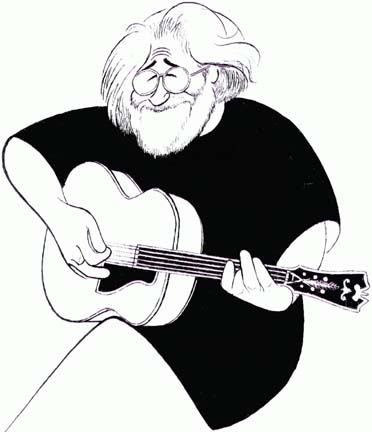
A more important issue, I think, is how Harvard takes a diverse group and makes it homogenous in some profound (and to my mind, depressing) ways.
There's also a nice reference to Harvard Rules in this month's Boston magazine, featuring my Yale college classmate, chef Ming Tsai, on the cover.... It's not online, but inside the magazine it's in a piece about Harvard admissions called "The Keys to the Kingdom." ¶ 9:11 AM 0 comments
Here's one from a person who disagrees with me about Gawker:
You are missing the point of Gawker...of course it is snarky and obnoxious, but it is also funny as hell and a breath of fresh air in our PC world. It is the same point people always miss when talking about Howard Stern. He is gross and vile, but most importantly he is funny. People wouldn't listen to him if he wasn't and they wouldn't read any of Nick Denton's blogs if they weren't either.
And here's my response:
I disagree. I'm a big fan of Howard Stern—I think he's really smart—and I don't think that he and Gawker have much in common. For one thing, Stern is never mean. He may give people a hard time, but deep down, you know he's a nice guy. The people at Gawker, on the other hand, are just bitter and nasty. Howard has a heart; Gawker has only bile.
Also, Howard makes sure to take his shots at people who are powerful or pompous or take themselves too seriously.
Yeah, Gawker does that too, sometimes. But sometimes Gawker just picks on people because it can—like the "secretary" reading her book. That's not standing up to PC-ness. That's just crummy.
Finally, whatever else you want to say about Howard, he puts himself out there. He says what he says to people's faces, and he's not afraid to make a fool of himself either. (Fartman comes to mind.)
The people at Gawker hide behind the anonymity of the Internet. They don't have a fraction of Howard's guts. Do you think they'd write what they write if they had to say it to people's faces? Not a chance.
Your thoughts?
¶ 9:07 AM 1 comments
Andy Rooney on Imus 11/4/05, MSNBC, 8:45am ET
*Thanks to the Drudge Report...for the quote and the font.
¶ 4:10 PM 2 comments
Why is it so hard for people at the Times to admit when they're wrong? ¶ 9:24 AM 0 comments
The book was James Frey's memoir of drug addiction, A Million Little Pieces.
Writes Gawker, "We didn’t quite believe what we saw; this woman was, after all, sporting a nicely teased helmet head and conservative Easy Spirit flats."
But then it's all explained for Gawker's fearless sleuth, who peers closer and sees that the book bears the seal of Oprah's Book Club.
Um...Gawker? People have been reading books they might not otherwise have read for years because of Oprah. That's kind of the point.
Even if they happen to fit your stereotype of secretaries.... ¶ 9:09 AM 4 comments
(Coming out soon in a snazzy new paperback, by the way.)
As always, West is unapologetic, energetic, and controversial. At Princeton, some students don't think much of his politics or his extracurricular activities (although he wouldn't think of them as extracurricular; to West, everything he does is about education).
But the piece also emphasizes West's close relationship with the students who take his class. Every week after class, the students and he all go out to lunch together.
I smiled when I read that, remembering that one of Larry Summers' criticisms of West was that he didn't devote enough time to teaching. Is there a single tenured Harvard professor who lunches with his or her students every week? (If ever?)
Much less interesting, by the way, is this Crimson profile of Henry Louis Gates, Jr., which sounds like it was more or less dictated by Gates.... Daniel J. Mendel argues that, as Gates steps down from the chairmanship of African and African-American Studies, "the department is sturdier than ever."
Well...no. It isn't. Gates is a master of spin, and he has done enormous things for his field. But despite his marketing genius, his department hasn't regained its former stature or momentum. ¶ 8:32 AM 0 comments
Like here, for instance, where she tears James Carville a new one.
Arianna's critique: Carville is compromised by his marriage to Mary Matalin, a close friend of Scooter Libby, and so he keeps turning the conversation away from Plamegate and towards other things; she rather brutally nails him for gassing on about the "Family Medical Leave Act."
Whatever the reason for Carville's odd bloodlessness, Arianna's got a point. It's time for Americans to get passionate about the war and the way it's been conducted. (Secret prisons, anyone?) We're coming to a moment in American politics where passion is going to be voters' measure of a candidate. Dems can't back down now. ¶ 8:22 AM 0 comments
That would be not just the war in Iraq, but the fight against terrorism.
Writes Kakutani: The authors "see more and more Muslims, many of whom had no earlier ties to radical organizations, enlisting in the struggle against the West, and they also point out the proliferation of freelance terrorists, self-starters without any formal ties to Al Qaeda or other organized groups."
And here's a point that I haven't heard made before: Simon and Benjamin "add that 'the sad irony' of the war is that Iraq now stands as an argument against democratization for many in the Middle East: 'the current chaos there confirms the fears of both the rulers and the ruled in the authoritarian states of the region that sudden political change is bound to let slip the dogs of civil war.'"
In other words, the war that was supposed to start the spread of democracy in the Middle East is actually making democracy less likely there.
Whoops!
The Bush administration has 39 months in which to salvage this fight against terrorism that it has mucked up so badly. That's probably not enough time to undo the years of damage, but it could be a start.
I'm not expecting anything, though. Because before beginning to set things right, George Bush and Dick Cheney would have to admit that they got things wrong. And that will never happen. ¶ 8:05 AM 0 comments
Or is it?
Consider this quote about how one of the characters, Gruner, responds to the monsters, who are called Sitauca:
The question was whether, once inside the lighthouse, one felt obliged to find some meaning in the madness. [Gruner] chose to mull away the nights and shun the days. He turned the adversary into savages, transforming a conflict into barbarity, the antagonist into fiend. The paradox was that this reasoning could only be upheld thanks to his inconsistencies. All was utterly consumed by his struggle for survival. The enormity of our peril was such that all discussions were postponed, as if he considered them absurd. And once he was protected behind the barricade of his logic, any further aggression simply confirmed his views. His fear of the Sitauca was the man's one true ally. The closer the Sitauca got to the lighthouse, the more vindicated Gruner felt. And the harsher the attack, the less Gruner would reflect on his own depravity.....
Sound familiar? ¶ 1:50 PM 0 comments
It's called "The Harry da Reid Code"—boy, that's clever—and it imagines Reid as a paranoid conspiracy theorist who conveniently ignores the fact that it wasn't just the Bush administration which thought Saddam Hussein had WMDs; the Clintonites did too.
The "they thought so too" argument has become a staple for Bush apologists, so let's dispense with it. (It won't take but a minute.)
Yes, the Clinton administration did think that Hussein possessed WMDs, and it did call for "regime change" in Iraq.
But in the process of beating the war drums, President Bush acquired far more information about what was really happening in that country—for which he deserves credit. Unfortunately, none of that information supported his administration's claims about Hussein's weapons program. Quite the reverse, in fact.
And as Reid and others have pointed out, the issue is not whether the Clinton people were wrong, the issue is whether the Bush folks knew that the information they were promulgating as gospel truth was either shaky or flat-out incorrect.
Moreover, when the Clinton administration called for regime change in Iraq, it did not specify how that change should occur—whether through supporting political dissidents (if there were any), a Kurdish rebellion, harsher sanctions, or invasion by U.S. forces. For a host of reasons, it is unimaginable to think of Bill Clinton starting an unprovoked war. The call for regime change was a policy statement affirming opposition to Saddam Hussein—not a call to arms.
And yet, Brooks mocks Harry Reid, portraying him sitting "alone at his kitchen table at 4 a.m., writing important notes in crayon on the outside of envelopes."
Huh.
If Harry Reid is paranoid, what would Brooks make of Dick Cheney, Scooter Libby, and the other war hawks—all of whom were completely paranoid, and completely wrong—if he were to turn a non-partisan eye upon them? ¶ 8:26 AM 0 comments
Apparently, having written a book on higher education, I am now an alumni expert on binge drinking.
Nonetheless, I was happy to oblige, as I do have strong feelings about drinking and The Game. Which is to say, I am all in favor of it.
Let's just set the scene here. Every year, Yale plays Harvard in both college's last game of the season. Whichever locale hosts the game, the weather is likely to be bitterly cold (though it's usually worse in Cambridge, and Harvard stadium has stone benches that will turn your bum into the kind of ice you used to be able to find in Antartica).
The quality of the football is not, shall we say, high.
I mean, it's high compared to a group of weekend warriors such as myself playing touch football in Central Park. But not really compared to, say, USC vs. Notre Dame.
(Which, don't get me wrong, is a good thing. Ivy League schools shouldn't worry too much about the relative quality of their athletics.)
A few days after the game, students take off for Thanksgiving break.
So The Game is primarily a social event, and for undergraduates, alcohol is a huge part of that. I went to all four Games during my time at Yale, and I can't remember a single play. (I do remember that Yale won the 100th-playing of the Game, but that's about it.)
I do remember getting blotto and having a fantastic time. I remember, for example, my friend Bliss, in a fit of inebriated laughter, toppling over her seat and landing in the lap of not entirely amused art history professor Vincent Scully.
I also remember rolling down a hill with my roommate Eric. Why, I don't know. It was a spontaneous gesture, and it seemed like a good idea at the time.
Another roommate, Peter, was in the marching band. I think he played the cymbal, an instrument which did not require him to stay sober. Yet another roommate, Tim, was a cheerleader. The primary benefit of this was a) girls (or, in Tim's case, as it turned out, guys) and b) going to Mory's after the games and getting drunk, followed by a power nap, then a second wind.
Yes, a good time was had by all.
None of us ever confused such drunken revelry with the real world; we knew that we were behaving childishly, and that we wouldn't be able to carry on such behavior later. (Apparently, though, we could become president.) Bliss is now a schoolteacher, Eric is a film producer, Tim is the head of a prominent business organization in New York, and Peter is a rabbi.
No one I know ever got hurt from drinking at The Game. And if they did, well, it happens. I'd rather have life with a lot of fun and a little risk than a life with no risk and little fun.
Anyway, I digress. Yale has now cracked down on drinking at The Game, banning drinking games, people standing on the roofs of cars, and tailgates during the second half.
This is, of course, a travesty. Which is pretty much what I told the Yale Daily News. People should have the right to stand on car roofs whenever they want. After all, they paid for the cars.
I do love the alum from the class of '41, though, who says that this isn't a problem for him, because he "wouldn't want to miss the kick-off."
To which I say, the kick-off is a bloody mary at about 10:30 game day morning.... ¶ 7:51 AM 0 comments
Some background: A number of newspapers reported last spring that Harvard was on the verge of landing the massive gift—it would be Harvard's largest ever—from Ellison, who, like Bill Gates, has become interested in public health. The money would go to establishing a medical database and journal at Harvard's Initiative for Global Health, which is more or less Summers' attempt to put the Harvard School of Public Health out of business. (That's my opinion, not Beam's.) Knowing how hot the field of international health is (cf. Bono, Gates, Sachs, etc.), Summers wanted an organization he could control, funded by big gifts such as Ellison's that would be funneled through his office.
But in the interim, Ellison was forced to settle an insider trading lawsuit by agreeing to give $100 million to charity, and now the gift appears to have been put on hold. Beam quotes one Harvard official saying, 'That put the gift in a complicated light. There was the possibility that the gift sprang not from spontaneous generosity, but as part of the litigation."
To which Beam rightly asks, So? The circumstances of Ellison's case were murky, and Harvard has surely accepted money from dirtier hands than his.
Instead, Beam reports, Harvard "is still negotiating with Ellison in the hopes of landing a donation untainted by the lawsuit. ''We want to see if we can move forward independently of the litigation,' the Harvard official explains.
I can't help but think that there's something else going on here: The publicity that would come from taking the money might include some bad press, but after all, it's $100 million to boost global health efforts—Harvard wouldn't have much trouble justifying that.
So what's the problem? Here are three guesses:
1) Ellison is a notoriously difficult man to deal with, and Harvard is having second thoughts about his role.
2) The redundancy between the Initiative for Global Health and the School of Public Health is causing internal feuding that has somehow mucked up the gift.
3) Larry Summers—who is deliberately lying low this year, trying to keep his name out of the press—has become so controversy-shy that he's erring on the side of turning down $100 million so as to avoid more headlines.
Perhaps some readers might have more informed thoughts? ¶ 7:30 AM 3 comments
What does this have to do with SUVs? The mentality used to market them and the mentality of throwing eggs at people are not so different. Both are marked by selfishness, a lack of consideration, disregard for community, contempt for the environment, and a false sense of toughness. Riding in a Hummer is like riding in a tank. What do you do in a tank? You shoot stuff at people. What do teenagers do in a Hummer? They throw stuff.... ¶ 1:52 PM 0 comments
More and more, I do....especially when reading that the CIA has been secretly holding, interrogating, and torturing alleged al Qaeda captives at secret facilities in Eastern Europe and around the world.
Dana Priest's scoop in the Washington Post is a blockbuster. (The second straight day in which the Post has kicked the Times' ass.)
Here's a crucial graf—and remember, as you read it, that in theory we still live in a democracy:
President Bush has said again and again that we are fighting the terrorists "over there" so we don't have to fight them here. And yet, his policies are turning Americans into something that is not quite a terrorist—not yet—but is something like a tyrant. Somewhere, Osama bin Laden is laughing.
Secret prisons? No Congressional oversight? "Waterboarding"? Prisoners held in steel cargo containers dying of asphyxiation? What country do we live in?
Here's another crucial graf: The black-site program was approved by a small circle of White House and Justice Department lawyers and officials, according to several former and current U.S. government and intelligence officials.
These people need to explain themselves. They have betrayed this country.
¶ 8:47 AM 0 comments
(No, it wasn't me, but thank you for asking.)
The money will be used to pay the students' annual tuition of $23, 750. All of the students' tuition.
I wouldn't be surprised if we start seeing more such gifts to universities. For two reasons. One, tuition is truly astronomical—over $40,000 at Yale and Harvard colleges. Two, these are wealthy universities. It's often remarked about Harvard that the university could easily afford to pay the tuition of its undergraduates. I think this is a bit of a disingenuous argument—Harvard could afford to pay for lots of things, but that doesn't mean it should—but it does have rhetorical power, and its ubiquitousness would suggest that it has widespread appeal.
Meanwhile, good for the donor to the music school. Any thoughts on who has $100 million to spare and really loves music? ¶ 8:14 AM 0 comments
At least, I think it was funny. If you need a smile, you can be the judge. ¶ 8:12 AM 1 comments
Cheney is sometimes so low-profile that it's almost possible to forget he exists. The ostensible rationale for this invisibility is that vice-presidents are supposed to be in the background. But the combination of a hidden vice-president and one with enormous power is unprecedented, and so that rationale doesn't really hold up.
One suspects the real reason is that Cheney likes to do things, but doesn't like having to answer for or explain them.
I mention this now because it is galling that a member of the vice-president's staff has been indicted on a matter in which Cheney is clearly involved, and all the veep can say is what a loyal public servant Scooter Libby is.
It's time for the vice-president to start talking—to the press, and to the public. Dick Cheney needs to remember that he was elected. ¶ 8:02 AM 0 comments
As you can imagine, this is frustrating.
But boy, I wish you could have read the posts. Just brilliant. Really. ¶ 7:58 AM 0 comments
As Sheidlower smartly points out, the word has come to be used as the exact opposite of its definition; in other words, people say "literally" when they mean "figuratively."
E.g., "At the end of his twenty-minute solo, the drummer literally blew up...."
Although I would pay a dollar to see that, such abuse of a perfectly good word drives me bonkers. I literally punch my face in frustration. I literally stab myself in the neck with a jagged shard of glass. I literally chop my own head off with a paper cutter.
Sheidlower's advice: Don't get too hot and bothered about it. The misuse of the term dates back at least 150 years, and in fact, anything except its most, um, literal meaning (i.e., word for word) is already straying off course.
His conclusion: "The one sensible criticism that can be made about the intensive use of literally is that it can often lead to confusing or silly-sounding results. In this case, the answer is simple: Don't write silly-soundingly. Some usage books even bother to make this point about literally. Then again, most usage advice could be reduced to one simple instruction: "Be clear." But that would be the end of a publishing category."
Lovely phrase, that "silly-soundingly," cleverly used. Something tells me the OED is in good hands. ¶ 7:48 AM 0 comments
So imagine my surprise when I picked up the paper this morning and read that Red Sox GM Theo Epstein is leaving the Red Sox after just three years—three years in which they won their first World Series in the better part of a century.
Wow.
Epstein did a fantastic job, and he's only something like 31. Pretty remarkable.
So far, you'd have to say, the Yankees are winning the off-season. And, Sox fans, such is the price of winning—ownership whose active role can make rooting for the team an occasional challenge. We Yankee fans have learned to deal with it, and appreciate the good things that George Steinbrenner does. You will, too, in time. But let's hear no more of that Evil Empire stuff, okay? ¶ 6:47 AM 0 comments
