Which makes one think that, along with coyotes in the New York subways as a means of rodent control, alligators might be one solution for urban sprawl.....
[After the bogus publication process] Viswanathan might almost be forgiven for having forgotten that originality was even the goal she was striving for. Not that she would think twice, either, when Little, Brown's publisher touted the "freshness of the voice" in a special publicity letter about her book. ....It's tempting to wonder whether Viswanathan, if she could find her own voice, might foist some of the blame for her borrowings onto her endlessly enabling elders. But that is, of course, the last thing a much-mentored superkid, intent on success, has been reared to do.
Also in Slate, Joshua Foer shows that KV can not have a photographic memory because, to put it bluntly, there is no such thing.
"If Viswanathan really wants to stick to her story," Foer writes, "I know a few scientists who'd probably like to meet her."
This is a boneheaded idea in so many ways.
First, as policy it makes no sense. The federal government can't just give money to people every time a commodity goes up in price. (So much for the free market!) The knowledge that the government will subsidize prices actually encourages producers to raise them. (Same thing with the asinine policy of giving tax breaks to people who buy hybrid cars.)
Second, it does nothing to address the causes of the problem.
Third, it's fiscally irresponsible.
Fourth—and this may be most depressing—it sends a terrible message to the country. There is no talk from Republicans of why citizens should use less energy, cut back on gas-guzzling SUVs, take public transportation when possible, and realize that every citizen is a participant in energy policy. There is nothing having to do with shared sacrifice. No one is saying, "Use less gas"—just, "Here, here's some spending money." The Republicans want to make us like dogs sniffing around the dinner table, hoping that some scraps will get tossed in our direction. This is not the way to make our country stronger.
And, of course, all this essentially constitutes a bribe in the months before the midterm elections.
I wonder if it will work?
Sports Illustrated gets the police report: According to the Creedmoor police report in August 1996, when the woman was 18, she told officers she was raped and beaten by three men "for a continual time" in 1993, when she was 14. She told police she was attacked at an "unspecified location" on a street in Creedmoor, a town 15 miles northeast of Durham.
The magazine also reports that the woman was hospitalized for about a week a year ago and treated for a "nervous breakdown."
The family is also trying to get the young woman to meet with civil-rights attorney Willie Gary, recommended by Jesse Jackson, but she will not. (Check out Gary's website—"Growing up in a poor migrant family, Gary beat the odds to become a multi-millionaire nationally renown [sic] attorney.... Gary keeps rising out of the shack he and his ten sisters and brothers shared." Sheesh. This next to the picture of him and his two Rolls-Royces.)
(By the way, let me give a shout-out to the Harvard Crimson here—the Duke Chronicle, which doesn't even have this story yet, makes me appreciate the job you guys do.)
Sports Illustrated also points out that the woman pleaded guilty to several misdemeanors in 2002.
What does all this mean? Got me. (Lawyers, would a judge allow this material to be entered into evidence?)
If I were a prosecutor, though, I wouldn't be feeling too confident about putting this woman on the stand.
Don't bet the ranch on that.
Maybe it's from reading these reviews on Amazon—where, as of this writing, Opal Mehta is ranked #29, which would likely make it a bestseller—or maybe it's because I still feel that the truth hasn't come out, but I have started to feel sorry for Kaavya Viswanathan. She must be going through hell.
It's not that I let her off the hook. A photographic memory? Please. She had a photographic memory of 45 passages? It's laughable. I don't think she even read Megan McCafferty; that was the work of the good folks at Alloy Entertainment. (Remember, this is the young woman who claimed that her preferred reading was Henry James and P.G. Wodehouse.)
And as readers of this blog know, I have somewhat strong feelings about plagiarism.
But I do feel that KV got caught up in something many young people (and adults, for that matter) would have been seduced by: the publishing machine. Her fancy-pants college advisor sends her to a literary agency, which snaps her up. A wan sample of her work is circulated to publishers, who on the strength of—what? certainly not her writing, it's entirely pedestrian—snap her up. (I'd be very curious to know if a photograph was included with the sample pages circulated to publishers.) When KV, at the beginning of her freshman year at Harvard, finds that writing is hard, she's told not to worry about it, the "packagers" at Alloy Entertainment can help. And they do. Somehow, a manuscript is produced.
At every step of the way, an adult is telling her that this is business as usual, standard operating procedure. And when that happens, it's easy to lose your moral compass. (If, to be sure, she ever had one.)
Yes, KV made mistakes. (And from Harvard's point of view, this kind of episode really ought to prompt some campus soul-searching about why people go to Harvard, what they do to get in, and whether the university has lost its soul. To that effect, check out these thoughts from Crimson editors on the deep inner meaning of the scandal, particularly Lauren Schuker's short essay.)
Yes, KV was a complicit pawn, but she was still a pawn. The ultimate responsibility here lies with the adults...who, of course, will not bear the brunt of the bad publicity.
Someday, I'd like to hear KV tell what really happened along the route to publication of this book. Wouldn't it be nice if Michael Pietsch—who, the Crimson points out, is also a Harvard grad—stepped up to the plate and said, "It's a common practice with young adult literature to enlist the help of ghostwriters, and in this case, one of those ghostwriters committed plagiarism. We apologize for violating the trust between a publisher and our readers."
Never happen, but it would be nice.
Meantime, KV, as someone who has himself lived through literary scandal—we both got harassed by Katie Couric—I can tell you, this will pass. The best way to survive it is to prove everyone wrong, and write a good book next time. Along the way, you have to discover the real joys of writing, the satisfaction that comes from doing it the hard way—i.e., sans ghostwriters— and the growth that comes with knowing that you did it something extremely difficult by yourself.
I wish you luck.
Taking to the airwaves, the man told Rita Cosby of MSNBC that he hadn't learned of the allegation until recently—"she told me afterwards because she didn't want me to know that part."
The Observer writes, In papers filed with the court, police who searched the Buchanan Boulevard house where the party occurred made no mention of seizing a broomstick. And a broomstick was not among the items that police said they wanted to seize when they applied for the search warrant.
Couple of thoughts.
This could be one explanation for the lack of DNA.
This could also be an excuse for the lack of DNA.
The father also said that his daughter is under immense pressure, which is surely true, and that she has considered dropping the case.
My cautious prediction? If the price is right, she will drop the case. I'm guessing that she pushes for an out-of-court cash settlement, and the players involved will agree to it because either a) they're guilty or b) a trial would be hellish, and you never know what could happen.
Here's the Times:
....the same editor, Claudia Gabel, is thanked on the acknowledgments pages of both Ms. McCafferty's books and Ms. Viswanathan's "How Opal Mehta Got Kissed, Got Wild, and Got a Life." Ms. Gabel had been an editorial assistant at Crown Publishing Group, then moved to Alloy, where she helped develop the idea for Ms. Viswanathan's book. She has recently become an editor at Knopf Delacorte Dell Young Readers Group, a sister imprint to Crown.
Ms. Gabel did not return calls for comment. But Stuart Applebaum, a spokesman for Random House, the publishing company that owns Crown, said Ms. Gabel, who worked at Alloy from the spring of 2003 until last November, had left the company "before the editorial work was completed" on Ms. Viswanathan's book.
"Claudia told us she did not touch a single line of Kaavya's writing at any point in any drafts," said Mr. Applebaum, who added that Ms. Gabel was one of several people who worked on the project in its conceptual stage.
Could Claudia Gabel be the woman who plagiarized material from one author to use in Viswanathan's "book"?That is an interesting quote from Stuart Applebaum—"did not touch a single line of Kaavya's writing." Careful readers will note that it does not say whether Ms. Gabel added any material to Viswanathan's writing, which may have constituted ten pages, for all we know. Visnawathan herself says that her first contribution to the book was an autobiographical e-mail sent to the good people at Alloy, and they took it from there.
Here's a hilarious mistake from the Times, by the way:
Ms. Viswanathan was, in some ways, an unusual Alloy author. She was not recruited by the packager, but rather, was introduced to it by William Morris, the agent.
Um...William Morris is not an agent; William Morris is a literary agency (which, by the way, happens to represent me) founded in 1898 by one—surprise—William Morris. It is rather astonishing that the reporters who cover publishing for the New York Times could make that boo-boo. (Well, on second thought, maybe it isn't.)
One final thing: Readers of the Times piece may also note that everyone at Little, Brown is very careful to say that Alloy Entertainment couldn't have been responsible for the act of plagiarism and that it was, boo-hoo, Kaavya Viswanathan.
Little, Brown, for one, was not blaming Alloy. "Our understanding is that Kaavya wrote the book herself, so any problems are entirely the result of her writing and not the result of the packager's involvement in the book," said Michael Pietsch, the publisher.
Read between the lines: The Little, Brown people are distancing themselves from Viswanathan...cutting her loose, because they care more about preserving their relationship with a book packager.
Note that quote too: "Our understanding is that Kaavya wrote the book herself...."
This is not the same as saying, "Kaavya wrote the book herself...."
In other words, Michael Pietsch is giving himself some wiggle room, because, frankly, Kaavya probably didn't write the book. But now that Viswanathan has publicly claimed that she did, Pietsch, who probably knows the truth, can say that "our understanding is that Kaavya wrote the book," thus letting Alloy off the hook.
Later, if it comes out that Alloy wrote the book, Pietsch can come out with a statement like, "We were, sadly, led to believe by Kaavya Viswanathan that she had written the book by herself..."
The legal interests of Little, Brown and those of Kaavya Viswanathan—because that's what this language is really about—are starting to separate. Viswanathan herself is quoted all over the place, in this article and elsewhere, and her quotes are not helping her case. If her publisher were still in her corner, you have to think they'd tell her to shut up already. My bet is, she's out there on her own, exiled by the lawyers at Little, Brown.
This is getting ugly.
According to the Duke Chronicle, "The complaining witness has a history of criminal activity and behavior, which includes alcohol abuse, drug abuse and dishonesty, all conduct which indicate mental, emotional and/or physical problems, which affect her credibility as a witness," defense attorney Kirk Osborn wrote in the motion.
Interesting. If true, that would both be intriguing (though not necessarily relevant) and, one presumes, an attempt to subvert the prosecution before this case comes to trial.
Meanwhile, D.A. Mike Nifong may reinstate misdemeanor charges against five of the lacrosse players for underage drinking and noise violations stemming from the infamous party.
He is tireless in his pursuit of justice, that man. Or, at least, someone he can convict of something....
Jack Shafer has a nice piece in Slate today on why plagiarists plagiarize. (I'm tempted to say "because they can.")
Among the reasons Shafer lists: writing is hard work, ambition exceeds talent, and contempt for the business.
I'd guess that Kaavya Viswanathan matches those three descriptions, and I'd throw in one more: In over her head. A young woman who dreams of being an investment banker—what kind of 16-year-old dreams of becoming an investment banker?—is told that she writes really well and she should write a novel. "I had only vaguely thought of becoming a writer," Viswanathan once admitted. But a book publisher throws money at her and says, We'll hook you up with some people who can help you with this....
The young writer gets the idea—probably not without reason—that everybody in the business employs ghostwriters. And so she isn't morally troubled by the fact that she's out promoting a book largely written (I'm guessing) by unknown scribes who "produce" content for the Generation Y market. And there you have it—the perfect ingredients for a literary scandal.
Viswanathan should have known better. But the ultimate responsibility here lies with Little, Brown, which was committing just as great a fraud as James Frey and Nan Talese at Random House....
What's the difference? Well, Frey and Talese were deceiving people who suffered from addiction. Viswanathan and her editor, Michael Pietsch, were pulling the wool over the eyes of teenagers.
Which is worse? Does it matter?
Good for the Harvard Independent for doing it. (Where's the Times on this seedy aspect of book publishing?*)
The Independent interviews Lizzie Skurnick, a former 17th Street editor and ghostwriter.
"The impulse at a place like the 17th Street is to have a house voice," Skurnick tells the Indy. "There are just reams and reams of stuff that’s written… It’s unavoidable that certain phrases will be recycled or said in a certain way… Often what you’ll find is that, it’s not that anyone is copying, it’s just that [these phrases] are the first things a mediocre writer would reach for.”
I wonder if the teen readers for whom these books are generated care whether or not the people who are claimed to have written them actually wrote them.
I know that when I was a kid, I would have been pretty broken up to learn that John D. Fitzgerald or Roald Dahl or Tolkien or E.B. White didn't really write the books that carried their names....
________________________________________________________________
P.S. A reader who has gotten to the paper earlier than I points out that the Times weighs in—oops—with a piece on exactly this subject on today's front page. (Did I say oops?)
Here it is.....
——Helen A.S. Popkin, MSNBC.com, today
"White-Trash Nation"
—by Tad Friend, New York magazine, August 22, 2024
Who could forget the cover photo of Anna Nicole Smith consuming a bag of Cheetos—which prompted a lawsuit from Smith, who apparently had not been told that she would be characterized as "white trash".....
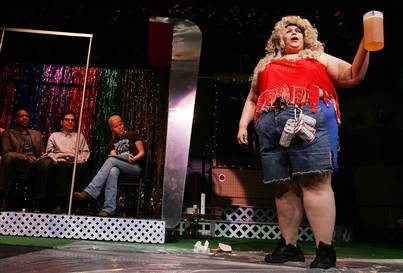
"White trash"...
Apparently not white trash....
Beam writes: Here is my cautious prediction: If and when the lawyers get through devouring one another, it will emerge that a staffer at Alloy, ''the creative think tank," introduced the plagiarism.
Yup. Beam and I cautiously agree. (I suggested the same thing yesterday.) I do wonder if Viswanathan has actually read the author, Megan McCafferty, from whom she claims to have plagiarized.
In other plagiarism news, Steve Ross, publisher of McCafferty's house, Crown Books, completely rejected Viswanathan's pseudo-apology.
According to the Globe, the Crimson, and the Times, Ross said: ''We find both the responses of Little, Brown and their author . . . deeply troubling and disingenuous. ...Based on the scope and character of the similarities, it is inconceivable that this was a display of youthful innocence or an unconscious or unintentional act."
Acording to the Times, Ross claims that there are "more than 40 passages in Ms. Viswanathan's book 'that contain identical language and/or common scene or dialogue structure from Megan McCafferty's first two books.'"
40 passages? Viswanathan really is a good internalizer.....
But against this gritty background, Springsteen was miraculous, heartwarming, authentic, inspiring—and generous. He's promoting a new record, called "We Shall Overcome—The Seeger Sessions," an album of American music popularized by the folk singer Pete Seeger. The concept is modest, an homage to an American legend and a musical tradition. But the show's spectacle was not; Springsteen was joined by no fewer than 19 other musicians on stage: a banjo player, an accordian player, four other guitarists (including his wife, Patti Scialfa, and a pedal steel player, such a gorgeous instrument), three backup singers, five horn players, a pianist, a drummer, a bass player and two violinists. All of them were fabulous musicians.
As the two-hour plus concert evolved, a couple of themes emerged: Springsteen's sense of family and community and his appreciation of history. When introducing one guitar player, a young man named (I think) Frank Bruno, Springsteen mentioned that Bruno's father, Springsteen's cousin, had taught him his first chords on the guitar, at age 13. "And then I went home and played, I don't know, Greensleeves—and right after that, Twist and Shout." That's an autobiography of an American great in a single sentence; I wish I could tell a story so well.
When beginning the song, "Buffalo Gals, Won't You Come Out Tonight,"—and we danced by the light of the moon—Springsteen mentioned that his grandmother used to sing it to him when he was going to sleep at night, and did a sweet, off-the-cuff imitation of her singing to him.
When he asked a stagehand for his "magic guitar," Springsteen joked, "When I play this one, look out," then explained that he'd had the battered old acoustic guitar "since Catholic school."
And when he asked his wife Patti and two of the female backup singers to solo—a request the singers clearly weren't expecting, as they quickly conferred on stage—he explained, "These three used to sing together on the streets of New York City 25 years ago."
All this against the backdrop of the tough town where Springsteen began his career back in the 1970s. (And at the end of the show, Springsteen read a list of local charities that the concert was benefitting.)
Family. Community. Humility. Respect. Few American artists could convey such values in the midst of a rock concert. Yet Springsteen did it not just with his words, or with the people he chose to play with, but with the music he chose to play. Only three of the songs, I think, were his own compositions. The rest were either Pete Seeger originals ("Turn, Turn, Turn") or folk songs played by Seeger, and time and again Springsteen introduced the songs by mentioning their original writer and their origin—"this one's from about a century and a half ago," or, "this is an old Irish anti-war song," or, "this is from one of the original minstrels."
In the process, he conveyed a profound sense of history and of tradition, sometimes quite literally, as when he sang "When the Saints Come Marching In," with its wonderful beginning, "We are traveling in the footsteps of those who've gone before."
Maybe it was at this point in the show when I suddenly realized why the Harvard plagiarist, Kaavya Viswanathan, disturbs me so much. There is in her act of literary theft none of those qualities that Springsteen brought to life last night and embodies in his career—none of that humility, respect, and reverence toward those who've gone before. None of that sense of tradition, of being a part of something larger, a product of the toil and the heartbreak and the joy of past generations. None of that sense of family, community, and love.
Plagiarism is the antithesis of all those things. It is a rejection of community, an insistence upon the primacy of the individual. It is disrespectful and immodest and selfish. It is greedy; it invokes contempt for those who work hard and don't cheat. It says that the labor of others does not matter except insofar as I can use it to further my own ambitions—in this case, raking in a half-million-dollar book deal and becoming an investment banker. Is that why people go to Harvard these days? I hope not. But this is what plagiarism says; this is what it is.
And it may say something about what afflicts Harvard, and indeed our country, that there seems to be so much of it going around. I'm glad there are people like Springsteen left to remind us that we don't have to succumb to cynical opportunism, that we can strive to be better.
Fish writes in his blog, "When you’re the proud parent of a graduating son or daughter, the last thing you want to hear is something that will make you think. You want to hear something that will make you feel good."
I don't agree with the argument, but I do agree that Salman Rushdie doesn't make you feel good. Perhaps Fish would prefer his wife, Padma Lakshmi?
Padma Lakshmi:
Could make Stanley
Fish feel good.
According to the Boston Globe, Viswanathan turned to Alloy when her original idea for a novel was considered "too dark."
While Viswanathan said the plot was her idea, she acknowledged in a February interview with the Globe that Alloy had played a major role in fleshing out the concept.
Alloy co-holds the copyright to "Opal Mehta...", which strikes some people the Globe interviewed as hard to explain if the company's role was only "fleshing out the concept."
''We would never recommend to an author that they share copyright for something as minor as refining a concept," said Boston-area literary agent Doe Coover.
I am curious: What is Alloy Entertainment? Its website, linked to above, describes the company as "a creative think tank that develops and produces original books, television series and feature films."
And how's this for a line to send Orwellian shivers down your spine: "Alloy Entertainment produces more than 40 new books a year."
What's really interesting is that Alloy Entertainment turns out to be essentially a subsidiary of a marketing company. This isn't really even some bogus ghostwriting firm; it's "one of the largest and most successful marketers and merchandisers to the youth market." The company's CEO, Matthew C. Diamond, "founded Alloy in January 1997 to tap into the enormous spending power of the Generation Y market."
What becomes clear is that that Kaavya Viswanathan's book really isn't a book at all; it's a piece of marketing aimed at the Generation Y market, a product, and Viswanathan—how much of this did she really write, even excluding the plagiarism?—may be little more than an empty vessel. Young, attractive, a Harvard student, and a member of a successful ethnic group, Indian-Americans (imagine the foreign rights!), she's a marketer's dream...so who cares whether she can write? It's not just her book that's product—it's Viswanathan herself.
After all, why else would you sign an 18-year-old to a two-book, $500,000 deal—when she hasn't even written a book yet?
The answer is, you don't—unless it's not her literary talents that you're buying.
In fact, one of the more intriguing possibilities of this story is that Viswanathan might not even have committed the plagiarism....but that it was the ghostwriters at Alloy Entertainment.
Whew. This is a tawdry business.
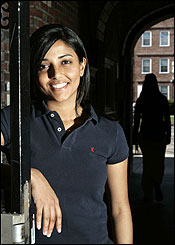
(Chitose Suzuki/ Associated Press)
Kaavya Viswanathan:
Did she plagiarize—
or was it her ghostwriters?
—The Boston Globe, April 25th
"No. I haven't [started writing the sequel] and I probably should. But I'm actually terrified about the writing process this time around. What if I find out I have nothing to say? What if I can't write? I just wish I could just move forward to the time when the sequel would be written and I could go around promoting it. I enjoy that part." (smiles)
—Kaavya Viswanathan, The Hindu, April 23rd
Top White House posts go to Jews
The article goes on to say that "White House policy is now in the hands of two Jews...."
Sounds like something David Duke might endorse, right?
It's actually from the Jerusalem Post.....
Oh, heck, what am I saying? Of course she isn't!
Here's this from the Times:
Calling herself a "huge fan" of Ms. McCafferty's work, Ms. Viswanathan added, "I wasn't aware of how much I may have internalized Ms. McCafferty's words." She also apologized to Ms. McCafferty and said that future printings of the novel would be revised to "eliminate any inappropriate similarities."
What a load of nonsense.
If you read the link above, you'll see that Viswanathan "internalized" some remarkably specific language. The Times says that there are "at least 29 passages that are strikingly similar." Ms. Viswanathan would appear to have an excellent memory.
Let's be serious. This not a case of "inappropriate similarities"—it's just plain-old ripping off someone else's hard work. And because Visnawathan is young and pretty and goes to Harvard, she made a hell of a lot more money off these words than their original author.
You know, 19-year-olds make mistakes—especially hyper-ambitious ones—and I wouldn't want to fault a person that age for the rest of her life. But still: Sometimes you just want to hear somebody admit, "Yeah, I plagiarized." (Or, in James Frey's case, "Yeah, I made the whole thing up.")
Internalized. Inappropriate similarities.
Argh. Apparently even 19-year-olds know how to spin these days.
FAS press person Robert Mitchell has this to say about whether Viswanathan will face any discipline: "Our policies apply to work submitted to courses. Nevertheless, we expect Harvard students to conduct themselves with integrity and honesty at all times."
Hmmm. Given that Allan Dershowitz has been accused of plagiarism, and Larry Tribe has admitted to it, and Andrei Shleifer is returning to Harvard to teach next fall, it would seem a little odd for the university to punish Viswanathan. After all, she's only doing the same thing that some Harvard professors do—and get away with.
Then again, those men are friends of Larry Summers, and Viswanathan, so far as I know, is not.
____________________________________________________
P.S. Some of the headlines I've seen about this story say that Viswanathan "admits borrowing passages."
What, was she going to give them back?
_____________________________________________________
P.P.S. A friend who works in intellectual property law suggests that there might be very specific legal reasons for Viswanathan's diction—that it is very hard to prove theft of intellectual copyright if you can claim that a work is the product of an internal process, a self-creation. In other words: I read and read something, then I "internalized" it and came up with something of my own.
Which would suggest that perhaps it's Viswanathan's publisher—more specifically, her publisher's lawyer—who's telling her what to say.
Does this let her off the hook? I don't think so.....
Dear Alumni and Friends,
I wanted you to be among the first to know that Professor Jay Light has been appointed as the next Dean of Harvard Business School. Please see today's press release that follows.
Sincerely,
Donella M. Rapier
Vice President, Alumni Affairs and Development
Harvard University
********************************************************************************************
Jay O. Light Named Ninth Dean of Harvard Business School
Jay O. Light, an expert in finance and investment management and the Dwight P. Robinson, Jr., Professor of Business Administration at Harvard Business School (HBS), will be the School's next Dean, President Lawrence H. Summers announced today.
"I am very pleased that Jay Light has agreed to become Dean," said Summers. "He has done an outstanding job as Acting Dean, and no one is more familiar with the range of opportunities and challenges facing Harvard Business School or better prepared to guide the School in meeting them. As his colleagues and friends well know, he has made extraordinary contributions to HBS over the years, and the School will be well served by his leadership qualities, his deep knowledge of the School's distinctive character, and his devotion to keeping its programs fresh, forward-looking, and strong as HBS heads toward its second century. Jay is also an excellent citizen of the University more broadly, and his collaborative outlook and engagement with issues of University-wide significance will help strengthen Harvard as a whole."
A member of the HBS faculty since 1970, Light will assume his new duties immediately. He has been the School's Acting Dean since August 1, 2005, and previously served in a range of senior leadership roles at HBS. He was chair of the School's Finance unit from 1986 to 1988 and played an active role in the recent restructuring of the required first-year MBA course in finance. From 1988 to 1992, he was Senior Associate Dean, Director of Faculty Planning, and from 1998 to 2005 he was Senior Associate Dean, Director of Planning and Development, responsible for the School's strategic planning and new initiatives.
"I am honored to take the helm of a School that has been my life's work for more than three decades," Light said. "I follow in the footsteps of some great leaders in management education, including Kim Clark, who stepped down from this office last July, and John McArthur, who ended his tenure as Dean in 1995. I am grateful for the lessons in leadership I learned from them."
"Harvard Business School is a unique place with extraordinary faculty, students, staff, and facilities, as well as an alumni body of 65,000 women and men who aspire to make a difference in the world," Light added. "I look forward to working with my colleagues in the years ahead to keep Harvard Business School the world leader in general management education."
Former Dean Kim Clark said, "I am delighted that President Summers has named Jay Light to be my successor. He has earned the respect of the entire HBS community. With years of wide-ranging experience in academia and the world of business, gifted in planning and implementation, he is especially well prepared to lead the School in an age of innovation, globalization, and technology." Clark concluded his service as Dean of HBS last summer to assume the presidency of Brigham Young University-Idaho.
As Acting Dean, Light has overseen the completion of Harvard Business School's successful $600 million campaign, the launch of new faculty initiatives in health care and science-based business, and the final stages of the renovation and restoration of Baker Library, which houses the world's preeminent collection of business books and archival materials. He also has led innovations in the School's core educational programs, including a team-based learning initiative in the MBA program and the launch of a new, modular leadership development program in executive education. He has played an active role in the University's planning for new facilities and activities in Allston as well.
Light earned a bachelor's degree in engineering physics with highest honors from Cornell University in 1963 and a DBA from Harvard University's joint program in decision and control theory in 1970. Before joining the HBS faculty, he worked in satellite guidance and systems planning at the Jet Propulsion Laboratory in Pasadena, California. He was later affiliated with a management consulting firm specializing in corporate strategy and planning. From 1977 to 1979, he took a leave of absence from HBS to serve as director of investment and financial policies for the Ford Foundation in New York, where, as Director of Investment and Financial Policies, he was responsible for formulating and implementing the policies used in managing the Foundation's multibillion-dollar investment portfolio. He returned to HBS in 1979 as a full professor with tenure.
Light is a director of the Harvard Management Company, which oversees the investment of the University's endowment. He also serves on several other boards, including those of Partners HealthCare and the Groton School. He is a member of the investment committee of several endowments and an adviser to several corporate and institutional pools of capital.
Light's extensive professional, research, and teaching interests have focused on the capital markets and institutional asset management, including the management of pension funds and endowments, as well as on the entrepreneurial management of technology companies. He is the author of The Financial System, numerous articles for professional journals, and many cases, notes, and working papers on asset management, risk management, negotiation, and corporate finance. In his decades at the School, he has taught many thousands of students in the MBA, doctoral, and executive education programs; his most recent teaching assignment was in the first-year required course on finance.
In announcing Light's appointment, Summers expressed appreciation to members of the HBS community for their advice on the selection of the new Dean. "I want to thank the many members of the community who offered their counsel during the course of the search, on both the choice of a new Dean and the opportunities and challenges that lie ahead for HBS," Summers said. "Your advice has contributed a great deal to an outcome that will carry forward the School's proud tradition of strong leadership and educational excellence."
Light lives in Belmont, Massachusetts, with his wife, Judy. They are the parents of two grown children.
Georgios N. Theophanous ’06, an economics concentrator who had Shleifer as a thesis adviser, called the professor a “very accurate” speaker and “remarkably energetic” thinker. He also rejected the relevance of Shleifer’s legal troubles to his standing as a Faculty member.
“He is an excellent professor and does remarkable research and those to me are the two main criteria that you should be using in deciding whether or not he’s going to be a valued professor,” Theophanous said. “The other stuff, that is for other people to worry about.”
Mmm-hmmm. And they say Hitler was a pretty dynamic speaker. Anything else, that's for other people to worry about.
A more serious point of comparison: As David Warsh has pointed out, Yale fired Shleifer's protege, Florencio López-de-Silanes, for double-billing about $150,000 worth of expenses. Yale spokesman Tom Conroy put it bluntly: "He has resigned from Yale as a result of financial misconduct and irregularities in his role as director of the International Institute for Corporate Governance. ....Appropriate corrective actions have been taken."
As Fred Abernathy and others have pointed out, Harvard has never said a peep about the $30 million that Shleifer cost the university....
In other news, the business school has awarded tenure to Ken Lay, Jack Abramoff is the new dean of the Kennedy School, and the law school has given Zacaria Moussaoui a three-year scholarship, providing he is not executed before September.

What is it with you people?
My thoughts....
Plagiarism is never the original sin, it's the symptom of some deeper dysfunction.
The Newsweek writers were probably so bored with the banal pseudo-sociological nonsense that they were writing about Duke lacrosse—I mean, just look at what they stole—that they couldn't trouble themselves to muster any original thoughts.
The Harvard student absorbed what may be Harvard's ascendant philosophy, if I may paraphrase—achievement without a soul. (She wants to go into investment banking. Shocker.)
The Raytheon chief surely had his "laws" of leadership written by a ghostwriter, who likely thought that the whole enterprise was so corrupt in the first place—he's writing "principles" to be spouted by a war profiteer— what's a little plagiarism in the mix?
One related example: Donald Trump allegedly wrote the foreword for a beauty book featuring the Miss USA contestants (Trump sponsors the pageant). When he threw a book party, he buried the author's name on the invitation, and when her father introduced himself to Trump as the father of the author, the sleazebag developer looked at him blankly, then said, "Oh, right. The author. Congrats."
Oh, right. The author.
"Our education system is idiotic," says Sternberg. ''We're actually going backwards. There's more emphasis on mindless thinking. What matters is how you use information. A manager won't last long on IQ alone." (Hello, Larry Summers.)
Ouch. While I think that the point is a fair one—heck, I pretty much said the same thing in this month's issue of Boston Magazine —that seems an underhanded way to make it—a little shiv between the ribs, as it were.
...at which point, things really get interesting.
This is amazing to watch. (Click on the hyperlink, then look at the "Best of TV" section in the bottom right-hand corner.)
Free Willy aside, orcas are pretty fierce animals.
Kim Roberts goes public.
In Durham, the second stripper—whose name is now disclosed as Kim Roberts—gives an interview to the Associated Press. It doesn't clarify things much.
"I was not in the bathroom when it happened, so I can't say a rape occurred -- and I never will," Roberts tells the AP.
But after watching defense attorneys release photos of the accuser, and upset by the leaking of both dancers' criminal pasts, she said she has to "wonder about their character."
"In all honesty, I think they're guilty," she said. "And I can't say which ones are guilty ... but somebody did something besides underage drinking. That's my honest-to-God impression."
This is unconvincing.Nor does it inspire confidence to note that Roberts is facing criminal charges of embezzlement—just as it does not inspire confidence in Collin Finnerty to note that he tried to beat up a gay guy for being gay—and that she e-mailed a New York public relations firm asking for advice on "how to spin this ]Duke situation] to my advantage."
"I've found myself in the center of one of the biggest stories in the country," she wrote. "I'm worried about letting this opportunity pass me by without making the best of it and was wondering if you had any advice as to how to spin this to my advantage."
Ka-ching!
Roberts does indeed seem to have spun this to her advantage: She was arrested eight days after the infamous party on charges that she embezzled $25,000 from a photofinishing company where she was working. On the day that indictments came down against the lacrosse players, a judge ruled that Roberts would no longer have to pay a 15% fee to a bonding agent. D.A. Mike Nifong signed a document saying he would not oppose the change.
"Why shouldn't I profit from it?" she asked. "I didn't ask to be in this position ... I would like to feed my daughter."
Which, of course, means that she has a financial incentive to support the allegations of rape. If nothing happened, her story isn't worth anything.Roberts said she knows what it's like to sit in jail, and that she would never wrongly accuse an innocent person.
"If the boys are innocent, sorry fellas," she said. "Sorry you had to go through this."
I'm sure she'll make a great defense—I mean prosecution—witness.Roberts also admits that she was the one who called 911 claiming that she had been called racial slurs by white men outside the party. And though the article is unclear on this point, it sounds like she admits that she made up those accusations. "Roberts acknowledged that she made the call because she was angry," according to the AP story. Angry because of the lax players' obscene suggestions regarding a broomstick, or because racial slurs really were directed at her? Hard to say.
Roberts does say this...
"Don't forget that they called me a damn nigger. She (the accuser) was passed out in the car. She doesn't know what she was called. I was called that. I can never forget that."
I'm not going to call Roberts a liar, but this story strikes me as awfully convenient.
_________________________________________________________________
Correction: As a poster points out, Roberts was convicted of embezzlement in 2001, and the new charge was related to a probation violation stemming from that conviction.
Stone was, of course, the senior fellow of the Corporation that chose Larry Summers. I have no idea how he felt about the current turmoil, but it's a safe bet that Stone, who loved Harvard, hated to see the distress at his alma mater. It surely wasn't what he wanted.
His death now has an extra sadness, the knowledge that he did not live long enough to see Harvard right itself. One wishes that Mr. Stone, a loyal and devoted servant of Harvard, could have lived just a little bit longer, to see a brighter day in Cambridge.
The coyotes eat primarily mice, rats, and young deer—something suburban dwellers ought to be pretty happy about. They have, apparently, attacked a few children, but in every instance it's been determined that human beings were feeding the coyotes, causing them to lose their natural fear of humans. In any event, dog bites vastly outnumber coyote bites. In many cases, coyotes are attracted to the suburbs by dumpsters overflowing with trash, which doesn't say much good about us humans.
The coyotes will, on occasion, eat lap-dogs and cats. Like a ban on car alarms, this could be considered a good thing. Regardless, it is an acceptable tradeoff for the wonder of having a wild animal in your midst. (No one ever said that we have a god-given right to let our lap-dog wander freely.)
The Washington Post reports that the thing to do if you see a coyote is to shout at it and wave your arms, which appears to do the trick—as with the vast majority of animals, they have far more to fear from us than we do from them.....
Meanwhile, I'm intrigued by this whole rat-eating thing. Perhaps we could introduce some coyotes into the New York subway system?
For no apparent reason, the government has been killing thousands of coyotes, on public and private lands, for decades. Because the federal government has nothing better to do....

Coyotes: Best admired from a distance.
It is a “huge stigma to say that we respect you but we still think you’re crazy and won’t pay for your surgery,” Lewis said, according to the Crimson.
Definitely. A huge stigma. Because it is, after all, the role of the modern university in American society to pay for people's sex change operations, and any suggestion to the contrary—well, that would be a huge stigma.
I tease, but it's probably only a matter of time till Harvard's health car covers exactly that.
To that end...
At Duke, university officials have finalized the details regarding grill use and alcohol policies for the Last Day of Classes celebration on April 26th.
(Just kidding!)
While Durham County D.A. Mike Nifong swears he's going to arrest a third suspect sooner or later, Reade Seligmann's lawyer says he has conclusive evidence that his client wasn't even at the party at the time the alleged rape allegedly occurred..... Maybe Nifong should just arrest the whole team, one by one, until he finds someone who doesn't have a good alibi.
Meanwhile, according to the Times, in Charlottesville, Va., Chip Royer, a lawyer for Jeffrey O. Bloxsom, who says he was assaulted by Mr. Finnerty last year, said Mr. Bloxsom was being hounded by the news media because of the Duke case and was now considering a civil suit against Mr. Finnerty.
A conversation with a media lawyer friend convinced me that I'm probably wrong and that it's not ultimately a good idea to print the names of alleged rape victims. But I remain uncomfortable with the fact that the accused are getting reams of bad publicity, as is Mr. Bloxsom (a terrific name, by the way), and the accuser, whose story seems profoundly murky, remains anonymous.
(One does have to wonder about Mr. Bloxsom's sudden consideration of a civil suit, however.)
I've noticed that the media has also declined to identify the woman referred to as "the second exotic dancer," despite the fact that she's given quite a few interviews. Of course, she's probably giving the interviews on the condition of anonymity. But surely some reporters down there must know her name. On what basis are they withholding her identity?
But as I say, it's probably right that if the media printed the names of alleged rape victims, many victims would not come forward to press charges against their assailants.
In an ideal world, perhaps the media wouldn't name the names of the accused until the end of a trial....
Sample Stern prose: It’s hard work, the pay sucks, the server shit the bed and there obviously aren’t enough drink tickets to go around.
Never mind "the server shit the bed"—compensation seems to be a recurring issue with Stern....
Also on the NY Post Sleazewatch, the Times has a good piece about how advertising in the Page Six Magazine is sure to buy you good mentions on Page Six...or is it that good mentions on Page Six encourage people to advertise in the Page Six Magazine?
Can we try not to kill this one, please?

Coyote: Run!
At Harvard, students don't like Jim Lehrer; at UPenn, students are underwhelmed by Jodie Foster; at Yale, students are eh about Anderson Cooper; and at Stanford, students don't love the idea of Tom Brokaw.
I think this dissatisfaction is appropriate; Tom Brokaw will give the same speech he's given a million times (remind you of anyone?); Anderson Cooper will talk about hurricanes and promote his forthcoming book; Jim Lehrer will—well, I don't know what Jim Lehrer will do. Put people to sleep, I'd guess. Nice guy and good journalist, but still....
(I think Jodie Foster might actually be kind of interesting.)
But Harvard students—who exactly do you think chose this Commencement speaker? I'll give you one guess: the same person who chose Bob Rubin, Tim Russert, and Ernesto Zedillo....
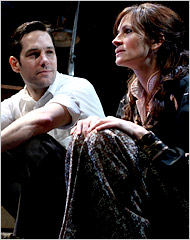
Look out, Paul Rudd.
—New York Times theater critic Ben Brantley, writing about Three Days of Rain (which is, by the way, an awful play, in which Roberts proves that she probably shouldn't try this theater thing again).
His conclusion: In Excellence Without a Soul: How a Great University Forgot Education, former dean of Harvard College Harry Lewis argues that Harvard — or its college at least — is aimless and adrift, with a scant idea of what to do with its undergraduates. Even if his critique has less irony and edge than one from Socrates would, it nevertheless serves as an informative condemnation of Harvard’s approach to education.
I love that line: Even if his critique has less irony and edge than one from Socrates would...
This is, of course, a way for a recent college grad to put that $150,000 education to work and let all of us know that he has read Socrates (in fairness, a pretension hardly limited to recent college grads).
Also, even if EWAS is less ambitious than Remembrance of Things Past...even if Lewis lacks the incisive pen of William Shakespeare...even if EWAS is bound to be less influential than the Bible.....
I suspect that Lewis' book will be reviewed in some ways just as Harvard Rules was; it will benefit from attracting the attention of people who went to Harvard, but will suffer from the fact that those people are already quite sure that they know exactly what is going on there, no matter how many years they have been away from campus......
Goodwin and Shuker describe the dramatic turnover in personnel at University Hall and consider whether that's a good or bad thing.
Couple points.
First, I wish they'd dug a little deeper in some instances. What exactly are the effects of this turnover? If critics say that University Hall has become infected by a "corporate culture," what exactly do they mean by that? Otherwise, Dick Gross has an easy time rebutting the charge by pointing out that he doesn't wear a tie to work. And if there is a corporate culture at University Hall, is that automatically a bad thing? I have no idea. Sounds bad, but it ain't inherently so. Tell me more....
What both sides seem to be arguing about is whether or not students are well-served by the changes in University Hall, and that's the one part of the article where Goodwin and Shuker drop the ball a little.....
Point two: There's a very interesting feud shaping up between Harry Lewis and his replacement, Dick Gross.
Consider this exchange (wrongfully buried at the end of the piece, where the Crimson traditionally puts its juiciest quotes, like Ed Glaeser's comparison of David McClintick's writing to the Protocols of the Elders of Zion):
“Many long-serving educational administrators have inexplicably left Harvard in recent years,” Lewis wrote. “They left Harvard, or were forced to leave, because they did not fit into the new, retail-store university, in which orders are taken, defects are papered over to get the merchandise out the door, and the customers are sent home happy by ‘student-service professionals.’”
Gross responds that he has “no idea what a student-service professional is,” adding that “no one on my staff could conceivably be described in that way.”
Having said all that, kudos to Goodwin and Shuker for a solid piece....
By the way, remember all the talk about what rich kids these lacrosse players are? Well, one of the defendants is from Essex Fells, New Jersey, which does sound like a faily posh place—in 2000, the median household income was $175,000. The other is from Garden City, New York, a Long Island town which is not particularly posh at all....
One of these days when I have the time, I hope to go back and look at how class was used against these defendants before anyone even knew who they were—how, in this case, being a poor, working single mother—a stripper—actually helped the accuser's credibility, while their broad socioeconomic profile was used to stigmatize the defendants. I'm not saying this is good or bad, just pointing it out as a factor in how journalists covered this case.

It's almost as if the paper has consciously decided to ignore the biggest story in academia: the resignation of its current president, the search for his replacement, and the enormous challenges that lie ahead for Harvard.
Some possible story ideas....
1) What is Summers doing now? The faculty is certainly worried.
2) $. $ $ $. Think sciences...FAS deficits...etc.
3) The alums. How do they feel? Plus, alumni $.
4) The Board of Overseers. Apparently they're having an election. Does anyone care? Should they?
5) Derek Bok: What's he doing now? How is he making the transition from semi-retirement to full-on president?
6) Summers' severance package. From what I hear, it ain't small.
7) The capital campaign. It's been put off year after year, and along with it, Allston. Can't start until there's a new president, and probably even then not for a year or so....
8) Speaking of Allston...what happens now? Is it back to the drawing board? How much of President Summers' planning will stay in place?
9) The Summers' circle. What happens to the people who closely aligned themselves with LHS?
10) Andrei Shleifer. Isn't he supposed to be returning next fall? That would be interesting.
11) Summers' future: How about a symposium?
12) What is Bill Kirby doing now? Not much, from the sound of it. And what of his severance package?
Where's Zach Seward when you need him? Oh, wait, he got kicked out....
—formerly media-friendly North Carolina D.A. Mike Nifong, as photographers snapped him coming out of the bathroom
"I can't imagine that a woman would do that to herself if she didn't feel like it was worth doing it. And the only reason it would be worth doing it is if she was raped. So, I have no reason to believe she was lying."
—the second "exotic dancer"
Meanwhile, Duke lacrosse t-shirts are a hot seller.....

Here's the dramatic lede: They're on every college campus where sports teams succeed: groupies who want to date athletes -- or at least have sex with them.
No, really, I'm serious. That's what it says.
Melissa, a freshman who declined to give her last name, said some of the allure was that guys on the team were "generally better looking, and they have a lot more confidence, too."
And they say network news is dead....
A 21-year-old lacrosstitute.
Goldberg writes: In taking on a sensitive, fraught subject, one might expect such eminent scholars to make their case airtight. Instead, they've blundered forth with an article that has several factual mistakes and baffling omissions, one that seems expressly designed to elicit exactly the reaction it has received. The power of the Israel lobby is something that deserves a full and fearless airing, but this paper could make such an airing less, not more likely.
Goldberg unearths a tidbit I hadn't read before: that the paper was originally commissioned as an article for the Atlantic Monthly, which decided not to run it....
Mearsheimer, meanwhile, says this about the future of him and his co-author: "It is too soon to tell what all of the repercussions will be, but we believed going into this that both of us would pay a significant price in our professional lives. We think, for example, that it would be almost impossible for Steve to ever be a high-level administrator at Harvard or any other top university. It is also highly unlikely that either one of us would ever get appointed to an important government position after this article. Plus there will be conferences and meetings that we won't be invited to because of the piece."
That feels right—correct—and wrong, at the same time.
Juan Cole, also in Salon, does manage to write sympathetically about the paper, concluding that most of the paper's harshest critics have avoided engaging its key arguments. Instead, they have raised straw men, attempted to shift the debate to the question of whether it is even acceptable to raise the subject, and either hinted or outright alleged that Mearsheimer and Walt are bigots. These tactics allow critics to sidestep all the crucial questions raised by the paper, while at the same time signaling to others tempted to comment that if they stick their heads up, they will be cut off.
Meanwhile, the second dancer at the party, who was allegedly separated from her friend, the alleged victim, during the assault, said that suggestions that she had contradicted her friend's testimony were "Out-and-out lies." She added, "It’s making me believe more and more every single day, every single news story that I hear coming from them, that they have something to hide and they’re scared of what’s to come.”
The second dancer told MSNBC that she had not seen a rape occur but she believed her friend. "I think that it’s quite possible that something really terrible had happened to her," the second dancer said. According to the New York Times, she said the accuser was "talkative and friendly and smiling" before the episode and totally incoherent afterward.
I think that it's quite possible that something really terrible had happened to her?That is a curious way to support a friend.
Nonetheless, everything about this situation remains murky, and the truth, instead of becoming clearer, seems further away than before....
Huh.
This one will bear watching....
—Shots in the Dark, on the allegations of rape at Duke, April 4
Jesse Jackson comes to aid of alleged rape victim
—The Duke Chronicle, April 17
As Matt Drudge would say, developing....
_________________________________________________________________
P.S. Several e-mailers suggest that this rumor is unlikely and that President Bok is some time off from making a decanal pick. We'll see.

"We were on a station for 24 hours, and the calves would be swimming around us crying," said Carin Ashjian, a biologist at Woods Hole Oceanographic Institution in Massachusetts and a member of the research team. "We couldn't rescue them."
Meanwhile, the New York Times reports that recently retired ExxonMobile chairman Lee R. Raymond was paid an average of $144, 573 a day in his 13-year tenure, for a total of $686 million. Under Mr. Raymond, ExxonMobile was an outspoken critic of the idea that global warming exists, and the company refused to take any proactive measures against it.
Nice work if you can get it, I suppose. But how do you sleep knowing that your massive fortune has come at the expense of the entire planet? And why do the rest of us tolerate one man's self-aggrandizement at the expense of future generations of children—whether human or animal?
In this q-and-a with Gawker, Stern presents his side of the story.
My error in judgment* was combining discussions about an investment in my clothing company* with one about advising him on media coverage,**** especially in such a way that it could be twisted out of all proportion**** by the slimeball, billionaire lapdogs at the Daily News*****.
Let's parse this, shall we?
* Nice! It wasn't a crime, an act of blackmail or just sheer greed. It was "an error in judgement." Hey, could have happened to anyone!
** Wow. So all along, billionaire Ron Burkle was really just spending hours of his valuable time desperately trying to invest in Stern's "clothing company," Skull & Bones," oddly named after a secret society Stern wasn't in at a school he didn't go to. Because, you know, that's how billionaires make their money—one six-figure investment in moribund clothing lines at a time.
Ron Burkle: Apparently saw gold in them there tote bags.
*** Advising him on media coverage...and here I thought that Stern was just asking for money to keep Burkle's name out of the paper.
**** Because if the shoe were on the other newspaper's gossip columnist, the New York Post would never, ever, even think of twisting anything all out of proportion.
***** The slimeball, billionaire lapdogs at the Daily News.... As opposed to the slimeball, billionaire lapdog who owns the New York Post. But then, the fact that Jared Paul Stern always fancied himself a rich, elitist socialite certainly shouldn't stop him from playing the class card now.
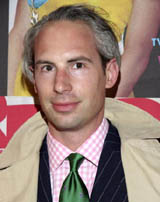
Jared Paul Stern: Just another workin'
fella, sticking it to The Man.
What's really interesting is that Gawker gives Stern all this space to spin what is clearly complete bullshit—please, please tell me that no one is falling for Stern's "I was set up!" line— and then omits its usual snarky rejoinders.
But wait! Turns out that Stern has assigned book reviews to the people who write Gawker!
Which, given the Gawker folks' rather, um, slender credentials for reviewing books (apparently they've read some), basically means that Stern was using his position as an editor to buy warm words for himself on Gawker.
And—wait for it!—here's the Gawker plug, from April 26, 2005:
New York Post scribe Jared Paul Stern, having decamped to the Catskills, had some time on his hands and came up with a product as twisted as the truth in the hands of the gossip columnist he sometimes still is. His new preppy-punk line of ties and polos, Skull & Bones (debuting tonight at a party at A.S. Parker, 1001 Madison Avenue) replaces "fuckin' cutesy critters," as he puts it, like alligators and polo ponies with the sign of the Jolly Roger.
Do I hear the sound of two hands scratching two backs?
(Full disclosure: Gawker has slagged me at least once that I can remember.)
(Whoops, make that twice.)
"She's breathing and appears to be fine," said the police officer who first came to the woman's aid. "She's not in distress. She's just passed-out drunk."
It's hard to know what to make of this; it could both help the prosecution or help the defense.
Certainly a drunk woman could be raped; in fact, her drunken state might have made her more vulnerable to an act of violence. And if the lacrosse players got her drunk....
On the other hand, it's hard to imagine that you'd be viciously raped by three men for half an hour, as she has claimed, and, minutes later, pass out in a car. Possible, I guess, but hard to imagine.
The more we learn, the more this case comes across as, at the very least, murky.
I wonder: How many people are still comfortable with maintaining the anonymity of the accuser?
Who should that person be? Let's hear your nominations, posted below....the buzz I hear is that Drew Faust, to whom Larry Summers twice offered Bill Kirby's job, is an early frontrunner....
HARVARD UNIVERSITY PRESIDENTIAL SEARCH COMMITTEE
James R. Houghton, Chairman
Frances D. Fergusson, Susan L. Graham, Nannerl O. Keohane, Patricia A. King,
William F. Lee, Robert D. Reischauer, James F. Rothenberg, Robert E. Rubin
April 2006
Dear Members of the Harvard Community,
On behalf of Harvard's governing boards, I write to invite your advice on the search for a new president of Harvard, in light of Larry Summers' decision to conclude his tenure as our 27th president at the end of the 2005-06 academic year. We are grateful to President Summers for the vision and energy he has brought to the leadership of the University, and to Derek Bok for his willingness to serve as interim president from July 1 until a new president has taken office. As we embark on the search for a new leader for Harvard, we would value your observations on the major opportunities and challenges facing Harvard in the years ahead and the priorities that a new president should have most in mind in guiding the University. We would also appreciate having your views on the personal and professional qualities most important to seek in a new president, as well as your thoughts on any individuals you believe are deserving of serious consideration. We will, of course, be seeking a person of high intellectual distinction, with proven qualities of leadership, a devotion to excellence in education and research, a capacity to guide a complex institution through a time of significant change, and a dedication to the ideals and values central to a community of learning.
Through this time of transition, it is important that the University sustain momentum in advancing a range of continuing institutional priorities. We are renewing and enhancing the learning experience of our students, especially in the College and also across the schools. We are growing the faculty to build strength in fields of rising academic significance. We are forging new links among Harvard's faculties - to foster innovation in the sciences, international studies, and other vital endeavors across the disciplines and professions. We are opening Harvard's doors wider to outstanding students of limited financial means. We are planning carefully and imaginatively for the historic extension of Harvard's campus into Allston. In these crucial efforts and others, the University's continuing progress will depend on the energy, creativity, and goodwill of all of us who care about Harvard.
Under the University's charter, it is the responsibility of the Harvard Corporation to elect a new president, with the counsel and consent of the Board of Overseers. Consistent with past practice, the search committee will comprise the six members of the Corporation other than the president, together with three Overseers. In addition, we are appointing faculty and student advisory groups to inform our deliberations, and planning a series of consultations with various alumni groups. Our intention is to reach out broadly to solicit both general advice and specific nominations.
Your responses to this letter will be a critical element of that process. We hope you will take the time to share your perspectives with us. Please e-mail your thoughts to [email protected], or address correspondence to the Harvard University Presidential Search Committee, Loeb House, 17 Quincy Street, Cambridge, MA 02138. The committee will hold your replies in strict confidence.
We look forward to hearing from you. Many thanks, and all best wishes.
Sincerely,
James R. Houghton
Senior Fellow, Harvard Corporation
Chair, Presidential Search Committee
He does state that "a lot of people have called with various ideas" of what he might do next, though he declined to specify what those ideas might be.
My guess: Summers will get back into the field of international economic policy in some way, getting involved in the Council on Foreign Relations, doing the rubber-chicken circuit, perhaps doing some consulting. Ultimately, one would think he'd head to Wall Street in some way—although as a friend who works on Wall Street said to me, a lot of those banks don't want the kind of press that Larry Summers seems to bring with him, like Pigpen and his cloud of dust. But perhaps a hedge fund?
Summers certainly has an outstanding economic mind, and it would be nice to see him cut loose on Bush administration economics. The risk for him, of course, would be that he'd alienate his remaining supporters, most of whom are conservative. But the man has always been an economist, and he must be appalled by what is coming out of Washington these days. (Imagine a Treasury secretary so disempowered that no one wants the job.) Summers could be of real value to the country by espousing some clear-headed economic wisdom.
If you folks have any better ideas for Mr. Summers' future employment, do feel free to post them....
Pigpen: Apparently a lot like Charlie Brown.
And if so, when did the booing start—before or after Cheney threw a pitch in the dirt?
The Post's Howie Kurtz sums up the debate. But either way, wouldn't you just love the chance to boo our warmongering, environment-destroying, face-shooting vice-president?
Dick Cheney: Boo.
The Duke Chronicle describes the people who hired Bennett as "a group of people close to the Duke lacrosse team." Come on, Chronicle—what the hell does that mean? Parents? Athletic boosters? Alums? It's kind of a big deal, actually....
And I think the great majority of honest people would have to answer, "I don't know."
Today I find myself even more in awe of those passengers who fought back, reading the details of tape recordings from that flight played in the trial of accused terrorist Zacarias Moussaoui.
The pleading voice of a flight attendant before she is coldly murdered...the sounds of passengers as they surge toward the cockpit...the horrific decison by the hijackers to "pull it down."
And perhaps most chilling: the repetition of "Allah is the greatest" as the hijackers roll the plane over and point it towards the ground. That's some god you terrorists have....
I'm opposed to capital punishment, but if anything could make me want to kill someone who's not currently trying to kill me, it's the emotion of hearing such a tape.
Nonetheless, I don't think Moussaoui should get the death penalty; that would make him a martyr to others like him.
He ought to be locked up in solitary...and forced to listen to those recordings every day, all day, for the rest of his life.
You will remember that Jamie Houghton is also, of course, the senior fellow on the Harvard Corporation.
Mrs. Clinton has apparently been invaluable to Corning, using her access with President Bush and foreign governments to push for aid to Corning.
And in return, Corning has been generous to Senator Clinton, becoming one of her largest sources of campaign contributions. (And giving her approximately ten times as much as her Democratic colleague, NY senator Chuck Schumer.)
Jamie Houghton also held a fundraiser for Clinton at his home that collected "tens of thousands of dollars" for her reelection (i.e., presidential) campaign.
This is not only interesting for Harvardians, it may be relevant. Many opponents of Larry Summers think that Jamie Houghton was slow to hear and respond to their concerns, and stood by Summers rather longer than he should have. Could the fact that Summers was a Clinton loyalist, and Jamie Houghton now very much needs Mrs. Clinton, have anything to do with his reluctance to act in the Summers matter? What about the fact that Summers-loyalist Bob Rubin was also on the board, and Bob Rubin, who also has a very close relationship with the Clintons, could also be valuable to Houghton's work with Corning?
In other words, was Jamie Houghton using his position on the Harvard Corporation to help his company?
I have no evidence of any of this, I hasten to add; I'm just thinking out loud. (Well, out blog.)
The point is twofold. One, you have to consider the possibility of such corruption behind the veils of the Corporation's secrecy. It could happen...but because the Corporation is so secretive, we'd never know about it. A good argument against the secrecy of the Corporation, especially as the university becomes increasingly enmeshed witt the worlds of business and politics. Any time powerful and wealthy people get behind closed doors and start making decisions that they never tell anyone about, a good American gets nervous.
And two, this potential conflict of interest is an unintended consequence of hiring a president from the world of politics. The political relationships Larry Summers brought to Harvard could be exploited by, say, members of the Corporation in ways that have nothing to do with Harvard's best interests....
From: Derek Bok
To: [email protected]
Sent: Tuesday, April 11, 2024 3:21 PM
Subject: FAS Dean Search
Dear Members of the Faculty, Students, and Staff,
I am writing to share with you the names of your colleagues who have agreed to participate as members of the faculty search advisory committee in connection with the search for a new dean of the Faculty of Arts and Sciences. Members of the committee are:
David Blackbourn, History
James Engell, English and American Literature and Language
Alyssa Goodman, Astronomy
Caroline Hoxby, Economics
John Huth, Physics
James McCarthy, Organismic and Evolutionary Biology
Michael Sandel, Government
Margo Seltzer, DEAS
Elizabeth Spelke, Psychology
Richard Thomas, Classics
In addition, I will plan to meet with a group of non-tenured faculty to discuss the search, and both the Undergraduate and Graduate Student Councils are in the process of forming student committees to provide input into the search process.
I encourage you to be in touch with members of the search advisory committee to share your views on the challenges facing the FAS, the qualities we should seek in a new dean, or specific individuals who you think should be considered. In addition, you should feel free to write to me directly at [email protected].
With all best wishes,
Derek Bok
As the Crimson points out today, the list is heavily stocked with critics of Larry Summers. (He must be pissed.)
The point, I think, is that the list is reflective of the proportion of anti-Summers sentiment on the faculty, and Bok knows it. This was no cabal; this was the majority of the Faculty of Arts and Sciences, and the decanal search committee reflects that.
Scary as what's going on in Iran is, the Bushies plans of attack are even more alarming. It's not that anyone should take what's happening in Iran lightly. It's just that none of the war plans seem to make any sense—and the consequences could be horrific. If you think the Iraq war is bad, well, this threatens to make that look like Grenada......
That's Derek Jeter hitting a game-winning home run against the Kansas City Royals yesterday, Opening Day at the Stadium. What a terrific picture! That iconic image of the batter swinging through a pitch, head down, feet turning, driving the ball over the fence...
And the Yanks weren't the only team having a successful Opening Day yesterday. The Sox, who are starting the season hot-hot-hot, beat the Blue Jays, 5-3. Here's David Ortiz (Ortiz and Jeter—who else?) after his game-winning home run...
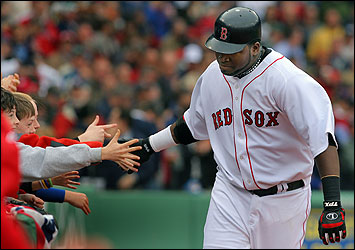
It all kinda makes you think that this could be a heckuva season.....
And it reminds me that now is probably a good time to let you in on my latest project: a book about the Yankees-Red Sox season of 1978. You may remember that that was the season in which the Yankees and the Red Sox fielded two of the greatest teams in their history and wound up playing a one-game playoff at the end of the regular season to determine the pennant-winner. The Yankees won, 5-4, mostly because of a three-run homer by shortstop Bucky Dent. (Bucky F'ing Dent, as some of you may know him.)
It's a fascinating season with some long-term importance for baseball, and I can't wait to write about it.....
Here's what one neighborhood resident had to say, according to the Duke Chronicle: "From what I understand, the DNA results aren't necessarily proving anything," said a Durham resident who wished to remain anonymous. "The neighborhood would like to see something-one or more found guilty." [Italics mine]
It will be interesting, if this case turns out to be a fraud, to go back and look at some of the journalism which has as its implicit foundation the idea that the lacrosse players are guilty. (You know who you are, Allan Gurganus and David Brooks. Are you still so sure that it was a tale of "lust gone wild"?)
Of course, we still don't know what did or didn't happen, and the Chronicle also has an interesting article about the implications of the DNA test results.
"The fact that no DNA was found doesn't end the inquiry-especially if there is an assertion that the rape involved the use of a prophylactic," said [lawyer Ed] Shohat, whose daughter currently attends Duke.
But the argument in the other direction seems slightly more compelling; Shohat also says that "the DNA tests [are] a major blow to the prosecution. The prosecutor took his investigation public with the DNA tests, and now in essence he has to eat the results."
Which brings me to a journalistic issue I've thought about quite a bit: I believe that, in cases in which rape is charged but the accusation is far from clear-cut, the media should name the accuser. Why? Because in protecting the name of the accuser, the media is essentially making a judgement that she is telling the truth, that she has in fact been raped, and that the accused are guilty. But false accusations of rape do occur. (Particularly when celebrities and athletes are involved.) And false accusations of rape can leave a stigma on the accused that is perhaps worse than the stigma associated with being raped. Since we are no longer so sure that all accusations of rape are fundamentally true, we must consider that there are times when it's appropriate to name the accuser.
I know that this is a highly subjective standard. If I were an editor, I wouldn't have named, say, the Central Park jogger. But as the days go by, I would give serious thought to naming the woman who has alleged this rape....especially if there are more indications that her story is untrue.
It's a tough issue. Your thoughts?
Grim numbers for Republicans. I wonder if they can change much until the situation in Iraq changes...because we all know by now that the president deceived the public in leading us to war. How does one get past that?
It's obviously a rhetorical question...but if I may answer it nonetheless, yes, I do. Not much prestige, perhaps, not in the long run. But some. In my opinion, what has most hurt the university is the widespread perception of its faculty as selfish, lazy, and out of control, probably the dominant narrative promulgated by the media in analyzing the resignation of Larry Summers.
If it is true that Larry Summers has been feeding this storyline to journalists such as John Tierney and Mort Zuckerman, then the president of Harvard has himself been contributing to the damage of the institution in order to rationalize his own ouster. Unfortunate.
Of course, if Harvard gets back on track under Derek Bok—in fact, it already has—and the faculty works well with a new dean and a new president, then suddenly it won't seem quite so out of control or power-hungry.....
Nifong, who has been a little too ubiquitous on tv and in print, one thinks, responds with a quote that isn't exactly confidence-inspiring. "I'm not saying it's over," he said. "If that's what they expect, they will be sadly disappointed."
It's possible, of course, that all three alleged rapists used condoms. (A consequence of the hotly-debated CSI Effect?) But the alleged victim says that she lost four fake fingernails fighting off the alleged attackers, and the nails were found in the bathroom where the attack supposedly took place. It seems almost inconceivable that there wouldn't be something from them on her.
Further damaging the accuser's case is the revelation that photographs from the party allegedly show the woman to be "very impaired" from the point she got there, with cuts and scrapes consistent with what she later claimed were the results of being attacked.
According to the Duke Chronicle and the Raleigh-Durham News & Observer, "A 27-minute gap in photos corresponds with a stint during which the woman and another dancer locked themselves in a bathroom, [according to] attorney Joe Cheshire, who is representing senior captain Dave Evans.... Photographs taken after the gap show the woman smiling and wearing a negligee that Cheshire said shows no signs of damage or violence."
Meanwhile, defendants of player Ryan McFadyen say that his appalling e-mail was actually a sick joke inspired by the film "American Psycho." I've seen the movie, and that's not an entirely impossible suggestion.
In which case, let me ask: Would McFadyen's e-mail actually constitute a form of satire, rather than a threat or "hate speech"—and should his suspension from Duke therefore be revoked? I'm beginning to wonder if maybe McFadyen didn't get a raw deal....
Joffe begins by saying that Mearsheimer and Walt's paper, The Israel Lobby, "puts The Protocols of the Elders of Zion to shame."
Curiously, Joffe then notes that he has worked with both men for "ages," and that neither of them "have it out for the Jews" so far as he can tell. Therefore, he suggests, "let's leave the Jew-baiting aside."
(Always a good idea, if you ask me, but somewhat curious given what Joffe's just written.)
"The gravest indictment is that the screed is anti-American," Joffe argues. "For campaigning on behalf of this or that U.S. foreign policy is as American as apple pie. "
This strikes me as a simplistic argument (maybe that's why the piece is "online only!"), and Walt and Mearsheimer could probably rebut it without too much difficulty. If, that is, they deigned to engage with the debate that they have ignited.....
I understand that it's impossible for them to respond to each and every brickbat, but it'd be nice to know if they have something planned.
Writing in the Washington Post, Eliot A. Cohen says of the Walt/Mearsheimer paper on the "Israel Lobby," that "yes, it's anti-Semitic."
Residents of Durham are pleased that Duke has cancelled the rest of the lacrosse team's season. Meanwhile, the lawyer for some of the lacrosse players has put out the story that the players felt "ripped off" by the two strippers [let us be honest about this, rather than using the euphemism "dancers"] they hired, who allegedly were paid for two hours and quit "dancing" after two to three minutes. The lawyer, Joe Cheshire, says that some of the players might subsequently have used "inappropriate" langugage, but that no rape occurred.
Meanwhile, there seems to be a lot of stereotyping about the nature of the lacrosse team and all lacrosse teams. They have the "elitism of preppies, the boorishness of jocks," according to this article in Slate, which produces not a whiff of evidence to prove either charge. (The writer says that most lacrosse players are damaged by their time spent at single-sex "academies," despite the fact that he doesn't actually name any of them.)
And writing in the New York Times, Allan Gurganus declares that "glamorous boarding-school sports are magnets for the attractive, competitive and wealthy young people that increasingly define Duke's student body."
How many unestablished facts does that sentence contain, I wonder?
Gurganus' conclusion: "When the children of privilege feel vividly alive only while victimizing, even torturing, we must all ask why."
Interesting. Seems to me that if such stereotypes were used when writing about, say, a primarily black team, lots of alarms would (and should) be going off.....
Something clearly happened at Duke that night. What it is, we still don't know. But Gurganus has these guys all but tried and sentenced to exile in Tasmania. "Victimizing, even torturing..."? Perhaps we should wait for a trial before being so certain.

Those of you who are lucky enough not to be regular readers of the New York Post may not know this story, so a brief recap:
1) Page Six, which appears in Rupert Murdoch's New York Post, is the most powerful gossip column in the country, and usually the nastiest. Its content is regularly recycled elsewhere, and it's had an enormous, and unpleasant, impact on celebrity journalism.
2) One of its longtime contributors, Jared Paul Stern, has been captured on video apparently demanding payoffs from billionaire Ron Burkle in exchange for positive coverage—$100,000 to start, then $10,000 a month. The whole episode was captured on tape by the FBI and the United States district attorney's office in Manhattan.
3) The resulting fallout has brought critical attention to the way Page Six does its dirty business, and it's becoming apparent that the whole page appears to be a web of payoffs and profiteering. At last, the rest of the New York media is turning the same kind of critical eye upon Page Six that its editor, Richard Johnson, and his flunkies have cast upon the city for too many years. (Full disclosure: I've been on Page Six a few times, all but one of which I have erased from memory.)
A Murdoch flack, Gary Ginsberg (whom I know slightly), has come out of the woodwork to defend Page Six by saying, "I think the franchise is as strong as any in journalism. This is highly aberrational." But as the scandal starts to grow, the exact opposite impression is forming: Everything on Page Six appears to be up for sale. And because of the column's popularity, Rupert Murdoch has never troubled himself about its corruption.
Sure, not everything on Page Six is bad. Someone has to reign in all those out-of-control publicists and tantrum-throwing models. (You know who you are.) But in general, New York would be a better place without it....
The Crimson also reports on Alan Dershowitz's attack on the paper, posted on the Kennedy School website.
(Incidentally, KSG dean David Ellwood is doing absolutely the right thing in allowing people to post their responses to the Walt/Mearsheimer paper. It's kind of like, oh, the comments section of this blog, and frankly, it's a little weird that it has taken this episode for the Kennedy School to realize that, when you post things on the web, people sometimes actually like to comment on them.)
Couple things.
First, as he might say, it takes some chutzpah for Alan Dershowitz to attack other writers' sourcing.
At least from the Crimson piece, it doesn't seem that Dershowitz scores any major hits on the Walt/Mearsheimer paper, just a couple of glancing blows.
Second, here's an irony for you: Not too long ago, Larry Summers was, shall we say, strongly encouraging the government department to tenure none other than John Mearsheimer....
I wonder if Alan Dershowitz knows that.....
It is: "tommrow night, after tonights show, ive decided to have some strippers over to edens 2c [a dorm room]. i plan on killing the bitches as soon as [they] walk in and proceding to cut their skin off while cumming in my duke issue spandex."
This is so appalling it's hard to react in any way other than with outrage.
But the e-mail does raise one particular question. What did McFadyen mean by the ungrammatical phrase "after tonights show"? (From the sound of it, McFadyen ought to have begun his sentence with that phrase. Perhaps he was so fired up, he couldn't get his grammar correct.)
Because as the Chronicle reports, "Three men allegedly pulled the victim into a bathroom and sexually assaulted her anally, vaginally and orally for approximately 30 minutes."
To Ryan McFadyen, would that constitute a show?
Joe Cheshire, a lawyer representing at least one of the lacrosse players, says that if a rape had occurred, McFadyen would be more likely to e-mail his teammates telling them to be quiet, not sending the e-mail above. "When people do something bad, they wouldn't be writing e-mails about it," Cheshire said.
Then again, there's also the possibility that McFayden is just a stupid, ignorant, violent person, cocky enough to think that three members of the lacrosse team could rape a woman and "joke" about it afterward.....
Let us parse this, as Mike McCurry used to say.
First off, in my journalism world, when describing someone as "one of the world's best economists," it's usually appropriate to mention that you are friends with that economist, and that you used to play tennis together at Washington's St. Alban's tennis club, as reported in that fine work, Harvard Rules, now available in paperback. This is a simple rule, taught in introductory classes in journalism schools all over and regularly ignored by powerful columnists at the Post and Times.
Second, how exactly did Ignatius hear about that speech when it was delivered in India and only reported in Indian newspapers? One can reasonably presume that it was brought to his attention by President Summers.
In fact, it's even possible that Summers gave Ignatius the idea for the column in its entirety. Larry Summers is, after all, looking around for things to do—and some relationship with the IMF is a plausible option.
Which would make David Ignatius' column a thinly veiled job application for Larry Summers. In turn, Summers would prove a continuing source of column ideas and information—i.e., leaks—to David Ignatius.
Journalists....
In accepthing the resignation of the lacrosse coach, Brodhead rightly called the message "sickening and repulsive."
He added: "This episode has touched off angers, fears, resentments, and suspicions that range far beyond this immediate cause. It has done so because the episode has brought to glaring visibility underlying issues that have been of concern on this campus and in this town for some time — issues that are not unique to Duke or Durham but that have been brought to the fore in our midst."
Duke is lucky to have Brodhead as president during this awful situation.
Duke lacrosse player Ryan McFadyen,
who threatened to kill strippers.
What can one say?
Don't you just hate it when famous people defend the privacy of their children for years and years, then quickly sacrifice that privacy in order to make their ambition appear warm and fuzzy?
And then the New York Times actually prints stuff like, "That the most important people in her life had confirmed her own inclinations surely made it easier for Ms. Couric to decide..."—with a straight face?
Here's what's going on here: Carter is terrified of getting beaten by the tabloids and other media on this big story. (The New York Times isn't used to competition.) So he writes a puff piece about how amicable everything is, and then, when Couric decides to go public, she grants him an exclusive interview. Not wanting to lose that access, he writes another puff piece.
Journalists.....
Congratulations, Professor Jenkins.
According to the Crimson, "there are several members of the Faculty who have served the University admirably in this once-per-generation exercise of redefining education at Harvard College. But those who have served on committees, attended forums, and written essays are the piddling few; their work is mocked by a vastly larger portion of the Faculty that seems capable of showing up to monthly Faculty meetings—which last only 90 minutes—only when it means taking shots against someone who actually did care."
(The Crimson would seem to have a logical problem here given that Larry Summers fired the dean leading the review, not typically an act of caring, but never mind.)
The editorial goes on to charge that the faculty who were present were "woefully unprepared and uninformed."
Here's another hot-headed paragraph:
This shameful coordination and lack of devotion, especially in comparison to the impassioned, standing-room-only crowds that filled University Hall for nearly a year of attacking Summers, only reaffirms the perception of Harvard faculty members’ apathy toward undergraduate education. Pictured in a recent New York Times art editorial as “spoiled faculty members who refuse to teach,” FAS does itself no service by failing to attend its own crucial meetings.
I think that's a reference to John Tierney's column, which was more or less ghostwritten by Larry Summers. Was this editorial influenced by the president as well? I'm told that he's been suggesting stories for the Crimson....
In any case, I wasn't at the meeting, so far be it for me to say whether the Crimson is right. I'd like to hear from some of you about that....
It's all getting a little predictable, isn't it? Any moment, Al Sharpton and Jesse Jackson are going to arrive.
I don't mean to sound cynical. I'm against sexual violence as much as the next guy. (Probably more than the Duke lacrosse team, from the sound of it.) I'm no fan of rape culture. I'm not even sure what it is, but I know I'm not a fan of it.
All satirical asides aside, the problem is that no one really knows what happened, other than the people who were present. (And even they may genuinely believe contradictory accounts.) Shouldn't that be more definitively established before the alleged crime gets transformed into a larger political, cultural and racial issue?
As a longtime New Yorker, I can never forget the Tawana Brawley case, and the troubles that the men falsely accused in that hideous fiasco (by, among others, Al Sharpton) have had recovering their reputations....
...which is not to say that I have any idea what really happened. Just that I get nervous when people start holding rallies about alleged crimes.
One final caveat, before you all start reaming me out: One of the NCCU students suggested that if their football team (all black, I think) had been accused of raping a white woman, the accused would be in jail by now. I'd like to think that's not true...but that may be wishful thinking.
I'm fascinated by the amount of media attention paid to whether Couric is going to leave the Today show to anchor CBS News. Consider this Times story, in which all the anonymous sources emphasize how amicable everything is over at NBC, even if Katie does leave, which means that the atmosphere at NBC is incredibly tense and the long knives are out. (Katie Couric is roundly disliked by people who work for the Today show...and by some people, such as myself, who have been on it.) Don't people in the press realize that no one watches the evening news anymore? (I'll be mildly surprised if the network news even exists, at least in its current format, in five years.)
Anyway, the point is that no one looks that good after years and years of getting up at 3 A.M. without some serious surgical help.
Not that there's anything wrong with that.
He's also one of a number of people in the chattering classes who are talking about Al Gore's global warming road-show...something I've come across in my reporting as political editor of Plenty magazine. I've even heard a rumor that Vanity Fair is trying to land Gore for the cover of an upcoming issue. Sounds farfetched at first...but in a way, you could see it.
Is Gore the best alternative the Democrats have to Hillary Clinton? Quite possibly. Because they desperately need an alternative to Hillary—she's just too much of a lightning rod to win the presidency, no matter how badly the Bush administration has screwed things up.
Incidentally, you can read some of my latest for Plenty—it's the cover story!—on whether gender plays a difference in people's attitudes towards the environment.
Anyway, it's a pleasure to be back, but because I've been running around doing interviews, it's been tough to post. Not to worry—there's lots of news. It'll be here soon enough.
I admit that I'm surprised that this alleged act of violence has sparked such town-gown hostility...largely because it suggests that town-gown relations between Duke and Durham are pretty lousy, a fact of which I wasn't aware. (Is this common knowledge?)
Could this be a situation where the mayor of Durham tells people to settle down? After all, Duke students, no matter how white and how privileged they may be, hardly deserve such criticism.
When I was a college student, New Haven locals were far more likely to rape Yale students than the other way around. (It happened to a friend of mine.) But Yale students hardly went around saying that all residents of the city were rapists...and if they had, they would have promptly been rebuked. Just because the roles—and, largely, the races—are now reversed doesn't mean that this kind of language should go unfaulted.
(But then, everyone hates a redesign the first time they see it.)
I liked the fact that the old NYT site actually looked like a newspaper, and succeeded in giving you a sense of what stories were the most important. Both qualities are gone now. The site looks like Salon.com, which used to look kind of nice but initiated a disastrous redesign.... I don't like the blue font, and the grey seems too light to me.
I do like the feature that tells you which stories were most frequently blogged about....

In an e-mail, Walt tells TPMCafe that "I feel Harvard and the Kennedy School have behaved admirably in challenging circumstances. Many colleagues have been wonderfully supportive as well (whether they agree with the substance of our article or not)."
Kennedy School dean David Ellwood also has a long e-mail detailing his thoughts on the Walt-Mearsheimer paper here.
These reefs grow incredibly slowly, and they were extremely old—"colonies that were here when Columbus came by have died in the past three or four months."
Meanwhile, President Bush still believes what Michael Crichton tells him—that global warming is a big hoax cooked up by paranoid environmentalists.
It's my belief that this administration's greatest failure is not the war in Iraq, as terrible and tragic as that is. It's the long-term, probably irreversible damage it has done to the globe by ignoring global warming, encouraging the building of more coal-powered electric plants, giving tax breaks for SUVs, and promoting oil as the foundation of our energy policy.
But what does Dick Cheney care? He can still hunt quail on zoo-like ranches, and he won't live long enough to see a dying planet....
(Wusses. They wouldn't have lasted two weeks in New Haven....)
Meanwhile, Harvey Araton in the Times lambasts the players on the Duke women's basketball team for not speaking out about the lacrosse scandal. That strikes me as unfair. After all, the women are trying to win a national championship right now, and talking about the lacrosse scandal could well undermine all the hard work they've put into their own pursuit of excellence. (And if they win, and conduct themselves like model citizens in the process, wouldn't that serve as an implicit rebuke to the lacrosse team?)
Even more important, I think, is the fact that no one knows what actually happened that night. So what's the point of speaking out?
Well, they killed him.
I don't know about you, but I find this pointless death upsetting, and I'm hard-pressed to understand the flip tone—"Hal's birthplace was unknown, as was his birthday"—of the New York Times piece linked to above. The return of wild animals to this country's urban sprawl—and, sometimes, even Central Park—is one of the few pieces of environmental good news there is, and it makes our lives a little nicer. (Was there anyone in Manhattan who wasn't delighted by the pictures of Hal in the papers?) We should see such animals as a sign of hope that maybe the rest of the planet can survive the enormous damage we are inflicting upon it...

RIP, Hal.