Tomorrow I leave for my first vacation in—well, not in that long—but certainly since winter began. (I was never a huge fan of Cambridge winters.) I'm headed to warmer climes to do a little diving.
But I will have e-mail access, and I will try to post as need be.
In the meantime, thanks to all of you who read this blog and participate in the discussion about the Summers presidency and the future of Harvard. It's an important conversation, and I'm grateful to be able to play whatever small part in it I can. But every so often, I need to get underwater to get some balance back into my life. It's quite a humbling experience, and in that sense very healthy.
See you soon, if not before.
That's why I was pleased to see this editorial by Harvard lecturer Timothy McCarthy in today's Crimson. McCarthy—whose Harvard story constituted one chapter of Harvard Rules—is no fan of Summers. But he's also a dedicated teacher who, partly because of his relative youth and partly because of his philosophy, is unusually close to his students. So his editorial tries to both explain the nature of the faculty's opposition to Summers while suggesting ways to bridge the divide between professors and students.
His conclusion: Summers’ [departure] thus poses an important challenge. As faculty members, we must articulate clearly and persuasively the reasons for our own discontent with the president. Moreover, we must take student grievances seriously by engaging undergraduates in conversation—publicly and privately—in an effort to restore their confidence in us as educators who are fully committed to Harvard’s long-term health. We must demonstrate our desire to work closely with students to reform the undergraduate curriculum, and we must devote ourselves more assiduously than ever to good teaching and advising. Together, we must work to make Harvard the institution it can and should be—a place of higher learning where critical debate coincides with mutual respect, where moral values triumph over market values, and where transparency replaces secrecy. We have a better chance of accomplishing all of this now that Larry Summers is gone.
I think that's a reasonable viewpoint, and a constructive one. The aftermath of the Summers presidency poses real risks, but also presents great opportunities, and all parties have to be careful to avoid bickering and recriminations. (At the same time, the truth about what has really happened over the past years does need to come out.)
I've often asked readers of this blog whether Harvard is better off now than it was five years ago. I find it incontestable that it is not. But at the moment, the more important question is whether it could be—and I believe the answer is yes, and in a relatively short period of time. The challenge lies in asking, Where do we go from here to making this university a better, more harmonious, more cohesive institution? Tim McCarthy's editorial is a step in the right direction.
I've criticized the paper for the action, on the grounds that whether these people covered Summers or no, whether they are currently on the Crimson or not, it's inappropriate for someone affiliated with the newspaper to engage in such a public display of affection. It has hurt the Crimson's appearance of objectivity, I argued.
I still believe that. But one of the people in the photo has written a long rebuttal to this argument that is serious and worthy of being read. It's in a comment below, but I'm going to post it here so it's more visible. You all can make up your own mind.
[Meanwhile, Crimson folks, could you please correct those things about me in the Sam Teller interview? What's good for the goose, eh?]
[Also, while I realize that not everyone took my joke about the chest-painting as "totally gay" in the sardonic spirit in which it was intended, I still think there's something a little American Idol-ish about the act. But there you are.]
Richard -
Being as you continue to trash on us, calling us an "embarrassment to the paper," I feel like I need to respond to your comments.
First of all, it should be noted that we were all acting within the confines of our own dormitory, at a study break which had been planned out months ago. This was far from a public forum. But this is truly an aside from the points you are making; I simply wanted to point this out.
Second of all, none of us have to do with Summers coverage on the Crimson. I will break down our roles for you:
There are two photographers, one of which last contributed to the Crimson in 2003, and the other of which is a former executive editor. There is a sports beat reporter, mainly with a focus on soccer and lacrosse. He has not written any news stories. There is the business manager. The former business manager was certainly a member of the executive guard, but someone with no control over content. Finally, there is a former news executive editor. This is as close as you get with hitting home on your point. However, the news executive is not one who has covered Summers, or one who oversaw Summers coverage - an archive search turns up no references to Summers in the headline or lede of any articles. The total Summers coverage from these five individuals is in the form of two photographs: one mugshot, and one appearance at a study break dancing with freshmen, both in early 2005.
I should note that only executive guard members have any say over content that appears, and none of these executive influenced Summers coverage, nor have we given the appearance that we have.
None of us have, or have had any impact on Summers coverage throughout this ordeal, and as former editors, our actions do not reflect upon current coverage.
Those who must remain impartial on The Crimson are those who cover Summers, and those who control the content that he appears in. The Crimson, just like any other newspaper is clear about this; for example, The Crimson has written staff editorials supporting Summers. By definition, some members of the staff have taken a stance on the issue. We have made no effort not to weigh in on the topic as a staff – much like any major newspaper advocates for political candidates and political policies – but those who report on Summers do not participate.
Claiming that all Crimson staffers should remain mum on the issue is like stating no member of a magazine (former or current) should ever staff a political campaign, or join an organization on which the publication has reported. On the contrary, this restriction becomes quite silly unless is deals with only those reporters and editors who cover the topic. Do you think no one from the New York Times, George Magazine, or The New Republic, has ever advocated a cause or candidate discussed within its pages?
The Crimson currently covers all the varsity sports that take place on campus. Some Crimson editors are athletes. Does this bias the Crimson's coverage of sports? Should the organization force these editors to choose either their team or The Crimson? No - so long as they do not cover their own sport.
The Crimson reports on Harvard football. Does this preclude all editors from cheering in the stands, or, gasp, painting their chests in support?
I think this is truly the point that is of concern. The Crimson, or any other publication, would be paralyzed if every one of its editors had to refrain from taking stances on any issue covered in the paper, or expressing any sorts of opinions relating to any aspect of the publication’s coverage.
You also mention that perhaps we had a "booster-ish" attitude while we were contributing to the Crimson. Perhaps some of us did (I can only speak for myself), but any reporter might have any opinion on a given issue. Those who cover politics likely vote, and thus have an opinion strong enough to pull them to the polls; the important thing is that if they cover an issue, they cover it objectively and not publicly take a stance. Though we have publicly taken a stance, we did so after our tenure ended, and stayed away from Summers coverage during our time at the paper. The fact that we may have had an opinion, whether or not we covered Summers, is again irrelevant. We all have opinions about President Bush, but some still report on him.
The conflict of interest argument also cannot be applied retroactively - just because someone has an opinion now doesn't mean they shouldn't have covered an issue in the past. However, again, this is irrelevant, as none of us did cover Summers.
I think it's important that I address these issues if they concern you, and if this represents the organization's biggest flaw during all this coverage, I think it serves as a testament to the great reporting current editors have done so far.
I also think it is important that we try to maintain discourse while examining the issue - if you have a problem with coverage in the future, please say so, because I think it fosters productive discussion, but I personally think printing headlines such as "The Crimson Shows Its True Colors" and “Bad Journalism,” while labeling us as an "embarrassment" and “totally gay,” is at best inflammatory, and doesn't serve to further these goals.
Best,
“R”
This isn't a simple right-and-wrong debate, but it certainly raises questions of copyright that should concern every author or potential author.
Imagine if you could go online and download every song ever written for free. You can try to do that, but it's pretty hard these days. Google would do with books exactly what the RIAA has been fighting with music....
He's right, of course....and by the way, after the cartoon below was published, Marlette received thousands of death threats. What a surprise.
Berkowitz sounds like a reasonable man, and he makes about as strong a case for this argument—it's something of an old saw by now—that can be made. But his argument suffers from the lack of a broader awareness of Summers and the question of free speech. Because as I've written before, the greatest threat to free speech at Harvard was, ironically enough, Larry Summers himself.
It was Summers who tried to control and manipulate the press, rewarding favored journalists (James Traub, Daniel Golden) while cutting off others (yours truly, the Financial Times reporter he threw out of his office, etc.). It was Summers who created a climate of fear on campus which made professors and staffers afraid to talk to journalists, and sometimes even their peers. Summers who squelched debate about Israel when he pronounced that all those who favored divestment from Israel were anti-Semitic. Summers who criticized Cornel West for his political support of Al Sharpton and Ralph Nader. Summers who refused to support the law school's suit against the Defense Department, which charged that the Solomon Amendment was, in effect, a prohibition on free speech. Summers who refused to speak against the Patriot Act, not even the section of it which allows the government to track what books students checked out of Widener Library. Summers who made his own deans nervous about talking to the press, and Summers who insisted that press releases from around the university be vetted through Mass Hall. Summers who forbade anyone who worked for him to say anything on behalf of embattled Commencement speaker Zayed Yasin.
I could go on...but you get the point.
What free speech under Summers seemed to mean was that, while the speech of others was limited, Summers could say anything he wanted, no matter how offensive or just plain inaccurate—and then, if criticized for it, he and his defenders would retreat to the "I'm being attacked by the politically correct" line.
Of course, even without knowing the big picture, you could still argue that the reaction to Summers' women-in-science remarks was an attack on free speech. But in my opinion, even that is a weak argument. If you vehemently disagree with something—and you think it's just the latest in a series of leadership gaffes—you're going to express yourself passionately, and you might even come to the conlusion that you lack confidence in the speaker.
No one was saying that Summers didn't have the right to make those remarks...but the expression of strong opinions has consequences.
_________________________________________________________________
P.S. I was disappointed to see these remarks from Andrew Sullivan:
Peter Berkowitz blames the Harvard president's refusal to stand up resolutely enough for free speech, including his own. He was cashiered because he was too apologetic. Appeasement never works. They get you in the end.
Andrew's defense of free speech in other contexts is laudable. But here, it's just misguided, glib and wrong.
Beam looks at statements made by Alan Dershowitz, New Republic owner Martin Peretz, and professor Ruth Wisse; all three Summers defenders use language such as "coup" and "putsch" to describe the process of Summers' ouster.
And he describes an argument between Dershowitz and Randy Matory over Matory's statement that, as Dershowitz described it, "people who insisted that Palestinians have rights should be quiet." Matory remembers the exchange differently.
This is an explosive issue, and you can feel Beam treading carefully as he raises it. (He's careful not to take sides.)
I am surprised that he did not mention Edward Glaeser's comparison of David McClintick's II article to the Protocols of the Elders of Zion...that seems relevant.
In the conclusion of his column, Beam asks Ruth Wisse if she thinks that anti-Semitism was behind Summers' resignation. She strongly hints that she thinks the answer is yes.
To wit:
When I broached the notion of a ''fault line" with Wisse, who happens to be Harvard's Martin Peretz professor of Yiddish literature, she answered my question with a question: ''That's not the question that I'm being asked. The question that I'm being asked is, 'Was anti-Semitism the driving engine of this coup?' "
Well, what is the answer?, I asked her more than once. ''It's the point of view of many people who watch these things closely," she replied. ''It's something the Globe should investigate."
Is it really? I'd be curious to hear your thoughts.Ivry summarizes the article and quotes various people (myself included) on the extent of its influence. Surprisingly, I thought that it was quite influential, and Alan Dershowitz did not.
(That last line is to be read with a veneer of sarcasm.)
To my mind, McClintick's reporting both distilled the essence of the Shleifer scandal and provided a bevy of appalling specifics. Dershowitz, however, claims that "there weren't more than 20 or 30 people who read it" and that it was "full of leaps of logic."
Mr. Dershowitz has a remarkable facility for throwing out unsupported numbers that happen to support his personal opinions—the majority of professors and students at graduate schools are solidly behind Summers, only 20 or 30 people read the McClintick story. It is almost as if he had done research.
I would like to invite Mr. Dershowitz to name one or two leaps of logic. Because, after all, I'm sure that he would never smear a journalist's work without having something to back up his smear.
Professor, you are a great one for challenging people to debate, so I'd like to challenge you to share your criticisms of the McClintick story. You could either post something below, or, if you prefer, e-mail me at [email protected]. I'll post whatever you write, unless it's your unpublished novel. As the kids would say, If you got it, bring it.
Meanwhile....Summers' spokesman John Longbrake, whose job must really be unpleasant these days—and by the way, there used to be "Harvard spokespeople," and now we have "Summers' spokesman," a telling shift—declined to say whether Summers himself had read the piece and whether it had influenced his decision to resign.
Ivry probably couldn't have gotten an answer to this, but I wish she had put those questions to members of the Corporation.
Couple of points.
The existence of this article—particularly in the Times, particularly in the hard-news business section—is not good for Summers. There, in the title, you have "Expose"—sorry, don't know how to type the accent over the second "e" on this keyboard—followed by the words "Harvard's President."
Then, in the subhead, you have the phrase "Lack of Candor."
Such language makes powerful impressions. And there's more of it.
Readers of this blog may have noted that I continually refer to the Shleifer scandal as "the Shleifer scandal." That's because I believe it to be scandalous, and because I hope that the word "scandal" becomes firmly attached to any description of the episode. Not the "Shleifer case" or the "Shleifer affair," but the "Shleifer scandal."
So I'm delighted to see Ivry say that I have "written frequently about the scandal on [my] blog." Every time the word "scandal" is used in reference to the Shleifer, um, scandal, a little bit of history is shaped. (And, of course, it's nice to see some mention of this blog in print.)
Finally, I think Ivry did a nice job with this piece, and not just because she quoted me accurately. McClintick's article was influential, and it was smart to point that out, and Ivry did so fairly. Sometimes, the Times reminds you of how good it can be.
Writes Tierney: Harvard is an institution run for the benefit of the tenured faculty, as Summers discovered too late. His attempts to shake it up appealed to students and the junior faculty, but tenured professors were appalled when he told them to work harder. He dared to suggest that professors teach survey courses geared to undergraduates' needs — an onerous idea to academics accustomed to teaching whatever's in their latest book.
And of course Tierney quotes that Crimson poll —the now-infamous 3:1 ratio—as evidence of the faculty coup. According to Tierney, "Harvard has been able to take its undergraduates for granted. (It was a radical innovation when Summers called attention to surveys measuring students' dissatisfaction.)"
Mr. Tierney seems oblivious to the fact that the surveys in question generally measured student satisfaction with their social life, not their academic life. In any case, one could argue that Summers could best have improved the student experience by authorizing his dean to conduct an ambitious and profound curricular review. Of course, Summers tried to run it himself, and he did it so badly that the review is in shambles; the undergraduates who are allegedly so fond of Summers have not been well-served.
There's an interesting phenomenon happening here. Back when Summers made his women-in-science remarks, he was easily, probably unfairly, caricatured because the remarks could be personified in a specific individual.
But now the faculty is being caricatured simply because columnists can rail against "lazy" professors with "delicate psyches"—in Tierney's words—without actually having to name any of them. Or recognizing that the professors who do probably the least teaching and have the least contact with students are in Larry Summers' economics department. Or that the people most resistant to teaching those survey courses are usually in the sciences, an area upon which Summers lavished much of his attention and none of his criticism.
Summers was caricatured as an individual; the FAS is caricatured as a collective. And in some ways that is harder to redress than an individual's grievance. It plays into the hands of anti-intellectuals all over the country, who are only too willing to believe (as Tierney is) in lazy, smug, self-satisfied scholars.
(It will be interesting indeed when Harry Lewis' book, Excellence Without a Soul, comes out, charging that it is Summers who has truly failed Harvard undergraduates.)
I am amazed at the ability of columnists even at the Times to rail against the faculty and claim that they were up in arms because Summers told them to "work harder" without citing a shred of evidence to back this up.
Is it too much to ask for a single example? Just one solitary figure, kicking back in his overstuffed chair and telling Summers to stuff it?
I guess I'm just old-fashioned that way. I think journalists—even columnists—ought to provide some proof before they slam a 700-person group.
(And no, Cornel West doesn't count, because when it came to teaching undergraduates, Cornel West was one of the hardest-working professors at Harvard or anywhere else. And he happened to teach the most popular survey course on campus when Summers hauled him in for a tongue-lashing. But that is an irony which Tierney clearly doesn't know of.)
I'm also intrigued by that reference to "junior faculty" being pleased by Summers' attempts to shake up Harvard. It's true that Summers wanted to make it easier for junior faculty to win tenure, and I think that's generally a good idea. At the same time, I know plenty of junior faculty who, putting aside their professional self-interest, thought that Summers was a terrible president.
Mr. Tierney, in fact, is so uninformed—but has these curious details, such as the junior faculty thing and the surveys about student satisfaction—that one has to wonder if he didn't have one of those well-known background phone calls with Larry Summers.....
I know that some people have expressed concern about Summers staying through June. If Summers is now using the resources of his office to influence the way in which his presidency will be remembered—and to promote attacks on the Harvard faculty—that concern is well justified.
What in hell is Commencement going to be like?
Answer: a circus.
And somehow I think Summers—who, I think, kind of enjoys all the attention— wouldn't have it any other way.
To the rest of the world, Harvard stands for values greater than just academic excellence. Your editorial seems to suggest that because Dr. Summers could get a much-needed job done faster and better than anyone else, values such as personal dignity and civilized behavior are secondary.
Allow me to suggest that, as future leaders of the nation, you reconsider your own values.
It is gracious of the writer to concede that Summers could get the job done "faster and better than anyone else"—the evidence clearly doesn't support that—but even assuming it's true, his eloquent point remains.
Harvard students are smart and they will certainly, as their lives go on, become successful and influential. All the more reason, then, that they carry along with them the values of civility, decency, humility, and fairness—values that were conspicuously lacking in Larry Summers' leadership. Harvard alums need not just be rich people, powerful people—they must also be good people. As opposed to, say, Andrei Shleifer, whose behavior was appalling, but who was protected and promoted by Harvard's president.
These are intangible things, but in the long run, they may actually be more important than having a president who goes to pizza breaks and autographs dollar bills.
"[It] is a potent piece of hate creation—not quite ‘The Protocols of the Elders of Zion,’ but it’s in that camp.”
Not quite the Protocols of the Elders of Zion?
David McClintick's article was a painstakingly researched piece of investigative reporting into illegal and sleazy behavior. The fact that the protagonists involved are (I guess) Jewish is irrelevant. Unless every imputation of unethical behavior to a Jew is now to be considered anti-Semitic.
Along with Alan Dershowitz, Glaeser now becomes the second Harvard professor strongly suggesting that Summers' critics are anti-Semitic. Neither man has come out and said so explicitly, but they're inching up to it.
This is an ugly charge. If Dershowitz and Glaeser believe it, then they have an obligation to make their case explicitly, with all the seriousness it merits. Otherwise, they should stop hinting, and Glaeser should apologize to David McClintick.
_______________________________________________________________
By the way, Crimson writer Anton S. Troianovski buries the quote in the story's last graf. Are you kidding me? Here's a suggestion: A full story with the headline, "Summers Ally Compares Journalist's Account to Anti-Semitic Propaganda."
Sample line: "Don't want any more cartoons? Here's an idea: Stop bombing shit."
It's wildly offensive, deliberately immature, pretty smart, and utterly American. Which is to say that it's not going to go over real well in Pakistan....
....last night bore a closer resemblance to a Grand Slam event. Harvard University Police Department provided security, checking Harvard identification at the door—and a group of five Crimson editors and former Crimson executives seated in the third row greeted Summers with the letters L-A-R-R-Y painted on their chests in red paint.
Crimson editors are painting Summers' name on their chests?
Um....Crimson folks? You people do realize how seriously your credibility has just been compromised, don't you? If you guys want to be taken seriously—and if you don't want the entire community to think you're in the tank for Summers—you need to explain what just happened.
Also—not that there's anything wrong with this—but you do realize how totally gay that is, don't you?
_________________________________________________________
* Thanks to the poster who brought this incident to my attention....
Unique New Giving Opportunity
Nathaniel Eaton University Professorship
To select friends of Harvard:
Events of the last few days have unexpectedly created the opportunity for a few specially chosen friends of Harvard to endow a new University Professorship to be occupied by outgoing president Lawrence H. Summers. Please consider this unique opportunity to help establish the Nathaniel Eaton University Professorship. To underscore the distinction of the first incumbent, the name of this chair harks back to Harvard’s earliest days. Nathaniel Eaton, a friend of John Harvard, was Harvard College’s first head – not president, as there was neither a Faculty nor a board of Fellows or Overseers over which to preside. He was simply Master Eaton, and his faculty consisted of a single assistant master. Eaton served for the academic year 1638-39, after which applications to Harvard fell to a low, not since equaled, of zero, and the College went dormant for a year. The Nathaniel Eaton University Professorship will be distinctive not only for connecting today’s Harvard to its origins and for recalling the brief tenures of both Eaton and Summers. Eaton was also Summers’ equal in scholarly brilliance and in brusque faculty management style, and both Summers and Eaton were troubled by governance crises. Harvard historian Samuel Eliot Morison recounts Eaton’s brief term in office:
The trust placed in Nathaniel Eaton by the community was hardly justified. Very little is known of the single academic year in which he conducted the College, in the former Peyntree House, and that little is not to his credit. ‘He was a Rare Scholar himself, and he made many more such,’ wrote Cotton Mather; the studies were, one infers, of the English freshman grade; but Eaton was too prone to drive home lessons with the rod. At the opening of the second academic year, in August, 1639, the Master made the mistake of beating his assistant so briskly with a walnut-tree cudgel, ‘big enough to have killed a horse,’ that Thomas Shepard rushed in from the parsonage next door to save the poor man’s life, and the magistrates haled Eaton into court for assault. On that occasion there was a general ventilation of complaints against Eaton for brutality, and against his wife for the quality of food and quantity of drink dispensed to her boarders. The magistrates, who had been whipped themselves in school or college, were not disposed to dismiss Eaton for an occasional flogging. But the food question was more serious. … Eaton was promptly dismissed, and fled the country, and after sundry adventures in Virginia, Italy, and England, died in debtors’ prison in Southwark, hard by his friend Harvard’s birthplace. – Three Centuries of Harvard, 9-10.
The great university of which we are privileged to be members rose from the ashes of Eaton’s administration.
Donations may be sent to the Recording Secretary, designated for the Nathaniel Eaton University Professorship.
Okay, that's a little reductive. The Spectator editorial actually praises Larry Summers for his vision and encourages president Lee Bollinger to avoid Summers' mistakes.
(It occurs to me that if Larry Summers had been president at Columbia, where political sensitivity is dramatically greater than at Harvard, he would have been not just ousted, he would have been run out of town on a rail.)
The Yale Daily News article discusses the stylistic differences between Yale president Richard Levin and Larry Summers. Apparently they interviewed some very wise commentators:
Richard Bradley '86, the author of "Harvard Rules: The Struggle for the Soul of the World's Most Powerful University," said the absence of criticism by Levin following the remarks about women and science seems logical.
"Any criticism President Levin might have made would probably have been viewed as a product of the Yale-Harvard rivalry, rather than considered on its merits," Bradley said in an e-mail. "In any case, criticizing the president of another university doesn't seem like Levin's style."
So, in this op-ed for the Los Angeles Times, I tried to channel my frustration in a more constructive mode.
Here's the nut graf:
"The real lesson of Summers' failure at Harvard is very different... Summers was ousted not because of a clash of conservative versus liberal ideologies. After all, Summers was Bill Clinton's former Treasury secretary. He is a liberal. The real problem was that Harvard's faculty rejected the encroachment of Washington politics."
If you like that, do check out the rest....
Sam Teller of FM, the Crimson's weekly magazine, interviews me for their "Fifteen Minutes With..." feature. I slagged Sam last week for what struck me as over-the-top questioning during his interview with Judith Ryan, but he was fair to me and so I take it all back.
Which is not to say that I was completely satisfied, Sam.
To wit: Your headline calls me a "Harvard critic." Eh...not really. I can live with "Larry Summers critic," but I'm a big believer in Harvard.
Also, if you're going to call me a Harvard critic, shouldn't you at least mention that I went there? "A.M., '91," if you must know. ("Harvard dropout," if you prefer.) I know you Crimson folks don't give a damn about the grad school, but I did study and teach at Harvard for three years. You can look it up in the CUE guide!
Also, you have a little punctuation error that makes it look as if I refer to MIT prof Nancy Hopkins by her first name. I've never met the woman, and since I talk about her being caricatured, it's unfortunate that I sound comfortable referring to a female professor I've never met as "Nancy." Not so.
Also, I can't believe you quoted me as saying that I find the New York Times Magazine "so dull."
Okay, so I did say that. And okay, so I do think the Times Mag is massively boring. But still...I'm trying to make a living here.
And finally, since we talked about this blog so much, couldn't you at least put in a hyperlink to it on the electronic version of the interview? Seems only logical.
There. Thanks to the rest of you for indulging that. And Sam, I enjoyed our conversation.
Here's Dershowitz in the Washington Post: "One group of faculty managed a coup d'etat not only against Summers but against the whole Harvard community."
Here's Dershowitz in the Crimson: “I think this is an academic coup d’etat engineered by the hard left and stimulated by Summers’ politically-incorrect statements, but then joined by an assortment of others—including some who had been dismissed and disempowered by Summers, some who didn’t like his style, and a few well-intentioned people who didn’t understand the damage they were doing to the University.”
Here's the effect of Dershowitz's words as manifested in a Globe editorial: "Summers's departure raises fears that a small number of faculty from only one part of the university have staged a coup...."
And here is the headline for the editorial that Dershowitz, inbetween giving interviews to the Globe, etc., cranked out for the Globe:
Coup against Summers a dubious victory for the politically correct
First sentence: "A plurality of one faculty has brought about an academic coup d'etat against not only Harvard University president Lawrence Summers but also against the majority of students, faculty, and alumni."
Well, let's consider that opener, which is disingenuous from its first noun, "plurality."
If the FAS professors who opposed Summers were the architects of a coup, by definition they have to be a small group—that's what coups are, a takeover of power by a small group—and "plurality" usually suggests the largest of several groups, but one falling short of a majority. ("Bill Clinton won a plurality of the 1992 vote against George Bush and Ross Perot.")
But as Dershowitz surely knows, the bloc of professors aligned against Summers was a majority within FAS—if it were only a plurality, Summers would probably have taken his chances with that second vote of no-confidence.
It is, however, hard to argue for the existence of a coup when you have the majority of the university's largest faculty—and wealthiest school—in opposition to the president. Hence "plurality."
Dershowitz does not, however, hesitate to use the term "majority" when he refers to the allegedly pro-Summers opinion of students, faculty, and alumni.
How does he know this? Well, there's the Crimson poll of undergraduates, shaky though it may be. But about graduate students, Dershowitz has no idea. Faculty in other graduate schools? Ditto. One might expect that Dershowitz would know the pulse of the law school, but given the number of law school faculty who disagreed with Summers' inaction on the Solomon Amendment, it seems unlikely that HLS is a solid pro-Summers bloc. Alumni? Well, alumni giving is down about ten percent since Summers became president, and I've certainly spoken with quite a few of them who don't like Summers (particularly women). But maybe I've just happened to reach all those crazy radicals among the Harvard graduates working in law, business and finance here in New York City.
Let's face it: Dershowitz is simply making this stuff up.
Why, then, does he think that there's been a coup by the radical hard-left? What evidence does Dershowitz present for such a serious accusation? Let's look.
The Faculty of Arts and Sciences includes, in general, some of the most radical, hard-left elements within Harvard's diverse constituencies. And let there be no mistake about the origin of Summers's problem with that particular faculty: It started as a hard left-center conflict. Summers committed the cardinal sin against the academic hard left: He expressed politically incorrect views regarding gender, race, religion, sexual preference, and the military.
No evidence here, just a couple of canards. So let's dispense with them, shall we? (Won't take long.)
The first is that the Harvard faculty of arts and sciences has a "radical, hard-left"—sounds scary, doesn't it? Oooh!—constituency. It's true that there are a handful of left-wing professors within FAS. But in general, it's not a very politically active body, and it is hardly full of extremists, as Dershowitz claims.
The second myth is that Summers expressed politically incorrect views. No: Summers expressed stupid views. Economists are smarter than political scientists. Men are smarter than women. Seoul had a million child prostitutes.
The reason that Harvard faculty rejected these declarations is that, while couched as wisdom delivered from on high, they were uninformed, irresponsible, and beneath the level of intelligence the FAS faculty expects of the president. Not because they were politically incorrect.
In need of something to back up his smears, Dershowitz plays his trump card: "The original no-confidence motion contained an explanatory note that explicitly referenced 'Mr. Summers' apparently ongoing convictions about the capacities and rights not only of women but also of African-Americans, third-world nations, gay people, and colonized peoples.'"
Dershowitz concedes that this left-wing—for he's right, it was left-wing—language was deleted from the statement, but he implies that the omission was effected as a way of hiding the faculty's true agenda.
That is exactly wrong.
The reason the language, written by anthropologist Randy Matory, was deleted was because Summers' less ideological opponents believed that it would lose the day for them; in other words, that Matory's views were not representative of the faculty, but of Matory.
And, of course, they were right. The no-confidence vote passed because Summers' opponents believed that he was an incompetent leader, not because of some cloaked desire to stand up for third world nations and colonized people.
Dershowitz goes on to argue that Summers' opponents believe in free speech only for those who agree with them, but not for Larry Summers or his defenders. (It's a women-in-science controversy reference.) Their attitude, he proclaims, was "Free speech for me, but not for thee!"
As a reporter who's covered this story for years, I can tell you that this is an idiotic suggestion. It was not the faculty who stifled free speech, but the president. Larry Summers created a climate on campus in which members of the Harvard faculty and staff felt not just uncomfortable, but scared, to express their opinions; they feared professional and personal retribution. On February 20, 2004, the Crimson editorialized about this very phenomenon, writing: "As Summers has consolidated his hold on Harvard, his adminstration has demonstrated an unsettling penchant for secrecy.... Summers' tactics hint at contempt for students and faculty." In an interview with me, Crimson editor Kate Rakoczy noted that "the people who work for Larry are scared to death when the Crimson calls."
Larry Summers believed in free speech? Not for Cornel West, he didn't; he chastised West for the professor's political involvement. (And when asked by a member of the New York Times editorial board later to explain himself, Summers stated that West had "a sexual harrassment problem." But of course, as with so many of Summers' nastier remarks, that was supposed to be off the record.)
Larry Summers believed in free speech? Not for Zayed Yasin he didn't. Remember, this is the president who forbade anyone working for him to say a word in defense of the 2002 undergraduate commencement speaker who made the mistake of choosing a dumb title ("My American Jihad") for his otherwise praiseworthy talk. This is the president who never said a word to Yasin, one of Harvard's most upstanding students, after a national news organization falsely accused Yasin of supporting Hamas. Larry Summers let Zayed Yasin twist in the wind, and he did so because he did not want Yasin to express his views. Rather than reaching out to Yasin, Summers described him in semi-private conversations as a "little shit."
Larry Summers believed in free speech? Try telling that to the multitude of Harvard administrators who worried that the wrong remark might cost them their job...to all the professors who worried that they and their departments would be punished if they spoke to the press...to reporters who found his press office obfuscatory if not outright deceptive...to the deans of Harvard schools who dared to put out a press release without running it through Mass Hall first, to make sure that it contained language that made Larry Summers look good.
The irony is that, in fact, it's really Dershowitz who has the hidden agenda here; there's a subtext to his argument. Alan Dershowitz almost surely believes—and implicitly suggests—that the core group of Larry Summers' opponents is anti-Semitic and that their opposition to Summers is based on the fact that Summers is Jewish.
While Dershowitz may have many reasons for supporting Summers, judging by what he has said in public, Summers' opposition to anti-Semitism is paramount among them. The law school professor never spoke out for Summers more vigorously than he did during the debate over the Morning Prayers anti-Semitism talk. Similarly, he supported Summers' opposition to a speech by anti-Semitic poet Tom Paulin. (By contrast, he publicly broke with Summers when the president declined to stand up for gays in the Solomon Amendment debate.)
There's certainly nothing wrong with Dershowitz agreeing with and standing up for Summers on this issue. But when it informs his description of the "radical hard-left"—when, in this context, and for those who know the back story, Dershowitz is clearly using code words for anti-Semitic—it is deeply wrong for him to talk about a secretive minority of the faculty staging a coup d'etat.
Dershowitz closes by writing, "Now that this plurality of one faculty has succeeded in ousting the president, the most radical elements of Harvard will be emboldened to seek to mold all of Harvard in its image. If they succeed, Harvard will become a less diverse and less interesting institution of learning governed by political-correctness cops of the hard left."
I wonder: If there really is a "political correctness cop" in this discussion, is it faculty members of all different politics and temperaments who opposed Larry Summers, or is it Alan Dershowitz?
The point is, there are a lot of reporters that haven't been paying attention to what's going on at Harvard who are now rushing to get up to speed, and invariably, the results won't be pretty.
Case in point: Lois Romano's report in the Washington Post, which clearly gives the impression that the inmates are running the asylum and Larry Summers been done wrong.
The first two grafs are boilerplate factual stuff. Romano then writes in her third graf, "Summers's announcement comes after several weeks of inflamed rhetoric by his opponents on the faculty."
Inflamed rhetoric? Oooh—sounds dramatic. Would be nice if she quoted some. But perhaps that is too much to ask. Better just to categorize it.
Anyway, speaking of inflamed rhetoric, Romano then goes on to quote Alan Dershowitz, who gives no indication of knowing about what is going on at Harvard College and seems to care about it even less. But when you have no idea what's going on at Harvard and you need a quote fast, Alan Dershowitz is your man.
Here's Romano: "It's a real tragedy for Harvard," said Alan Dershowitz, law professor of long-standing at Harvard and a Summers supporter. "It says that one group of faculty managed a coup d'etat not only against Summers but against the whole Harvard community. He is widely supported among students and in the graduate schools."
A real tragedy. A coup d'etat against the whole Harvard community.
Nope. No inflamed rhetoric there.
Meanwhile, an assertion—totally unsupported—that Summers has wide support among the graduate schools. Maybe Dershowitz is right, maybe Summers did. But Romano is wrong to just let him throw that out there without any context.
And then inevitably Romano quotes that silly Crimson poll—you knew this was coming—without any discussion of its methodological problems or any context to the effect that most undergraduates have no idea and really don't care about what's going on with the Harvard administration.
In the next-to-last paragraph of the story, Romano then quotes an anonymous Summers critic who says, "This man could never get over not being the smartest man in the room. This is Harvard--we all have to get used to it."
With all the people who have eloquently gone on the record talking about their criticism of Summers—Peter Ellison, anyone?—this slightly muddled quote, buried at the end of her story, is the best Romano can do?
And then, the final insult. Romano writes: "Although Summers's supporters remained steadfast, sources say that some began to feel that his presence was disruptive and distracting to the school."
Summers' supporters remained steadfast? I'm sorry, but I think that is objectively wrong. Dershowitz did, true. So did Weiss and Mansfield. But Gergen, Pinker, Katz, Thernstrom and others all backed away from Summers. One reason the second vote did not take place is because Summers supporters were not remaining steadfast.
Romano's piece is just sloppy, rushed journalism. It won't be the last.
I mean, my gosh, if reporters want the real story, all they have to do is read this blog.....
I write to let you know that, after considerable reflection, I have notified the Harvard Corporation that I will resign as President of the University as of June 30, 2006. I will always be grateful for the opportunity to have served Harvard in this role, and I will treasure the continuing friendship and support of so many exceptional colleagues and students at Harvard.
Below are links to my letter to the community, as well as a letter from the members of the Corporation and a related news release.
Sincerely,
Larry Summers
http://www.news.harvard.edu/gazette/daily/2006/02/21-summers.html
http://www.president.harvard.edu/speeches/2006/0221_summers.html
http://www.news.harvard.edu/gazette/daily/2006/02/21-board.pdf
Summers to Quit Harvard Presidency
By DANIEL GOLDEN and ZACHARY M. SEWARD
February 21, 2006; Page A3
Lawrence H. Summers, losing a power struggle with faculty after a turbulent five years as president of Harvard University, is expected to resign this week.
Two people familiar with the situation said last night that the former U.S. Treasury secretary is expected to announce his resignation in advance of a faculty vote a week from today on a motion of no confidence in his leadership. It's unclear what plan Harvard may have for naming a successor or when Mr. Summers's resignation will take effect.
Backing for Mr. Summers from Harvard's seven-member governing board, known as the Corporation, has eroded in recent weeks in the face of renewed criticism from many arts and sciences faculty members, the people familiar with the matter said. Former U.S. Treasury Secretary Robert Rubin, a Corporation member who pushed for Mr. Summers's appointment in 2001, remains a supporter and was making calls on his behalf to at least one key Harvard official last week, one person familiar with the situation said. Several board members, including former Duke University president Nannerl Keohane and Urban Institute president Robert Reischauer, have been interviewing deans, faculty members and alumni in recent weeks about Mr. Summers's performance.
Mr. Summers and Corporation members couldn't be reached for comment. A Harvard spokesman declined to comment.
Mr. Summers's supporters, and even some of his detractors, say they are worried it will be difficult for Harvard to find a strong successor now that the faculty has demonstrated its clout. His propensity for controversial comments on educational and national issues was regarded by admirers as a welcome change from other college presidents who devote themselves primarily to fund raising. His resignation could renew concerns about whether presidents of elite universities can use their "bully pulpit" as they once did to express opinions on vital issues without risking their positions.
Mr. Summers's resignation would end the shortest stint of any Harvard president since Cornelius Felton died in 1862 after two years in office. The Corporation selected Mr. Summers, a renowned economist, as a strong leader who would assert his authority over entrenched fiefdoms. His achievements include establishing an institute on stem-cell research, increasing faculty size and expanding Harvard's campus.
However, a number of his initiatives, including curriculum reform, have bogged down. His brusque management style and sometimes outspoken views have offended faculty members and led to turnover among deans.
Arts and sciences faculty members voted no confidence in Mr. Summers last year after he gave a talk suggesting that innate gender differences might account for the relative scarcity of women with high-level academic careers in science and math. Faculty critics this year began assailing him on matters varying from the resignation of a key dean to the lack of any university discipline meted out to economics professor Andrei Shleifer, a close friend of the president. Last year, Harvard and Mr. Shleifer settled a civil suit brought by the federal government, stemming from allegations that he had violated conflict-of-interest rules by investing in financial markets in Russia while heading a foreign-aid program there.>>
—Harvard Rules, page 343
The Harvard website, meanwhile, has a scintillating story about the "Harvard State Fair," during which "students including Sara O'Rourke '09 were challenged to try their hand at traditional farm chores such as milking."
Meanwhile, here's a telling sign of how Harvard has fallen: I hear through the grapevine that one network nightly news show is planning to do a "funny" story about the craziness in Cambridge.
This resignation could not have come any later.
The Journal's piece is subscriber-only, but the Crimson summarizes it here.
Actually, there's basically nothing to summarize, except that the Journal article—co-bylined by Dan Golden and former Crimson managing editor Zach Seward—cites two anonymous sources saying that Summers is going to resign.
The Journal does get the interesting bit of news that Bob Rubin has called at least one university official the past week urging him to support Summers.
If Summers resigns, how long will it be before Rubin too has to leave?
I read the Crimson because the Crimson did a poll, and it is dumb, and because it says that students are pro-Summers by a ratio of 3:1, it is sure to be used as evidence of the faculty's foolishness by right-wingers everywhere who, without having a clue as to what is going on at Harvard, can now point to the Crimson's poll and say how stupid and wacko the faculty is.
And sure enough, here comes Andrew Sullivan, now blogging for Time, who writes: "The p.c. left on the faculty may despise Larry Summers, but a new poll shows that the students are fine with him."
(Sullivan, by the way, did his dissertation under Summers supporter Harvey Mansfield.)
I wonder what "p.c. left" Sullivan is referring to? It'd be nice if he could name a name. Except that—oh!—that might undermine his argument.
But that's what a bad poll will do. Let's look at why it's bad.
The Crimson e-mailed 840 students asking them various questions about Summers. The results? "Just 19 percent of undergraduates in the survey said that Summers should resign, while about 57 percent said he should not."
But consider the techniques of the poll. We don't actually know how these 840 students were chosen or whether they were generally representative of the student body. How many were men? How many were science majors?
Of the 840 people surveyed, about half—424 people—responded.
More than half of the respondents were freshmen.
Which means a) that half of the people who answered this poll have absolutely no idea what is going on, but answered it anyway. And b) as few as students from each class other than first-years answered this poll.
I'm not an expert on polling, but right away, that raises some issues. Freshmen, for one thing, are surely less likely to want Summers to resign, since, barely cognizant of Summers' history at Harvard, they wouldn't see much of a reason for him to.
I see on the message boards some posters have raised the issue of respondent bias—whether strong Summers supporters are more likely to be represented in the pool of respondents, if most students don't have particularly strong feelings about Summers (as might be expected, given their level of contact with/knowledge of him).
So...we don't know how the respondents were selected, we don't know the exact breakdown by class, we know that more men responded than women—who, given the women-in-science speech, are less likely than men to be strong Summers supporters—and we know that the poll is dominated by freshmen.
All told, sounds like a poll that probably shouldn't be trusted. I expect it's true that Summers has more support among students than among faculty. But I also expect that we're going to hear this 3:1 ratio tossed around a lot in the next few weeks.
I hear, for example, that the Boston Globe is working on a story about student opinion regarding Larry Summers....
Bombardieri quotes an alum named Jack Corrigan who supports Summers and lists some of his accomplishments—the stem cell institute, free tuition for low-income families, and "a project with Google to digitize Harvard's library."
Couple thoughts about that last.
First of all, that initiative was supposed to be the doing of Harvard library director Sidney Verba. Now I guess we know who really made it happen.
Is it good for Harvard? Not particularly. Is it good for Google? Yes, incredibly good, to have Harvard sign on to a project that is hugely controversial, because many writers see it as the biggest threat to copyright protection in history.
So why would Summers okay the deal? (Or, perhaps, pressure Verba to okay it?) Could it have been because his former chief of staff at the Treasury Department, Sheryl Sandberg....
Anyway, I'm sure the two visits were entirely coincidental....still, Mr. Corrigan, you might want to omit that particular "accomplishment" from your roster.
(It is interesting, though—that's such an odd thing for an alum to emphasize, it feels like a talking point....)
In the second graf of the piece, Bombardieri rightly puts her strongest quote:
''I'm a little sad and a little nervous," said Larry Katz, an economics professor and a friend of Summers. ''Here is someone I think is a brilliant scholar, and a person of great skill and integrity, but he seems to have failed to connect with so many other bright scholars on campus."
Asked if Summers could still govern successfully, Katz said, ''I think it's unclear. Everyone has to think about what's in the best interest of the university, not the specific interests of any one person."
If that's the strongest answer Katz can give—"everyone has to think about what's in the best interest of the university"—then Summers truly is in freefall.
David Gergen—surprise—backpedals away from Summers as well. Bombardieri writes that he "stressed that he didn't know the full story behind the grievances of Summers's critics."
(If that's the case, then why was he such a steadfast Summers supporter for so long?)
The Corporation ''is going to have to consider its fiduciary responsibility, to consider what's in the best interests of Harvard," Gergen added.
In other words—Larry Summers is no longer in the best interests of Harvard.Steve Pinker adds that Summers has made it hard for his defenders to defend him by not sticking up for himself. For example, the curricular review suffered from Summers' withdrawal and a subsequent lack of "vision," Pinker argues. Given that the review was led by Summers for three years before Summers exited from it, and it was a disaster throughout, this remark would fall under the category of historical revisionism.
The 2/28 vote of no-confidence will never happen. (If it does, every member of the Corporation should instantly proffer his or her resignation.)
We are in the endgame now.
Doesn't much sound like him, does it? So let's consider what this really means. Possibilities include:
1) This ski weekend was long-planned and Summers saw no point in canceling it.
2) Summers is under a lot of pressure and hastily decided to get away from campus. Which would be understandable.
3) Summers is pulling a Washington move, trying to look relaxed and above the fray by going on vacation.
4) Summers is giving Harvard a raised middle finger to the effect of, "Do what you want, I'm outta here."
Option #1 is what Summers' apologists John Longbrake and Steve Hyman are selling. That argument is complicated by the fact that Summers blew off a meeting with the Institute of Politics fellows and an announcement with the mayor of Boston regarding Allston developments.
The IOP meeting suggests that Mass Hall is really, really screwed up right now. These people can not get their stories straight.
According to one IOP fellow who e-mailed the Crimson, "We were told he had a meeting that ran long."
Which turned out to mean that Summers had already gone skiing. (Evidence of option #4, to my mind.) Which means that someone just lied to the IOP.
The existence of that excuse does suggest that Summers was planning on going to the meeting until he decided to go skiing. (Options 2, 3 and 4.)
If the ski trip was long-planned, why was the IOP meeting on Summers' schedule at all?
“I made the mistake,” Summers' spokesman John Longbrake told the Crimson.
Huh. So the president's press secretary is also his scheduler? I don't think so.
Longbrake needs to be very careful lest he join the long list of people whose integrity and career have suffered after close professional association with Larry Summers. He's clearly falling on his sword , trying to take responsibility for Summers' apparently last-minute decision to blow off the K-School meeting by claiming it was a scheduling snafu.
Longbrake has had good relations with the press by trying to be forthcoming and not trying to spin the unspinnable, as his predecessor, Lucie McNeil, did. (McNeil's once-promising career: severely damaged by working for Summers.)
Don't ruin it now, John. When this mess is all over, no one's going to remember that you were loyal to Summers—except, perhaps, the people who don't like him—and you'll have to live with the fact that you compromised yourself.
Steve Hyman, who says that Summers was not at the Allston event because the timing of it was dictated by Mayor Tom Menino's schedule, is too far gone to be saved. That excuse is laughable—not least because Summers and Menino don't much care for each other, and Harvard wouldn't want to snub the mayor by, say, calling him up and saying that Larry Summers can't come to a joint announcement because he's in Utah skiing.
A year ago, Summers checked out of the curricular review. Is he now doing the same with Allston?
More evidence of option #4...
Which, don't get me wrong, is far from a sign that Summers plans to resign. More likely he's daring Harvard to fire him..... Does Summers have something on members of the Corporation? Something that he's threatening to leak, if he's not happy with the outcome of this controversy?
Daniel Golden in the Wall Street Journal was the first to report that members of the Corporation have been engaging professors in conversation about possible scenarios involving a Summers resignation.
(Golden is an aggressive reporter with a nose for news; it is not good news for Larry Summers that he is now working this story.)
On the 19th, Marcella Bombardieri at the Globe weighed in with a piece titled "Harvard board said to weigh Summers's fate."
(Can we please have all newspaper style desks agree to ban the "s's" formulation? It's archaic and ugly—just try to pronounce it. "Summers' fate" is just fine.)
Over at the Times, Alan Finder produces the weakest story of the bunch, "Board Said to Be Seeking Faculty Views on Harvard President." His piece appears to be dependent upon a single anonymous source.
Online, insidehighered.com weighs in with a round-up of its own.
A few thoughts on what we can glean from these collected pieces.
The active board members are Nan Keohane and Robert Reischauer; treasurer James Rothenberg also gets a mention. Jamie Houghton is reportedly engaged, but not as visibly. Robert Rubin is nowhere to be seen. Patricia King is not yet a member of the Corporation.
Isn't it interesting that the Corporation members who seem most concerned about the future of Harvard are the ones who happen to be academics, rather than businessmen?
So...what does it mean that they are talking with professors? It could mean very little; if the Corporation were not so insanely secretive, one would think, "Well, of course they're talking with the faculty? How could they not?" But given the traditional aloofness of the Corporation, the mere fact that they are talking with the faculty is news.
If the leaks were coming from around the Corporation, I'd say that the Corporation itself was trying to ramp up the pressure on Summers. But they don't seem to be.
There's another way in which these conversations seem important; they didn't take place a year ago. At least, not in the same manner, a real listening process. Suggesting that the Corporation is taking this most recent uproar more seriously than it did last year's, and realizes that it can't just sit back and do nothing—again.
A couple of thoughts on Bob Rubin.
His silence—his absence—are provocative. Is he such a stalward ally of Summers' that he is derelect in his responsiblities to Harvard? That's a possibility.
It's also possible that any conversations by Rubin, who was essential to Summers' becoming president, would be instantly leaked and parsed for signs of what Summers' reportedly most loyal supporter is really thinking. Even the mere existence of such conversations would be taken as an ominous sign for Summers.
I can't help but thinking that Rubin will have to play an important part in this before it's all over.
Two guesses:
1) When the Corporation sends an emissary to Summers to say, "Larry, it's time to go," it will be Bob Rubin.
2) It will also be Bob Rubin who will set up Larry Summers with a lucrative Wall Street job, announced a month or so after his resignation, that will ease the sting for Summers. The Harvard president is, by most standards, a rich man...but compared to what he could be making in Manhattan, he's a pauper. Spinning his departure as a defeat by the radical left-wing nuts of academia, Summers will become a hero on the Street, where his arrogance will once again be mistaken for brilliance and his salary will jump by a factor of 25 to 50.
The question is, what happens to Lisa New? When Summers moves to New York, will she resign her Harvard tenure? Thus becoming yet another person closely associated with Summers whose professional career has suffered as a result? Or can Bob Rubin finagle her a position at Columbia—doubtful, as Columbia president Lee Bollinger has no love for Summers, or Harvard, which should have chosen him in the first place—or NYU?
According to the Crimson, "the letter also says Summers did not participate in 'judgements regarding whether, when or how Harvard should review the conduct of employees involved in the HIID project.'"
Without having read the letter, which the Crimson only excerpts, I don't want to say that Iuliano is wrong. And of course he's a very sharp and ethical guy, so I'm sure that what he's saying is legally accurate.
But from what I hear, Iuliano is being misleading at best. My sources say that Larry Summers was constantly talking with Andrei Shleifer, discussing Shleifer's legal problems, from at least the time that Summers became known as a candidate for the presidency of Harvard. Shleifer—one of Summers' biggest advocates for the presidency—was apparently confident that, as president, Summers could and would make Harvard adopt a legal strategy supportive of Shleifer. Those conversations did not stop after Summers was named president.
Note, of course, that Iuliano writes that Summers recused himself "from the outset of his presidency at Harvard." That is interesting language. What exactly does "outset" mean? Does it mean when he was first named president, in March of that year? Or when he was legally named president, in July? Or when he was sworn in, in October 2001? Or just some time roughly around when Larry Summers started his presidency. Who knows?
"Outset" is a useful term because it sounds specific on first reading, and on closer consideration it reveals itself to be so vague as to be virtually meaningless...and in my dealings with lawyers, it's my impression that vagueness is not unintentional.
Here's an interesting question that Iuliano doesn't raise: What connection did Larry Summers' friendship with Andrei Shleifer have to do with the ouster of Harvard general counsel Ann Taylor (Iuliano's predecessor) in June 2002?
Did Andrei Shleifer ever urge Larry Summers to fire Taylor as a precursor to changing Harvard's legal strategy? Did Summers ever discuss with Shleifer the best way to force Taylor out? And wouldn't firing the architect of Harvard's legal strategy be considered involving oneself with the legal disposition of the Shleifer scandal?
(And if so, should not Iuliano recuse himself from any involvement in or comment upon the Shleifer scandal, given that Taylor's departure resulted in his promotion?)
If the alumni class action lawsuit ever gets the chance to happen, these would be interesting questions to ask Larry Summers while he is under oath.
Because ostensibly that would keep him from lying.
The Shleifer scandal is ugly business...but sooner or later, the truth will come out. And Harvard will be be better off for it.
Veritas. Right?
It's nuts...and the decision to call for a halt to the process shows that the faculty gets this, even if Larry Summers and the Corporation don't.
Nonetheless, it's a dramatic move that shows how the current crisis really is paralyzing the university. And if you think that the faculty isn't getting any work done, you can imagine that Mass Hall isn't exactly a beehive of productivity these days. And I wonder how that fundraising stuff is going?
In an accompanying Crimson article, Lois Beckett and Johannah Cornblatt write that the "Summers storm could sidetrack the [curricular] review," which surely falls into the category of stating the obvious.
The last two paragraphs of the story carry what seems to me like the real news value—this quote:
<<“I think with Kirby resigning, the future is very much up in the air,” said Johnstone Family Professor of Psychology Steven Pinker, a member of the review’s Committee on General Education.
Pinker said that he and some of his colleagues aren’t disappointed by the review’s derailment. “Frankly, I wouldn’t shed any tears if it didn’t pass,” Pinker said. >>
Pinker might just as well have poured gasoline on the review and tossed a match on it. He helped write the thing, and even he can't support it.
Of course, if he wouldn't shed any tears if it didn't pass, why should it make any difference whether Bill Kirby was remaining dean or not?
The answer that, with Kirby or without him, it's a lousy review, and Harvard should just accept that and move on.
And Crimson folks—when you get a quote like that from an architect of the review and one of Larry Summers' most vocal supporters (well, at least he used to be)—that's your second paragraph, not your second-to-last. IMHO, anyway.
Bombardieri got former Harvard graduate school dean Peter Ellison, who resigned the position a year ago, to talk on the record about what it was like to work for Larry Summers. And the answer? Not pretty.
Ellison recounts two damning anecdotes.
The first is the story of a meeting between the two men in which Summers suggested moving some funds from a sociology program to the Kennedy School.
According to Ellison, ''President Summers asked me, didn't I agree that, in general, economists are smarter than political scientists, and political scientists are smarter than sociologists? To which I laughed nervously and didn't reply."
The second story is more damaging still. After a meeting in which Summers undercut Ellison's authority over a question related to the granting of Ph.D's, Ellison offered his resignation to Summers. (That's what you're supposed to do when you feel you can no longer do your job.) Summers claimed that the incident had been a misunderstanding and promised to send a letter to the meeting participants saying so.
The letter was never sent. And later, at a faculty meeting, Summers was asked if the issue in question had ever been discussed. He lied; he said no.
Some thoughts.
About the second episode...If you look at my Harvard quiz below, you'll see that this episode isn't the first time that Summers has reneged upon a promise. I'm sure there are other examples. Freel free to post them.
Nor is it the first time he's lied. One example that comes to mind: Saying that he didn't know enough about the Shleifer scandal to have an opinion on it. I'm sure there are other examples; feel free to post them.
I don't mean to sound flip about this, because these are things that I actually take quite seriously. Harvard has a president who can not be trusted to keep his word and lies. This a big deal, and the Corporation's ongoing tolerance of it is a mystery to me.
At the boarding school I attended, there were just three cardinal rules: No lying, cheating or stealing. If you broke any one of those rules, you'd soon be attending a different school. You certainly didn't think you could be president of Harvard.
About the economists being smarter thing.... Well, of course, Summers believes this, and anyone who's had any dealings with him at all can hear the words coming out of his mouth. It's actually unfortunate (though understandable) that Ellison didn't call him on it. Summers might well have backed down. That's what bullies do, when people stand up to them.
The larger point is, Why make such a statement anyway? It's deliberately picking a fight. It reminds me of Robert Conrad in those old Energizer commercials. "Go ahead. Knock it off. I dare you."
(C.f. Harvard Rules, page 147: "The president grew conspicuously more interested in his environment whenever an element of competition was introduced.")
Forgive me for being crude, but..it'd be hard not to come out of such a meeting thinking to yourself, What an asshole....
I mean, wouldn't that be the typical human response? Why would Larry Summers not get that?
One website, Tradesports.com, is taking bets on just that question....
Somebody might want to tell Jamie Houghton. I'd give you his e-mail, except—oh, wait—the senior fellow of the Harvard Corporation isn't actually listed in the Harvard directory.
Am I the only person who finds this bizarre?
If I didn't know better, I'd say that the questions were written by the Crimson's pro-Summers editorial board.
And not just the questions; the article's subhead reads, "The thoughts of a malcontent professor."
That's an interesting word, malcontent. It means "dissatisfied" or "rebellious." Ryan is certainly the former; I'm not sure that standing up for the interests of the faculty makes her rebellious. In any case, malcontent clearly carries a negative, unflattering connotation, and I think it's a loaded word to use to describe her, especially in a headline.
Some of the questions are equally loaded. Rather than asking what Ryan thinks the second motion of no-confidence might achieve that the first didn't, questioner Sam Teller asks, "Don’t you think it’s Summers’ right to continue working until he resigns or is fired by the Corporation?"
As if to imply that professors should just sit back and let the Corporation take care of everything. After all, to quote a certain Crimson editorial, they are "ultimately employees."
Teller then asks, "How much should the opinion of the Faculty of Arts and Sciences (FAS) matter, given that the rest of the University—the majority of the University—hasn’t experienced any sort of similar uproar?"
This is, of course, almost verbatim from the Crimson's pro-Summers editorial. The implication, of course, is that the FAS opinion is basically unimportant.
A little later on, Teller asks, "Some Summers supporters have described the Faculty as ‘drunk with power.’ How would you respond?"
I've been following this issue pretty closely, and I haven't seen anyone use those words. Could Teller be using the old, "I've got a hyperbolic phrase I want to use, but I don't want to be the one saying it, so I'll just put it in the mouths of 'some people'"?
In addition to "malcontent," Teller also describes Ryan as "radical," "confrontational," says she "must enjoy seeing her name in the big papers," asks if she feels "qualified" to be "leading the charge," and wonders what it took to "push [her] over the edge."
Go ahead, Sam—why don't you ask Professor Ryan if she's any good at science and math?
For her part, Ryan handles this pretty graciously. But the Crimson really needs to be more careful about showing its biases. Is the faculty "drunk with power"—or is Sam Teller just drunk?
And Teller seems to be forgetting the most important point of all here: Unlike anyone associated with Mass Hall, unlike anyone on or associated with the Corporation, Judith Ryan is speaking to the press, speaking to the community. Maybe she's doing that not because she "must enjoy seeing her name in the big papers," but because she feels she has a responsiblity to do that, particularly in a university community where the freedom of speech and open exchange of ideas should be valued above all else.
If that makes her a "malcontent," then let us hope that Harvard produces more such rebels.
A newspaper reporter should value such willingness to speak one's mind, rather than suggesting that it is bizarre and irresponsible.
Rothenberg further explained that as a member of the board of directors of a massive non-profit, tax-free institution, he felt a moral responsibility to speak clearly and publicly to the members of the Harvard community, as well as the press. "If the Corporation is to retain any of its moral legitimacy, it must deal with the current situation in a candid and public way," Rothenberg said.
Oh...no. Wait. I'm sorry.
Rothenberg actually spoke about some money he gave Harvard for hiring new professors. (I'm sure it's just a coincidence that this news was announced now, as more and more professors grow furious with the Corporation.) He didn't really say that whole thing about the Corporation being moral and candid.
Silly me. Never mind!
Well, that's a dead giveaway that she's not being completely honest. Because no one drinks Dr. Pepper.
Dick Cheney has now confessed that he had a beer. Since Cheney would never lie or mislead the press, I have total confidence that that one beer was the only alcoholic beverage consumed by the party of Texas hunters. They were only bloodthirsty, you see.
But I do like this animated hunting game in which the player (you!) gets a lesson in how not to hunt quail....
I also like this Humane Society piece about "canned hunting," in which hundreds of farm-bred birds are released so macho men like Dick Cheney can kill them. (Well, try to kill them.)
I'm not a hunter, but this practice—which makes it virtually impossible to miss the birds, unless, of course, you shoot a 78-year-old man in the face—seems less than challenging. Less than macho. Why, it's more gay than the gay cowboys from Brokeback Mountain—who actually are quite macho—if you know what I mean.
And given that there's really not much skill involved—basically, all you have to do is avoid shooting a 78-year-old man in the face—the fact that Cheney does this all the time raises the disturbing suggestion that the vice-president likes to shoot overfed, confused animals for pleasure....which is a little sick, don't you think?
Feel free to post your answers on the message board...
1) Which Harvard figures of gravitas and stature are now spending much of their time conversing with members of the Corporation?
2) Which one of Harvard's most important alumni and donors has now become directly involved in pushing for Summers' firing or resignation?
3) Which 19th-century American conflict are people now citing as a likely scenario if Summers does not leave?
4) Which president of Harvard either has hired or is considering hiring a personal lawyer?
5) Which university is rumored to have substantially and deliberately over-reported donor contributions, possibly leading to the departure of a high-level administrator who did not want to be associated with the practice?
6) Which high-level Harvard figures believed that they had extracted a promise from Larry Summers to resign in the summer of 2005...only to be stunned when that promise was not honored?
7) What Harvard professor and/or administrator was Larry Summers referring to when, in a phone call from a public place at the World Economic Forum in Davos, Switzerland, he apparently told an aide, "Fuck xxxx"?
The call happened to be picked up by a live microphone nearby....
8) What Harvard president is said to be hunkering down, preparing for a fight, prompting rumors of "an intervention" from people who worry that he does not realize the extremity of the situation?
This one reports on the new motion by physics professor Daniel Fisher calling upon the Corporation to act.
“This Faculty respectfully adjures the Governing Boards, especially the Corporation, to re-establish in collaboration with the Faculty effective governance and leadership of Harvard University,” the motion reads.
It's a smart move by Fisher. He's taking advantage of the Corporation's love affair with secrecy. Now it's not just the faculty and the president who are involved in this fight, it's the Corporation—and the more the Corporation is mentioned in press accounts of this ugly controversy, the less they're going to like it, and the more they're going to want to distance themselves from the man who has always been the igniter of controversy.
The Crimson quotes Peter Gomes as saying that the Corporation will invariably try to keep any of its actions double-secret. (Like probation!)
"Peter J. Gomes, the Plummer professor of Christian morals and an expert on Harvard’s history, said Summers’ firing, if it happened, would be a 'very hush-hush sort of thing. No one wants it said that the Corporation ever fired a president of the University.'"
Well...I do. Because why shouldn't a governing board of a $30 billion, tax-free, non-profit organization publicly explain itself?
The Crimson's second piece today looks at how, unlike last spring, President Summers can't simply apologize and throw money at his current troubles....
What could he say? "Sorry, Bill. But someone had to take the fall."
Instead, Summers sticks to a quote about Kirby's firing that, in my opinion, is killing him: "This was his decision."
Every time that quote is repeated, it reminds the faculty how their president dissembles. A decision to resign when the alternative is to be fired is not exactly free will.
(Which is to say, there's not a hint of schadenfreude.)
The News gets a number of quotes that move the ball forward.
Judith Ryan: "I personally think that the only good solution would be for him to resign."
Yale president Richard Levin: No comment.
This would fall under the "If your enemy is shooting himself in the foot, stand back and let him" category.
Stephan Thernstrom: "The Corporation … is probably rather troubled by what's going on now. It would not be too astonishing if President Summers' days were numbered, but that could be wrong."
A remarkable concession from one of Summers' strongest supporters. This does not bode well for the Harvard president.
Like the Times piece discussed below, this article seems pretty balanced. The real damage to Summers is its existence. Let me put it this way:
Harvard=Larry Summers, controversy, division, anger.
Yale=Richard Levin, stability, growth, no controversy.
That may or may not be fair, but public perception has nothing to do with fairness.
The New York Times finally weighs in, of course, in one of those stories that is likely to satisfy neither side of the fight.
According to reporter Alan Finder, Summers' critics "cited deficits in the budget of the Faculty of Arts and Science; what they described as a slowdown in the hiring of new faculty members in disciplines not favored by Mr. Summers; the departure of a number of senior administrators; and a $26.5 million settlement by Harvard of a civil suit filed by federal prosecutors that involved investments by a Harvard economics professor, a friend of Mr. Summers, who was working on a federal contract to help privatize Russia's economy."
(To the poster below: There is your list of grievances.)
I did a little informal ranking of the article, categorizing its 26 paragraphs as either pro- or anti-Summers. "Pro" meant anything that sounded like a defense of him; "con" was either criticism or damaging factual information.
By my judgment, 16 of the article's paragraphs were unflattering to Summers, and ten of them were in defense of him. If you figure that a number of the unflattering paragraphs were simply informational, I think that comes out to be a pretty fair piece of reporting. Summers' supporters might have asked for a few paragraphs detailing what Summers' accomplishments during his presidency have been.
What is most damaging to Summers is the mere existence of this article, which brings Summers' trial to a broader public eye than previously.
Of course, there are always things that one wishes could be placed in context for people not familiar with the culture of Harvard.
Such as:
—Finder devotes two paragraphs to the Crimson editorials in support of Summers, without mentioning that the Crimson edit board has drifted to the right in recent years and that the edit board is obsessed (God knows why) with the passage of the curricular review. Stick a fork in that thing, guys. It's done. Time to move on.
—Finder quotes Harvey Mansfield as saying that Summers' opponents "are mostly the feminist left and its sympathizers. They fear that affirmative action will be abolished or diminished. They want more diversity, which means, paradoxically, more people like themselves. They want to run the university, and I think that Larry Summers wants to take it in a different direction."
Of course, if you tap Harvey Mansfield on the knee with a little hammer, he'd say exactly the same thing.
—Bill Kirby is coming out of this looking (from a public perception standpoint) better and better. He is allowed to give a quote talking about the extent of faculty growth under his deanship...but Finder only briefly references the high-eight-figure deficit he is leaving for his successor. Proving that people fired by Larry Summers invariably come out looking good.
—Ruth Wisse says, "I think [Summers' critics] feel that he is more and more vulnerable, because when he was attacked, he did not defend himself. I think that this is a posse looking for excuses to lasso its target."
With all due respect to Professor Wisse, this is one of those quotes that says more about its speaker than its subject.
Members of Congress have been using their staffers to rewrite unflattering portrayals of themselves on Wikipedia...
The Globe discovers that India is kind of important....
Ann Coulter is offensive...
War, especially a war grounded in deception, can turn good people into brutal thugs....
Hillary Clinton is a boring speaker....
"At best," the Crimson argues, "such a vote will be a dilatory and untimely distraction from more vital issues facing the Faculty—a dean search, the curricular review, and the Allston expansion among them; at worst, the motion can be seen as a crass power grab in the wake of the Dean of the Faculty William C. Kirby’s resignation."
To which one can only say, Do these people read their own newspaper? Because the editorial seems wholly disconnected from all the fine reporting that the Crimson has done in recent months.
Consider the three "vital issues facing the faculty" raised above: the decanal search, the curricular review, and the Allston expansion.
If the faculty does not stand up for itself, it will have no meaningful role in the decanal search. Now, one can argue that it shouldn't, but even in a time of good relations between FAS and Mass Hall, that's not a strong argument.
"At the heart of the matter, [Kirby's firing] seems to be an honorable parting of ways over managerial differences between Kirby and his boss, Summers," the Crimson says.
Call the Harvard police, because this sentence can only have been written by someone on crack.
Summers appointed a weak dean because he didn't want a strong one; and then, when the dean's weakness proved a source of frustration for Summers—see curricular review, below—Summers repeatedly badmouthed him to various professors and members of his staff, then canned him. I'm not sure I'd call that "an honorable parting of ways." Nor would I call it an acceptance of responsibility; ultimately, the managerial shortcomings were not Kirby's.
The curricular review—which, until a year ago, when 1/14 forced him to back off, was masterminded by Summers—is so minor and ill-considered, it is an embarrassment to Harvard, something the Crimson does not seem to realize, and the university would be better served by scrapping the thing and starting over. How did this situation arise? Because Larry Summers never wanted the faculty to do more than rubber-stamp what he recommended, and for the review's first years, he tried to dictate its course.
The Allston expansion is certainly important....but as one professor involved in it e-mailed to me, "The Allston Science and Technology planning is a joke. Summers first has a S/T [science/technology] task force staffed with people he can control. Now, HMS is balking at the plan drawn by the task force. What does Summers do? He sets up a new University Science and Planning committee and asks the committee to collect recommendations from all S/T depts and report to him by May."
That's just one person's opinion, true. But the fact is, we know little about the Allston planning, because the process has been less than transparent.
This is not confidence-inspiring.
The Crimson goes on to argue essentially that, because there are other constituencies at Harvard—alums, students, other faculties—the FAS faculty should sit down and shut up. The logic is curious. The Crimson does not generally worry much about what is going on elsewhere at the University, and when it sees undergraduate interests threatened, it is the first to portray Harvard as a college which just happens to have some other, far-off buildings. Its concern for the other faculties seems, well, selective.
Finally, the Crimson says, "Harvard's governance is set up in a way that makes plain that professors, who are ultimately employees, do not hold the reins of power. That function is left to the Corporation.... So far, neither its members nor the alumni Board of Overseers have found cause to bring Summers to task."
This is not just obnoxious—"who are ultimately employees," what the hell is that supposed to mean?—it is wrong.
Yes, Harvard's governance is different than, say, Oxford's, where the dons run the university. But the relationship between the faculty and the governing boards has always been more complicated than employer and employees. The faculty, for example, tend to stay at Harvard longer than the Corporation members do, and they tend to know more about what's really going on at the university than do members of the Corporation, who these days drop in about once a month for their secret meetings. Who can forget Bob Rubin's remark last spring that he was unaware of any faculty discontent over Larry Summers?
In any case, there's a larger problem here that the Crimson is missing: the University is in the midst of a profound crisis of governance, in which the powers of the Board of Overseers have been usurped by the Corporation, which has itself been corrupted. So much so that one Corporation member, Conrad Harper, felt that the only way he could express his frustration was to resign in protest of Larry Summers.
Such a resignation had never before happened in Harvard's history. That would seem to constitute bringing Summers to task, don't you think?
As has been discussed on this blog, there is also the question of whether Bob Rubin and Larry Summers, two Corporation members, were not using the University to protect their own reputations in choosing to allow the Andrei Shleifer scandal to go to court, costing Harvard tens of millions of dollars. Was Shleifer going to testify that Rubin and Summers knew of his illegal investments in Russia while they were at the Treasury Department? We may never know.
There remains on the Corporation just one member, Jamie Houghton, who was not appointed during Larry Summers' presidency. If there's ever been a time in Harvard history when the Corporation was so stacked by the Harvard president, I'm not aware of it. (This is a story that the Crimson ought to have done.)
Perhaps the Crimson should spend less time fretting about a faculty that, right or wrong, is standing up and speaking its mind, and more time reporting on the small, unaccountable, and secretive governing body at the helm of this university. Is there a reason why Harvard is the only university in the country with such a governing board? Why Harvard's is the only governing board (that I know of, at least) which does not disclose even the general outline of its conversations? Why, during the second leadership crisis within a year, the members of the Corporation still will not speak publicly to the Harvard community?
As I've said before on this blog, the Crimson has a history of being deferential to power, and this editorial continues in that vein, despite the excellent work of the Crimson's own reporters.
Anonymous said...
So,based on the previous post, are we to conclude that Summers' contract was indeed renewed for another five years at the Feb 6th meeting?
Fox News, Providence—Harvard President Again Facing Vote by Angry Faculty
Guardian Unlimited, UK—Harvard President Again Facing Criticism
The same story, an AP story by education writer Justin Pope, also appeared in the Los Angeles Times, Forbes.com, the Washington Post, the Boston Globe (the Globe needs an AP writer to tell it what's going on at Harvard?), the Ledger of Lakeland, Florida, New York Newsday, the Houston Chronicle, the Columbus (Ohio) Ledger-Enquirer, the Monterey Herald, the Akron Beacon-Journal, the Fort-Worth Star Telegram, the South Caroline State, the Biloxi Sun Herald...and, yes, the New York Times (though not, it seems, in the dead-tree version—a big break for Summers, who surely wants to keep this out of the Times).
It's an interesting compilation—I've omitted a fair number, because my fingers are getting tired— pretty much covering the country. Soon enough, I expect, English-language overseas papers will be getting into the act.
For those custodians of Harvard's reputation, this should be a sobering concern. (That would be you, Jamie Houghton—do you want to be remembered as the Corporation senior fellow on whose watch Harvard stumbled and fell?)
One controversy linked to a specific speech will not inflict long-term damage upon an institution's reputation. But controversy after controversy after controversy, and the general public starts to absorb an impression...and once impressions form, they are not easily undone.
The question then becomes, what to do, what to do? Is it better to stick it out and face an indefinite more of the same? Or to get all the controversy over with in one grand barrage of publicity and announce a fresh start?
I can't help but wonder if the hardest part of all this for the Corporation members involved isn't the simple admission of a mistake.
________________________________________________________________
P.S. The New York Times, by the way, really ought to be embarrassed for not having done anything on the Shleifer scandal. It's a fascinating and important story about how the world really works. Then again, the paper didn't do anything on the Harvard AIDS scandal either, in which dozens, perhaps hundreds, of Africans died while Larry Summers tried to wrest control of a federal grant from its legal recipients. I'm told that, after all the coverage of the 1/14 troubles, the Times felt it would be "piling on" to cover the AIDS scandal. That's a novel type of news judgment, but the Times works in mysterious ways...
There's still opportunity, of course. If I were pitching a Harvard piece to my editors there, I'd use the Shleifer scandal as the hook...something like this: "For the second time in a year, Harvard president Lawrence Summers is facing an unprecedented vote of no-confidence from his faculty—and his close relationship with a scandal-tarred professor is a major reason why."
(I understand, by the way, that Crimson managing editor Zachary M. Seward will be taking some time off to catch his breath. A shame: Seward, author of the recent two-part series on how Mass Hall handled the 1/14 crisis, has good instincts and good sources. Let's hope his successor builds on all the good work he has done.)
The poster suggests that anyone looking for neutral information should turn to Harvard Magazine and its report on the latest faculty meeting. To which I say, by all means. The more sources of information, the better. There are, as I learned during my long-ago graduate seminar with Bud Bailyn, many different approaches to historiography, and one must approach all of them with a healthy skepticism.
Harvard Magazine is generally not the most neutral source of news, but it did an excellent, thorough, and fair report of last winter's troubles. Its report on the faculty meeting is a transcription of that meeting, and it makes for fascinating reading. There is no editorial comment whatsoever, but at times you can viscerally feel how uncomfortable and tense that meeting must have been, as one professor after another rose to ask pointed and painful questions.
I'm not a lawyer, and yet, I wonder: Did Summers have to know specific details of the investments to know that they were unethical and very possibly illegal? (Which is to say, was it legal for Shleifer to make any investments in Russia?)
And what level of knowledge is required for Summers himself to become legally vulnerable? This is an answerable question, Crimson folks: Some smart former U.S. attorney could tell you whether Summers was required to do more than simply tell Shleifer to be careful because "the world is a shitty place."
McClintick's piece tiptoes around the question of what Summers knew and when, probably because he couldn't prove anything. And this is the one area where I would criticize what is otherwise a remarkable piece of journalism; McClintick clearly implies that Summers (and Martin Feldstein) knew pretty well what was going on there, but he never directly addresses the issue.
Perhaps a follow-up?
Incidentally, I misquoted Larry Summers' statement on the Shleifer scandal below. The correct statement, according to the Crimson, is: “I am not knowledgeable of the facts and circumstances to be able to express an opinion as a consequence of my recusal."
This is, of course, a claim that does not pass the smell test...If there's one thing the Harvard faculty knows about Summers, it's that he is well-informed. In fact, he's generally only too happy to tell you how well-informed he is. So for him to turn around now and plead ignorance—even if it were true, which it surely is not, no one would believe it.
Which means that the Harvard faculty believes that its president is a liar. I know, that sounds harsh, but it's an incontestable conclusion.
Horowitz: "Not all of the professors depicted in this volume hold views as extreme as Ward Churchill’s, but a disturbing number do." (Cornel West is one of these scary, scary professors.)
Don't we all have better things to worry about?
Horowitz's book is obviously designed to tap into the pool of conservatives who get really, really upset about the liberal threat to the academy, and talk about how hard it is to be conservative on campus.
(Almost like being black in Alabama in 1968. Oh, wait—not really.)
Looks to me like this book is just going to be boring.
I do, however, like the looks of the sassy young lady featured wearing a snug-fitting t-shirt that says "ACLU—Enemy of the State." Who says Republicans aren't sexy? She could subvert my ideology any time....
I wouldn't actually buy this t-shirt, because a) I'm not a big one for provocative t-shirts in general—I never much cared for those Urban Outfitters t-shirts with Jesus on them, and I don't like the A & F t-shirts making fun of various things—and b) I have no desire to get killed.
But I sure as heck support the right of people to sell it...and I'm proud that it's the counter-culture which is stepping forth to stand up for free speech, while the MSM (NYT, Wash Post, etc., etc.) is pathetically silent....
Meanwhile, rumors are swirling that another professor will place a motion on the docket calling upon Summers to resign.
Peter Bol, professor of East Asian languages, has an interesting quote regarding the decanal search: “There are two views in the faculty,” Bol said. “One is that the right kind of dean will be able to work with the president; the other is that it does not matter who the dean is, no one will be able to work with the president. If a majority of the faculty believe that having the right kind of person will work, then the rest should step back and let the President choose whom he will. If a majority of the faculty no longer believe that anyone could work successfully with the president, then that is a lack of confidence.”
I think that is both true and, in its framing of the issue, quite strategically clever. It's particularly significant given that, as I understand it, Bol isn't just any old prof, but was considered (before everything fell apart) a candidate to replace Bill Kirby...and here he is, implying that he couldn't work with Larry Summers.....
One thing is for sure: Having raised again the issue of Summers' suitability to be the president of Harvard, the faculty can not now back down, lest it invites the perception that it is merely grumpy and whiny and immature. (Not my sense, but you know how those darn journalists can twist things.)
If you have your boot on the neck of your enemy—for the second time—you can not again release it.
Public relations will be important. If I were on the Harvard faculty, I would think strategically about how to work with the press and interested parties such as myself. You know the folks in Mass Hall will be doing it....
Last time around, the faculty was caricatured in some quarters as out-of-touch and left-wing. "Hysterical."
This time around, the stakes are even higher. IMHO, the people who speak to the press should a) know what their message is, and b) stay on it. And the faculty needs to be proactive in reaching out to the press.
I'd say, get David Gergen to work on it, but he's taken....
Of course, all this advice is moot if the New York Times continues its ostrich-like approach to covering this story.....
This is happy? Summers looks like he's doing his resolute best to ignore Kirby, and Kirby looks like he wants to stab Summers in the neck....

IN HAPPIER TIMES. Summers and Faculty Dean
William C. Kirby stood side-by-side before Kirby's
resignation spared a Faculty uprising.
Allison Frost, Evan Jacobs, and Samuel Jacobs (you guys brothers?) report that the Faculty Council, the FAS governing board, is considering a plan by which the new FAS dean would be appointed by the faculty, and not the president.
You have to think that Summers would resign sooner than accept that humiliation...but maybe that's the point.
Meanwhile, Daniel Schuker reports on the history of the president's role in decanal appointments.
Schuker quotes the always sage Henry Rosovsky to the effect that, while the faculty's role may be greater or lesser, presidents always choose deans—a quote which nicely shows how radical the Faculty Council plan is.
He also quotes the sometimes coherent yours truly on the question of how a high number of decanal appointments influences the president's power.
“The knee-jerk answer is that this adds to [Summers’] power because it gives him a greater hand in the running of Harvard’s schools,” said Richard Bradley, author of the book “Harvard Rules,” a critical assessment of Summers’ tenure.
But, according to Bradley, if deans depart or are forced out by Summers, that “makes it harder to attract good people down the line.”
Just to elaborate slightly—because what else is a blog good for, if not to elaborate slightly?—my quote about the "knee-jerk answer" had a second half. What I also suggested is that it may actually be the case that the appointment of weak deans, rather than adding to presidential power, may ultimately decrease it. Why? Because inept or ineffectual deans who don't do a good job of running their schools ultimately make the president look bad.
That's exactly what happened with Bill Kirby and the curricular review, which is the greatest single reason Summers has ousted Kirby, which is the greatest current reason for the faculty's discontent: As long as Kirby was in office, there existed two respositories of faculty dissatisfaction.
With Kirby gone, there is only one....
"It is fiction," Larry Nation, communications director for the association, told the NYT. "But it has the absolute ring of truth."
Well...no. It doesn't. There isn't a single credible scientist who thinks that State of Fear has the ring of truth.
Only in an age of truthiness could a science fiction writer win a journalism award for a book that's a complete crock...
Why, not even the Republicans in Congress would take Crichton seriously enough to have him testify at a Congressional hearing on global warming.
Oh, wait, actually...they did.
We need to get James Frey and Michael Crichton in a room together to do a genre switch. Memoir=true. Fiction=made-up.
This might require a Vulcan mind-meld...which is totally true, by the way.
According to the Los Angeles Times, "Frey said they didn't have the right to alter the facts in the book, the observer recalled this week. 'How could they do this? This was his life! How could they change the facts of his life?' Eventually, Frey fired his agency."
James Frey strikes me as a less and less sympathetic character....
The consensus, according to one Hollywood producer the Times spoke with: "He's probably ruined in Hollywood."
Tres bon!
"When extremists extract concessions from democracies on points of principle, either by blackmail or terror, democracies do not have long left," Charlie Hebdo editor Philippe Val wrote.
Exactement!
But before we start to thinking of the French as macho men...Jacques Chirac wimped out. "Anything that can hurt the convictions of someone else, in particular religious convictions, should be avoided," Chirac said. "Freedom of expression should be exercised in a spirit of responsibility."
Mon Dieu!
Anything that can hurt the convictions of someone else, in particular religious convictions, should be avoided?
Oh, for chrissakes.
I believe that I saw a UFO when I was a boy, and I can't imagine a heaven without dogs and dolphins. Really. And if you want to go ahead and make fun of me for it, you go right ahead. I might get offended. But I won't burn you in effigy or blow up your home. (Or blow you up, for that matter.)
Particularly irritating in Chirac's statement is the suggestion that, somehow, religious convictions are more, um, sacred than other convictions, and we must tiptoe around them more than we would any other deeply-held beliefs. That is annoying as hell. Chirac's just created a privileged class. Never mind, you atheists and agnostics and Darwinists; your convictions are just a little less important than those of people who believe that a big ark carried all the animals of the world through a big thundershower.
As a journalist, I certainly believe in the responsible exercise of free speech. But I also believe in the irresponsible exercise of free speech. It's not my thing. But then, I'm not always so sure what's responsible and what isn't, and I wouldn't trust anyone to determine what constitutes irresponsible speech. (I'm American that way.)
So...better to err on the side of more speech rather than less. Unless you'd like the government making those judgments. Or maybe Pat Robertson? Or Osama bin Laden?
That's why, for example, I deplore the burning of flags, whether it's done by American left-wing fanatics or Islamic religious fanatics. But I oppose an anti-flag burning amendment to the Constitution, and I support the right of Islamic fanatics to burn as many flags as they want....
It's when they start burning buildings and killing people that we have to worry.....
Here's why:
1) Summers survived one leadership crisis a year ago. It seems unlikely that he can weather another—or even that he would want to.
It's just a matter of time before he starts chatting with David Gergen about how to spin a possible departure. (Here's a hint: Call up Bill Kristol, the Weekly Standard editor whom you brought to lecture at Harvard, and fume about "left-wing radicals on the faculty"....)
2) I think Summers will resign rather than face an alumni lawsuit based on the premise that he and Bob Rubin knew of Andrei Shleifer's illegal wheelings and dealings when they were at the Treasury Department. Summers' reputation rests upon the impression of success surrounding his time at Treasury; he will not risk the loss of that reputation.
More: If Bob Rubin feels that his own cleaner-than-thou image is threatened—thanks to Summers, it's already acquired a couple dings—he will withdraw his support for Summers and Summers will have no choice but to resign. The two men are friends and colleagues, but ultimately, nothing matters more to Rubin than his reputation. If he has to, he'll cut Summers loose.
3) I keep thinking about the wedding presents. I wrote some weeks back about how odd it was that, when Larry Summers and Lisa New got married, they registered for gifts at Williams-Sonoma (and perhaps other places, for all I know). Quite a few posters said that I was being ungracious, but it nonetheless struck me as odd that a couple who lived in Harvard's presidential mansion would commit the faux pas of asking for wedding gifts for a mutual second marriage....
Why would anyone who lives at Elmwood and plans to live there for some time ask for wine glasses and an ice cream maker and the like?
4) The alums—all of them, not just the ones who may sue. Surely they are getting fed up by now.
5) Yale and Stanford...does anyone think that they've been fiddling while Harvard burns?
Here's my prediction: A resignation in the summer, if not before. Larry Summers likes to bury bad news in the dog days of summer. Shortly after, Bob Rubin will resign from the Harvard Corporation. (If he did it at the same time, he'd be admitting that he and Summers are linked, a concession Rubin will not want to make.)
Followed by the return of Derek Bok for a year—after all his eloquent writing on universities, Bok could hardly say no when his comes calling; plus, Bok has played the healer role before, when he first became president—and then the appointment of a new president.
(Marcella Bombardieri gets this right in the Globe, by the way, while Evan Jacobs and Anton Troianovski play it in the last graf of their piece—an error in judgment, I think.)
After citing the university statement of values, Abernathy asked Summers about David McClintick's expose on the scandal in Institutional Investor magazine was correct.
(An expose, by the way, which the Globe has studiously ignored, perhaps because it was so utterly scooped. That the Globe did not run that story is a good example of why the Globe is a mediocre newspaper.)
When Summers claimed that he had recused himself—a claim no one at Harvard believes, except (one wonders) perhaps Summers himself—Abernathy repeated his desire for Summers' opinion.
Summers, I am told, claimed that he "did not know any of the facts in the matter." (A verbatim quotation.)
That response produced an audible gasp of shock and disbelief from the faculty. As one e-mailer put it to me, "The president lied in a bold-faced fashion...."
I suspect that this claim on Summers' part is going to be very problematic for him; it simply defies credulity. It is a lie. And just as the American president can not lie to the public, the Harvard president can not lie to his faculty.
As the Crimson put it, "the spark that ignited yesterday’s uproar was the resignation of Dean of the Faculty William C. Kirby 12 days ago amid reports in The Crimson that Summers forced him out."
Kirby received a standing ovation when he entered the Faculty Room in University Hall, which is a testament to picking your enemies well; being fired by Larry Summers is the only thing that could have generated that much goodwill for Bill Kirby. As the Dalai Lama is wont to say, "The enemy is a very good teacher."
What's remarkable is that this meeting was reportedly angrier and more hostile to Summers than the one a year ago to discuss his women-in-science remarks. That fact suggests that, for the past year, Summers had not only been ineffectual at diffusing faculty discontent, but his actions have increased it. How is that possible?
Meanwhile, none of Summers' allies were on hand to defend him, which is curious. Either they didn't know this attack was coming—in which case they haven't been hearing the ever-growing buzz of discontent—or they're deliberately sticking their heads in the sand. Perhaps they've abandoned him. Harvey Mansfield, the conservative professor of government, explained his absence yesterday by telling the Crimson that he'd forgotten about the faculty meeting—an explanation that invites skepticism. (Harvey would probably give that explanation, were it offered to him, a "C" for lacking credibility.)
History professor Stephan Thernstrom, another Summers defender, is on leave this semester, but explained that had he known the criticism of Summers was going to happen, "I might have gone."
Might have gone?
(In any case, given that Thernstrom's speech last year rallied Summers' opponents to pass the no-confidence resolution, his absence might have been the best help he could give Summers.)
One thing that struck me as important about this meeting: The professors who stood to fault Summers were a diverse group, and not the same ones who stood last spring. They can not be easily pigeonholed.
Moreover, their criticisms did not hinge upon a single line of attack, as was the case last year. Among the concerns raised were:
1) the fate of the curricular review
2) the FAS deficit
3) the drop in alumni donations
4) the Shleifer scandal (more on this later)
What this amounts to is a constellation of concerns—rather than just a single boneheaded speech—that does, indeed, constitute good reason for a lack of confidence.
Here's the question, Harvard: Are you better off than you were five years ago?
As Larry Summers fights for his job—again—that is the case he must make.
I don't think so.
Blackberries are the most obnoxious status symbol since, I don't know, slaves. Blackberry users are constantly walking down the street bumping into people; interrupting perfectly good conversations with the words, "Hang on a second, let me just get this;" clicking away in otherwise quiet moments; and generally taking themselves way too seriously. Because you know what? Very few people really need to have instantaneous e-mail....
So shut down the Blackberry!
Next, I'm going after cell phones on subways......
Yeah. He's doing a great job of showing it.
I suppose these prophets of hate would miss the irony that all they're doing is proving the validity of the cartoon in question.
But here's a good time for the CIA to make itself useful: I propose a massive effort to dissolve tons of Xanax in the water supplies of certain Muslim countries. Somebody needs to tell these people that all this anger is bad for their health!
I've spoken to people lately who haven't been following this madness; what's all the fuss about, they say?
Only the most serious attack on the liberal Western values of democracy, free speech and tolerance since 9/11....
Today Mickey fires perhaps his most personal shot yet, concluding with these lines:
Ouch! Hitting Sullivan with the you-got-fired-as-editor-of-the-New-Republic-and-you-deserved-it stick, that's rough.
I take no sides in this blog war—well, that's not really true, because after seeing Brokeback Mountain, I'm inclined to think that Andrew is generally right about the importance of the movie—whereas I also kind of agree that Mickey's right and BM is a "left-message" film.
The point is, they both have good points. Meantime, forget the movie. I'm sittting down with some popcorn and enjoying the catfight!
Has anyone else noticed that, at least in this country, it's the blogs who are standing up for free speech, while the networks and newspapers have been too intimidated to show the cartoon that's causing all the controvery?
I think this is why the game yesterday had such a herky-jerky rhythm: Every time the Seahawks tried to get into a groove, the refs found some phantom penalty with which to drain their momentum.
Judging from the coverage of the past two weeks, the league and ABC decided that Pittsburgh was the story to promote. (Did you know that Jerome Bettis is from Detroit?) One can only surmise that the refs got the message....
First: What is the reason for the potential lawsuit?
The potential litigants believe that Harvard President Lawrence Summers and Corporation member Robert Rubin chose to defend professor Andrei Shleifer from federal prosecution for fraud not because they believed Shleifer innocent, but for just the opposite reason. The potential litigants believe that, if Harvard did not defend Shleifer in court, Andrei Shleifer was prepared to testify that Summer and Rubin knew of his illegal investments when Summers and Rubin were running the Treasury Department.
Let me repeat that: The potential litigants believe that, if Harvard did not defend him in court, Andrei Shleifer was prepared to testify that Lawrence Summers and Bob Rubin knew of his investments in Russia—investments that violated both federal and Harvard conflict-of-interest guidelines—when they were at the Treasury Department.
It follows from this argument that, when Summers and Rubin advocated defending the matter in court rather than accepting a settlement offer from the federal government, they were merely trying to protect their own reputations.
In my previous blog on the subject, a poster raised the subject of how an alumni group would have standing from which to sue the Corporation.
I'm still a little vague on this, but it could be argued that Harvard's founding documents—articles of incorporation and acts of the Massachusetts colonial and commonwealth governments—provide specific grounds on which the alumni group has standing to sue.
In any case, if Summers and Rubin were using Harvard's money to cover their own asses, there is certainly precedent for donors to sue the directors of a charitable institution for recovery of misused funds.
And the money at stake is substantial: the difference between Harvard's ultimate costs—estimated to be around $44 million—and what Harvard could probably have settled the case for before it joined Shleifer's defense, an amount believed to be in the low seven figures. We're talking conservatively a $35 million difference.
And there's another question at stake: Whether in choosing to defend Shleifer without consulting the Harvard Board of Overseers, the members of the Harvard Corporation illegally violated Harvard's founding documents. Those documents stipulate that the Corporation can take no decision of import without explicit ratification by the Board of Overseers at the BOO's next meeting.
Has the Corporation illegally usurped the powers of the Board of Overseers? That's certainly a question a potential lawsuit would want to investigate....
Time after time, a bad call drained the Seahawks momentum and cost them points. The offensive pass interference which cost the 'hawks a touchdown? You've got to be kidding me. The third-quarter holding call which robbed them of a first down as they were driving for a go-ahead touchdown? Puh-leeze. Roethlisberger's touchdown? A close call...so of course it went to the Steelers.
You couldn't blame the Seahawks for looking disheartened. They beat the Steelers...only to lose the game.
All of which raises a question: Why can't you ask for a video review of a penalty call? I don't know what the rationale for that rule is—except perhaps to spare the refs embarrassment—but the if that offensive pass interference call could have been reviewed, the Seahawks would have had the touchdown they deserved....
(There's also a poster who asks for my address, which is either a joke or a threat. If it's the former, it's kind of creepy; if it's the latter, it proves my point.)
The poster writes: No one can support the violence that these drawings have sparked, nor does one have to defend the religious convictions that make them offensive to Muslims. But they are offensive. Still, more to the point, solidarity with whom?
I find that a curious construction. No one can support the violence, but....
That comes perilously close to excusing the violence, insinuating that it's, well, understandable.
It isn't—it is mayhem, madness, and hatred—and we shouldn't apologize for or excuse away the behavior of those Muslims who've been making death threats, rioting, and burning the Danish embassy in Lebanon.
I agree that the cartoon is "offensive." So what? Nobody really gets hurt from being offended. Being offended is the price you pay for living in a free society. Would you rather live in a theocracy? Because that is what these people—who are hardly representative of all Muslims, by the way—would impose on the world if they could.
Andrew Sullivan has a lovely quote from Matthew Parris on his website:
"Offence implicitly offered, and offence actually taken, are two different matters. On the whole Christians, for example, take offence less readily than Muslims. The case for treating them, in consequence, differently is obvious, but we should be wary of it. It means groups are allowed to be as thin-skinned as they wish: to dictate for themselves how delicately we must tread with them — to create, as it were, their own definition of respect and require us to observe it. Those who do this may not always realise that that they create serious buried resentments among those of fellow-citizens who are more broad-shouldered about the trading of insult."
In addition to that, I would say simply that violence is not the answer. You can't go around attacking people every time they offend you. The world can't survive like that. The New York Times has a story today suggesting that it's inevitable that Iran will become a nuclear power. What if the people who lead Iran get offended? Is it bye-bye, Denmark?
I never thought I'd agree with Michelle Malkin, but she's been all over this and she's got it exactly right; this episode can not be excused away. Michelle has this Reuters quote on her website:
In an Internet statement, the Islamic Army of Iraq, which has claimed responsibility for killing foreign hostages, urged militants to kidnap Danes and "cut them into as many pieces as the number of newspapers that printed the cartoons".
"The Islamic Army in Iraq also declares that all countries whose newspapers printed the insulting and disgraceful pictures are legitimate targets and our response will be ... tremendous."
There is so much about Islam that is worthy of respect; it is a great religion. The behavior of these terrorists and protesters, who carry signs saying "Death to Freedom" and "Behead all those who insult Islam" only degrades that religion.
So...solidarity with whom?
With Denmark...
With all those who believe in a free press, including all those newspapers and bloggers around the world which have run the cartoons as a gesture of support for Denmark...
With the values of free speech, tolerance, and non-violence....
With Salman Rushdie, whose book I bought—even though I had no intention of reading it, he's not my thing—because of the fatwa....
With all those Muslims who deplore the culture of violence and hatred that has spread throughout some parts of the Islamic world....
These cartoons may not be the ideal symbol to rally behind in defense of Western values. They are clumsy and, yes, offensive. Too bad. I find Rolling Stone's cover with Kanye West as Jesus offensive, and I'm not about to blow up their offices or cut their art director into pieces.
Yes, the cartoons are offensive. But you can't always choose the moments when you have to stand up and be counted. The reaction to these cartoons is appalling, and those who would burn and threaten and intimidate must know that they face a united front.
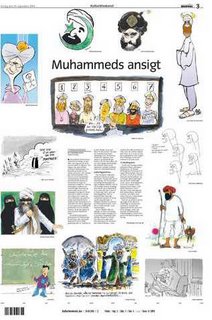
Congress approved a $750 million, five-year plan aimed at building healthier marriages Wednesday as part of its deficit reduction bill.
Good thing the fiscally-responsible Republicans don't believe in big government....
--Richard Bradley, Huffington Post, May 31, 2024
"The Gladwell Effect"
--Rachel Donaldio, The New York Times, February 6, 2024
"The Gladwell Effect is my term for writers who try to imitate Gladwell's techniques in hope of attaining something near his popularity..."
--Richard Bradley
"Gladwell...has helped create a highly contagious hybrid genre of nonfiction.... In the past year, several other books in the Gladwell vein have appeared...."
--Rachel Donaldio
I'm flattered....
According to Professor Harry Lewis, quoted in the Crimson, DEAS took a vote on the review now because, essentially, they wanted to send a shot across the bow—better a cautionary vote now than a flat-out rejection later.
I'm sure that's true...but I wonder if this shot won't hit the ship itself. Allow me to mix metaphors: This sinking ship is stumbling to the finish line, which makes you wonder if somebody shouldn't pull the plug on it.
(Sorry. That was terrible.)
I just find it hard to imagine that Bill Kirby—never all that popular with his constituency anyway—will, in his lame-duck status, wield the political capital necessary to pass a bad review.
Unless, perhaps, somehow he can frame a vote for the review as a sign of support for the autonomy of the FAS.....
How'd the Lampoon editor do that? (I haven't been on campus in a while, but the Lampoon isn't exactly prolific.) After all, two-book deals are pretty hard to come by in publishing these days.
I'm sure the fact that Random House publishes both his father and his stepmother has nothing to do with it....
Meanwhile, the Crimson reports that, at a meeting with students in the Leverett House dining hall, Larry Summers declined to address a direct question about whether he forced Bill Kirby to resign, saying that "Dean Kirby's letter speaks for itself."
Since the letter does not actually speak for itself—it is vague on what led to Kirby's resignation—Summers' answer is pretty lame, and I doubt he'll be able to maintain that pose of aloof non-responsiveness. When the dean of the Faculty of Arts and Sciences "resigns" after just four years in office, in the middle of a curricular review, the president owes the faculty more explanation than vague and political non-answers.
Sometimes I wonder if President Summers realizes that he's dealing with a community of fairly smart folks around Cambridge. That answer—the letter "speaks for itself"—is such obvious B.S., why even bother to say it? It insults the intelligence of the audience.
If Summers thought Kirby was failing in his job, he should say so. Because I'm sure that he would never oust a dean without having sound, meritorious reasons.
So here's a better response, which, unlike a certain Kennedy School uber-adviser, I volunteer free of charge: "You know, this isn't the right time or place for me to address Dean Kirby's resignation. But when it's appropriate, I will."
It still declines to answer the question...but at least it isn't deceptive in pretending to answer the question.
I'm always mystified when people prevaricate when there's no reason not to be honest. Why do they do it?
Because it's their nature.....
Oh, and word is there's a faculty meeting next Tuesday. I wonder what they'll talk about......
How much money is at stake? Hard to say, because we don't know what Harvard might originally have been able to settle the Shleifer matter for. But still, it seems a safe bet that the amount the litigants would seek to recover from individual members of the Corporation would be in the eight figures....
If this lawsuit happened, it would rock the Harvard community and attract national attention, because it would surely have implications for other universities. It would also bring much-needed attention to the Shleifer scandal.
Perhaps I'm going to have to write a sequel to Harvard Rules.....
That may now be changing.
Rumor has it that a group of alumni has formed to commence a class action lawsuit against the Harvard Corporation—more specifically, those members of it who were present when key decisions about how to handle the Andrei Shleifer case were made. The list of potential defendants includes: Larry Summers, Hanna Gray, Jamie Houghton, Bob Rubin, former treasurer D. Ron Daniel, and Robert Reischauer.
The basis for the legal action: fiscal irresponsibility in the Shleifer matter. In other words, choosing to defend Shleifer in court when the university's lawyers allegedly advised the university to settle the matter right away. The argument: the members of the Corporation have a fiscal responsibility to spend Harvard's money wisely just as the members of a corporate board of directors do.
The lawsuit would seek to recover the difference between the amount Harvard ultimately paid in fines and legal fees and the amount for which Harvard could have originally settled the matter. That could be in the area of $20-$30 million.
To be recovered from individual members of the Corporation, the money would be donated to student financial aid.
I have no idea if this is a legally viable argument, and I emphasize that the reality of this lawsuit is just a rumor. Obviously, I haven't been able to confirm it.
If it's true, you'll be hearing lots more about it soon enough. If it isn't, you won't.
________________________________________________________________
P.S. A poster raises the issue of how such a group would be able to claim standing to file such a lawsuit. Sounds like a good question. If anyone could shed light on that, I'd be curious to hear your thoughts.
As some of you may know, a few years back I was embroiled in a literary scandal myself. My decision to write a memoir about my former boss, John Kennedy, was angrily opposed by some of my former co-workers, who planted a number of anonymously-sourced stories about me in the media. I was writing the book because I couldn't get a job, because I wanted to be linked with the Kennedys in history's eye, because I was gay and had a crush on John, and so on.
Nasty stuff—and all planted anonymously, entirely without attribution, in the press.
But there was one, more substantive issue which my critics raised: the presence of a confidentiality agreement, signed by the original staff members of George (myself included), that we wouldn't write about John.
I felt strongly, both in the specifics and as a general principle, that such an agreement could not restrict one from writing about a deceased public figure. (I've subsequently written more on that subject.) Others disagreed, and used the issue to portray me as greedy and duplicitous.
In any case, my agent, Joni Evans, and I had always informed my publisher, Sarah Crichton at Little, Brown, about the agreement, and she had assured us that it was not a problem.
Turned out she was wrong. At some point in this whole controversy, the not-yet-defunct Brill's Content ran a lengthy article about me and the book. Content had a new editor, David Kuhn, formerly of Talk, who was hired to make the magazine snarkier—Content was hemorrhaging money—and I was his first victim.
The inevitable hatchet job by Abigail Pogrebin was so full of anonymous quotations, the magazine's ombudsman later singled it out as an example of what Brill's Content had been founded not to do.
And the ombudsman didn't know the half of it—didn't know, for example, that the magazine had dug up (and I do mean "dug up"—this was not easy to find) an intimate photo from my personal life and had planned to run it until I furiously pointed out that it was a sleazy violation of a woman's privacy; didn't know that the magazine had Photoshopped a picture of me with John to make it look as if I had my arm around his shoulders.
The piece also contained a damning legal commentary from First Amendment lawyer Floyd Abrams on the validity of the confidentiality agreement—without mentioning that Abrams happened to be Content's lawyer. Given that, without such a quote, Content really didn't have a story, Abrams' dual role of lawyer and source was a fundamental conflict of interest.
The day after the Brill's Content article came out, Sarah Crichton called Joni Evans, my agent, and told her that Little, Brown was reneging on its deal with me—not because of the confidentiality agreement, but because of the adverse publicity the planned book was receiving.
Joni asked Crichton to hold off talking to the press until she and I could figure out our next move. Then she called me. I was in shock.
Within half an hour, a reporter from the New York Post was on the phone. Somehow the Post had been informed that Little, Brown was abandoning the book deal.
The next day's Post contained a quote from Sarah Crichton, who said that she was backing out because I had only told her about the confidentiality agreement days before, and now that she knew of it, she couldn't publish the book.
That was—there's no other way to put this—a calculated, deliberate lie; Little, Brown's lawyers had had the document for weeks, maybe even months, a fact of which Crichton was well aware. During the entirety of that time, Crichton had been assuring us that the agreement wasn't a problem, that the lawyers were just crossing their t's and dotting their i's, and that everything was fine.
In the Post, though, Crichton was covering her ass, and she was willing to use me as a fall guy to do it. Even if it meant lying through her teeth. That was why Crichton, who had previously been nothing but warm and friendly to me, never had the guts to call me and speak to me about what happened—because she knew that she was a liar, and she knew that I knew it.
The following days and weeks were brutal for me. I was out of work, my reputation had been shredded, and my good intentions been convincingly spun as greed and betrayal.
I don't know that I could have survived that time without some sort of breakdown if it weren't for Joni Evans' support.
It would have been easy for her to dump me, just as Kassie Evashevski dumped James Frey. (Though, to be fair, Evashevski maintains that Frey lied to her; given the above, you can understand why I withhold judgment about such accusations.)
Joni didn't cut me loose—even though her association with me couldn't have been helping her excellent reputation. Instead, she assured me that I would survive and that the book would too. I clung to those assurances like the proverbial drowning man.
More than that, she set up a series of meetings with New York's most prominent First Amendment lawyers to get their opinions on the confidentiality agreement issue. She took me to lunch at the most visible Manhattan literary hotspots, to let the book world know that I had her support. That may sound trivial to you, but trust me: in the insular world of Manhattan publishing, it matters.
And when I decided to take a year off and write the book without a contract, without a publisher who was even considering it, without an income, Joni supported me all through that time as well, reading the clunky early drafts, giving me feedback, and most of all sustaining my confidence that I could rebound from this profoundly demoralizing and disillusioning setback.
Then, of course, when a manuscript was ready, she went out and sold the thing to people who saw that it was an honorable book, and it wound up hitting #1 on the New York Times bestseller list. But most important to me was the fact that, at last, I could point to American Son and say to people, "There. It's a clean, honest, admiring portrait of John Kennedy—exactly what I'd always said I was going to do."
And people could see that I was, in fact, a man of my word who, whether or not you agreed with me, was acting on principle. Which mattered to me more than any money or success.
Forgive the length of this story. But as you can see, I have some reason to be grateful for an agent who sticks by her writer when things really get ugly. And I know how rare such a person is. Much as James Frey deserves the criticism he has received, I hope he has someone like Joni Evans in his corner.
I quote:
PW: WHOSE RESPONSIBILITY IS IT TO VERIFY BOOKS?DO YOU THINK PUBLISHERS SHOULD HAVE FACT-CHECKERS?
KE: Certainly after this experience, I have to wonder if there is such a thing as a "nonfiction memoir." One can fact-check facts, but how do you fact-check memory and perception? I'm less clear on whether or not I think publishers have a responsibility to carefully check nonfiction works of a journalistic nature.Ultimately, I feel an author should be responsible for his or her own work, but I leave that to the legal minds.
This is a bunch of semantic hooey. Certainly in a memoir, the author's interpretation of events is subjective. Whether those events actually happened is not.Why is this even a question?
Huh.
If that's true, of course you can't blame her. But somehow I wonder if, now that the Frey train has derailed, and everyone hasn't made the vast majority of money off him that they're going to, everyone isn't just covering their own asses now.
He's not going to get another book deal for years, if ever...and if he does, it will presumably be for little money. (Every publisher knows that Frey will be desperate.)
Meanwhile, his agent will continue to take her 15% off further sales of A Million Little Pieces. One can assume she's already made a million bucks or so off the book.
"I have purposefully chosen not to comment on the controversy until now because I felt it was important to let James speak for himself," Evashevski told PW.
Boy. This is a cold town. That excuse is a load of crap. Evashevski didn't comment because she wanted to stay as far away from the controversy as possible, and hope that no one would notice her role in the Frey fiasco. At least Nan Talese had the guts to stick up for Frey, even if her reasoning was idiotic and her honesty uncertain.
As you may have noted, I'm not a fan of Frey's...but I hope that wherever he is, he has some people who are sticking by him and telling him that life will go on. I want the guy to learn a lesson...but it isn't necessary to destroy his life.
The answer is: Yes, absolutely. I take confidentiality extremely seriously, and when it comes to e-mail, I assume that something is intended to be anonymous unless it explicitly says otherwise.
So keep those comments and tips coming....
Meanwhile, a couple of corrections.
I was wrong to say that no one at Harvard is making lectures available via podcast. A poster below informs me that Harry Lewis is doing just that. Good for Lewis, who seems to be shaping up as a real alternative, anti-Summers force around Harvard. I can't wait to read his forthcoming book, Excellence Without a Soul. It seems likely to have a considerable impact on Harvard alums, coming as it does from a man who has spent something like 40 years at the university.
And another clarification: In my post on the Summers-Shleifer conspiracy theory, I theorized that a quote from Summers to Shleifer came from Shleifer, when in fact it came from Larry Summers' deposition in the federal case. (Thanks to the posters who let me know.)
I still wonder, though, if Shleifer doesn't have some leverage over Summers that is impinging on Summers' ability to deal with the Shleifer scandal in an ethical way. The alternative would seem to be just...well...the absence of ethics.
Thanks again to the posters who bring these things to my attention. I try to be more accurate than James Frey, but once in a while, mistakes do creep in...
Among the names mentioned: Theda Skocpol, David Cutler, and Jeremy Knowles.
But none of these names come without baggage.
Skocpol is considered strong and independent. Ergo, Summers probably wouldn't choose her.
David Cutler is an economist friend of Summers, which would pretty much eliminate any faculty trust in him.
Jeremy Knowles, the crafty Brit, is extremely competent and reasonably well-liked by the faculty—but then, nobody can trust Knowles.
The Crimson also raises the curious option of Summers appointing himself as dean—apparently there's precedent for this—a move which would presumably prompt mass hari kari around 02138.
There's also one piece of hard news in the piece: Drew Faust—whom, I'm told, was offered the FAS deanship by Summers before he offered it to Kirby—has removed herself from the running the second time around.
This is going to be very tricky for Summers, who is promising to consult widely during the search. Of course, Summers always says he'll consult widely during his searches, and then he goes and chooses the person he wants. (Not that there's anything wrong with that; it's probably unreasonable to expect a president to appoint a dean he doesn't want.)
So if you have any tips for Larry Summers, you can write him at the rather pathetic e-mail, [email protected].
But hey, the way things are going at Mass Hall these days, don't be surprised if your e-mail shows up in the Crimson....

Dear Richard,
I think you fail to understand the rationale behind the leak that Bill Kirby was about to be fired and the role that the Crimson played in Kirby's dismissal. Larry Summers appointed Bill Kirby because he was weak and likely to do the president's bidding. Kirby was then in a difficult position. He carried out many unwise and unjust policies as directed by Summers, yet he was too weak, and basically too decent and honest, to do everything that Summers wanted. Furthermore, Summers constantly undermined him, blaming Kirby whenever one of Summers' ideas turned out to have been stupid. All these made for an untenable working relationship between the two men, and Kirby had planned to resign in the spring in as decorous a manner as possible. He is concerned about his reputation and his career, and his instinct has always been to put as good a face on things as possible.
Summers, however, knew that he had a meeting of the Governing Boards (both the Corporation and Overseers) coming up on February 6th. He was aware that questions were likely to be asked about the parlous state of FAS finances, which are entirely Summers' fault. It is Summers who was overenchanted with "big" science; Summers who insisted on an uncoordinated, rushed plan for science on both sides of the river (building Harvard's most-expensive-ever science buildings in Cambridge while simultaneously starving FAS to pay for his science theme park in Allston); Summers who offended donors, spent money that he could not raise, and generated controversy that delayed a campaign indefinitely. Summers was aware that some Overseers were deeply discontented and were planning to ask questions about his leadership. In short, Summer was worried that the meeting would go down a dangerous path and might lead to his contract not being renewed for another five years.
Summers therefore decided to leak the information to the Crimson that Kirby was about to be fired. He thought that the timing was perfect. He was in Davos. Kirby was just returning from a trip to New York. The news of Kirby's departure would occupy the entire meeting of the Governing Boards. Summers could lead a long discussion of how Kirby would be replaced and how the replacement would solve all of the problems in FAS.
It appears, from conversations with members of the Corporation and the Board of Overseers, that Summers' plan worked at least in part. They were duped. Many of them went home on Monday night satisfied that Summers had a plan to replace Kirby and that, with his replacement, all would be well.
Back to the leak. The leak was given not only to the Crimson but also to the Boston Globe (Marcela Bombarieri). This happened at approximately 7 p.m. The Crimson and Marcela then went looking for confirmation. It appears that a second source called the Crimson, but possibly the Crimson found the second source on their own. Both of the Crimson's sources were so close to Summers that they were indubitable. Marcela telephoned around on Friday evening trying to find sufficient confirmation to satisfy her editor, who probably has higher standards of journalism than the Crimson. Finally, at about 9 (time approximate), the Crimson telephoned Kirby and said they were going to run the story THAT EVENING that he was being fired. Kirby had a short time to give them a letter of resignation so that he could appear to have resigned. Kirby spent the short time at his disposal editing his letter (which may have been partly composed already). He was no given no time even to call his own deans. This was by design. If Kirby had had time, at least a couple of his deans would have advised him not to resign–to insist on being fired. They would have told him that, if Bill had the stomach for a fight, he would have the faculty's support.
The Crimson, in short, was doing the dirty work of the President. It is not entirely clear to what extent they knew what they were doing and to what extent they were tools. What is clear is that the Crimson has largely been bought off by Summers. This happened sometime just before graduation last year when Lauren Schuker, then editor-in-chief, was given inducements to support Summers. It should be noted that, at about that time, Schuker changed her Facebook.com entry to include laudatory statements about Summers, including one extraordinary statement about being "fascinated" with Summers and finding him "SEXY". From that time onwards, that some Crimson reporters have been largely in Summers' employ.