It is hilarious. And in a strange way, it is heartwarming. There is more genuine laughter in this movie—the people in it, not just the audience—than you'll see in a lifetime of sitcoms. Much of the film is really about the tribe that is comedians...how they all know each other, they respect each other, and they all know this one joke, passed down through the ages. No matter how slick they get, how much money they make, they remember where they came from, and the beauty and art in the telling of one, simple but not so simple, joke. It's fitting that the best telling of the joke is done by squeaky-clean Bob Saget, whom middle-America knows from the old sitcom "Full House" and, I think, "America's Funniest Home Videos." His telling of the joke is genius—there's really no other word for it. He interrupts the telling to go out and "entertain people"—it looks like he's got a stand-up gig to do—and you somehow feel that you've been privy to something much funnier than whatever he's about to do for that other audience.
Then there's Gilbert Gotfried, telling the joke to make people laugh and raise money weeks after 9/11....Kevin Pollack imitating Christopher Walken doing the joke...Drew Carey describing his little flourish at the end in a way that can only be described as sweet...Andy Richter telling the joke with his infant...and when the infant doesn't laugh at the punchline, he pushes it a little farther, as if to say, "Oh, yeah? That didn't get you laughing? All right, try this!"
The Aristocrats is about a joke, but it's really a movie about a group of people who are very, very good at making the rest of us laugh, and the joy we all get when they say the things that we dare not.
The Globe story is better because it adds new material to what the Crimson reported yesterday. Reporter Marcella Bombardieri finds a source who is "close to Harvard's leadership" and "familiar with the discussions over Harper's resignation" who provides these insights:
"...Harper was displeased with Summers' criticism of celebrity professor Cornel West, which prompted West to leave Harvard. Harper was also upset, according to the source, both about Summers' comments on women in January and his remarks about Native American history at a conference this past fall. In that speech, Summers contended that many more Native Americans were killed by disease than by Europeans, and spoke of the 'vast majority of suffering' as a 'concidence that was a consequence' of assimilation and 'nobody's plan.'"
Some thoughts of my own.
You'll notice that Harper says "it's up to Harvard" to release his resignation letter. That's different than saying that it shouldn't be made public. Harper clearly wants his grievances to come out. Fascinating; he must really be pissed. This move puts some pressure on Summers, et al, to release the letter—just as happened with the transcript of his remarks at the women-in-science conference.
The question of the Corporation and its composition now becomes so urgent for Harvard, it has risen to the level of a crisis. In four years, Larry Summers will have appointed five of the six Corporation members other than himself. The last holdout is Jamie Houghton, who is not young, and surely can't enjoy having to stick up for Summers every time some new controversy arises.
(And yet, Houghton, the Harvard loyalist, does it. Notice his quote about Harper's resignation: "I regret that he has chosen, in reflecting on recent matters at the university, to bring his service to a close." This we can classify as spin. That clause—"in reflecting on recent matters at the university"—is a subtle dig, an attempt to suggest that this is the last fall-out from the women-in-science fiasco, and nothing more...when in fact Harper's dissatisfaction with Summers dates back at least to the Cornel West matter in the fall of 2001. Houghton is playing damage control here...and in the process, he is damaging his own reputation and credibility. Sad for an old man nearing the end of his career to compromise himself for a younger man who probably doesn't deserve it.)
(It is possible that if Houghton were really the Harvard loyalist, he would organize Larry Summer's ouster...but then, he's outnumbered, isn't he?)
The question becomes, what if everyone wanted to fire Larry Summers...except the people who have the power to do it? Because Larry Summers appointed them....
Wait. Stop. That was sensational. True, but sensational. Let me start over.
Conrad Harper, the only African-American member of the Harvard Corporation in its 355-year history, has just resigned from that body, telling the Harvard Crimson that he "could no longer support President Summers."
The Corporation, you will recall, is Harvard's seven-member (including President Summers) governing body. It meets about once a month, in secret, and is notoriously tight-lipped. It happens to be the body which chose Larry Summers to be president—although Harper was rumored to have preferred Lee Bollinger, then the president of the University of Michigan and now the president of Columbia.
Since Summers was chosen, four members of the Corporation have retired from it, and Summers has handpicked replacements who are, in background and interest and perspective, rather like him.
Harper has apparently never been a fan of Summers. He was said to be furious about Cornel West's departure for Princeton, and very concerned that Skip Gates would also leave. This spring, after the faculty vote of no-confidence in Summers, Corporation senior fellow Jamie Houghton released a letter saying that the Corporation supported Summers. Some eyebrows were raised over the fact that Houghton was the only signatory; it was whispered that Harper had refused to sign.
The quote that he gave—he "could no longer support President Summers"—adds some circumstantial evidence to that theory.
While this event may seem like inside baseball to some, to the Harvard community, it's a very big deal. I'm not aware of any precedent—not, at least, in Harvard's modern history. (Larry Summers is creating all sorts of unfortunate precedents at Harvard: first president given a vote of no-confidence, first president to become a national object of controversy, etc.)
Conrad Harper is a smart, highly respected man, a member of the New York legal establishment, a member of the United States establishment. He's no fire-breathing radical, and he wouldn't take this step lightly. He clearly wants it to have some impact.
This should be interesting.....
My uneasiness is not completely quelled by watching last night's episode, in which a group of rookie soldiers tries not to get killed during its first week in Iraq. There are some awkwardly Hollywood moments in the episode, such as when the African-American recruit named Angel composes a song that just happens to be the show's theme song. (And not a particularly good one, either—it sounds like a beer ad.)
But still, there were moments when we saw a side of the war that we don't see on the nightly news. At one point, a female soldier is nearly shot when she's trying to take a nighttime crap in the desert. Not pretty, but I'm sure that this is how many of the deaths in Iraq come—in the middle of the most mundane acts, the combination of the banal and the horrific.
At episode's end, a US truck drives over a roadside bomb, and a soldier has his leg nearly blown off; another soldier tries to hold it together as the wounded man is lifted onto a stretcher. The agonized cries of the wounded man are truly haunting.
Who knows? In a culture where so many prefer reality tv to reality, and where the Bush administration won't allow photographers to take pictures of coffins coming home from Iraq, maybe it will take a fictional TV series for people to start realizing just how terrible war is—especially when it's based on lies.
Short version: Miller was so pro-war that she's the one who told Scooter Libby and Karl Rove of Valerie Plame's CIA identity, in order to discredit ambassador Joe Wilson, Plame's husband, who was writing anti-war editorials in the pages of Miller's own newspaper.....
Which, if true, would make me recant all the nice things I've previously said about Judith Miller's principled stand on sourcing. More important, it would just be appalling—terrible for journalism, terrible for the Times.
Is it possible? I think so. I once saw Judith Miller speak about the war in Iraq, and was impressed by her passionate hatred of Saddam Hussein's regime—this was a subject about which she clearly had no objectivity. Of course, you can understand why. But her cold fury did seem to have affected her ability to report on the war without sounding boosterish. At one point, describing her status as an embedded correspondent with a group of soldiers, she described American soldiers in Iraq using the first person plural....
Let's consider the group of people now of interest in the CIA agent's outing: John Bolton, Ari Fleischer, Karl Rove, Scooter Libby...and let's not forget Bob Novak, the journalist who started it all.
Strikes me that, as you might expect from a nasty piece of work, this is a nasty group of people. It says something about President Bush that, although he can come across as genial and likeable, he surrounds himself with a bunch of hitmen, and their court scribe, Bob Novak....
"Seconds ago, I received two weeks’ notice from my senior research assistant [RB:
a) You have at least a master’s degree in American history or a closely related field like American studies, or, you have at least two years experience as historical researcher or editor or as a particularly impressive intellectually-oriented journalist on say, a Matt Yglesias or SARAH WILDMAN level (which means I should already be acquainted with your work).
b) You already live, or will be living, in or around New York City two weeks from today.
c) You can make a commitment to work 20-40 hours a week at least until Labor Day
d) You are independent, efficient, grown-up, well-organized, and discrete [sic]."
The picture alone of this incident is disturbing.....
I don't want Clement, one of the Sox's pleasant surprises this season, to win any more games, but not for this reason. Here's hoping that he's okay.
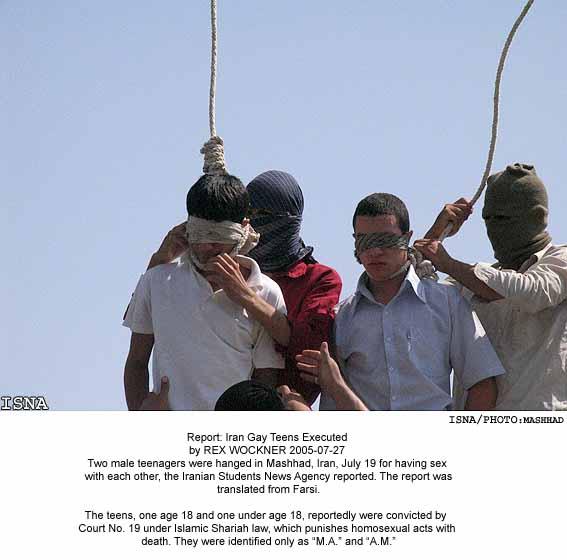
Two teenage boys, one 18 and one younger, have been executed in Iran because they allegedly had sex with each other. It's big news all around the world...except here. Would it be too much for the White House to voice its displeasure?
"The NCAA is the beer industry’s pied piper among children," said George A. Hacker, director of the alcohol-policies project at CSPI.
Uh-huh. And college students would never drink beer if they didn't see it advertised during basketball games.
CSPI is generally a good watchdog group, but they do tend to the puritanical. Wouldn't it be nice if they, and the rest of the country, suggested instead that young people learn that there's nothing wrong with a beer or two, as long as they drink responsibly? A beer or a glass of wine at dinner isn't going to kill an 18-year-old. (No, leave that to insurgents in Iraq. I still don't get the whole, you're allowed to join the army and kill people, but you can't drink a beer afterward, thing...)
Of course, three or four beers, followed by a quick drive down the road, might kill you, and some other people too. (Especially if you're driving an SUV.) But one beer does not invariably lead to three.
At the moment, this country says to young people, don't touch a drop of alcohol till you're 21, and then, boom, go crazy. Wouldn't a more gradual, common-sensical approach work better?
Well, times have changed, and now the Republican Party has become the party of big government, in everything from spending to domestic security to education. One specific area is the Solomon Amendment, which would allow the government to sever federal aid to educational institutions that ban military recruiting—not just the part of the institution that bans the recruiting (say, a law school), and not just the aid related to the military. The Clinton administration didn't enforce this law; the Bush administration is enforcing it.
Given Roberts' past position on Title IX, I'd like to hear a Judiciary Committee senator ask him whether he now thinks that the Solomon Amendment allows the government "to rummage willy-nilly through institutions," or whether the government's reach "can only go as far as the federal funds go." It seems only fair.
What a load of crap.
I remember back in the '80s, when Iacocca, now 80, first used that line in commercials. At the time, he was hawking Chrysler's infamous line of K-cars, perhaps the biggest pieces of junk ever to set wheel to the road. (If you don't remember them, does this help? Chrysler LeBaron, Dodge Aries, and Plymouth Reliant.)
Perhaps out of sheer chutzpah, those ads actually worked at the time; people went out and bought Chryslers. Will they again? It's hard to imagine. Chryslers' cars have improved since that time, but still...if I could find a better car than a Chrysler? To do that, all I'd have to do is look at any car made by Honda, Nissan, Toyota, Volkswagen, Audi, BMW, Mercedes, Subaru, and so on.
I was thinking of this as I read an article in today's Times about how Sony has been caught in a payola scandal. Apparently Sony was giving away computers, trips, sneakers and other stuff to disc jockeys in exchange for playing songs by Sony artists. Now you know why Good Charlotte and Celine Dion have careers.
What's the connection? In both instances, I think, capitalism isn't working. Chrysler is using ads that are literally incredible; Sony is trying to shove bad musicians down people's throats. (Well, ears, really.) The result is that consumers, who are more sophisticated than they were back during Iacocca's first time around, may actually shun Chrysler cars more than they do now; and music fans, bored of formulaic radio, start stealing music off the Internet, listening to webcasts and Podcasts, and just generally rejecting all the crap that the music biz shovels out to the public.
Here's a particular irony about the Sony story: Apparently it's totally fine for Sony to break the law to get you to hear their music...but it's totally, totally wrong for consumers to break the law to try to hear/download music that they actually like....
Writing in the Boston Herald, Virginia Buckingham argues that Summers has dropped the ball by failing to push for the reinstitution of ROTC on the Harvard campus. (At the moment, Harvard students who enroll in ROTC travel to MIT for their training.)
Faced with recruiting shortfalls, the military needs officers, Buckingham says. And Harvard students lose out on a life-changing patriotic experience by not supporting the military.
Buckingham's article is both right and wrong. It's wrong in the sense that Summers has in the past pushed for the restoration of ROTC at Harvard, particularly in the weeks after 9/11. She's right in that Summers, after getting lots of credit for his rhetoric from American conservatives never actually did anything to bring ROTC back. Doing so would require a vote of the faculty, and Summers has never chosen to expend his political capital on such a vote. Accurately or not, that decision has created the appearance that Summers wants to get credit for talking up military service without raising a sweat on its behalf.
I'm of two minds about this. The reason Harvard doesn't have its own ROTC program is because of the military's anti-gay discrimination; Harvard bans recruitment on its campus by any employer that discriminates. I think that's a principled stand, and I support it.
At the same time, I do think that there's real value in military service, and that the exclusion of the military does separate Harvard from the national mainstream in some unfortunate ways. It also exposes Harvard to charges of being unpatriotic, which, in my opinion, it is not.
There is, of course, an easy solution. The military has a severe recruiting shortage; the military bans gays from service. Hmmm.
But since the military doesn't seem likely to change its policy, what to do? I honestly don't have an answer for that. Do you?
The irony here, of course, is that people buy SUVs because they feel safer in them. A double irony, really. They're not safer, because they're more likely to lose control and crash. And the people they crash into are invariably more likely to be wounded or killed than if they were hit by, say, a Honda Accord or Volkswagen Jetta.
So I think I'll start pointing out some of these incidents here on the blog.
Like this one: Infant Clings to Life after Crash by Repeat Offender. It's upsetting on many levels. A guy driving an SUV hit a pregnant woman in an SUV. The guy had repeat convictions for driving while on drugs, and had had his license suspended. His girlfriend admitted that she allowed him to use her car even though she knew that his license had been revoked....
Massachusetts is considering a law which would mandate jail time for repeat driving-under-the-influence offenders, to which one can only say, Of course. You drive drunk more than once, and you should go to jail.....
The more I learn about this episode, the more upsetting it gets.
I still haven't read a good explanation of why this man was shot in the first place. That's because there is no good explanation.
Here, from Sarah Lyall's report in the New York Times, is the reason Menezes was shot and killed:
"Having found the address in a backpack left behind by one of the bombers in the failed attacks on Thursday, the police were watching the building where Mr. Menezes lived. But they failed to realize, apparently, that there was more than one apartment there. So when Mr. Menezes left the building to go to a job on Friday, they followed him. They trailed him onto the No. 2 bus, bound for the Stockwell subway stop, a little more than 10 minutes away."
Let's just emphasize that: the police didn't know that there was more than one apartment in the building. And yet they are considered competent enough to make a split second decision about shooting someone in the head.
According to the police, Menezes was wearing a "bulky jacket," which made them think he might be hiding something. Plainclothes policeman allegedly identified themselves, Menezes—who had been attacked by a gang a few weeks before—panicked and ran. He actually ran headfirst into a train and fell on his stomach. The police then shot him, from behind, five times in the head.
I'm going to emphasize the word "allegedly" here, because that's what cops always say after shooting someone in the back of the head—that they properly identified themselves first.
So let us consider two things about this incident. Jean Charles de Menezes would never have been shot if he didn't have dark skin. And if he didn't have dark skin—if he were, say, a white Oxford student—the British authorities would be apologizing, and the British public would be demanding it. But Menezes is Brazilian, and so he is dead.
However, I'm happy to announce that the Re-Ethicist is back!
This week, Randy Cohen, a.k.a. the Ethicist, responds to a letter from Jo Sanders of Seattle. Along with her husband, Jo went to see her son participate in an improv comedy competition, the winner to be determined by audience vote. She thought that her son's team was not the best, so she voted for another team. Her husband agreed with her estimation, but voted for his son's team out of loyalty. "Who was right?"
Randy Cohen, a.k.a. the Ethicist, replies, "I'm with your husband."
Wrong!
" Your husband could more convincingly argue that by soliciting votes from an audience with obvious personal ties to participants, the venue surrendered any hope of a dispassionate verdict," Cohen writes.
This strikes me as a fancy way of saying that two wrongs make a right. They're biased, so you can be too.
But let us consider this event from its impact on the boy. There is no satisfaction in a hollow victory. Chances are that Ms. Sanders' son knows his group wasn't the best. (And if he doesn't, he might want to consider another hobby.) Knowing his secondary status and yet winning would only teach the youth that the best way to get ahead is not on merit, not on ability, but by stacking the deck.
Let me close by pondering the premise of Ms. Sanders' question: "Who was right?"
In this situation, two people took two different actions, each for what they considered moral reasons. Must one be right and the other wrong? Can not two people be right at the same time? And correspondingly, are they not both wrong at the same time?
Discuss.
In this situation, there is no such thing as Truth. There is just one truism: Randy Cohen, a.k.a. the Ethicist, is wrong!
I say that with sadness, but not opposition. It's impossible not to ride the subways these days and not think how vulnerable they are to terrorist attack; it's a small miracle that nothing has happened so far. We not only allow, we encourage bag searches on airplanes. Why not subways?
The only problem, of course, is that random bag searches often aren't random at all; if you're a backpack-toting tourist from Pakistan, odds are you're going to spend some time with your friendly New York policeman.
I know I should be upset about that, too, but I can't say that I am. Given who's committing acts of terrorism these days, and the sheer impossibility of inspecting everyone's bag, it only makes sense to do some profiling of potential searchees. Let's just hope that the search process is carried out with some sensitivity, so that we don't wind up needlessly humiliating people who've done absolutely nothing wrong.
But let there be some logic to this process, as well. I remember how, after 9/11, the Yankees banned the carrying of bags into the Stadium. In reality, men were forced to check their bags, no matter how small, at a bar across the street. Women could carry in purses of virtually any size....
""I don't know that he has addressed any issues. They are kind of locking him away, letting him run on his father's name."
Huh.
Um....Mrs. Dole...wasn't your husband a senator for, oh, about 30 years? And weren't you the one who ran one of the most notoriously issue-free campaigns in modern political history?
Oh, and if your name-piggybacking weren't enough...I'm sorry, but who's president, again? And governor of Florida?
Honestly, these people....
As the Boston Globe points out, just nine months ago, Summers declared that there was no need for such a figure at the university. That, of course, changed after his remarks about women's lack of brainpower in matters scientific.
Who is Hammonds? Well, she's a black woman with a B.S. in physics from Spelman College and a B.E.E. in electrical engineering from Georgia Tech. She also has an S.M. in physics from MIT and a Ph.d. in the history of science from Harvard. She's been involved in undergraduate advising at Harvard and served on a task force for women faculty. She's published one book, Childhood's Deadly Scourge: The Campaign to Control Diphtheria in New York City," 1880-1930," and a number of papers usually dealing with race, gender, and science, such as one titled, "Black (W)holes and the Geometry of Female Sexuality." She's now working on a book about the history of race in science and medicine.
I think it is safe to say that, for all sorts of reasons, this is not the kind of professor Larry Summers would have preferred to appoint to a high-ranking position in his administration....
Let's consider what we know about Roberts.
1) He's qualified. It'd be nice if he were more of a legal thinker, but on the other hand, he's had enormous experience in the law, he's obviously very smart, and he seems to have lived an ethical life. Three out of four ain't bad.
2) He's conservative. So what? He's well within the mainstream of political and legal thinking. The president certainly has a right to appoint conservative judges to the Supreme Court, as long as they're not nut-jobs. Anyway, as we all know, once appointed, judges can surprise you.
3) By attacking Roberts, Democrats and liberals would only damage their own credibility; they'd look as if they were fighting only because they've geared up for a fight. Let Roberts pass. Remember that some day there will again be a Democratic president, who will want his qualified nominees to SCOTUS to receive respectful treatment from the opposition party.
There are plenty of battles to fight; Democrats don't need to fight this one. They'll only wind up looking hysterical and out-of-the-mainstream.
4) Anyway, I suspect that it's the next nomination liberals will have to worry about—the imminent replacement for Rehnquist. If Dems huff-and-puff on this one, they'll lack credibility when the president really does nominate a dangerous ideologue and they huff-and-puff all over again.
5) And here's a final piece of unasked-for advice. The president has tried to frame the debate by appropriating the term "civility." Democrats should retake the word and change the subject by asking the question: "Is it civil for the president's closest aide to engage in a smear campaign against a patriotic CIA agent?" Don't talk about John Roberts. Talk about Karl Rove.
(I'd link to it, but the Post charges you for stories that are a day old. Doesn't Rupert Murdoch have enough money?)
So I'll just quote Keith extensively.
(Necessary back story: American Media is the publisher of various gossip and weightlifting magazines, and the company that signed Arnold Schwarzenegger to a secret $8 million consulting deal just days before he became governor.)
Keith Kelly: "Insiders at American Media said that as the company began to sweat over how to deal with the disclosure [of Schwarzenegger's deal], many ex-employees said they were surprised to suddenly receive warning letters from American Media informing them that they were still bound by their confidentiality obligations to the publisher. The letters went out on July 7 to hundreds of employees—from lowly assistants and secretaries to top executives.
"A spokesman for American media, Stuart Zakim, said that there was 'absolutely no connection' between the warning letters on July 7 and the Schwarzenegger disclosure a week later.
"'It was just a reminder that we do periodically,' he insisted of the letters."
Well, we can just write off that disclaimer as PRBS. (You can figure that out.) The letters were obviously an attempt to intimidate employees who might have known something about the Arnold deal from talking to the press. It isn't be the first time American Media has attempted to intimidate its employees; as I wrote back in April, the company actually sued to stop an ex-employee from writing a novel because it was rumored to be a send-up of AMI editor Bonnie Fuller.
I've mentioned before the ironies in a company that publishes Star and the National Inquirer trying to stop its employees from speaking to the press....
But the problem with confidentiality agreements goes beyond mere irony. They are a real threat to the practice of journalism and historiography in this country. Again, to quote myself, confidentiality agreements are increasingly used by the powerful to silence the powerless. And yet, no one seems to make a fuss about them.
As some of you may know, I've had my own run-ins with a confidentiality agreement. In my case, a document intended for one thing was deliberately distorted by people who hadn't written or signed it to try to keep me from writing a book—and those people were almost successful.
Now Arnold Schwarzenegger is using confidentiality agreements to keep his staff from talking about him, and AMI is using them...also to keep their staff from talking about Arnold. Now we know one reason why: Because the governor of the nation's largest state received an $8 million payoff (and was there any actual work involved on his part?) which may well have affected his veto of a piece of legislation.
I'm sure there are instances where confidentiality agreements are important: business transactions, for example. More and more, though, they're just insidious.
According to the AP, "The toothy tiger shark may not have won the competition, but it did win the admiration of other fishermen. Steven James of the Boston Big Game Fishing Club said this truly was a monster shark, and one that 'could eat you.'"
Could. But didn't. And I'd bet that it's been decades since anyone was killed by a shark off Martha's Vineyard. Conversely, humans kill millions of sharks every year. Most are caught in massive, miles-long drift nets; many are killed for their fins, which Asians use in soup; and some are killed by fishermen who think that destroying a beautiful animal makes them bigger men.
A beautiful animal, you say? Absolutely. Sharks are amazing creatures, especially when seen underwater. I've never dived with tigers—and frankly, I wouldn't advise it, unless from a cage—but trust me, when you see a shark underwater, it's like no other fish in the sea: dramatic, powerful, and graceful. And rare. It's getting harder and harder to see sharks, as human beings kill more and more of them—whether by accident, in the mistaken belief that their fins are aphrodisiacs, or, perhaps worst of all, for sport.
And the media doesn't help much. This wasn't a "monster shark," as the AP put it. This was a big shark, a fantastic specimen, and one that's getting harder and harder to find. Imagine if the AP had said, "a rare, magnificent specimen of one of the world's oldest species was pointlessly slaughtered today by human beings who wanted to win a contest and take a picture of themselves with the dead animal before tossing its carcass back in the ocean." That's more true than calling the shark a "monster." So how come no one writes it?
I don't want to be attacked by a shark any more than anyone else does, but on the other hand, I don't want to live a life entirely free of risk. It's sheer hubris to think that we should rid the planet of any other species that might put us in danger, no matter how infinitesmal the odds. Yet that's exactly the effect of the hysterical media coverage every time a shark bites a surfer's leg off.
These Martha's Vineyard fishermen shouldn't be proud of themselves. They should be ashamed.
Who can forget all those classic Star Trek episodes in which Kirk would say, "Mr. Scott, how long to fix the warp drive?" And the chief engineer would answer, "I don't know, Captain, but I'd guess about three weeks." And Kirk would grit his teeth and say, "Well, Scotty, you've got 12 minutes until we all die."
And somehow Mr. Scott, a role model for resourcefulness while under the influence, always managed to fix the damn thing just in time.
Having gone where no man has gone before, James Doohan has now gone where all men and women will ultimately travel. Let us hope that he is looking down on us from above, a glass of his beloved scotch in his hand, that irreverent grin on his face, ready as ever to save the Enterprise should his services again be required.
Why do these things somehow seem to go together?
More to come, but I'm on deadline.....
Case in point...
Last night, I was walking down a stretch of Columbus Avenue, between 70th and 71st, that I've walked a hundred times if I've walked it once. For some reason, I happened to look up at a building on the west side of the street. High on its red brick facade was a large, wooden sign I'd never noticed before. "J.M. Horton Ice Cream Co.," it said in grand old block letters. The sign looked old, and I couldn't believe that I'd never seen it before.
On arriving home, I promptly googled "J.M. Horton Ice Cream," and found something, of course. (How did we live without Google?)
J.M Horton was an ice cream maker founded, apparently, in 1873. At one point, it was the largest ice cream company in New York, selling three-fifths of all the city's ice cream, and providing desserts to several presidential inaugurals. It existed in that Columbus Avenue location even before 1904, when the IKT, New York's first subway line, began running on nearby Broadway. A few shops down the block was a little store called Hellman's Deli. You will recognize the name as the maker of the mayonnaise that we can't eat as much of as we'd like to.
Pretty great, huh? A sign from the past saved into the present. A reminder of what the Upper West Side once was.
The Yanks are in first place, Johnny Damon's hitting streak ended, and the J.M. Horton sign rules over Columbus Avenue. Who cares about the weather? (Which is miserable, by the way.) There's no better city in the world.
President Bush, as you probably know by now, has changed his tune on Karl Rove. In the past, he said he'd fire anyone who was "involved" in leaking Valerie Plame's identity. Now he says he'll fire anyone who "committed a crime."
This blatant shift to save his brain—which is to say, Karl Rove—has fooled no one.
Whatever your politics, this should be a truly demoralizing moment in the history of presidential politics. The President of the United States has just declared that people who work for him can engage in all manner of skullduggery—as long as they're not convicted of a criminal offense.
This is setting the bar shamefully low.
I've never worked in the White House, but I would consider it one of the greatest honors in American life. Nobody should have a higher standard of ethics than people who work in the White House—whatever party they belong to.
Being able to work for the president as long as you are not a felon is not a sufficiently high standard. This country deserves better.
Two other points.
Remember all the Bush—ite rhetoric back in 2000-2001 about how they were going to restore honor and dignity to the White House?
You don't hear that any more.
And two, can you imagine what conservatives would be saying if Bill Clinton had pulled a switcharoo like this? The anti-Slick Willie crowd would be screaming bloody murder.
Well, guys—consistency's a virtue. Let's hear it.
Let me be the first to say that, in some respects, they have no right to be there. Their pitching staff is a ramshackle joke. (Is there a less clutch, less pleasant human being alive than Kevin Brown? If you're going to be a jerk, you'd better at least be good.) The Yankees have an entire starting rotation on the disabled list. (And it's only costing them about $60 million.)
Watching Bernie Williams play the outfield reminds me of watching Michael Jordan in the minors. It's excruciating. You want someone to pat his hand and tell him everything's going to be okay.
Jason Giambi is having such a wonderful and unexpected resurgence that even some of my Yankee friends (you know who you are, ye of little faith) wonder if he isn't back on the juice.
And when one of these players gets hurt....the Yankee bench is thinner than Lindsey Lohan.
Nonetheless...here we are. Number one, baby.
I have previously referenced the classic football film, "The Replacements," so you'll know what I mean when I say, you gotta have heart. The Yankees, apparently, do. Heart is Gary Sheffield and A-Rod beating the Red Sox like a drum. It's Al Leiter coming up from the minors and pitching a gem. It's Jason Giambi bunting—bunting!—for a single. It's Ruben Sierra, the occasional DH, coming up big in the top of the 8th against Texas last night. It's Tanyon Sturtze, pitching as many innings as he can. And it's Mariano Rivera, with an ERA so low that Ed Klein has to look down to see it.
This Yankee team has driven me crazy at various times over the season...but I'm kinda starting to believe. I've been burned before with this bunch, oh yes. But pleaseGodpleaseGodpleaseGod...let us continue to kick some Red Sox ass.
P.S. Meanwhile, up in Boston, Dan Shaughnessy is blaming Red Sox manager Terry Franconia. He writes: "The Sox have lost nine of their last 13 at Fenway and the manager with the World Series ring on his finger is suddenly sitting on the hot seat."
Silly Dan Shaughnessy. Don't you know you're the one to blame for the Sox's swoon? You're the guy who wrote that the Sox would win it going away, "like Secretariat in 1973." Your hubris has angered the gods of baseball.
Guess what, Boston? The Curse is back, and it's Dan Shaughnessy's fault.
So it was a delight yesterday to read this item on the New York Post's Page Six. I'm going to quote the whole thing here (sorry you can't see the photo), because this level of vitriole in the New York media is indeed unusual:
"July 17, 2024 -- THIS is the face of snarkiness incarnate. Unknown outside the dork-infested waters of the Blogosphere, her name is Jessica Coen, and she's the co-editor of Gawker.com, where she regurgitates newspaper and magazine stories and slathers them in supposedly witty sarcasm. Every time we bump into Coen, 25, who likes to accessorize with a stuffed dog poking out of her handbag, she smiles and showers us with sycophantic praise. But her every mention of PAGE SIX on her Web site is snide and snarky. Word to Coen: Next time you see us at a party, keep walking. Or slithering. You can't be a boot-licker and a back-stabber at the same time."
Gawker's response? A weak attempt at parody:
"There’s This Pot. And This Kettle.
This is the face of hard newsiness incarnate. Unknown outside the skeeve-infested circles of gossip-mongers, its name is Page Six, and it serves as the gossip column for the New York Post. (Incidentally, the Post is owned by Rupert Murdoch, who isn’t even American.) Page Six, which eats only the kittens they choose not to drown, loves to set fire to your furniture while wearing last season’s skeevy H&M. Page Six hates Live 8 and was thrilled to hear about what happened in Iraq this weekend. On their way to a vacation in North Korea, Page Six tried to kill a recently adopted Ethiopian baby. Word to Page Six: Watch your step, ‘cause Brad Pitt ain’t gonna have none of that."
Advantage: Page Six, whose attack has the ring of truth, while Gawker's response is just...lame.Don't get me wrong, I'm not a big Page Six fan either. But Page Six is buried within the NY Post—not exactly highbrow media—and in a weird way, it does have its own set of moral codes.
At its best, Gawker is a vehicle for social satire of our celebrity culture. More often, it's just a way for kids whose careers aren't going as planned to be mean without having to be held accountable for their nastiness.
I like Keith, but he sometimes gets things a little off; his column implies that working for Plenty is a full-time gig, which it isn't. I hope to have some (good) news about Book III soon....
Anyway, check out Plenty. It's a new magazine and a little rough in spots, the way new magazines usually are, but it's got a lot of energy and some very creative stuff inside. I like it.
The gist of the story is that Rove mentioned that Joseph Wilson's wife was a CIA agent to Robert Novak, but only in passing and only when Novak called him, thus discrediting the idea that Rove was planting this information with anyone who would print it.
But there's just one source for this: "someone who has been officially briefed on the matter."
The source is later described thusly:
"The person who provided the information about Mr. Rove's conversation with Mr. Novak declined to be identified, citing requests by Mr. Fitzgerald that no one discuss the case. The person discussed the matter in the belief that Mr. Rove was truthful in saying that he had not disclosed Ms. Wilson's identity."
Sounds a lot like Robert Luskind, Rove's lawyer, to me....but then, that term "official" suggests that it's a White House staffer...perhaps White House counsel Harriet Miers (who?).
Regardless, we know just that there's one source, with a clear agenda, describing the details of this conversation. Is that really enough for the Times to go with it?
I'm not sure at all on this one....
Okay, this one is too easy.
And because it is too easy, I am not going to have the obvious fun with it. Because if I were throwing out the first ball at a baseball game, I'd probably throw the damn thing into the crowd on the first-base side.
But does anyone else remember the milk-drinking scene from one of my favorite films, "My Life As a Dog"?
I'm going out tonight, so this makes me particularly glad for my new DVR....
<
Ms. Preston, are there any circumstances under which you could support the prescription of anti-depressants for either children or adults?
But you don't actually need to know Preston's fundamental bias to see the holes in her reasoning.
It would be helpful, for example, to see a copy of her and Kirstie Alley's letter to the FDA regarding anti-depressants, signed by 20 "doctors," including "researchers" and "nutritionists." Without a link to the letter, we can't know what it actually says or who these signatories really are. What are their credentials? (Could they be fellow Scientologists?)
Preston argues that anti-depressants are turning kids into "walking time bombs." That's an irresponsible and alarmist statement. She claims that 8 of the last 13 school-shooters were taking prescription drugs. Even if that's true, it hardly proves cause and effect. It could show only that the drugs didn't work.
Preston quotes her doctors saying, "We can no longer sit back and let the clock tick, waiting for more deaths, suicides or people driven to violent acts by psychotropic drugs."
It's unclear what "deaths" she's talking about, but it's worth pointing out that the FDA advisory she's referring to is based on studies of 4500 kids taking anti-depressant drugs—none of whom committed suicide.
And yet, Preston says, "a 'troop of drugged-out zombies' is frighteningly real." If she really means "troop" and not "troupe," she's talking about something out of The Manchurian Candidate. Look out, President Bush.
One could go on, pointing out that Partnership for a Drug-Free America studies are notoriously biased, and DEA classifications for drugs are notoriously politicized.
Preston's right on one point: The issue of prescribing drugs to children is a serious one, and it's good that the FDA is studying potential risks. But I'm not sure that any practitioner of Scientology—which rejects science and holds that space aliens populated Earth—has anything of value to contribute to the debate. Those interested in finding more objective information should turn to this page.
Preston's hysterical treatise might be amusing if it didn't have a real downside; she could scare parents of troubled kids away from getting help for their children.
"The worst outcome from this complex situation would be failure to treat children with serious depression," Dr. Steven Hyman, former head of the National Institute of Mental Health, told the Dallas Morning News.
And that really could lead to kids committing suicide.
While we can and should criticize the Bush administration for much about the way it has sold and conducted this war, acts like this remind us that, if our president is not completely good, our enemy is completely evil.
How in Allah's name could anyone blow up children?
Here he criticizes the Harry Potter novels, saying that they are "are subtle seductions, which act unnoticed and by this deeply distort Christianity in the soul, before it can grow properly."
Jesus.
I guess that since the Church has begun attacking Charles Darwin, trashing J.K. Rowling was the logical next step....
That's my first reaction, anyway, to this report that New York's MTA is considering wiring subways for cell phone use. I love the fact that New York subways are one (perhaps the last) urban space where you can escape constant talkers who a) have absolutely nothing of interest to say, and b) no hesitation about letting you hear that they have absolutely nothing of interest to say.
My reaction is mitigated somewhat by the fact that the impetus for this reconsideration is the London bombing, and the fact that cell phones would be useful in case of a terrorist attack on the subway.
But still...in the subterranean subway world, manners are really important, and the emphasis upon them seems to be waning. Fewer people than in the past stand aside when the doors open to allow passengers to exit; the other day, I couldn't get out of a train because an MTA employee—an MTA employee!—was standing squarely in the middle of the doors, pushing to get in as passengers tried to get out. A couple of nights ago, I saw a man emit two long, discolored strings of saliva on the train floor next to where he sat—and he would have spat a third time if I hadn't told him that he was disgusting.
For the most part, the New York city subway is a marvel of civility in dehumanizing conditions. But permitting cell phones to function in them...that just might be the tipping point.
I'm with Wolcott on this one. (I'm with him on most things, actually. Smart guy.)
Yes, Oliver Stone's politics are out there. Yes, if you give him a microphone, he'll be sure to say things that shock and awe. But he's a hell of a filmmaker. How many directors could list Salvador, Platoon, Wall Street, JFK, Any Given Sunday (an underappreciated classic), The People vs. Larry Flynt, Nixon, The Doors, and Born on the 4th of July in their credits? That's a pretty impressive list.
More to the point, when have we become so scared of politics in our art? Let's assume that the worst happens and Stone makes the 9/11 equivalent of JFK—a brilliant piece of filmmaking with a loopy political premise. Well, the loopiness will be argued about, debated, dissected. The country will survive. And there'll be more serious conversations about the relationship between art, politics and history than there otherwise would have been....
That's why I'm so pleased that Steven Spielberg is making a movie about the terrorism at the 1972 Munich Olympics.
Spielberg has shown that he's capable of dealing with serious issues—the most serious—when he sets his mind to it. Now there's controversy about the fact that he's making this movie. Some of that is political paranoia; we're constantly on the lookout now for people who are soft on terror. But much of it—too much—is because the right wing hates directors who try to think seriously about politics; they don't trust Hollywood, and they don't trust historiography that forces people to ask questions.
Here's one good example, from today's New York Post:
"[Hillary] Clinton and other liberals maintain that it is up to the government to make sure children are properly fed, clothed and educated. The conservatives, on the other hand, argue that children need fathers and mothers, preferably one of each, and not bureaucrats to look after them."
By implication, Democrats don't think that children need mothers and fathers, but want children raised by "bureaucrats"....
But in his original column, Novak said that "senior Administration officials" told him that Joseph Wilson's wife was a CIA agent. That means at least two. So who's the other one? Or did Novak just add an "s" to make his sourcing look stronger?
The money-management firm has now dropped $150 million in payments to two departing executives, Purcell and Crawford, one of whom was a complete failure, one of whom showed up at work for about 90 days, earning something like $300,000 a day.
Why anyone would invest their money with Morgan Stanley after this, I don't know. Because guess where your fees are going? Into the silk-lined pockets of incompetent and greedy fat-cats.
Morgan Stanley is a public company. Time to sell, baby.
<
But he does link to three postings that, he says, give the impression that THP is filled with left-wing wackos:
In fairness to Andrew, he's got a point; at least two of these postings imply a moral equivalence between George Bush and the London bombers, or suggest that Bush has some responsibility for the bombing. And that's a dangerous, wrong-headed road for liberals to go down.
Deepak Chopra's ode to peace doesn't bother me. We'd all like to believe that his vision of the world is plausible.
But it is disturbing to read Jann Wenner say this: "If the London bombings are the work of an Al Qaeda offshoot, then you have to fairly say, in the same way we condemn other's terror, this is in part the result of Bush's War on Iraq."
I know what Wenner's saying, but I can't support it: Even if you think that Bush is responsible for the killing of innocent people in Iraq, that doesn't justify others going out and doing the same. Anyway, 9/11 (etc.) happened before the war in Iraq, so al Qaeda clearly doesn't need that particular rationale to commit acts of terror.
Finally, it's infuriating to read this from Tom Hayden: "Imperial fantasies, as shattered as the London transit system. The G-8 leaders feign innocence while the innocents die."
That's not logic. That's warmed-over '60s rhetoric with more punning than thinking. To talk of the G-8 leaders "[feigning] innocence while innocents die" is the worst kind of bogus, lazy moral equivalence.
But as I said to Andrew, such rhetoric from the far left, while unhelpful, doesn't bother me as much as the analogous points of view from the far right, because the far left doesn't actually have any power, and the far right has a hot line to the White House. >>
What do you think? Should I apply? Should you apply? Rumor has it that the education system in Texas could use some help....
The newspaper adds something that I'd forgotten—that President Bush had, on two occasions, promised to fire anyone involved in the Plame matter.
As the Times nicely puts it, "Nearly two years after stating that any administration official found to have been involved in leaking the name of an undercover C.I.A. officer would be fired, and assuring that Karl Rove and other senior aides to President Bush had nothing to do with the disclosure, the White House refused on Monday to answer any questions about new evidence of Mr. Rove's role in the matter."
Given that Rove has already admitted some involvemement in the matter—though whether he mentioned Plame's name is unclear—Bush has cause to fire him now. So what's the hold-up?
Obviously, it's that Rove is a vital figure in this White House. "In private," the Times' Richard W. Stevenson writes, "several prominent Republicans said they were concerned about the possible effects on Mr. Bush and his agenda, in part because Mr. Rove's stature makes him such a tempting target for Democrats."
Just one question: What agenda?
Or, not what you want to see first thing in the morning....
(No offense, Tucker: It's just a little much.)
Advertisement

It's been a crazy half-season for the Yankees so far, and they could well collapse again after the All-Star game.
But if you'd told me, after some of the losing streaks the Yankees have endured this season, that they'd be 2.5 down at the halfway mark with a four-game series against Boston coming up, I'd take that in a heartbeat.
Over the weekend, I chatted with one of my relatives who's a loyal employee of the Baltimore Orioles. (Thanks for the t-shirt! Your book is on the way.)
One thing he and I could agree on: It's wonderful to have a competitive race in the AL East. Of course, we both hope our teams will win the division, but three good teams within 2 1/2 games of each other...pretty great.
* Named after the Boston Globe columnist who predicted the Red Sox would win the division by a landslide.
This story only gets more confusing, and the disclosure that Time reporters use "double super secret background" doesn't help.
According to the Newsweek piece, Rove told Cooper to be skeptical about former ambassador Joseph Wilson's claim that his trip to Niger was authorized by CIA director George Tenet. In reality, Rove said, the trip had been authorized by Wilson's wife, who worked at the CIA on weapons of mass destruction.
So Rove apparently did not use Valerie Plame's name or indicate that her work was classified. Whether he knew these facts or not is unclear.
To make the story even more confusing, the circumstances under which Cooper decided to testify before a grand jury now turn out to have been murky at best. Cooper announced that he had decided to testify rather than go to jail because he had received "an express personal release from my source."
Well, now that "personal release" turns out to be a quote from Karl Rove's lawyer in the Wall Street Journal....
This story gets harder and harder to follow, and I'm sure that the vast majority of American't aren't following it.
But I think the main point is this: The drive to start a war in Iraq was based on deceit and dishonesty by the Bush administration, and the consequences of that deceit and dishonesty are still raining down around us like embers from a burning building. The Matt Cooper-Judith Miller-Karl Rove matter is one such ember, and it may fizzle out or re-ignite elsewhere....
But still..."double super secret background"? An unfortunate choice of words. It makes relations between the press and the White House sound like a game, and I guess all too often, that's exactly what they are.....
Susannah Meyers of Asheville, North Carolina, writes: I work for a small print shop where a customer placed an order for bumper stickers that read, ''Defend American Against the Communist/Vote Republican.'' I think his faulty grammar suits his ridiculous message, and I do not want to correct it. I'd rather save my energy for helping those who mean well. What should I do?
The Ethicist's Response: "You should do your job according to the usual professional standards, ensuring that the printing isn't blurry and the ink doesn't run in the rain. You have no obligation to provide extra services -- correcting this customer's solecisms, improving his prose, painting his house. You may, if your boss consents, reject the job altogether...."
The Re-Ethicist Says: Wrong!
First, it would be well within a printer's professional responsibilities to point out glaring errors of grammar, and you do not have to agree with the customer's sentiments to agree. In fact, if Ms. Meyers is indeed as liberal as she proclaims herself, she should want to help educate the customer, or at least teach him that he's making a couple of gramattical mistakes.
Second, while the printer has the legal right to reject a job, she would be ethically wrong to reject this one.
While Cohen does add that the decision not to print something should be used only rarely, as with a racist screed, he does give Meyers license to not print this one, as long as it's okay with her boss. (Spoken like a true Timesman, always deferential to power; whatever you do, check with your boss first.)
Imagine if every printer who didn't like a political sentiment refused to print a customer's request....or every editor who didn't agree with an article's point of view refused to print it. Or every publisher... Or every broadcaster.... Or every billboard owner...
I could go on, but you get the point: This is America, where we not only tolerate dissenting points of view, we encourage them; we think that dissent makes us stronger. We have a responsibility to air opinions we disagree with, in the belief that the exercise of free speech is something fundamentally American that ultimately makes this a stronger nation.
A printer's greatest pride and highest calling is to print something she couldn't disagree with more.....
The mind boggles.
This is a man who, in his short tenure as chief executive of Morgan Stanley, was a complete disaster—so much so that he had to be fired lest every other executive at the firm quit.
One wonders what he would have been paid if he'd been even reasonably competent.
But one doesn't have to wonder why Morgan Stanley announced this late on a Thursday afternoon after a terrorist attack.... The firm clearly hopes no one will notice. Let's hope they're wrong.
Perhaps I should ask the Re-Ethicist about this....
If so, you have to also think that they've terribly miscalculated. They haven't just attacked London now; they've attacked an Olympic city, and in that sense they have attacked the world.
Sometimes, as with 9/11, you think, These bastards combine deep cunning with total nihilism, and what a terrifying combination that is.
Other times....
Yesterday's attack is tragic and appalling, of course. But if the terrorists were trying to achieve some strategic objective, the bombings were just stupid. They accomplish only one thing: to drive home just how isolated and out of touch with the world these terrorists are.
We in the U.S. feel a special kinship with England, certainly. But London is now playing host to the world. I have a feeling that even from the terrorists' warped point of view, this bombing is going to be a serious mistake.....

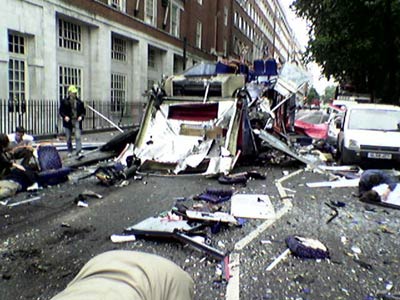

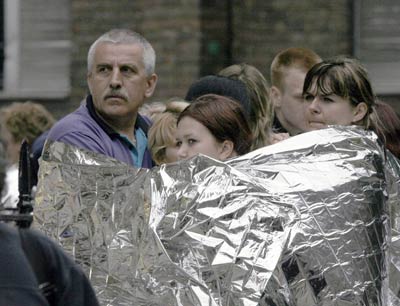

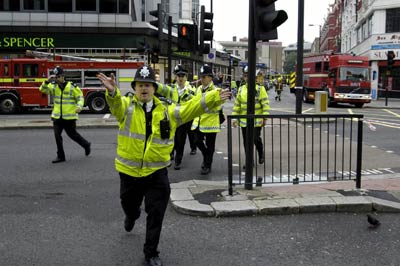
| 08/07/2024 |
| London Bombs |
 |
| People trapped in the Tube after one of the several explosions hit commuters at morning rush hour |
| 08/07/2024 |
| London bombs |
 |
| Passengers are evacuated from an Tube train in a tunnel near Kings Cross station (Alexander Chadwick/AP) |
| 08/07/2024 | |||
| London bombs | |||
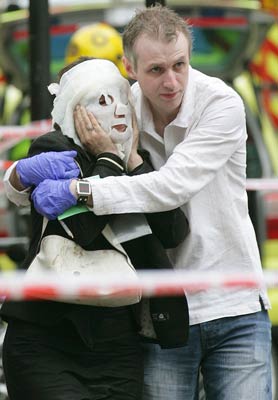 | |||
| An injured woman is escorted away from Edgware Road Tube station after the third of the four blasts (Andre Camara/The Times) | |||
| 08/07/2024 |
| London bombs |
 |
| A woman is rushed into the Royal London Hospital in Whitechapel after being injured by the explosions at Aldgate East underground (Anna Branthwaite/The Times) |
| 08/07/2024 |
| London bombs |
 |
| A helicopter lands at the Royal London Hospital carrying seriously injured commuters from the explosions (Anna Branthwaite/The Times) |
| 08/07/2024 | |||
| London bombs | |||
 | |||
| Going home: commuters surge towards Liverpool Street mainline station as it re-opens after the morning terror attack (Gareth Fuller/PA) | |||
The game itself was terrific. Mike Mussina held the Indians to two runs in seven innings; A-Rod, Jason Giambi, and Derek Jeter all homered; and the Yankees started a rookie, Melky Cabrera, in centerfield. When Cabrera singled his second time up, the crowd of 52,000 gave him a standing ovation. Sweet.
The Yankees now have three promoted minor-leaguers playing regularly on the team: Cabrera, second baseman Robinson Cano, and pitcher Chien Mien-Wang. (Someone check my spelling on that.) I love it. Somehow it's so much easier to root for these young athletes when expectations are low and you know they're just learning the game...and when they're not getting paid $15 million a year.
Consider the Yankees' pitching staff at the start of the season: Randy Johnson, Jaret Wright, Mike Mussina, Kevin Brown, and Carl Pavano. Free-agent signings all. While Mussina's been solid, if not great, Johnson has been inconsistent and generally not very impressive. Wright, Pavano, and Brown are all on the disabled list. After last year's ALCS Game Seven, Kevin Brown may be the most hated Yankee ever; you might as well have taken $30 million and set it on fire....
Who knows whether the rookies will be good enough to spark this team? That's okay. I'd rather watch Melky Cabrera play his heart out and struggle than watch Kevin Brown mail it in and cash his checks....
Oh, and by the way, Dan Shaughnessy: it's 3 1/2 games now....
But does that mean progressives and First Amendment advocates should now abandon her as she sits in jail for refusing to disclose her source? Is it really fair to ask, as Shearer does, "Is there such a thing as karma? If so, Judith Miller is in the pokey as punishment for helping to get over 1700 Americans and thousands of Iraqis killed for a reason yet to be determined."
These are tough times for journalists. The media's credibility is lower than at any point since perhaps the turn of the last century, and not because it's doing a worse job than usual, but because it's the target of sustained political attacks from both sides of the ideological spectrum...and because any press exposed to the blogosphere, at any time in history, would have its failings glaringly exposed. It's just that never before have so many media critics been able to disseminate their criticisms, and predictably, the media's image has suffered.
In that context, it's inspiring to see a journalist remind the public of how seriously we take our craft. There's lots of discussion now about what constitutes a journalist: Are bloggers journalists? Are talking heads? Is Bill O'Reilly a journalist? What about Armstrong Williams?
That discussion is fostered by the fact that, unlike law and medicine—or even, in my state, hairdressers—American journalism has never been a licensed guild, but an open profession. I think that's one of the great things about the free press in this country, but it does lead to frequent confusion about just exactly what a journalist is.
Well, Judith Miller is currently suggesting one definition: journalists are people who play by the longstanding rules of the profession and live with the consequences.
(Bob Woodward, in protecting Deep Throat's identity for decades, serves up the same lesson.)
How many bloggers would do the same? How many pundits? As Lawrence O'Donnell himself admitted, he didn't write his big scoop about Karl Rove's alleged role in the leak of Valerie Plame's name because he didn't want to get "dragged" before a grand jury. This despite the fact that he'd had his information "for months."
In an eloquent editorial this morning, the Times reminds us why this fight is so important. And in a refreshing bit of honesty, the paper notes:
"To be frank, this is far from an ideal case. We would not have wanted our reporter to give up her liberty over a situation whose details are so complicated and muddy. But history is very seldom kind enough to provide the ideal venue for a principled stand. Ms. Miller is going to jail over an article that she never wrote, yet she has been unwavering in her determination to protect the people with whom she had spoken on the promise of confidentiality."
Another thing that makes this far from an ideal case, of course, is that the reporter involved is one whose work is hotly contested.
No matter. As the Times concludes, "What is at stake is nothing less than our society's perpetual bottom line: the citizens control the government in a democracy. We stand with Ms. Miller and thank her for taking on that fight for the rest of us."
Indeed. Judith Miller may be an imperfect hero, but in this fight, she's still a hero.
Now David Burdick, a columnist for the Daily Pennsylvanian, points out that this penchant for secrecy isn't limited to Harvard, but crops up elsewhere in the Ivy League, particularly the Council of Ivy League Presidents.
In a very smart column, Burdick writes about the council's annual meeting, and the fact that the eight presidents involved refuse to say a word about what was discussed. He's particularly concerned about athletic policy, where there are a number of pressing issues (that I'm not very familiar with).
My favorite section:
<
Ironically, it would be hard to find a group as well-versed in open debate of ideas as the Ivy presidents.
Columbia president Lee Bollinger has written an entire book about "free speech in the modern era."
James Wright, the president of Dartmouth, wrote a 300-plus page book on political dissent -- and that only focused on dissent in late 19th Century Colorado.
Who could forget Harvard president Lawrence Summers, who has taken more heat than anyone this year for his public debate of controversial ideas?
And of course there's Gutmann, who seems to make sure that the word democracy appears in the title of everything she writes.>>
It's a classic story: thinkers who promote openness until they actually come to power, when they decide that the free flow of information is, well, a pain in the ass....
In the classic football film, The Replacements, Gene Hackman is asked by a TV reporter what his team needs to come back from a halftime deficit. "Heart," he says. "We gotta have heart." (Whereupon Keanu Reeves suits up for the second half and wins the game.)
The Yanks have enough talent to win it all. They just need to show some heart. Finally, it looks like they are.
And wouldn't it be great if the Yankees came back to win the division after Boston Globe columnist Dan Shaughnessy flat-out declared that that the Sox would win it going away? "Come late September, this is going to look like Secretariat at the Belmont in 1973," Shaughnessy wrote about four days ago.
''We're going to the Series, boys!" shouted Kevin Millar in the locker room after the Sox beat the Phillies the other day. "The fucking Sox are on a roll!"
Getting a little ahead of yourselves, aren't you, boys?
How incredibly great would it be the Sox pulled a catastrophic fold and didn't even make the playoffs? Oh pleaseGodpleaseGodpleaseGod let it happen....
Couple of things...
One, I'm enjoying watching O'Donnell keep the heat on, but where has he been for the past year or so? O'Donnell says he's only now going public with his information that it was Rove because he didn't want to "dragged" before a grand jury. So, in other words, after other journalists have taken all the heat, O'Donnell gets to enjoy his scoop.
That's not exactly a textbook definition of courage.
Second, how does O'Donnell respond to the Washington Post story discussed below in which Luskin flat-out denies that Rove disclosed Plame's identity? On the HuffPo, he ignores it.....
Oh, one final thing: Why are conservatives so silent on this matter? You know that if it were the Clinton White House involved, they'd be screaming bloody murder. But outing a CIA agent is a scandal regardless of which political party does it. At the very least, it appears to be against the law, and in a larger sense, it may be treasonous.
I'm sure that conservatives are patriots too, and therefore deeply disturbed by the idea that a White House operative may have been responsible. Right? Anyone there?
Yesterday, the boy's father received a telephone call from Steve Jobs, the head of Apple, who wanted to offer his sympathies.
In part because a good friend of mine was just mugged on the subway in Times Square, I'm fascinated and a little moved by this episode. Apple's lawyers and PR people couldn't have recommended that Jobs call the grieving parent; no point in further associating your company with a horrific crime.
So Jobs could only have called because...well, because he has a heart. (If you need anything at all, Jobs reportedly told the boy's father, call me.) That's something we don't expect from our chief executives—and often, in our macho business culture, something we don't even value.
There are, of course, plenty of stories to the effect that Jobs is a megalomaniac and a jerk, at least when it comes to business. But as far as I'm concerned, the man just showed a lot of class.
This picture convinces a friend of mine that she did—and of course, right before a trip to Singapore would be the time...
"Karl did nothing wrong. Karl didn't disclose Valerie Plame's identity to Mr. Cooper or anybody else," Robert Luskin told the Washington Post's Carol D. Leonnig. "Luskin said the question remains unanswered: 'Who outed this woman? . . . It wasn't Karl.'"
What are we to make of this? I don't think we should automatically believe it. Rove, after all, is fighting for his career—or at least his White House job—and he surely knows it. He's not under oath, and even if he were, even presidents perjure themselves under oath sometimes. If Cooper's notes don't specifically finger Rove as the leaker, then even if it were Rove, he can deny-deny-deny. In part because Cooper isn't talking....
On the other hand, for Rove simply to lie would be a very big gamble, and I certainly wouldn't assume that.
So...we wait. And in the meantime, I'll do my best not to pre-judge Karl Rove regarding his role in this incident.
I'm a scuba diver, so I certainly don't begrudge people their high-risk fun. But skydiving? As far as I'm concerned, just flying is risk enough...
Couple of things: I'm amused that the CIA is refusing to allow Plame to publish an op-ed. So the White House can disclose her identity, but she can't defend herself?
And two, I wish Republicans would stop attacking Plame and her husband, Joe Wilson, by saying that somehow she "got" him the trip to Niger as a kind of boondoggle. Let's say it's true. Wilson had been an ambassador to two African countries, and had worked under both Republican and Democratic presidents. He wasn't a partisan figure until all this happened—but he was a well-qualified diplomat.
But let's look at the larger picture: Is a fact-finding trip to Niger really such a desirable junket?
Finally, Republicans have insinuated that Plame's secret identity was actually widely known. The Times' piece strongly suggests otherwise....
Instead, he quotes a letter written by Thomas Jefferson and ponders pleasantly about that for a while.
The quote is this: "Never suffer a thought to be harbored in your mind which you would not avow openly. When tempted to do anything in secret, ask yourself if you would do it in public. If you would not, be sure it is wrong. "
Possibly I have a dirty mind, but to me, that quote cries out for a little Freudian reading. As in: Well, how would you feel about avowing your lustful thoughts for a slave woman?
The Ethicist avoids this topic, however, as it is the 4th of July tomorrow and the Ethicist, unlike the Re-Ethicist, prefers not to make waves.
He does mention slavery, however--it would be awkward not to-- and writes, "Jefferson's inability always to heed his own advice makes him not hypocritical but human, and it does not gainsay the wisdom of that advice."
Wrong!
Of course Jefferson's inability to heed his own advice makes him a hypocrite. And all the more human for it. After all, Jefferson's primary reason for not freeing his slaves was economic; he was a terrible businessman and constantly in need of money, and he simply couldn't afford to free his slaves and live in the style to which he was accustomed.
What we must take from Jefferson instead is the fact that, even if he was not always strong enough to do the right thing, he knew what the right thing was, and he wrote words that inspired generations to come to make better choices than he did. Jefferson is fascinating because he is so human. A hypocrite, yes. But surely we are all hypocrites about some thing or other; one can not dismiss a person's life and work because of hypocrisy. Jefferson's value comes from the fact that he helped to create the rhetoric and the idea of freedom for all people, and it is for these enduring accomplishments, rather than his personal failings, that we should remember him.
If you disagree, take a visit to the Jefferson Memorial in Washington, something I try to do whenever I visit that city. The words on that monument leave me with a feeling of immense humility, and usually get me a little choked-up. In some lives, it is actions rather than words that matter most. In Jefferson's, it is the words that matter.
But the news that Karl Rove was probably the source of the leak that Valerie Plame was a CIA agent is huge. Now we know that the president's right-hand man told at least one reporter of the identity of an undercover CIA agent, very possibly breaking the law.
What, I wonder, would conservatives say had this episode happened in the Clinton White House?
Well, they probably would have said that the perpetrator was, um, a traitor; that it was typical of how Democrats don't love America; and they'd call for his firing, at the very least, and probably his prosecution.
Is turnabout fair play? Well, yes and no. On the one hand, the White House deserves it, and Rove certainly does, what with his talk about how Democrats want to put terrorists in therapy.
On the other hand, the Democrats shouldn't hit below the belt just because some conservatives would. It'd be unfair to say that Rove's treason--because, yes, that really is what it is--says anything in general about this White House or the Republican Party.
But it does seem to me that it becomes very tricky for the White House to maintain in its employ a man who deliberately disclosed the covert identity of a CIA agent in order to discredit a political opponent who happened to be that agent's spouse.
The question is, Will the White House do the right thing and fire Rove?
And close on its heels: How could the president not have known that Rove was the leaker? After all, President Bush announced that he was calling for an internal review of the episode long ago, and called for the people involved to reveal themselves.... So hasn't Karl Rove, at least in theory, been disobeying the president for many months now?
My conservative/libertarian friend Bruce thinks that I've been uncivil on the blog lately, even though I'm calling for more civil conversation in this country.
Perhaps he's right. Perhaps the stress of moving has finally gotten to me. Or perhaps it's just my sense that the country really is headed in the wrong direction and the president, along with those who work for him, are in deep denial about it, because they can not accept responsibility for the mistakes they've made.
But no matter about that now. I'm headed off tomorrow for a weekend away, and I want to wish all of you a happy 4th of July. Let's try to put partisan politics aside for a few days, and remember that this is still a remarkable country, and we all hope that its best days lie yet ahead. Let's give some thought to the men and women in Afghanistan and Iraq, and thank them for putting their lives on the line, whether or not we agree with the war.
And as we celebrate the 4th of July, let us celebrate most of all the freedom that we have—the freedom to engage in these arguments, to get pissed off at one another and argue without violence, to write blogs or post comments on them. It is this right—the First Amendment—that more than any other, I think, helps to preserve liberty even when—especially when—we disagree with those in power.
Red state, blue state; Democrat or Republican; gay or straight; black, white, or whatever...happy 4th of July, everyone.
—from the new issue of GQ...
(Sorry, couldn't resist. And I actually like Jessica Simpson. As celebrity fembots go, she seems like a nice person.)
On the Open Democracy website, Gara LaMarche has a smart piece looking at how the right wing is attacking the foundations of a free society: broadmindedness, the culture of law, a free media, and independent science and academia.
The radical right, LaMarche warns, "is doing steady damage to key elements of open society, the very elements that can monitor and check the abuses of a power-hungry political majority. We ignore it at our peril."
He continues: "The current American political and social scene has not in memory seen so systematic an effort by a controlling party and ideology control to hobble all significant and potential sources of opposition."
Sound alarmist? Yeah, actually, it does. But when you read all the evidence that he compiles, it really does suggest that the American right-wing, that bastion of patriotism, doesn't have much love for the great institutions and traditions (courts, universities, the press, freedom of religion) that make this the world's greatest democracy. And really does want to put all of these things under theocratic control.
The section on how the right tries to bully and threaten universities was of particular interest to me, and LaMarche smartly makes this observation:
"The problems of Lawrence Summers, president of Harvard University, following his January 2005 address, offer an interesting contrast [to right-wing attacks on academic freedom]. There are ample grounds for criticism of his observations about women and science, though the vote of no-confidence in him by his faculty probably has more to do with an attitude and a series of imperious actions and comments. But in the right-wing press, Summers – despite his generally progressive views and service in the Clinton administration – is portrayed as a hero for taking on a politically-correct elite."
Just so....
Particularly as we head into the 4th of July weekend, this is a must-read.
