
* An article on June 21 incorrectly stated Harvard's fundraising under Larry Summers' leadership. In fiscal year 2005, Harvard raised $590m, which was the second best year in dollar terms in Harvard's history.
Shots In The Dark
Friday, June 30, 2024
Larry Summers' Parting Shots
Today is the last day of the Summers' presidency. (Some would note that it precedes Independence Day, a national holiday.)
President Summers has been popping up in various odd places lately. Last night he appeared on the Charlie Rose Show (he and Rose are, apparently, friends from Washington days). I didn't see the show, but here's a summary.
(By the way, the interview negates George Stephanopolous' claim that his talk with Summers would be Summers' only interview.)
Summers also gave an interview to Justin Pope, the AP's education writer. (Why Pope? Seems an odd choice; one wonders if Pope would agree to a Q & A, while other outlets would not.)
An excerpt...
I can't really figure out whether Summers is suggesting that the Corporation needs changing (I don't think so) or that the FAS needs to have more power taken away from it (seems more likely...)
More to come later...but by the way...I'm taking Germany over Argentina.
President Summers has been popping up in various odd places lately. Last night he appeared on the Charlie Rose Show (he and Rose are, apparently, friends from Washington days). I didn't see the show, but here's a summary.
(By the way, the interview negates George Stephanopolous' claim that his talk with Summers would be Summers' only interview.)
Summers also gave an interview to Justin Pope, the AP's education writer. (Why Pope? Seems an odd choice; one wonders if Pope would agree to a Q & A, while other outlets would not.)
An excerpt...
AP: Harvard is governed essentially the way it was 350 years ago: by a secretive, 7-member, self-perpetuating body called the Harvard Corporation. Does the system need to change?
Summers: I think the university does need to reflect on questions of governance... The university's governance structure was set at a very different time when universities were investing much less than they're able to invest today, when the demands on them from a larger society are much less than they are today.
And so I think particularly after a period of some tension between a president and members of the faculty, I think it would be appropriate for there to be reflection on institutions of governance at Harvard.
AP: But to what end?
Summers: I think the university needs to be more prepared to change and adapt itself. I think that the veto power is too widely distributed within the university. There's too much stove-piping into individual disciplines and individual departments. The Faculty of Arts and Sciences hasn't created or eliminated a department in more than 35 years.
Stovepiping?I can't really figure out whether Summers is suggesting that the Corporation needs changing (I don't think so) or that the FAS needs to have more power taken away from it (seems more likely...)
More to come later...but by the way...I'm taking Germany over Argentina.
Thursday, June 29, 2024
Larry Summers and the Department of Economics
Thanks so much to all of you who've been contributing such thoughtful comments lately. Here's another one that deserves to be highlighted. I'd be curious to hear some responses to this...as it seems that some answers are called for.
Henry Rosovsky and Michael Spence were both economists and deans of FAS. While Spence was not as successful as Rosovsky it was not because of his relations with FAS faculty. Faculty did not dislike Summers because he is an economist, but because he was an arrogant, unprincipled, unethical and ultimately ineffective leader. But why did so many economists rally around him? Perhaps because he put his friend David Cutler in charge of the social sciences? Perhaps because economics increased its number of faculty appointments by a very large percentage even while other social sciences with large enrollments did not grow at all (Psychology) (History is the other social science to grow a great deal, I wonder why History and Economics grew so much?). Perhaps they liked Summers so much because he made such a big deal about "improving undergraduate education" but did nothing about the economics department which has very unsatisfied undergraduates? Perhaps it is because there is a dirty secret that the economists teach much, much less than other social scientists and humanists. They doctor their teaching loads with team taught classes where they show up a few times a semester and a lot of professors get credit for the same course and they make it look like they are teaching a normal load? Perhaps it is because he said out loud what the economists must believe about women not being smart since they had until this year only two tenured women? Or perhaps it is because he defended their friend Shleifer even while it deeply shamed the university? Or perhaps there are other skeletons in that closet? If Larry Summers had cared one iota about undergraduate education he would have gone after people in his own department and he would have asked them to teach a full load, to hire some women to tenured posts, to pay attention to their undergraduates, to show up in their offices instead of working at the NBER. If he cared about Harvard's bottom line he would have stopped the process of economists running their grants through NBER and giving them the overhead instead of Harvard. Glaeser is a smart guy, unethical and sleazy, but smart. That is why he did not want to be on the radio with Richard Thomas, who is both smart and ethical and who could counter some of Glaeser's self serving lies about Larry Summers.
Henry Rosovsky and Michael Spence were both economists and deans of FAS. While Spence was not as successful as Rosovsky it was not because of his relations with FAS faculty. Faculty did not dislike Summers because he is an economist, but because he was an arrogant, unprincipled, unethical and ultimately ineffective leader. But why did so many economists rally around him? Perhaps because he put his friend David Cutler in charge of the social sciences? Perhaps because economics increased its number of faculty appointments by a very large percentage even while other social sciences with large enrollments did not grow at all (Psychology) (History is the other social science to grow a great deal, I wonder why History and Economics grew so much?). Perhaps they liked Summers so much because he made such a big deal about "improving undergraduate education" but did nothing about the economics department which has very unsatisfied undergraduates? Perhaps it is because there is a dirty secret that the economists teach much, much less than other social scientists and humanists. They doctor their teaching loads with team taught classes where they show up a few times a semester and a lot of professors get credit for the same course and they make it look like they are teaching a normal load? Perhaps it is because he said out loud what the economists must believe about women not being smart since they had until this year only two tenured women? Or perhaps it is because he defended their friend Shleifer even while it deeply shamed the university? Or perhaps there are other skeletons in that closet? If Larry Summers had cared one iota about undergraduate education he would have gone after people in his own department and he would have asked them to teach a full load, to hire some women to tenured posts, to pay attention to their undergraduates, to show up in their offices instead of working at the NBER. If he cared about Harvard's bottom line he would have stopped the process of economists running their grants through NBER and giving them the overhead instead of Harvard. Glaeser is a smart guy, unethical and sleazy, but smart. That is why he did not want to be on the radio with Richard Thomas, who is both smart and ethical and who could counter some of Glaeser's self serving lies about Larry Summers.
Maureen Dowd On the Warpath
Maureen Dowd uses her column today to share how much she sympathizes with Anna Wintour, the thinly fictionalized protagonist of "The Devil Wears Prada," and excoriate the author of that book, Lauren Weisberger.
On the first front, Dowd says that the Wintour character in the film doesn't sound unreasonable in her expectations of what an assistant should do.
Is it so wrong of Miranda to expect her assistant, Andy Sachs (played by Anne Hathaway), to know how to spell Gabbana, reach Donatella and ban freesia? Is it so bad to want help getting a warm rhubarb compote for Michael Kors? Or to have an assistant who knows what an eyelash curler is?
Dowd then notes that she herself once asked her assistant to choose her cell phone ring, "50 Cent's "In Da Club" or the Fox Sunday football theme?"
Which is just the kind of personal detail that makes Dowd so annoying: It's irrelevant and shouts, "Look at me! Look at me!" And it's schizophrenic. I'm a guy's girl, she says—I listen to rap and watch football. But I'm helpless at technology, she admits, fluttering her eyebrows. Can't you please help me with my phone?
In any case, Dowd truly sympathizes with Wintour over Weinberger because " it just seems better, this time, to side with the Wicked Stepmother than the opportunistic Cinderella."
Weinberger's an sleazeball, Dowd argues. "This Cinderella's primary value turned out to be voyeurism, profiting by keeping her nose to the glass and poaching off her glamorous former boss's life."
She recycles the in-vogue (no pun intended) term for "The Devil...", calling it a "hiss-and-tell." Then she adds that "Lauren Weisberger plotted to be rich and famous by writing about how she didn't want to become Anna Wintour....[But] it's more admirable to be the beast to which the parasite attaches itself than to be the parasite.
Well, this is singularly harsh stuff, and, I think, unfair.
I write, of course, as a colleague of a famous person who ultimately wrote a book about that person. It's a very different kind of book than "The Devil Wears Prada," of course—warm and complimentary, I think/hope. Nonetheless, some pundits criticized me on the same grounds: That plebeians who come to know rich and famous and powerful people should not disclose their secrets.
Nonetheless, I think I can be relatively objective.
First of all, I seriously doubt that Lauren Weisberger "plotted to be rich and famous" by writing a novel. Think for a minute about American culture these days, and who gets to be rich and famous. Writing novels isn't exactly your ticket to fame and fortune. More likely she's a young woman who wanted to write a book and wrote about what she knew. She has since gone on to produce a second book which, I gather, while not great literature, shows that she has some talent for the genre.
Second, Anna Wintour has, in her world, an immense amount of power, lots of money, the resources of a giant publishing company behind her...and by all accounts she is imperious and cruel to people who work for her. She also promotes anorexia, both in the pages of her magazine and in her body, and the destruction of animals for their fur.
If you have power and you don't use it for good, it seems to me, you open yourself up to people pointing this out. Especially when you treat those people terribly merely because you can. Or worse: Because in the value-void world of fashion, it actually adds to your reputation to act like a total bitch.
The process of writing a "hiss-and-tell" may not be pretty, nor the motives perfect. But these books do serve a function: they promote democracy in a country where celebrity is increasingly blurred with royalty. (And if you don't believe me, check out pictures of Anna Wintour at a fashion show.) They are what you might call a cultural check-and-balance.
Maureen Dowd has grown so far removed from the lower orders that she has forgotten this—forgotten what it's like to have no power, no clout, no money. For a New York Times columnist, that's both a shame and a problem.
It's unfortunate that Dowd doesn't realize this; that she has no self-consciousness. If she did, she might realize that her description of Weisberger—the parasite attaching itself to the beast—is, some would say, a pretty good description of journalists. If Maureen Dowd really wants to see the devil in Prada, she should look in the mirror.
On the first front, Dowd says that the Wintour character in the film doesn't sound unreasonable in her expectations of what an assistant should do.
Is it so wrong of Miranda to expect her assistant, Andy Sachs (played by Anne Hathaway), to know how to spell Gabbana, reach Donatella and ban freesia? Is it so bad to want help getting a warm rhubarb compote for Michael Kors? Or to have an assistant who knows what an eyelash curler is?
Dowd then notes that she herself once asked her assistant to choose her cell phone ring, "50 Cent's "In Da Club" or the Fox Sunday football theme?"
Which is just the kind of personal detail that makes Dowd so annoying: It's irrelevant and shouts, "Look at me! Look at me!" And it's schizophrenic. I'm a guy's girl, she says—I listen to rap and watch football. But I'm helpless at technology, she admits, fluttering her eyebrows. Can't you please help me with my phone?
In any case, Dowd truly sympathizes with Wintour over Weinberger because " it just seems better, this time, to side with the Wicked Stepmother than the opportunistic Cinderella."
Weinberger's an sleazeball, Dowd argues. "This Cinderella's primary value turned out to be voyeurism, profiting by keeping her nose to the glass and poaching off her glamorous former boss's life."
She recycles the in-vogue (no pun intended) term for "The Devil...", calling it a "hiss-and-tell." Then she adds that "Lauren Weisberger plotted to be rich and famous by writing about how she didn't want to become Anna Wintour....[But] it's more admirable to be the beast to which the parasite attaches itself than to be the parasite.
Well, this is singularly harsh stuff, and, I think, unfair.
I write, of course, as a colleague of a famous person who ultimately wrote a book about that person. It's a very different kind of book than "The Devil Wears Prada," of course—warm and complimentary, I think/hope. Nonetheless, some pundits criticized me on the same grounds: That plebeians who come to know rich and famous and powerful people should not disclose their secrets.
Nonetheless, I think I can be relatively objective.
First of all, I seriously doubt that Lauren Weisberger "plotted to be rich and famous" by writing a novel. Think for a minute about American culture these days, and who gets to be rich and famous. Writing novels isn't exactly your ticket to fame and fortune. More likely she's a young woman who wanted to write a book and wrote about what she knew. She has since gone on to produce a second book which, I gather, while not great literature, shows that she has some talent for the genre.
Second, Anna Wintour has, in her world, an immense amount of power, lots of money, the resources of a giant publishing company behind her...and by all accounts she is imperious and cruel to people who work for her. She also promotes anorexia, both in the pages of her magazine and in her body, and the destruction of animals for their fur.
If you have power and you don't use it for good, it seems to me, you open yourself up to people pointing this out. Especially when you treat those people terribly merely because you can. Or worse: Because in the value-void world of fashion, it actually adds to your reputation to act like a total bitch.
The process of writing a "hiss-and-tell" may not be pretty, nor the motives perfect. But these books do serve a function: they promote democracy in a country where celebrity is increasingly blurred with royalty. (And if you don't believe me, check out pictures of Anna Wintour at a fashion show.) They are what you might call a cultural check-and-balance.
Maureen Dowd has grown so far removed from the lower orders that she has forgotten this—forgotten what it's like to have no power, no clout, no money. For a New York Times columnist, that's both a shame and a problem.
It's unfortunate that Dowd doesn't realize this; that she has no self-consciousness. If she did, she might realize that her description of Weisberger—the parasite attaching itself to the beast—is, some would say, a pretty good description of journalists. If Maureen Dowd really wants to see the devil in Prada, she should look in the mirror.
Harvard To Ellison: You're a Liar
Marcella Bombardieri picks up the Larry Ellison story in today's Globe, in which several Harvard officials speculate on what Ellison's real motives for reneging on his proposed $115 million donation may have been.
No one seems to believe that Ellison is really so upset over Summers' departure that it just wouldn't be the same for him to pay up.
Writes Bombardieri:
...Some other officials at Harvard say Ellison’s rationale for abandoning the gift don’t quite ring true, given how events unfolded in the more than two years since Harvard and Ellison reportedly began talking.
Bombardieri is the only writer I've seen who seems to realize that both sides in this ugly mess should just shut up.
Well, she doesn't exactly put it that way.
Here's what she says:
The failed deal is bad news for both sides, said Stacy Palmer, editor of the Chronicle of Philanthropy. ``When people hear a gift's been withdrawn, it's not good for Harvard and it's not good for Ellison," she said. ``People are always worried about their reputation as a good place to give."
Translation: Both parties should just shut up.
Derek Bok has wisely kept his name out of these stories. But maybe it's time for the president, or someone who works for him, to give Professor Murray a call and ask him to go away for the holiday weekend already.
In newspapers across the country, word is out that a huge donor to Harvard withdrew his money because he was unhappy about Summers' departure. True or not, that isn't a story you want to get around. It's making Harvard look passive and whiny and jilted, not strong and self-confident. The quotes coming out of Harvard have a sore loser quality about them.
Here's a tone that might work better: "We're sorry that Mr. Ellison decided to make another choice, but we hope to work with him in the future, and meantime, we're continuing our important work trying to stop the spread of disease in Africa."
And, except maybe for the middle part, it has the advantage of actually being true.....
_____________________________________________________________
P.S. Here's a question, though: Why did Harvard actually start to set up the institute and hire staff even before the money had come through—especially given that Ellison has a history of shaky giving?
No one seems to believe that Ellison is really so upset over Summers' departure that it just wouldn't be the same for him to pay up.
Writes Bombardieri:
Christopher Murray, the professor who would have run the institute, questioned Ellison's statement that the gift was withdrawn because of Summers's resignation .
``I am not sure what to make of Ellison's remarks, as he was not willing to speak with Summers on this topic, despite repeated attempts," Murray said in an e-mail to Bloomberg News yesterday. Murray also told the Globe last week that Harvard had not communicated directly with Ellison since last November, several months before Summers's resignation.
InsideHigherEd.com has a piece that further emphasizes the point....Some other officials at Harvard say Ellison’s rationale for abandoning the gift don’t quite ring true, given how events unfolded in the more than two years since Harvard and Ellison reportedly began talking.
Bombardieri is the only writer I've seen who seems to realize that both sides in this ugly mess should just shut up.
Well, she doesn't exactly put it that way.
Here's what she says:
The failed deal is bad news for both sides, said Stacy Palmer, editor of the Chronicle of Philanthropy. ``When people hear a gift's been withdrawn, it's not good for Harvard and it's not good for Ellison," she said. ``People are always worried about their reputation as a good place to give."
Translation: Both parties should just shut up.
Derek Bok has wisely kept his name out of these stories. But maybe it's time for the president, or someone who works for him, to give Professor Murray a call and ask him to go away for the holiday weekend already.
In newspapers across the country, word is out that a huge donor to Harvard withdrew his money because he was unhappy about Summers' departure. True or not, that isn't a story you want to get around. It's making Harvard look passive and whiny and jilted, not strong and self-confident. The quotes coming out of Harvard have a sore loser quality about them.
Here's a tone that might work better: "We're sorry that Mr. Ellison decided to make another choice, but we hope to work with him in the future, and meantime, we're continuing our important work trying to stop the spread of disease in Africa."
And, except maybe for the middle part, it has the advantage of actually being true.....
_____________________________________________________________
P.S. Here's a question, though: Why did Harvard actually start to set up the institute and hire staff even before the money had come through—especially given that Ellison has a history of shaky giving?
Wednesday, June 28, 2024
The Summers Presidency on WGBH Tonight
Professor Richard Thomas, the chair of the classics department, has posted something two items below that is worth putting on the main page (and if you have a chance to look at that item, the first post is quite interesting as well).
WGBH is doing a piece on the Summers presidency at 7 p.m. tonight (on Greater Boston). Professor Ed Glaeser of the Economics Dept. was to represent the positive side of the Summers presidency, and I was approached by Jeff Keating of WGBH and agreed to go on and give what would have been a moderate but generally more qualified point of view. I was to have gone to their office at 4:00 p.m. today. At 3:30 p.m. today WGBH called me and asked if I would go on with Harvey Silverglade since Prof Glaeser had "time issues" and couldn't make it. Yeah, sure, as we'll see.
I said I wouldn't go on unless it was to balance an altenative FAS faculty positon (i.e. Prof Glaeser's), which had been the plan all along. They said they would get back to me, but did not do so.
At 4:15 I called them, and surprise, surprise, Prof. Glaeser's "time issues" had been resolved, he had arrived, and was about to tape the show. I said, "I'll be right over," but was told Prof. Glaeser had said he would not do the show if any other faculty member was put on. I said I thought WGBH might have refused to proceed in such circumstances.
So tune in at 7 p.m. for a fair and balanced back and forth, with Prof. Glaeser responding to previously taped pieces with Profs. Daniel Fisher and Judith Ryan which he has presumably had the opportunity to see prior to his remarks.
Tricky move, Prof. Glaeser and WGBH.
Richard Thomas
In the Department of Bad Writing
"When David Ortiz steps to the plate for the Boston Red Sox, you think about a bat connecting with a ball. You don't think about a fist connecting with a wife."
—Joan Vennochi, Boston Globe, today
—Joan Vennochi, Boston Globe, today
Ellison to Harvard: Drop Dead
The Wall Street Journal, among others, reports that Larry Ellison isn't giving a dime to Harvard after all. The reason? According to an Ellison spokesperson, because of the unsettled situation at Harvard in the wake of Larry Summers' departure. (All right, imminent departure.)
According to the Journal, Mr. Ellison said he plans to give the money that would have gone to Harvard to a charity that trains teachers and educates impoverished children in the developing world. He didn't identify the institution or elaborate further.
Something about this doesn't feel right; Ellison's intended gift was first made public in June 2005, and it wasn't as if Summers wasn't already a controversial figure at that point; women-in-science had already happened. In fact, at least from a public perspective, the months from June through January were relatively calm ones in the Summers era. Ellison had eight months in which to start writing checks. He didn't....and now he says it's because of upheaval that began in February.
There's another story here. Anyone know what it is?
By the way, these Journal etchings are sort of odd, aren't they?
![[Lawrence Summers]](../public/resources/images/HC-EO679_Summer_20051026033647.gif)
According to the Journal, Mr. Ellison said he plans to give the money that would have gone to Harvard to a charity that trains teachers and educates impoverished children in the developing world. He didn't identify the institution or elaborate further.
Something about this doesn't feel right; Ellison's intended gift was first made public in June 2005, and it wasn't as if Summers wasn't already a controversial figure at that point; women-in-science had already happened. In fact, at least from a public perspective, the months from June through January were relatively calm ones in the Summers era. Ellison had eight months in which to start writing checks. He didn't....and now he says it's because of upheaval that began in February.
There's another story here. Anyone know what it is?
By the way, these Journal etchings are sort of odd, aren't they?
World Cup Fever, Part 52
Like many of you, I was appalled that Italy beat Australia the other day, 1-0, with about five seconds to go in stoppage time. The "win" came on a penalty kick that shouldn't have been a penalty kick; trying to stop a run by Italian Fabio Grosso, Australian defender Lucas Neill attempted a sliding tackle inside the box. A dangerous play if you don't make contact with the ball...but Neill didn't make contact with either the ball or Grosso. The Italian began to maneuver around Neill's prone form, then came up with a better idea; he fell over his opponent. The ref called a penalty kick, and that was it.
There are two schools of thought about diving in soccer. One is that it's boring and irritating and reflects a certain lack of toughness that is very un-American; we are, in theory, tough. The other is that it's an art form, as Austin Kelly argues in Slate today.
Perhaps both are true, but I'm inclined to dislike the ease with which players fall to the ground and grab their calves in apparent agony, only to jump to their feet and trot around seconds later. It disrupts the flow of the contest, like all those fouls in the last minute of a basketball game. And, as Harvey Mansfield would put it, it is not manly.
(Professor Mansfield, an op-ed on this subject would be timely: soccer diving, manliness, and the American aesthetic. Feel free to run with that.)
Besides, the Australians—the Soccceroos—played a tough game against a far more experienced opponent. Wouldn't it have been great if they'd beaten the Italians? The team from Italy has not particularly impressed me so far...but they're great actors. Get anywhere near them and they crumble like France's Maginot Line.
Come to think of it, the French are pretty good at diving too.
Let's see now, who's left: England, France, Germany, Brasil, Argentina, Italy, Ukraine, and Portugal.
How can you not root for Brasil?
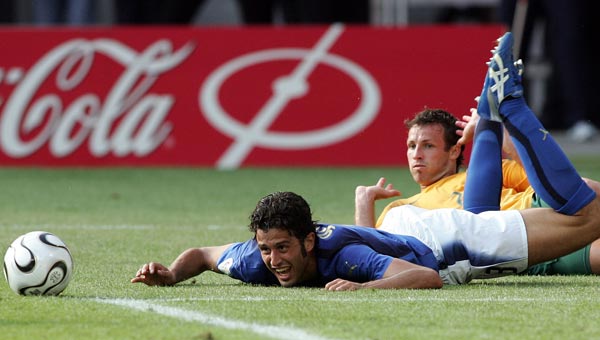
The Italian takes a dive—thereby robbing Australia, a great nation,
of a chance to advance at the World Cup.
There are two schools of thought about diving in soccer. One is that it's boring and irritating and reflects a certain lack of toughness that is very un-American; we are, in theory, tough. The other is that it's an art form, as Austin Kelly argues in Slate today.
Perhaps both are true, but I'm inclined to dislike the ease with which players fall to the ground and grab their calves in apparent agony, only to jump to their feet and trot around seconds later. It disrupts the flow of the contest, like all those fouls in the last minute of a basketball game. And, as Harvey Mansfield would put it, it is not manly.
(Professor Mansfield, an op-ed on this subject would be timely: soccer diving, manliness, and the American aesthetic. Feel free to run with that.)
Besides, the Australians—the Soccceroos—played a tough game against a far more experienced opponent. Wouldn't it have been great if they'd beaten the Italians? The team from Italy has not particularly impressed me so far...but they're great actors. Get anywhere near them and they crumble like France's Maginot Line.
Come to think of it, the French are pretty good at diving too.
Let's see now, who's left: England, France, Germany, Brasil, Argentina, Italy, Ukraine, and Portugal.
How can you not root for Brasil?
The Italian takes a dive—thereby robbing Australia, a great nation,
of a chance to advance at the World Cup.
Tuesday, June 27, 2024
The Fight Between Larry and Larry
The San Jose Mercury News reports that Larry Ellison is giving a $100 million gift to the Ellison Medical Foundation to sponsor research on aging and aging-related diseases.
Though the paper says the gift is unrelated to the $115 million Ellison allegedly promised but never paid to Harvard, it's hard to imagine that the Oracle chief executive, reported by the Wall Street Journal to be laboring under a cash crunch, is likely to make two $100 million gifts.
A source close to Ellison said Monday that Summer's shaky tenure and ultimate departure has adversely affected Ellison's decision to give the [Harvard] donation.
The Mercury News adds that the money will count toward Ellison's settlement with the federal government in an insider trading case....
From this and the other published stories on the Ellison gift, it's impossible to tell what really happened here. Was Ellison a Summers supporter who withdrew the gift in protest of Summers' ouster? Or was he just reluctant to give the money to a place—and a president—so plagued by controversy? Or did his decision not to pay the money have nothing to do with Summers, and he's just using that as an excuse?
One wonders if the flurry of news stories coming out of Harvard can't now be seen as preemptive spin—Summers making it look as if Ellison was reneging because he's not reliable, rather than the more embarrassing spectacle of Ellison deciding that he didn't want to give Summers the money.
As I say, impossible to tell from the published facts....
Though the paper says the gift is unrelated to the $115 million Ellison allegedly promised but never paid to Harvard, it's hard to imagine that the Oracle chief executive, reported by the Wall Street Journal to be laboring under a cash crunch, is likely to make two $100 million gifts.
A source close to Ellison said Monday that Summer's shaky tenure and ultimate departure has adversely affected Ellison's decision to give the [Harvard] donation.
The Mercury News adds that the money will count toward Ellison's settlement with the federal government in an insider trading case....
From this and the other published stories on the Ellison gift, it's impossible to tell what really happened here. Was Ellison a Summers supporter who withdrew the gift in protest of Summers' ouster? Or was he just reluctant to give the money to a place—and a president—so plagued by controversy? Or did his decision not to pay the money have nothing to do with Summers, and he's just using that as an excuse?
One wonders if the flurry of news stories coming out of Harvard can't now be seen as preemptive spin—Summers making it look as if Ellison was reneging because he's not reliable, rather than the more embarrassing spectacle of Ellison deciding that he didn't want to give Summers the money.
As I say, impossible to tell from the published facts....
Monday, June 26, 2024
Flying the Coop
Is the bloom finally off Anderson Cooper's rose? The reviews of his two hour-interview with Angelina Jolie are in, and they're not good.... Even Gawker, which fell for Cooper like I fell for Miss Ferens in 4th grade, thought that the Coop was kind of boring with Jolie, and that the whole two hours felt like a Sally Struthers ad.
("When I was in Africa...." "No, when I was in Africa.....")
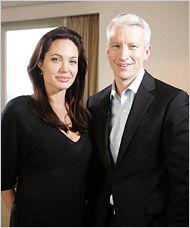
Jolie and Cooper:
What's wrong with this picture?
What was clear from the interview was that Jolie dictated its terms; in exchange for giving CNN her first interview, she would get to talk almost entirely about Africa. Good for her and Africa, bad for CNN. Anderson, you couldn't have slipped in just one question about Jennifer Aniston? Aside from the fact that it made for dull television, wasn't there a time when CNN was above that kind of horsetrading? Or at least a little less naked about it?
The good news for Cooper: His book is #4 on the NYT bestseller list......
("When I was in Africa...." "No, when I was in Africa.....")
Jolie and Cooper:
What's wrong with this picture?
What was clear from the interview was that Jolie dictated its terms; in exchange for giving CNN her first interview, she would get to talk almost entirely about Africa. Good for her and Africa, bad for CNN. Anderson, you couldn't have slipped in just one question about Jennifer Aniston? Aside from the fact that it made for dull television, wasn't there a time when CNN was above that kind of horsetrading? Or at least a little less naked about it?
The good news for Cooper: His book is #4 on the NYT bestseller list......
This Week with Larry Summers
The Harvard president for five more days appeared on "This Week with George Stephanopoulos" yesterday, making his case that the reason for his ouster as Harvard president was because he wanted to change an institution that did not want to change.
George Stephanopoulos, the struggling host of the struggling show, announced that this was Summers' "first and only network interview." Curious. Does that mean that if Tim Russert picked up the phone and called Mass Hall, Summers would say no? And if Summers was only going to do one interview, why do it with the lowest-rated Sunday morning chat show?
A couple of guesses. First, maybe no one else asked. Second, Summers and Stephanopoulos surely know each other from the Clinton administration, so maybe their preexisting relationship was a factor.
(It would have been nice to hear Stephanopoulos throw in even a token disclosure: "Summers, with whom I worked in President Clinton's administration...." But no.)
The interview went fine for Summers, I'd say; if I were he, I would be pleased. But that's more because of Stephanopoulos' embarrassingly uninformed questions and reverential attitude than Summers' (much improved) interview skills; Stephanopoulos always comes across like the altar boy he used to be, trying to please his elders with his good manners.
Thus, his questions weren't softballs; they were tee-balls. What went wrong at Harvard? Summers said, "Maybe I pushed too hard." Stephanopoulos' amorous follow up? "Where did you push too hard?"
Summers, as political as he is, wouldn't answer even that gentle question. "Oh, a university like this has been around for 370 years and it may be resistant to changing too rapidly," he answered.
Stephanopoulos' next challenging question: "You were also pushing against political correctness on a number of fronts." He mentioned ROTC, grade inflation, women in science. "Were you a victim of political correctness?"
Summers said no, then, basically, yes. "That's much too simple a characterization. There are a lot of things that went on here. I do believe that universities like this one must be open-minded to every perspective, be prepared to take on every subject...and I did speak out on those things."
A key to decoding Summers: When he says "universities like this one," which he says a lot, he means "Harvard." It's a way of implicitly criticizing Harvard while trying to make it look as if he's making a general point about higher education.
Stephanopoulos' next question: "Isn't one of the lessons of your tenure that you can't engage in that kind of inquiry?"
Summers spoke, as he has often done, of turning "heat into light." Then he ruefully conceded that "there may be some people who were deterred from my experience from doing studies they otherwise would have done."
Stephanopoulos: "A majority of students said they didn't want you to go. A majority of the Board of Overseers say they didn't want you to go. Why did you resign? Why not stay and fight."
It was, I think, at this point that I began savagely beating my head against the wall.
First off, no one has ever taken a count of the Board of Overseers that I know of, but from all I'm told they were more anti-Summers than the Corporation was at the end. So where did Stephanopoulos get this factoid, which is not only wrong but also misleading, in that most viewers will not know that Harvard also has a Corporation, which did want Summers to go? (Stephanopoulos thereby created the impression that Summers's resignation was contrary to the wishes of the university's governing board.)
It's such a weird thing to say that someone must have fed it to him...because you'd never have seen that fact in print.
But more important, the whole theme of this discussion—Summers as change agent, taking on the insidious forces of political correctness—is, frankly, just asinine. (And it shows why Stephanopoulos, for all his pat-me-on-the-head smarts, really doesn't think very deeply.)
Fine, Summers was a change agent. But political correctness had nothing to do with what happened at Harvard in the last five years.
Which is more "politically correct" these days, opposing ROTC or calling for its return to campus?
Is it politically correct to question the reality of grade inflation? Or is it politically correct to decry it?
(I always thought that the truly politically incorrect voices in this debate were those like Stephen Greenblatt, who said, Of course Harvard students get good grades, they're really smart. Surely that's more likely to offend than simply saying, We must lower grades.)
Is it politically correct to be offended when the president of the world's most important university makes off the cuff remarks about women's genetic capabilities? Or is it politically correct to say that people who take umbrage at genetic insinuations are just being politically correct?
Perhaps what goes on at universities is simply too complicated to discuss on TV; perhaps Summers is too complicated a figure to explain on TV.
But please...can we discard this paradigm of bold intellectual warrior versus inert, change-hostile, politically correct faculty? That paradigm is reductive, tired, and wrong.
It's one reason why Stephanopoulos' show isn't doing better: The man is too afraid to make anyone angry to challenge conventional wisdom, and as a result, even when he lands what should be a good interview, like Summers, he does nothing with it.
Note that I say "should be a good interview." One thing about Summers that disappoints me these days: For a man said to speak with such candor and intellectual energy, he sure does mouth a lot of platitudes.
"Be willing to change, be willing to move forward....Ask what that institution is not doing today that it can be doing.....if Harvard could find the courage to change itself, it could make a significant contribution to changing the world." Etc., etc.
Summers is constantly on message; he has his soundbites down. I suppose you can't blame him for that. But I wonder if the outside world, which doesn't know what Summers is like in private, would watch that interview and think, "What's all the fuss about? This guy's just a politician like all the rest of them...."
George Stephanopoulos, the struggling host of the struggling show, announced that this was Summers' "first and only network interview." Curious. Does that mean that if Tim Russert picked up the phone and called Mass Hall, Summers would say no? And if Summers was only going to do one interview, why do it with the lowest-rated Sunday morning chat show?
A couple of guesses. First, maybe no one else asked. Second, Summers and Stephanopoulos surely know each other from the Clinton administration, so maybe their preexisting relationship was a factor.
(It would have been nice to hear Stephanopoulos throw in even a token disclosure: "Summers, with whom I worked in President Clinton's administration...." But no.)
The interview went fine for Summers, I'd say; if I were he, I would be pleased. But that's more because of Stephanopoulos' embarrassingly uninformed questions and reverential attitude than Summers' (much improved) interview skills; Stephanopoulos always comes across like the altar boy he used to be, trying to please his elders with his good manners.
Thus, his questions weren't softballs; they were tee-balls. What went wrong at Harvard? Summers said, "Maybe I pushed too hard." Stephanopoulos' amorous follow up? "Where did you push too hard?"
Summers, as political as he is, wouldn't answer even that gentle question. "Oh, a university like this has been around for 370 years and it may be resistant to changing too rapidly," he answered.
Stephanopoulos' next challenging question: "You were also pushing against political correctness on a number of fronts." He mentioned ROTC, grade inflation, women in science. "Were you a victim of political correctness?"
Summers said no, then, basically, yes. "That's much too simple a characterization. There are a lot of things that went on here. I do believe that universities like this one must be open-minded to every perspective, be prepared to take on every subject...and I did speak out on those things."
A key to decoding Summers: When he says "universities like this one," which he says a lot, he means "Harvard." It's a way of implicitly criticizing Harvard while trying to make it look as if he's making a general point about higher education.
Stephanopoulos' next question: "Isn't one of the lessons of your tenure that you can't engage in that kind of inquiry?"
Summers spoke, as he has often done, of turning "heat into light." Then he ruefully conceded that "there may be some people who were deterred from my experience from doing studies they otherwise would have done."
Stephanopoulos: "A majority of students said they didn't want you to go. A majority of the Board of Overseers say they didn't want you to go. Why did you resign? Why not stay and fight."
It was, I think, at this point that I began savagely beating my head against the wall.
First off, no one has ever taken a count of the Board of Overseers that I know of, but from all I'm told they were more anti-Summers than the Corporation was at the end. So where did Stephanopoulos get this factoid, which is not only wrong but also misleading, in that most viewers will not know that Harvard also has a Corporation, which did want Summers to go? (Stephanopoulos thereby created the impression that Summers's resignation was contrary to the wishes of the university's governing board.)
It's such a weird thing to say that someone must have fed it to him...because you'd never have seen that fact in print.
But more important, the whole theme of this discussion—Summers as change agent, taking on the insidious forces of political correctness—is, frankly, just asinine. (And it shows why Stephanopoulos, for all his pat-me-on-the-head smarts, really doesn't think very deeply.)
Fine, Summers was a change agent. But political correctness had nothing to do with what happened at Harvard in the last five years.
Which is more "politically correct" these days, opposing ROTC or calling for its return to campus?
Is it politically correct to question the reality of grade inflation? Or is it politically correct to decry it?
(I always thought that the truly politically incorrect voices in this debate were those like Stephen Greenblatt, who said, Of course Harvard students get good grades, they're really smart. Surely that's more likely to offend than simply saying, We must lower grades.)
Is it politically correct to be offended when the president of the world's most important university makes off the cuff remarks about women's genetic capabilities? Or is it politically correct to say that people who take umbrage at genetic insinuations are just being politically correct?
Perhaps what goes on at universities is simply too complicated to discuss on TV; perhaps Summers is too complicated a figure to explain on TV.
But please...can we discard this paradigm of bold intellectual warrior versus inert, change-hostile, politically correct faculty? That paradigm is reductive, tired, and wrong.
It's one reason why Stephanopoulos' show isn't doing better: The man is too afraid to make anyone angry to challenge conventional wisdom, and as a result, even when he lands what should be a good interview, like Summers, he does nothing with it.
Note that I say "should be a good interview." One thing about Summers that disappoints me these days: For a man said to speak with such candor and intellectual energy, he sure does mouth a lot of platitudes.
"Be willing to change, be willing to move forward....Ask what that institution is not doing today that it can be doing.....if Harvard could find the courage to change itself, it could make a significant contribution to changing the world." Etc., etc.
Summers is constantly on message; he has his soundbites down. I suppose you can't blame him for that. But I wonder if the outside world, which doesn't know what Summers is like in private, would watch that interview and think, "What's all the fuss about? This guy's just a politician like all the rest of them...."
Saturday, June 24, 2024
Talk about Funny Money
Anita Raghavan has a great tidbit in this morning's Wall Street Journal.
It's brief, so I'll quote:
So much to say about this, but a prior engagement beckons. Meantime, your thoughts?
It's brief, so I'll quote:
Harvard University President Lawrence H. Summers in his final commencement address offered praise for "a Bronx postman's son," a Harvard graduate "whose life was changed" by his education there. "This man," Mr. Summers said earlier this month, "is now to lead one of America's great financial firms."
Though he went unnamed in the speech, the description fits Lloyd C. Blankfein, the incoming chairman and chief executive of Goldman Sachs Group Inc. What also went unmentioned: Mr. Summers has been talking to Mr. Blankfein about a job.
The pair met in New York three months ago to discuss employment possibilities at Goldman, according to people familiar with the meeting. Aware of the job talks, a member of the university's governing board described the president's allusion to Mr. Blankfein in the commencement speech as "self-serving." A spokesman for Mr. Summers declined to comment.
So much to say about this, but a prior engagement beckons. Meantime, your thoughts?
Friday, June 23, 2024
Our World Cup Runneth...Out
Well, Ghana beat us, 2-1, yesterday, and the United States soccer team now goes away for the next four years. A shame. The penalty kick that put Ghana ahead came on a terrible call—just as the red cards that gave Italy a one-man advantage came on bad calls.
But unlike the Italy game, when the U.S. played spirited, aggressive soccer, we just weren't very good against Ghana. The play on which Ghana scored its first goal, in which U.S. captain Claudio Reyna had the ball stolen from him just outside the box, was amateurish. Meanwhile, Ghana was tough; you have to give them credit.
Though they don't deserve to continue, I hate to see the U.S. go.
I love, however, to see that Brasil is starting to get its act together. It beat Japan yesterday, 4-1. But it wasn't just the goals that were fun to watch. The thing I love about Brasil is how well they do the little things in the game. No one traps the ball better, for example. Watch the way the Brazilians bring even bullet passes softly to the ground, how they catch the ball with their chests or the inside of a thigh and gently drop it to their feet. It's incredibly hard to do that; they make it look so easy that you take it for granted. Then their passes thread the needle or go to unexpected spaces, leaving the other team scurrying to catch up.
Ronaldinho is an excellent example. The ESPN announcers, who cannot say his name without prefacing it with the words "the great," have lamented the fact that he hasn't scored. Not me. Watching the game, you can see that Ronaldinho is the key to the Brazil midfield; his passing is so creative, he unsettles his opponents. They never know where he's going to put it, and he can put it anywhere—a chip into the penalty box, a blast to the opposite field, a push pass down to a sprinting wing. And his ballhandling is astounding; every time he touches the ball, it seems, three or four defenders surround him. But he never looks fazed, and he doesn't lose control. Then, generously, he's always pushing the ball to a player left open by the swarm of defenders he attracts.
There was a moment yesterday near the end of the game where Brasil was trying to kill time
and just began passing the ball around. I lost count, but I'm guessing they completed about 30 passes before Japan was able to take the ball away. It was breathtaking, beautiful soccer. (I love the geometry of the passing game, the way triangles and squares and parallelograms take shape on the field, then disappear and become something else.) To me, that was more embarrassing to Japan than the lopsided score; gently zipping the ball from one player to another, Brasil made the Japanese, desperately running around trying to follow the passes, look like a bunch of high schoolers.
Too bad about the Americans...but Round Two is going to be very exciting.
But unlike the Italy game, when the U.S. played spirited, aggressive soccer, we just weren't very good against Ghana. The play on which Ghana scored its first goal, in which U.S. captain Claudio Reyna had the ball stolen from him just outside the box, was amateurish. Meanwhile, Ghana was tough; you have to give them credit.
Though they don't deserve to continue, I hate to see the U.S. go.
I love, however, to see that Brasil is starting to get its act together. It beat Japan yesterday, 4-1. But it wasn't just the goals that were fun to watch. The thing I love about Brasil is how well they do the little things in the game. No one traps the ball better, for example. Watch the way the Brazilians bring even bullet passes softly to the ground, how they catch the ball with their chests or the inside of a thigh and gently drop it to their feet. It's incredibly hard to do that; they make it look so easy that you take it for granted. Then their passes thread the needle or go to unexpected spaces, leaving the other team scurrying to catch up.
Ronaldinho is an excellent example. The ESPN announcers, who cannot say his name without prefacing it with the words "the great," have lamented the fact that he hasn't scored. Not me. Watching the game, you can see that Ronaldinho is the key to the Brazil midfield; his passing is so creative, he unsettles his opponents. They never know where he's going to put it, and he can put it anywhere—a chip into the penalty box, a blast to the opposite field, a push pass down to a sprinting wing. And his ballhandling is astounding; every time he touches the ball, it seems, three or four defenders surround him. But he never looks fazed, and he doesn't lose control. Then, generously, he's always pushing the ball to a player left open by the swarm of defenders he attracts.
There was a moment yesterday near the end of the game where Brasil was trying to kill time
and just began passing the ball around. I lost count, but I'm guessing they completed about 30 passes before Japan was able to take the ball away. It was breathtaking, beautiful soccer. (I love the geometry of the passing game, the way triangles and squares and parallelograms take shape on the field, then disappear and become something else.) To me, that was more embarrassing to Japan than the lopsided score; gently zipping the ball from one player to another, Brasil made the Japanese, desperately running around trying to follow the passes, look like a bunch of high schoolers.
Too bad about the Americans...but Round Two is going to be very exciting.
More Funny Money
I suggested yesterday that a flurry of stories about Larry Ellison's non-existent gift to Harvard was curious. After all, there was no news in any of the stories; a gift that hadn't happened...still wasn't happening. Not usually cause for the media to go ballistic.
So why the stories in the Wall Street Journal, the Financial Times, the San Francisco Chronicle, Bloomberg, the Washington Post, the San Jose Mercury News, the Boston Herald (and this wasn't a wire story), etc.? I know the media has herd-like tendencies, but still...that was weird.
Could it be, I suggested, that someone at Harvard was pushing this story? And if so, who would have a self-interest in doing that?
I saw some evidence of a Harvard role in the fact that Harvard officials appeared to be cooperating with the story on background—the Herald reported that Ellison's secretary told one Harvard official that Ellison was on safari, and the Herald sure as hell didn't get that from Ellison's secretary.
(Prompting one of you to fault me for blaming "every single thing that happens at Harvard on Larry Summers.")
Problem was, I couldn't see quite why Summers would have any particular reason to publicize the non-existent gift and embarrass Ellison.
Silly me.
Two pieces of circumstantial evidence now make me think that the point of the articles wasn't to embarrass Ellison and secure the money, but to make Larry Summers look good.
First, there's this little squib in the Financial Times, a paper with which Summers has cooperated in the past:
Correction: Harvard
Second, an article in the San Francisco Chronicle quotes anonymous sources saying that, were it not for Larry Summers' ouster, Ellison's millions would be en route.
<Ellison delayed the project because of controversy embroiling economist and then-Harvard President Lawrence Summers.
He's the only guy in the entire world who could do it, huh? Let's remember: the project is basically evaluating data on health care spending in foreign countries. But only Larry Summers has the international clout for that. (Someone should tell Condi Rice.)
Now, to be fair, this storyline could be coming from Ellison, an excuse for not giving the money. It's certainly not impossible.
But then today we have this headline in the New York Sun, a newspaper which has been supportive of Summers:
Summers's Ouster May Be Behind Delay in Oracle CEO's $115M Harvard Gift
And more evidence that Harvard folks are cooperating with these stories:
The delay is curious in part because, according to Harvard insiders, Mr. Ellison was insisting at one juncture that his entire gift be spent in three years, with possible additional sums to follow based on performance. The speed with which the money was to be burned through made some Harvard officials, including Mr. Summers, nervous. During negotiations, Mr. Ellison reportedly agreed to add five endowed professorships, adding some long-term stability to the effort.
Harvard is leaking like a sieve....and the picture those leaks paint is that of Larry Summers, the voice of reason, outnegotiating Larry Ellison....
It's a little confusing, I know. So let me just take a shot at what's going on here.
The most plausible explanation I've read about why Ellison isn't coughing up the cash comes from the Wall Street Journal article a few months back suggesting that Ellison was having cash flow problems, and various reports saying that Ellison wanted to use this Harvard gift to pay off court-ordered gifts for charity—Ellison settled charges of insider trading. But when it turned out that this donation might not count against that legal settlement, Ellison backpedaled.
That's part one.
Part two is that Larry Summers is trying to shape the current perception and historical evaluation of his presidency by trying to establish via the press that fundraising was booming during his tenure. (Remember that Mary Peretz, a Summers ally, has also been pushing this storyline in the New Republic. Coincidence? Doubt it.)
Summers already promotes the idea that the undergraduates support him, as well as the graduate schools . Now, if my guess is right, he's pushing the theme that the alumni are also on his side.
Next thing you know, he's going to be endorsed by Angelina Jolie.
It's all about isolating and blaming the FAS.... and making himself look good while making Harvard look bad.
Did the Harvard Corporation include language in Summers' severance agreement to the effect that the outgoing president could not act in ways detrimental to the University?
If not, they are strangely naive, and Summers truly outnegotiated them.....
So why the stories in the Wall Street Journal, the Financial Times, the San Francisco Chronicle, Bloomberg, the Washington Post, the San Jose Mercury News, the Boston Herald (and this wasn't a wire story), etc.? I know the media has herd-like tendencies, but still...that was weird.
Could it be, I suggested, that someone at Harvard was pushing this story? And if so, who would have a self-interest in doing that?
I saw some evidence of a Harvard role in the fact that Harvard officials appeared to be cooperating with the story on background—the Herald reported that Ellison's secretary told one Harvard official that Ellison was on safari, and the Herald sure as hell didn't get that from Ellison's secretary.
(Prompting one of you to fault me for blaming "every single thing that happens at Harvard on Larry Summers.")
Problem was, I couldn't see quite why Summers would have any particular reason to publicize the non-existent gift and embarrass Ellison.
Silly me.
Two pieces of circumstantial evidence now make me think that the point of the articles wasn't to embarrass Ellison and secure the money, but to make Larry Summers look good.
First, there's this little squib in the Financial Times, a paper with which Summers has cooperated in the past:
Correction: Harvard
Published: June 22 2006 03:00 | Last updated: June 22 2006 03:00
Huh. Who would want to correct the impression that fundraising didn't go like gangbusters during the Summers presidency? That phrase "the second best year in dollar terms in Harvard's history" is an unnecessary part of the correction, a little gift, and clearly someone at Harvard asked for it. The language—"in dollar terms"—sounds like that of an economist, don't you think? (Since the dollar amount had just been stated, wouldn't the rest of us just say "the second best year in Harvard's history"?)
Second, an article in the San Francisco Chronicle quotes anonymous sources saying that, were it not for Larry Summers' ouster, Ellison's millions would be en route.
<
The sources, who asked to remain anonymous because they feared losing their jobs, said only Summers had the international clout needed to roll out such an ambitious project, which involved tracking how health care dollars are spent and what impact they have in the developed and developing worlds.>>
That is too funny. "Only Summers had the international clout needed to roll out such an ambitious project...."He's the only guy in the entire world who could do it, huh? Let's remember: the project is basically evaluating data on health care spending in foreign countries. But only Larry Summers has the international clout for that. (Someone should tell Condi Rice.)
Now, to be fair, this storyline could be coming from Ellison, an excuse for not giving the money. It's certainly not impossible.
But then today we have this headline in the New York Sun, a newspaper which has been supportive of Summers:
Summers's Ouster May Be Behind Delay in Oracle CEO's $115M Harvard Gift
And more evidence that Harvard folks are cooperating with these stories:
The delay is curious in part because, according to Harvard insiders, Mr. Ellison was insisting at one juncture that his entire gift be spent in three years, with possible additional sums to follow based on performance. The speed with which the money was to be burned through made some Harvard officials, including Mr. Summers, nervous. During negotiations, Mr. Ellison reportedly agreed to add five endowed professorships, adding some long-term stability to the effort.
Harvard is leaking like a sieve....and the picture those leaks paint is that of Larry Summers, the voice of reason, outnegotiating Larry Ellison....
It's a little confusing, I know. So let me just take a shot at what's going on here.
The most plausible explanation I've read about why Ellison isn't coughing up the cash comes from the Wall Street Journal article a few months back suggesting that Ellison was having cash flow problems, and various reports saying that Ellison wanted to use this Harvard gift to pay off court-ordered gifts for charity—Ellison settled charges of insider trading. But when it turned out that this donation might not count against that legal settlement, Ellison backpedaled.
That's part one.
Part two is that Larry Summers is trying to shape the current perception and historical evaluation of his presidency by trying to establish via the press that fundraising was booming during his tenure. (Remember that Mary Peretz, a Summers ally, has also been pushing this storyline in the New Republic. Coincidence? Doubt it.)
Summers already promotes the idea that the undergraduates support him, as well as the graduate schools . Now, if my guess is right, he's pushing the theme that the alumni are also on his side.
Next thing you know, he's going to be endorsed by Angelina Jolie.
It's all about isolating and blaming the FAS.... and making himself look good while making Harvard look bad.
Did the Harvard Corporation include language in Summers' severance agreement to the effect that the outgoing president could not act in ways detrimental to the University?
If not, they are strangely naive, and Summers truly outnegotiated them.....
Thursday, June 22, 2024
He's Away on Safari?
Suddenly stories about Larry Ellison's missing gift to Harvard are everywhere. The Financial Times, the San Jose Mercury News, Bloomberg....
This can not be a coincidence. Is someone planting them? Answer: Yes. The question becomes, Who would have a vested interest in embarrassing Ellison?
In any case, this story from the Boston Herald details Harvard's troubles trying to get Ellison on the phone. Given the level of detail, it would appear that Harvard officials cooperated with the article.
Hmmm........
If Harvard is actually planting these stories, I'd like your thoughts on whether that's something that would ever have happened pre-Larry Summers. It seems a bad business to publicly embarrass a donor who won't pay up.
This can not be a coincidence. Is someone planting them? Answer: Yes. The question becomes, Who would have a vested interest in embarrassing Ellison?
In any case, this story from the Boston Herald details Harvard's troubles trying to get Ellison on the phone. Given the level of detail, it would appear that Harvard officials cooperated with the article.
Hmmm........
If Harvard is actually planting these stories, I'd like your thoughts on whether that's something that would ever have happened pre-Larry Summers. It seems a bad business to publicly embarrass a donor who won't pay up.
Can You Kill a Lobster Painlessly?
This website says no...but then, it wants you to "eliminate lobsters, crabs, and other sea animals from your diet" (fat chance), so you can't really trust it then, can you?
Meanwhile, lobsterlib.com (yes, seriously) makes the case that lobsters and humans actually have a lot in common—lobsters carry their young for nine months, they have "an awkward adolescence," and so on.
Hmmm. While it's true that my ex-landlady bore a certain resemblance to a lobster, I remain unconvinced.
Trevor Corson, author of The Secret Life of Lobsters—which they say is pretty good, actually—agrees that the whole dropping a lobster into boiling water is not such a fine thing. He's got a better technique—with pictures!
He also has a nice piece in Boston Magazine on anti-lobster activism.....
Who knew that people spent so much time thinking about how best to kill a lobster? Me, I find it heartening. With some exceptions (veal, foie gras), I'm not against eating animals—they do it, so why shouldn't we?—but I am for treating natural things with respect....
Meanwhile, lobsterlib.com (yes, seriously) makes the case that lobsters and humans actually have a lot in common—lobsters carry their young for nine months, they have "an awkward adolescence," and so on.
Hmmm. While it's true that my ex-landlady bore a certain resemblance to a lobster, I remain unconvinced.
Trevor Corson, author of The Secret Life of Lobsters—which they say is pretty good, actually—agrees that the whole dropping a lobster into boiling water is not such a fine thing. He's got a better technique—with pictures!
He also has a nice piece in Boston Magazine on anti-lobster activism.....
Who knew that people spent so much time thinking about how best to kill a lobster? Me, I find it heartening. With some exceptions (veal, foie gras), I'm not against eating animals—they do it, so why shouldn't we?—but I am for treating natural things with respect....
Stephen Colbert Swings, Hits
I'm coming around on Stephen Colbert, who seems to be getting better and better. Of course, it helps that conservatives give him such great material to work with. Like Dan Henninger, deputy editorial page editor of the Wall Street Journal, who noted on Fox News that a woman in India had apparently married a snake and he'd like gay people who want to marry to "absolutely, positively guarantee that the next movement is not going to be allowing people to marry their pet horse, dog or cat."
"And you know what?" Henninger sneered. "Given the "anything goes" culture we live in, I don't think they can deliver that guarantee."
What a jerk.
Colbert's response: "I think we can all agree with Henninger's flawless logic. If a woman in India marries a snake, gay people in America should have to justify it."
Check out the video—it's hilarious.
"And you know what?" Henninger sneered. "Given the "anything goes" culture we live in, I don't think they can deliver that guarantee."
What a jerk.
Colbert's response: "I think we can all agree with Henninger's flawless logic. If a woman in India marries a snake, gay people in America should have to justify it."
Check out the video—it's hilarious.
Wednesday, June 21, 2024
Harvard: Follow the Money
I misspoke recently when I said that Harvard was still waiting on Larry Ellison's promised $20 million gift.
According to InsideHigherEd.com, it's actually a $115 million gift...and it still isn't showing up. I think we can just write that one off, don't you?
According to InsideHigherEd.com, it's actually a $115 million gift...and it still isn't showing up. I think we can just write that one off, don't you?
Fighting Back Against the Contrarians
Maybe it's the occasional sanctimony of its proponents, maybe it's the hypocrisy of some of its advocates, but there's something about environmentalism that seems to invite contrarians to oppose it.
Take Alex Beam, the definition of contrarian, writing in today's Boston Globe. Beam takes aim at a target that you knew he couldn't resist: the decision by Whole Foods to stop selling lobster because of the brutal way it is generally transported and killed. For Beam, this smacks of political correctness; it's a denial of the fact that humans are predators. He extends his criticism to what he calls the "do no harm" movement—people who use fallen timber to build their houses, or aspire to stage "carbon-free" weddings.
Writes Beam, in an enormous leap of illogic,
Wouldn't it be great if we could just wait for trees to fall down so we could build houses for people? Wouldn't it be great if millions of chickens and cattle could be convinced to sign up for voluntary euthanasia programs so we could eat meat? Wouldn't it be nice if those nasty insurgents who are killing our sons and daughters in Iraq would just come talk to us over some Organic and Fair Trade Certified Monkey King Jasmine Green Tea, always available at you-know-where?
Of course, the desire to minimize the environmental damage one does during one's life has nothing to do with the recognition that there are bad people in the world whom we must, on occasion, kill. Beam knows this...but people who can afford to use fallen timber are rich, easy targets.
On the lobster front, Beam is particularly wrong, I think, both in the specifics and on the general principle. An ex of mine used to be a chef, and she told me horrific tales of how lobsters were treated in restaurants—placed inside the ovens while they were still alive because it was easier and, for some of the cooks, funny. Dropping a live creature, even one pretty low on the pecking order, into a pot of boiling water doesn't exactly soothe the conscience either. If one can minimize the pain of a fellow creature, even one that you're about to eat, why not?
Truth is, there's value in treating the animals we kill for food with respect and decency, and not just because it's easier on them. It's good for us. Killing animals with a minimum of pain increases our respect for the natural world and makes us more deeply appreciate the food we consume. If we value the animals that give their lives to be eaten by humans, then doesn't it become harder to kill a beautiful shark just to set a record? Or fire an explosive spear into a whale's head? Or slaughter a manatee with a powerboat because speed gets you off? And while treating animals humanely doesn't mean that we deny the existence of bad people, might it not carry over into how we treat our peaceful fellow citizens? If you treat animals with respect, aren't you more likely to do the same to people? And isn't the same true regarding disrespect?
Thinking about how we kill lobsters before we eat them may sound trivial. I'd suggest it's a small step in redressing how we think about the relationship between humans and other animals.
Now, on to another contrarian: the science and environmental writer Gregg Easterbrook. For years Easterbrook has campaigned against the existence of global warming. Not long ago, he realized that history was moving on and leaving him behind, so he conceded that he was wrong.
"Based on the data," Easterbrook wrote, "I'm now switching sides on global warming, from skeptic to convert"—as if everyone who was already there was basing their opinion on mumbo-jumbo, while Easterbrook was dutifully busy crunching the numbers.
But he's still cranky about being wrong, as evinced in this piece he's just done for Slate, in which Easterbrook argues that the reason hurricanes are causing greater damage now than in the past is because, thanks to development, there's more stuff for them to wreck.
Well...duh.
This is a point that anyone who's thought about the issue even the tiniest bit recognized long ago. In fact, in an interview in Plenty magazine last February conducted by, um, me, MIT atmospheric scientist Kerry Emanuel spoke of just this truism.
RB: As damaging as they are in the United States, aren't hurricanes far more devastating in places we don't pay much attention to?
KE: It depends on what your definition of devastation is. In terms of the monetary loss, it's the United States. In terms of loss of life, hurricanes do far more of that in developing countries—in Central America, Bangladesh, places like that.
Which is to say that Easterbrook misses the point. While we obsess about the tragedy of New Orleans, we overlook the fact that hurricanes are much more lethal in less-developed countries, and worrying about the damage done to buildings, even cities, is to some extent an example of how lucky this nation is. As terrible as New Orleans was, other countries have got it worse...and will continue to do so because, as Emanuel has argued, hurricanes are growing increasingly powerful because of global warming.
I love contrarians—there are those who would say I am one myself—but on the other hand, just because they're contrarian doesn't mean they're right.
Take Alex Beam, the definition of contrarian, writing in today's Boston Globe. Beam takes aim at a target that you knew he couldn't resist: the decision by Whole Foods to stop selling lobster because of the brutal way it is generally transported and killed. For Beam, this smacks of political correctness; it's a denial of the fact that humans are predators. He extends his criticism to what he calls the "do no harm" movement—people who use fallen timber to build their houses, or aspire to stage "carbon-free" weddings.
Writes Beam, in an enormous leap of illogic,
Wouldn't it be great if we could just wait for trees to fall down so we could build houses for people? Wouldn't it be great if millions of chickens and cattle could be convinced to sign up for voluntary euthanasia programs so we could eat meat? Wouldn't it be nice if those nasty insurgents who are killing our sons and daughters in Iraq would just come talk to us over some Organic and Fair Trade Certified Monkey King Jasmine Green Tea, always available at you-know-where?
Of course, the desire to minimize the environmental damage one does during one's life has nothing to do with the recognition that there are bad people in the world whom we must, on occasion, kill. Beam knows this...but people who can afford to use fallen timber are rich, easy targets.
On the lobster front, Beam is particularly wrong, I think, both in the specifics and on the general principle. An ex of mine used to be a chef, and she told me horrific tales of how lobsters were treated in restaurants—placed inside the ovens while they were still alive because it was easier and, for some of the cooks, funny. Dropping a live creature, even one pretty low on the pecking order, into a pot of boiling water doesn't exactly soothe the conscience either. If one can minimize the pain of a fellow creature, even one that you're about to eat, why not?
Truth is, there's value in treating the animals we kill for food with respect and decency, and not just because it's easier on them. It's good for us. Killing animals with a minimum of pain increases our respect for the natural world and makes us more deeply appreciate the food we consume. If we value the animals that give their lives to be eaten by humans, then doesn't it become harder to kill a beautiful shark just to set a record? Or fire an explosive spear into a whale's head? Or slaughter a manatee with a powerboat because speed gets you off? And while treating animals humanely doesn't mean that we deny the existence of bad people, might it not carry over into how we treat our peaceful fellow citizens? If you treat animals with respect, aren't you more likely to do the same to people? And isn't the same true regarding disrespect?
Thinking about how we kill lobsters before we eat them may sound trivial. I'd suggest it's a small step in redressing how we think about the relationship between humans and other animals.
Now, on to another contrarian: the science and environmental writer Gregg Easterbrook. For years Easterbrook has campaigned against the existence of global warming. Not long ago, he realized that history was moving on and leaving him behind, so he conceded that he was wrong.
"Based on the data," Easterbrook wrote, "I'm now switching sides on global warming, from skeptic to convert"—as if everyone who was already there was basing their opinion on mumbo-jumbo, while Easterbrook was dutifully busy crunching the numbers.
But he's still cranky about being wrong, as evinced in this piece he's just done for Slate, in which Easterbrook argues that the reason hurricanes are causing greater damage now than in the past is because, thanks to development, there's more stuff for them to wreck.
Well...duh.
This is a point that anyone who's thought about the issue even the tiniest bit recognized long ago. In fact, in an interview in Plenty magazine last February conducted by, um, me, MIT atmospheric scientist Kerry Emanuel spoke of just this truism.
RB: As damaging as they are in the United States, aren't hurricanes far more devastating in places we don't pay much attention to?
KE: It depends on what your definition of devastation is. In terms of the monetary loss, it's the United States. In terms of loss of life, hurricanes do far more of that in developing countries—in Central America, Bangladesh, places like that.
Which is to say that Easterbrook misses the point. While we obsess about the tragedy of New Orleans, we overlook the fact that hurricanes are much more lethal in less-developed countries, and worrying about the damage done to buildings, even cities, is to some extent an example of how lucky this nation is. As terrible as New Orleans was, other countries have got it worse...and will continue to do so because, as Emanuel has argued, hurricanes are growing increasingly powerful because of global warming.
I love contrarians—there are those who would say I am one myself—but on the other hand, just because they're contrarian doesn't mean they're right.
Monday, June 19, 2024
Politicians—They Drive You Crazy
Way back in 1988, an upstart Connecticut pol named Joe Lieberman used harsh negative advertising to unseat incumbent senator Lowell Weicker, a liberal Republican. In the years since then, Lieberman has become the favorite of conservative Democrats who don't really care whether he represents Connecticut (my home state) or not. Nationally, Lieberman is nothing but high-minded, and the pundits love him for it. But locally, he's a dirty, unprincipled politician who's shown his willingness to do anything to win. This new ad, in response to a Lowell Weicker endorsement of his primary opponent, Ned Lamont, shows it.....
Getting Lieberman out of the Senate would be a wonderful thing.
Meanwhile, Steven Colbert rebounds from his disastrous White House correspondents' dinner with a hilarious, if depressing, interview with Georgia congressman Lynn Westmoreland, who must surely be one of the stupidest people ever elected to Congress.
Colbert: "This has been called a do-nothing Congress. Is it say to safe that you're the do-nothingest?"
Westmoreland responds that there is one other congressman who hasn't introduced a single piece of legislation.
Later, Colbert brings up the fact that Westmoreland co-sponsored a bill requiring the display of the Ten Commandments in the Senate and House of Representatives. Reasonably enough, Colbert then asks Westmoreland to name them.
Long pause.
"What are all of 'em? You want me to name them all?"
Westmoreland names...three.
On second thought, maybe Joe Lieberman isn't so bad after all....
Getting Lieberman out of the Senate would be a wonderful thing.
Meanwhile, Steven Colbert rebounds from his disastrous White House correspondents' dinner with a hilarious, if depressing, interview with Georgia congressman Lynn Westmoreland, who must surely be one of the stupidest people ever elected to Congress.
Colbert: "This has been called a do-nothing Congress. Is it say to safe that you're the do-nothingest?"
Westmoreland responds that there is one other congressman who hasn't introduced a single piece of legislation.
Later, Colbert brings up the fact that Westmoreland co-sponsored a bill requiring the display of the Ten Commandments in the Senate and House of Representatives. Reasonably enough, Colbert then asks Westmoreland to name them.
Long pause.
"What are all of 'em? You want me to name them all?"
Westmoreland names...three.
On second thought, maybe Joe Lieberman isn't so bad after all....

A Whale Story
While I was in the Galagapos Islands, we saved a sea lion. During a walk along a beach, my friends and I noticed an animal with a considerable length of fishing wire wrapped around cutting deeply into its neck. Several members of my group were marine biologists who work with sea lions, mannatees, and the like, and they decided to try to rid the animal of its man-made noose. Clapping their hands, they isolated it from a crowd of sea lions—they're friendly animals, unless they feel threatened, and this wasn't something one wanted to try amidst a crowd. One man was able to wrap a towel around the sea lion's head so that it couldn't use its strong jaws and sharp teeth. A second person threw a towel over the animal and held it down; a third swooped in with a knife. In seconds, it was all over: The wire was cut and the animal flopped away, barking, wearing on its face a look that truly seemed like recognition—and gratitude.
So I was delighted but not surprised to read the following article, sent to me by an eco-minded friend, about a whale similarly freed from crab trap lines by humans.
After a crab fisherman spotted a humpback whale entangled in nylon ropes near the Farallones, a group of islands about 20 miles off the coast of San Francisco, a group of divers from Marin County Marine Mammal Center got into the water to try to free it. No one had ever done that successfully before, and it's dangerous—humpback whales are not small. But this whale was in bad shape. About 20 of the crab-trap ropes, which are 240 feet long with weights every 60 feet, were wrapped around the animal's body. Some twelve crab traps, each weighing about 90 pounds, were also hanging from the whale, pulling it down. As the San Francisco Chronicle reported, the whale was struggling to get to the surface to breathe.
The divers began to cut the ropes, and to their surprise, the whale simply let them, as if it knew what was happening. Then....
When the whale realized it was free, it began swimming around in circles,
according to the rescuers. [Diver James] Moskito said it swam to each diver, nuzzled him
and then swam to the next one.
"It felt to me like it was thanking us, knowing that it was free and that
we had helped it. It stopped about a foot away from me, pushed me around a little bit and
had some fun."
If you've ever seen a humpback whale, you can imagine what a remarkable moment this must have been. Especially because humpbacks generally shun human company.
Such human kindness is inspiring. Unfortunately, it seems to be the exception when it comes to whales. The media hasn't been covering this much, but the struggle to save the whales from hunting and extinction has taken a turn for the worse. Yesterday, as the Washington Post reports, a majority of countries on the International Whaling Commission voted to resume commercial whaling. "It's the first serious setback for those against whaling in years," said Glenn Inwood, a spokesman for the Japanese delegation. "It's only a matter of time before the commercial ban is overturned."
The way things are going, Inwood is right; there's just one more vote needed at the IWC, and then the ban—a historic conservation measure—will be history.
Meanwhile, the pro-whaling nations support their move with spurious arguments that they surely don't believe, like saying that killing whales will be good for fishing. (On the grounds that whales eat fish.) Of course, by that logic, killing humans would be the best possible thing one could do for fishing.
Whales are remarkable, majestic, beautiful animals, and there aren't a lot of them left. (The right whale, for example, is probably a goner.) If they vanish from the planet, what kind of world will we have left? Not one that I want to live on.
So I was delighted but not surprised to read the following article, sent to me by an eco-minded friend, about a whale similarly freed from crab trap lines by humans.
After a crab fisherman spotted a humpback whale entangled in nylon ropes near the Farallones, a group of islands about 20 miles off the coast of San Francisco, a group of divers from Marin County Marine Mammal Center got into the water to try to free it. No one had ever done that successfully before, and it's dangerous—humpback whales are not small. But this whale was in bad shape. About 20 of the crab-trap ropes, which are 240 feet long with weights every 60 feet, were wrapped around the animal's body. Some twelve crab traps, each weighing about 90 pounds, were also hanging from the whale, pulling it down. As the San Francisco Chronicle reported, the whale was struggling to get to the surface to breathe.
The divers began to cut the ropes, and to their surprise, the whale simply let them, as if it knew what was happening. Then....
When the whale realized it was free, it began swimming around in circles,
according to the rescuers. [Diver James] Moskito said it swam to each diver, nuzzled him
and then swam to the next one.
"It felt to me like it was thanking us, knowing that it was free and that
we had helped it. It stopped about a foot away from me, pushed me around a little bit and
had some fun."
If you've ever seen a humpback whale, you can imagine what a remarkable moment this must have been. Especially because humpbacks generally shun human company.
Such human kindness is inspiring. Unfortunately, it seems to be the exception when it comes to whales. The media hasn't been covering this much, but the struggle to save the whales from hunting and extinction has taken a turn for the worse. Yesterday, as the Washington Post reports, a majority of countries on the International Whaling Commission voted to resume commercial whaling. "It's the first serious setback for those against whaling in years," said Glenn Inwood, a spokesman for the Japanese delegation. "It's only a matter of time before the commercial ban is overturned."
The way things are going, Inwood is right; there's just one more vote needed at the IWC, and then the ban—a historic conservation measure—will be history.
Meanwhile, the pro-whaling nations support their move with spurious arguments that they surely don't believe, like saying that killing whales will be good for fishing. (On the grounds that whales eat fish.) Of course, by that logic, killing humans would be the best possible thing one could do for fishing.
Whales are remarkable, majestic, beautiful animals, and there aren't a lot of them left. (The right whale, for example, is probably a goner.) If they vanish from the planet, what kind of world will we have left? Not one that I want to live on.
Sunday, June 18, 2024
The New Republic Weighs In on Harvard
Marty Peretz shows this week why his magazine, The New Republic, is still such a player in Harvard's intellectual and public life.
First off, Steven Pinker writes about University of Utah researchers who conducted a study of Jewish intelligence and found it a) genetically-based and b) high. (The links are probably subscriber only--sorry.) The relationship between genetics and intelligence is, of course, a subject on which Pinker has written and thought about a great deal; it was largely from his work, The Blank Slate, that Larry Summers drew the material for his remarks about women and science.
The controversy over those remarks is the unspoken subtext of this article.
As Pinker writes, In recent decades, the standard response to claims of genetic differences has been to deny the existence of intelligence, to deny the existence of races and other genetic groupings, and to subject proponents to vilification, censorship, and at times physical intimidation. Aside from its effects on liberal discourse, the response is problematic. Reality is what refuses to go away when you do not believe in it, and progress in neuroscience and genomics has made these politically comforting shibboleths (such as the non-existence of intelligence and the non-existence of race) untenable.
Physical intimidation? In any case, you can be sure that the controversy over Summers' NBER speech is on Pinker's mind throughout this article.
Following Pinker's essay, Martha Nussbaum, a professor of political science at the University of Chicago, reviews Harvey Mansfield's Manliness and finds it impotent. It's such a devastating review, actually, that one almost wants to look away to spare the author embarrassment.
Writes Nussbaum: When we compare Mansfield to our decent-if-not-very-flashy [hypothetical philosopher], it seems appalling that Mansfield has spent decades teaching great philosophical texts to undergraduates who cannot easily tell a careful reading from a careless one, or low standards from high ones--especially when the teacher keeps portraying himself as the bold defender of standards. Undergraduates typically take a while to learn to analyze the arguments in Plato logically and to care about things like validity, ambiguity, and contradiction. Many of them, then, will not notice how riddled with logical error and verbal ambiguity their teacher's pronouncements are. That is the sort of thing that they are in class to learn. But surely other, older people know. How did someone whose every paragraph is a stake in Socrates's heart come to be an exemplar of philosophical seriousness?
Ouch.
And finally, TNR owner Marty Peretz uses the magazine's Diarist column to defend Larry Summers and attack Summers' critics. The column is called "High Ground," though online it's blurbed as "Lawrence Summers and His Enemies."
Peretz doesn't soften his blows. He dubs Jeremy Knowles, the interim FAS dean, an "oleaginous retread"; calls Corporation senior fellow Jamie Houghton "the nonexecutive chairman of Corning Inc.," which may be technically true but is written to suggest something else (Peretz calls Corning "the company founded by [Houghton's] ancestors more than a century and a half ago," and we know just what he means by that); and says that Nan Keohane is the most overrated figure in academia. "The book to which she owes her reputation—I think it was her Ph.D. dissertation...."
I repeat: Ouch.
I know and like Marty Peretz, who hired me long ago to be an intern at the New Republic, for which I will always be grateful. And I respect Marty; he's absolutely fearless, even if sometimes his words are...injudicious. (So, for that matter, are mine, sometimes.)
Rhetorically, Peretz is Summers' most efficacious defender. He ignores entirely the intellectually defunct curricular review, the Shleifer scandal, the budget deficit, and—perhaps most important—the absence of an articulated and serious vision of the meaning of the university and its future.
Peretz is, however, devastating on the subject of faculty critics of Summers. The ranks of these Summers detractors included those who simply sup off Harvard, while his supporters largely consisted of scholars who add luster to it....
Let us remember that one of the most vigorous of those supporters was Harvey Mansfield, who was just gutted and left for bled by Peretz's own magazine. Not much luster there.
Peretz also throws in a reminder that he has money, quite a lot of it, and knows other people who do—and apparently would have given large sums of it to Harvard were it not for the ouster of Summers.
My own impression of wealthy alumni who were once my students is that Summers made them more generous; and, as for the future, they will wait and see. I know of at least three gifts in the $100 million range that were very likely to materialize and now are dicey.
Well, maybe. Gifts of $100 million that were "very likely to materialize" could have materialized before now, but didn't. (In fact, one prematurely publicized gift, Larry Ellison's $20 million, has simply vanished.) If these supporters believed in Summers so much, why didn't they give the gift as an expression of their support?
It is easy to say that one was on the verge of giving a huge donation until.....
And then, of course, one can assume the existence of donors who sat on the sideline because of Summers' presence.
We will probably never know the true story of alumni giving at Larry Summers' Harvard. But if contributions were truly setting the records that are claimed, Summers would still, in all likelihood, be president—faculty opposition be damned.
Peretz's argument has other flaws. He points to undergraduate support of Summers and writes that "the most astute constituency at Harvard, it turns out, is the cohort of undergraduates."
Never mind that two paragraphs before, Peretz criticized these very same students for their ignorance, writing, Remember C.P. Snow's lecture about "The Two Cultures"? Well, in 1959, when he delivered it, undergraduates at least knew something of both cultures. Now they know neither Middlemarch nor genomes, neither the Missa Solemnis nor quarks.
Well, which is it? Are they astute? Or ignorami? Or are they ignorami who astutely recognized that Summers' devotion to their well-being meant the elimination of requirements they don't like and a new student pub?
I don't believe that. But it is the logical, if inadvertent, implication of Peretz's own argument.
Who was intimidated by Summers? Peretz asks in the end. "Only those who couldn't answer his questions."
I imagine that was sometimes true. In Harvard Rules, I recount the story of one undergraduate whom Summers humiliated in a meeting because the student asked him a challenging question based on a faulty premise. And perhaps there were some who could have responded to Summers but simply couldn't handle his aggressive style. When you call a law professor stupid in front of the entire law school faculty, that can intimidate people.
But it's a wildly unfair generalization. A fairer generalization might be that people whose professional future lay in the hands of a man widely seen to play favorites and punish personal critics were intimidated by him. People who worked for Summers and feared that disagreeing with him or falling into his bad graces would cost them their jobs were intimidated by him. I know this because I interviewed many of those people for Harvard Rules.
Marty Peretz, who has been very fortunate financially, doesn't have a job and doesn't need one. More power to him for that—and because of that. It helps give him an unusual perspective on Harvard. But sometimes, that perspective is more than wrong; it is callow.
First off, Steven Pinker writes about University of Utah researchers who conducted a study of Jewish intelligence and found it a) genetically-based and b) high. (The links are probably subscriber only--sorry.) The relationship between genetics and intelligence is, of course, a subject on which Pinker has written and thought about a great deal; it was largely from his work, The Blank Slate, that Larry Summers drew the material for his remarks about women and science.
The controversy over those remarks is the unspoken subtext of this article.
As Pinker writes, In recent decades, the standard response to claims of genetic differences has been to deny the existence of intelligence, to deny the existence of races and other genetic groupings, and to subject proponents to vilification, censorship, and at times physical intimidation. Aside from its effects on liberal discourse, the response is problematic. Reality is what refuses to go away when you do not believe in it, and progress in neuroscience and genomics has made these politically comforting shibboleths (such as the non-existence of intelligence and the non-existence of race) untenable.
Physical intimidation? In any case, you can be sure that the controversy over Summers' NBER speech is on Pinker's mind throughout this article.
Following Pinker's essay, Martha Nussbaum, a professor of political science at the University of Chicago, reviews Harvey Mansfield's Manliness and finds it impotent. It's such a devastating review, actually, that one almost wants to look away to spare the author embarrassment.
Writes Nussbaum: When we compare Mansfield to our decent-if-not-very-flashy [hypothetical philosopher], it seems appalling that Mansfield has spent decades teaching great philosophical texts to undergraduates who cannot easily tell a careful reading from a careless one, or low standards from high ones--especially when the teacher keeps portraying himself as the bold defender of standards. Undergraduates typically take a while to learn to analyze the arguments in Plato logically and to care about things like validity, ambiguity, and contradiction. Many of them, then, will not notice how riddled with logical error and verbal ambiguity their teacher's pronouncements are. That is the sort of thing that they are in class to learn. But surely other, older people know. How did someone whose every paragraph is a stake in Socrates's heart come to be an exemplar of philosophical seriousness?
Ouch.
And finally, TNR owner Marty Peretz uses the magazine's Diarist column to defend Larry Summers and attack Summers' critics. The column is called "High Ground," though online it's blurbed as "Lawrence Summers and His Enemies."
Peretz doesn't soften his blows. He dubs Jeremy Knowles, the interim FAS dean, an "oleaginous retread"; calls Corporation senior fellow Jamie Houghton "the nonexecutive chairman of Corning Inc.," which may be technically true but is written to suggest something else (Peretz calls Corning "the company founded by [Houghton's] ancestors more than a century and a half ago," and we know just what he means by that); and says that Nan Keohane is the most overrated figure in academia. "The book to which she owes her reputation—I think it was her Ph.D. dissertation...."
I repeat: Ouch.
I know and like Marty Peretz, who hired me long ago to be an intern at the New Republic, for which I will always be grateful. And I respect Marty; he's absolutely fearless, even if sometimes his words are...injudicious. (So, for that matter, are mine, sometimes.)
Rhetorically, Peretz is Summers' most efficacious defender. He ignores entirely the intellectually defunct curricular review, the Shleifer scandal, the budget deficit, and—perhaps most important—the absence of an articulated and serious vision of the meaning of the university and its future.
Peretz is, however, devastating on the subject of faculty critics of Summers. The ranks of these Summers detractors included those who simply sup off Harvard, while his supporters largely consisted of scholars who add luster to it....
Let us remember that one of the most vigorous of those supporters was Harvey Mansfield, who was just gutted and left for bled by Peretz's own magazine. Not much luster there.
Peretz also throws in a reminder that he has money, quite a lot of it, and knows other people who do—and apparently would have given large sums of it to Harvard were it not for the ouster of Summers.
My own impression of wealthy alumni who were once my students is that Summers made them more generous; and, as for the future, they will wait and see. I know of at least three gifts in the $100 million range that were very likely to materialize and now are dicey.
Well, maybe. Gifts of $100 million that were "very likely to materialize" could have materialized before now, but didn't. (In fact, one prematurely publicized gift, Larry Ellison's $20 million, has simply vanished.) If these supporters believed in Summers so much, why didn't they give the gift as an expression of their support?
It is easy to say that one was on the verge of giving a huge donation until.....
And then, of course, one can assume the existence of donors who sat on the sideline because of Summers' presence.
We will probably never know the true story of alumni giving at Larry Summers' Harvard. But if contributions were truly setting the records that are claimed, Summers would still, in all likelihood, be president—faculty opposition be damned.
Peretz's argument has other flaws. He points to undergraduate support of Summers and writes that "the most astute constituency at Harvard, it turns out, is the cohort of undergraduates."
Never mind that two paragraphs before, Peretz criticized these very same students for their ignorance, writing, Remember C.P. Snow's lecture about "The Two Cultures"? Well, in 1959, when he delivered it, undergraduates at least knew something of both cultures. Now they know neither Middlemarch nor genomes, neither the Missa Solemnis nor quarks.
Well, which is it? Are they astute? Or ignorami? Or are they ignorami who astutely recognized that Summers' devotion to their well-being meant the elimination of requirements they don't like and a new student pub?
I don't believe that. But it is the logical, if inadvertent, implication of Peretz's own argument.
Who was intimidated by Summers? Peretz asks in the end. "Only those who couldn't answer his questions."
I imagine that was sometimes true. In Harvard Rules, I recount the story of one undergraduate whom Summers humiliated in a meeting because the student asked him a challenging question based on a faulty premise. And perhaps there were some who could have responded to Summers but simply couldn't handle his aggressive style. When you call a law professor stupid in front of the entire law school faculty, that can intimidate people.
But it's a wildly unfair generalization. A fairer generalization might be that people whose professional future lay in the hands of a man widely seen to play favorites and punish personal critics were intimidated by him. People who worked for Summers and feared that disagreeing with him or falling into his bad graces would cost them their jobs were intimidated by him. I know this because I interviewed many of those people for Harvard Rules.
Marty Peretz, who has been very fortunate financially, doesn't have a job and doesn't need one. More power to him for that—and because of that. It helps give him an unusual perspective on Harvard. But sometimes, that perspective is more than wrong; it is callow.
Friday, June 16, 2024
World Cup Fever, Part III
A terrific game between England and Trinidad-Tobago yesterday, in which the latter team was clearly outmatched but played its heart out nonetheless. T-T almost came away with a zero-zero tie, which would have actually been a huge victory for the team from the smallest nation in the World Cup.
But it was not to be. In the 83rd minute, David Beckham swung a precision cross in to forward Peter Crouch, who appeared to hold down the dreadlocks of his defender as Crouch, who's 6'7", headed the ball past the goalie. I don't like Crouch much; in the two games I've seen England play, he strikes me as dirty. And it was hard not to root for Trinidad-Tobago—talk about the underdog.
That one goal seemed to take the wind out of T-T, though, and they gave up another a few minutes later, losing by the final score of 2-0. That they played so hard and so well for almost the entirety of the game, against a team which was expected to whoop them soundly, was inspiring; they have a lot to be proud of.
Also inspiring was Ecuador's 3-0 victory over Costa Rica. No one expected Ecuador to be good; the team plays in Quito, 9,000 feet above sea level, and the thin air gives them an enormous home field advantage which was not expected to carry over to Germany. (When I was in Quito on my way to and from the Galapagos, the air made it hard to walk up three flights of steps to my hotel room, and gave me a headache while sleeping every night.) But Ecuador has now beaten Poland and Costa Rica; I have a feeling the people of Ecuador are going nuts right now. Another inspiring World Cup story, and another reason to love this tournament.
I ate at a Brazilian restaurant last night and started talking soccer with the proprietor. "Brazil is going to have to do better" in its next game, he said. Who do they play? I asked. Neither of us could remember. He stuck his head into the kitchen and shouted. Someone shouted back.
"Japan," he said. "Sunday."
You have to love it.....
But it was not to be. In the 83rd minute, David Beckham swung a precision cross in to forward Peter Crouch, who appeared to hold down the dreadlocks of his defender as Crouch, who's 6'7", headed the ball past the goalie. I don't like Crouch much; in the two games I've seen England play, he strikes me as dirty. And it was hard not to root for Trinidad-Tobago—talk about the underdog.
That one goal seemed to take the wind out of T-T, though, and they gave up another a few minutes later, losing by the final score of 2-0. That they played so hard and so well for almost the entirety of the game, against a team which was expected to whoop them soundly, was inspiring; they have a lot to be proud of.
Also inspiring was Ecuador's 3-0 victory over Costa Rica. No one expected Ecuador to be good; the team plays in Quito, 9,000 feet above sea level, and the thin air gives them an enormous home field advantage which was not expected to carry over to Germany. (When I was in Quito on my way to and from the Galapagos, the air made it hard to walk up three flights of steps to my hotel room, and gave me a headache while sleeping every night.) But Ecuador has now beaten Poland and Costa Rica; I have a feeling the people of Ecuador are going nuts right now. Another inspiring World Cup story, and another reason to love this tournament.
I ate at a Brazilian restaurant last night and started talking soccer with the proprietor. "Brazil is going to have to do better" in its next game, he said. Who do they play? I asked. Neither of us could remember. He stuck his head into the kitchen and shouted. Someone shouted back.
"Japan," he said. "Sunday."
You have to love it.....
"Academic Freedom" at BYU
A Brigham Young University professor has been fired after writing an op-ed supporting same sex marriage.
Philosophy professor Jeffrey Nielsen wrote in the Salt Lake Tribune that "Legalizing gay marriage reinforces the importance of committed relationships and would strengthen the institution of marriage."
Daniel Graham, chair of the philosophy department, instantly fired Nielsen.
A university spokeswoman, Carri Jenkins, told insidehighered.com that “the department made the decision because of the opinion piece that had been written, and based on the fact that Mr. Nielsen publicly contradicted and opposed an official statement by top church leaders."
The nerve of him.
(The incident also shows that Harvard is not the only institution with a deplorable reliance on spokespeople. You'd think that if you've just fired a man for speaking his mind, you'd have the guts to speak yours. But maybe it doesn't work that way.)
InsideHigherEd.com reports that BYU does have a statement on academic freedom. It's not a good sign that it's several pages long. It reads, in part, “For those who have embraced the gospel, BYU offers an especially rich and full kind of academic freedom.” But, on the other hand, "reasonable limitiations mediate the competing claims of individual and academic freedom."
In other words, BYU has no academic freedom.
Why does this matter? Well, of course it's not a good sign for gay people in Utah, and it's no fun for Mr. Nielsen.
But it also matters because Massachusetts governor Mitt Romney is a Mormon, and he's almost certainly running for president.
Would someone please ask him if believes that university professors should be fired for supporting gay marriage? And maybe, just maybe, Romney will have pull a JFK and declare his independence from his church before he can be taken seriously as a national politician.
Philosophy professor Jeffrey Nielsen wrote in the Salt Lake Tribune that "Legalizing gay marriage reinforces the importance of committed relationships and would strengthen the institution of marriage."
Daniel Graham, chair of the philosophy department, instantly fired Nielsen.
A university spokeswoman, Carri Jenkins, told insidehighered.com that “the department made the decision because of the opinion piece that had been written, and based on the fact that Mr. Nielsen publicly contradicted and opposed an official statement by top church leaders."
The nerve of him.
(The incident also shows that Harvard is not the only institution with a deplorable reliance on spokespeople. You'd think that if you've just fired a man for speaking his mind, you'd have the guts to speak yours. But maybe it doesn't work that way.)
InsideHigherEd.com reports that BYU does have a statement on academic freedom. It's not a good sign that it's several pages long. It reads, in part, “For those who have embraced the gospel, BYU offers an especially rich and full kind of academic freedom.” But, on the other hand, "reasonable limitiations mediate the competing claims of individual and academic freedom."
In other words, BYU has no academic freedom.
Why does this matter? Well, of course it's not a good sign for gay people in Utah, and it's no fun for Mr. Nielsen.
But it also matters because Massachusetts governor Mitt Romney is a Mormon, and he's almost certainly running for president.
Would someone please ask him if believes that university professors should be fired for supporting gay marriage? And maybe, just maybe, Romney will have pull a JFK and declare his independence from his church before he can be taken seriously as a national politician.
Thursday, June 15, 2024
The World Cup: It's Hot!
I can't help but notice that print and online coverage of the World Cup invariably seems like an excuse to run photos of beautiful female fans in various states of ecstasy.
Like this....
Or this...

Usually these photos are run under the guise of saying something about how World Cup fever is catching, but it's pretty clear that they're merely an excuse to run pictures of gorgeous women from foreign countries.
For example...

It's probably a blatant attempt to sell newspapers or drive online traffic. Imagine!
But I'm okay with that blatant sexploitation, because, as my female friends keep reminding me, the players are hot. David Beckham seems to be the favorite by consensus...but given that on every team you have 22 young men in excellent physical shape, with no helmets or hats covering their heads—as opposed to, say, baseball and football—there's plenty to see and choose from. Go to it, ladies.
David Beckham: Apparently, attractive.
Perhaps this is the path to soccer popularity in the U.S.—sex appeal. And why not?
Like this....
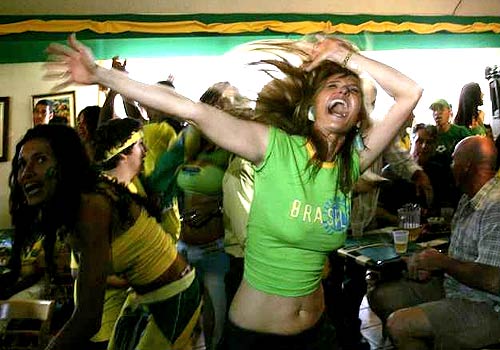
Or this...

Usually these photos are run under the guise of saying something about how World Cup fever is catching, but it's pretty clear that they're merely an excuse to run pictures of gorgeous women from foreign countries.
For example...

It's probably a blatant attempt to sell newspapers or drive online traffic. Imagine!
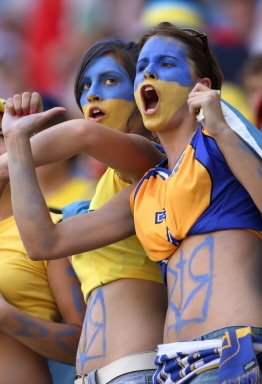
But I'm okay with that blatant sexploitation, because, as my female friends keep reminding me, the players are hot. David Beckham seems to be the favorite by consensus...but given that on every team you have 22 young men in excellent physical shape, with no helmets or hats covering their heads—as opposed to, say, baseball and football—there's plenty to see and choose from. Go to it, ladies.
David Beckham: Apparently, attractive.
Perhaps this is the path to soccer popularity in the U.S.—sex appeal. And why not?
But What If You Have Eyes and Still Can't See?
Okay, President Bush might not have known. But still, it's painfully funny when he teases a reporter for wearing sunglasses, saying, "You gonna ask that question with your shades on?"
Turns out the reporter, Peter Wallsten of the LA Times, is blind.
Whoops!
Turns out the reporter, Peter Wallsten of the LA Times, is blind.
Whoops!
Wednesday, June 14, 2024
The Books on Harvard
Harry Lewis' Excellence Without a Soul is trashed by one Leon Neyfakh in the New York Observer this week. I was interested to see the byline: Neyfakh is a Harvard senior.
"Excellence Without a Soul," Neyfakh writes, "would be an excellent book if it hadn’t been written by a robot." Neyfakh describes the book as full of "winding abstractions—superficially and cloyingly attached to his actual observations as dean." He also criticizes its "boring topic-sentence argumentation and hollow, impotent vocabulary."
At which point one should mention something that Neyfakh doesn't disclose in his review: He is dating one of Lisa New's daughters, a sophomore at Harvard in the fall. (Lisa New is, of course, Mrs. Larry Summers.)
Since there is no love lost between Lewis and Summers, and Lewis' book is critical of the president, Neyfakh should have been conflicted out of writing the review. There's simply no question about that. Possibly he could have disclosed the conflict, but consider how awkard that would have been—imagine the phrasing.
In the spirit of full disclosure, I should add that I have my own curious history with the daughter in question. (No, not that kind of history.)
When Harvard Rules came out, my publisher tried to arrange a reading at the Harvard Book Store, which declined the opportunity—something I found odd, given that the book was a natural for the store. "The bookstore doesn't want to jeopardize its relationship with the university," one of its employees told a publicist for HarperCollins, my publisher.
Turns out that the reason the store wouldn't hold a reading was because the young woman worked there, and because of her mother's relationship with Larry Summers, she had a personal antipathy to Harvard Rules. And so, according to other clerks at the store with whom I spoke, the store wouldn't support the book by organizing a reading. Perhaps its owners genuinely feared angering Larry Summers.
I tell this story every time someone starts telling me how great independent bookstores are. I love the Harvard Book Store, and I've spent a lot of time and money there. But this episode definitely caused me to lose respect for it.
"Excellence Without a Soul," Neyfakh writes, "would be an excellent book if it hadn’t been written by a robot." Neyfakh describes the book as full of "winding abstractions—superficially and cloyingly attached to his actual observations as dean." He also criticizes its "boring topic-sentence argumentation and hollow, impotent vocabulary."
At which point one should mention something that Neyfakh doesn't disclose in his review: He is dating one of Lisa New's daughters, a sophomore at Harvard in the fall. (Lisa New is, of course, Mrs. Larry Summers.)
Since there is no love lost between Lewis and Summers, and Lewis' book is critical of the president, Neyfakh should have been conflicted out of writing the review. There's simply no question about that. Possibly he could have disclosed the conflict, but consider how awkard that would have been—imagine the phrasing.
In the spirit of full disclosure, I should add that I have my own curious history with the daughter in question. (No, not that kind of history.)
When Harvard Rules came out, my publisher tried to arrange a reading at the Harvard Book Store, which declined the opportunity—something I found odd, given that the book was a natural for the store. "The bookstore doesn't want to jeopardize its relationship with the university," one of its employees told a publicist for HarperCollins, my publisher.
Turns out that the reason the store wouldn't hold a reading was because the young woman worked there, and because of her mother's relationship with Larry Summers, she had a personal antipathy to Harvard Rules. And so, according to other clerks at the store with whom I spoke, the store wouldn't support the book by organizing a reading. Perhaps its owners genuinely feared angering Larry Summers.
I tell this story every time someone starts telling me how great independent bookstores are. I love the Harvard Book Store, and I've spent a lot of time and money there. But this episode definitely caused me to lose respect for it.
World Cup Fever, Part II
O jogo bonito was little in evidence yesterday when Brazil played Croatia. True, Brazil won, 1-0, but you'd have to say that Croatia was the story of the game. While ESPN's announcers were treating Brazil like its team was the second coming—one of them practically having a coronary every time Ronaldinho touched the ball—Croatia was unexpectedly tough, and they could very well have tied, if not won, the game had a couple of breaks gone their way. Brazil looked good, with flashes of greatness, but also defensively vulnerable. As Croatia's Robert Kovac explained, "In the first half we had too much respect for Brazil but it's always like that we you play against the world champions."
We'll see if they improve as the tournament goes on—it's a safe bet that they will.
Meanwhile, Spain and Ukraine are playing even now....
Is it just me, or is World Cup fever finally catching on in the United States?
Devoted fans: another reason to watch the World Cup.
We'll see if they improve as the tournament goes on—it's a safe bet that they will.
Meanwhile, Spain and Ukraine are playing even now....
Is it just me, or is World Cup fever finally catching on in the United States?
Devoted fans: another reason to watch the World Cup.
The Dead Are Dying
Let me take a moment to take note of two sad passings: Lawrence "Ramrod" Shurtliff and Vince Welnick.
Ramrod, as he was universally known, was the road manager for the Grateful Dead, and Welnick was one of the band's last two keyboard players, along with Bruce Hornsby.
I didn't know much about Ramrod until reading this terrific reflection on him in (where else) the San Francisco Chronicle.
A friend of Neal Cassady and Ken Kesey, Ramrod was in charge of the equipment for virtually every Dead show from 1967 on, which is quite a few Dead shows.
According to the Chronicle, drummer Mickey Hart remembered one New Year's Eve when he thought he might be too high to play. Ramrod solved the problem by strapping Hart to his drum stool with gaffer's tape. Hart recalled another show in San Jose with Big Brother and the Holding Company, where the starter's cannon the band used to punctuate the drum solo of "St. Stephen's" went off early.
Some years later, in 1990, Welnick joined the Dead as a replacement for Brent Mydland, the oft-debated keyboard player who died of a drug overdose. Since Mydland was the third keyboard player in the band to die, Welnick could perhaps have been understandably nervous.
I vividly remember that day in August 1995 when Jerry Garcia died; it was devastating, the loss of one of the great American musicians of the 20th century. The deaths of Ramrod and Vince Welnick deepen that loss.
At least we will always have the music to remember them by.
Ramrod, as he was universally known, was the road manager for the Grateful Dead, and Welnick was one of the band's last two keyboard players, along with Bruce Hornsby.
I didn't know much about Ramrod until reading this terrific reflection on him in (where else) the San Francisco Chronicle.
A friend of Neal Cassady and Ken Kesey, Ramrod was in charge of the equipment for virtually every Dead show from 1967 on, which is quite a few Dead shows.
According to the Chronicle, drummer Mickey Hart remembered one New Year's Eve when he thought he might be too high to play. Ramrod solved the problem by strapping Hart to his drum stool with gaffer's tape. Hart recalled another show in San Jose with Big Brother and the Holding Company, where the starter's cannon the band used to punctuate the drum solo of "St. Stephen's" went off early.
"I looked back," Hart said. "His face was on fire. He'd lost his eyebrows. You could smell his flesh. And he was hurrying to reload the cannon in time. That was the end of the cannons."
Sometimes, in this horrific era of George Bush and Tom DeLay and Donald Trump and Donald Rumsfeld, it is hard to believe that the '60s ever happened, isn't it? "Strapping Hart to his drum stool with gaffer's tape...."
Some years later, in 1990, Welnick joined the Dead as a replacement for Brent Mydland, the oft-debated keyboard player who died of a drug overdose. Since Mydland was the third keyboard player in the band to die, Welnick could perhaps have been understandably nervous.
As things turned out, Welnick was really good, and we fans quickly came to think of him as an essential band member. He knew an awful lot about musical history, and convinced the band to play songs that they hadn't done in years, like "Here Comes Sunshine." (Welnick was also on board in 1995, when they played "Unbroken Chain" for the first time in 22 years.)
Unfortunately, Welnick was a smoker, and contracted a lung disease (he didn't talk publicly of it) in 1995. He died on June 2, 2006, apparently of a suicide. The details have not been released.I vividly remember that day in August 1995 when Jerry Garcia died; it was devastating, the loss of one of the great American musicians of the 20th century. The deaths of Ramrod and Vince Welnick deepen that loss.
At least we will always have the music to remember them by.
Tuesday, June 13, 2024
World Cup Fever
Well, the U.S. embarrassed itself yesterday, losing to the Czech Republic 3-0 in a game in which we had something like six shots on goal, only one of which was really close. Ouch. We stank, pure and simple.
Nonetheless, I'm having a fantastic time watching as much of the Cup as I can.
Soccer, which I played as a youth, is o jogo bonito, the beautiful game (though that's actually the expression applied to Brazil's style of play). It is not as obvious as, say, American football or basketball. There are no sacks, no dunks, no spikes. The things to love about soccer are more nuanced: a beautiful pass into a space that's about to be filled; the footwork of a wing who seems trapped in the corner of the field and somehow escapes; the fluidity and speed with which a play can emerge and move from one end of the field to another, like a school of fish suddenly changing direction.
No one does it better than Brazil, and as soon as the U.S. gets eliminated, that's who I'm rooting for.
No, not just because Brazil is the favorite, not just because of Ronaldinho...
...although, let's just talk about Ronaldinho for a second, shall we? If you don't really appreciate the glory of soccer, take a look at this video clip. It shows Ronaldinho trying on a new pair of cleats, then fluidly, oh so fluidly, starting to dribble a soccer ball with his feet and knees. Then he does something that is hard to believe: From about 25 yards away from the goal, he casually bangs a shot off the crossbar. It bounces back to him and he chests the ball, never letting it hit the ground. Then he does it again. And again. And again.
Four times off the crossbar, four times he catches the ball—and not once does it touch the ground.
Astonishing. There's not an athlete in this country who could do anything like that. (It's so astonishing, some people think it's a fake. It's possible. But the dribbling alone is worth a look...watch closely, for example, the first time Ronaldinho picks the ball up with his feet. Beautiful.)
But the reason I'll root for Brazil is because watching their team is such a joy, and because the game is so important to them. I've had occasion to spend time in Brazil. It's a wonderful, beautiful, sad, friendly, scary, optimistic, broken country. It's a love song of a country, a poem, a dance, and all that passion and humanity shows in the way that Brazilians play soccer. Watching them, you can't help but be caught up in o jogo bonito; you can't help but better understand why soccer moves the world.
Brazil plays Croatia today. Check it out, around 2:45 on ESPN2.
Nonetheless, I'm having a fantastic time watching as much of the Cup as I can.
Soccer, which I played as a youth, is o jogo bonito, the beautiful game (though that's actually the expression applied to Brazil's style of play). It is not as obvious as, say, American football or basketball. There are no sacks, no dunks, no spikes. The things to love about soccer are more nuanced: a beautiful pass into a space that's about to be filled; the footwork of a wing who seems trapped in the corner of the field and somehow escapes; the fluidity and speed with which a play can emerge and move from one end of the field to another, like a school of fish suddenly changing direction.
No one does it better than Brazil, and as soon as the U.S. gets eliminated, that's who I'm rooting for.
No, not just because Brazil is the favorite, not just because of Ronaldinho...
...although, let's just talk about Ronaldinho for a second, shall we? If you don't really appreciate the glory of soccer, take a look at this video clip. It shows Ronaldinho trying on a new pair of cleats, then fluidly, oh so fluidly, starting to dribble a soccer ball with his feet and knees. Then he does something that is hard to believe: From about 25 yards away from the goal, he casually bangs a shot off the crossbar. It bounces back to him and he chests the ball, never letting it hit the ground. Then he does it again. And again. And again.
Four times off the crossbar, four times he catches the ball—and not once does it touch the ground.
Astonishing. There's not an athlete in this country who could do anything like that. (It's so astonishing, some people think it's a fake. It's possible. But the dribbling alone is worth a look...watch closely, for example, the first time Ronaldinho picks the ball up with his feet. Beautiful.)
But the reason I'll root for Brazil is because watching their team is such a joy, and because the game is so important to them. I've had occasion to spend time in Brazil. It's a wonderful, beautiful, sad, friendly, scary, optimistic, broken country. It's a love song of a country, a poem, a dance, and all that passion and humanity shows in the way that Brazilians play soccer. Watching them, you can't help but be caught up in o jogo bonito; you can't help but better understand why soccer moves the world.
Brazil plays Croatia today. Check it out, around 2:45 on ESPN2.
Thought for the Day
In a review of two novels about Upper East Side kids and their schools, Michiko Kakutani writes....
The head of the school refers to students as "customers" and seems intent on increasing "customer satisfaction." The school's cafeteria is a food court that includes sushi and a pizza oven; the school's deans cheerfully accept a host of excuses for plagiarism and cheating. "Leniency," John observes, "was in keeping with the philosophy of the school — let no revenue stream be interrupted."
Remember, she's talking about New York.
The head of the school refers to students as "customers" and seems intent on increasing "customer satisfaction." The school's cafeteria is a food court that includes sushi and a pizza oven; the school's deans cheerfully accept a host of excuses for plagiarism and cheating. "Leniency," John observes, "was in keeping with the philosophy of the school — let no revenue stream be interrupted."
Remember, she's talking about New York.
Whither Larry?
On his blog, David Warsh has an interesting column on Larry Summers' future.
Here's one paragraph that seemed particularly on target:
Probably he is finished in government. The meteoric rise that began with the Reagan CEA under Feldstein, that led to becoming chief economic adviser in the presidential campaign of Michael S. Dukakis, then to the chief economist's job at the World Bank under George H.W. Bush, and, finally, to the Clinton Treasury Department, may be over. His role in the Shleifer affair makes it unlikely that Summers ever again can be confirmed by the Senate.
Is this right, or is it a reflection of Warsh's passion about matters Shleifer? I was going to say that Republicans might use the Shleifer matter to torpedo any Summers nomination...but then decided that these days, Republicans like Summers more than liberals do, and probably care less about the corruption issue. In fact, it seems likely to be Democrats who'd raise objections to Summers, not just because of Shleifer but because of his insults to various Democratic constituences, primarily women and African-Americans.
So, yes, it's hard to imagine Hillary Clinton inviting Summers back into government. Al Gore? Not a chance. Who'd want a man who shuffles along, surrounded by controversy wherever he goes, like Pigpen and his cloud of dust?
That leaves two alternatives, according to Warsh: Wall Street, with which Summers gained more than a passing acquaintance during his years at the Treasury Department, and international economics, of which he has become a distinguished practitioner.
The latter could include being a foundation head or coming back to teach at Harvard.
Increasingly I think that Summers will come back to Harvard. He has a new house in Brookline, a wife with tenure, and a stepdaughter who's a Harvard sophomore (I think).
More than that, the Wall Street option seems, if one truly considers it, unlikely. Yes, I've heard the rumors that Bob Rubin will hire him at Citigroup—a move which would, I think, humiliate Summers, as it would be the third straight job he's gotten as a result of Rubin's patronage—or that he'll go to Goldman Sachs.
But what would he actually do at those places? Take meetings? We all know how that goes. Make connections in foreign lands? Perhaps—but a lot of people in those foreign lands don't really like Larry Summers, as Joe Stiglitz will tell you. Crunch numbers? I suppose. But lots of people can do that...and as mentioned before, what Wall Street firm wants the inevitable publicity? What hedge fund?
No, the best bet right now is for Summers to come back to Harvard. Warsh mentions the business school, and I think that's right. It's in Allston, which has a physical separation from the Yard and Mass Hall and a symbolic importance to Summers. It was one of the few places where Summers had a significant reservoir of support. It would allow Summers to engage in consulting and speechifying, and make more money, which he would like to do. And Summers would certainly be a demanding and challenging classroom instructor.
Summers could also write a book—something in the Freakanomics vein, meaning smart and contrarian, but in a constructive way. Problem is, he can't write, as a perusal of the speeches on his website will tell you. (Not that he wrote them—but that's the point.) Maybe he could work with the guy who co-wrote Freakanomics.
(If I were a newspaper editor, come to think of it, I'd want to have lunch with Summers and broach the topic of his writing a column. If Summers really were to let his hair down, relax a bit, and write with the flair, intelligence and originality he shows during question-and-answer periods, he could make a very fine newspaper columnist. His provocative nature could be a perfect fit for that medium. He'd certainly be more interesting than, say, John Tierney.)
The problem here is that Summers would almost surely think such a popular book beneath him, and want to produce a tome on foreign policy and international relations, like something that Henry Kissinger would write to be discussed at the Council on Foreign Relations. Ho-hum.
Warsh, however, disagrees with me, writing...
Larry Summers remains a very big frog; there is no doubt at all about that: the question is what kind of pond he will choose. Granted, a university like Harvard contains multitudes. A close look at the bitterness of the negotiation that in February compelled his resignation, however, suggests that neither Professors Summers nor Shleifer, nor, for that matter, Harvard Corporation member Rubin, will remain connected to Harvard for more than a year or so.
Largely because I'm unconvinced of the viability of other options, or Summers' sense that they are insufficiently elevated for him, I think Summers will head to HBS in a year, with perhaps a joint position at the Kennedy School.
Here's one paragraph that seemed particularly on target:
Probably he is finished in government. The meteoric rise that began with the Reagan CEA under Feldstein, that led to becoming chief economic adviser in the presidential campaign of Michael S. Dukakis, then to the chief economist's job at the World Bank under George H.W. Bush, and, finally, to the Clinton Treasury Department, may be over. His role in the Shleifer affair makes it unlikely that Summers ever again can be confirmed by the Senate.
Is this right, or is it a reflection of Warsh's passion about matters Shleifer? I was going to say that Republicans might use the Shleifer matter to torpedo any Summers nomination...but then decided that these days, Republicans like Summers more than liberals do, and probably care less about the corruption issue. In fact, it seems likely to be Democrats who'd raise objections to Summers, not just because of Shleifer but because of his insults to various Democratic constituences, primarily women and African-Americans.
So, yes, it's hard to imagine Hillary Clinton inviting Summers back into government. Al Gore? Not a chance. Who'd want a man who shuffles along, surrounded by controversy wherever he goes, like Pigpen and his cloud of dust?
That leaves two alternatives, according to Warsh: Wall Street, with which Summers gained more than a passing acquaintance during his years at the Treasury Department, and international economics, of which he has become a distinguished practitioner.
The latter could include being a foundation head or coming back to teach at Harvard.
Increasingly I think that Summers will come back to Harvard. He has a new house in Brookline, a wife with tenure, and a stepdaughter who's a Harvard sophomore (I think).
More than that, the Wall Street option seems, if one truly considers it, unlikely. Yes, I've heard the rumors that Bob Rubin will hire him at Citigroup—a move which would, I think, humiliate Summers, as it would be the third straight job he's gotten as a result of Rubin's patronage—or that he'll go to Goldman Sachs.
But what would he actually do at those places? Take meetings? We all know how that goes. Make connections in foreign lands? Perhaps—but a lot of people in those foreign lands don't really like Larry Summers, as Joe Stiglitz will tell you. Crunch numbers? I suppose. But lots of people can do that...and as mentioned before, what Wall Street firm wants the inevitable publicity? What hedge fund?
No, the best bet right now is for Summers to come back to Harvard. Warsh mentions the business school, and I think that's right. It's in Allston, which has a physical separation from the Yard and Mass Hall and a symbolic importance to Summers. It was one of the few places where Summers had a significant reservoir of support. It would allow Summers to engage in consulting and speechifying, and make more money, which he would like to do. And Summers would certainly be a demanding and challenging classroom instructor.
Summers could also write a book—something in the Freakanomics vein, meaning smart and contrarian, but in a constructive way. Problem is, he can't write, as a perusal of the speeches on his website will tell you. (Not that he wrote them—but that's the point.) Maybe he could work with the guy who co-wrote Freakanomics.
(If I were a newspaper editor, come to think of it, I'd want to have lunch with Summers and broach the topic of his writing a column. If Summers really were to let his hair down, relax a bit, and write with the flair, intelligence and originality he shows during question-and-answer periods, he could make a very fine newspaper columnist. His provocative nature could be a perfect fit for that medium. He'd certainly be more interesting than, say, John Tierney.)
The problem here is that Summers would almost surely think such a popular book beneath him, and want to produce a tome on foreign policy and international relations, like something that Henry Kissinger would write to be discussed at the Council on Foreign Relations. Ho-hum.
Warsh, however, disagrees with me, writing...
Larry Summers remains a very big frog; there is no doubt at all about that: the question is what kind of pond he will choose. Granted, a university like Harvard contains multitudes. A close look at the bitterness of the negotiation that in February compelled his resignation, however, suggests that neither Professors Summers nor Shleifer, nor, for that matter, Harvard Corporation member Rubin, will remain connected to Harvard for more than a year or so.
Largely because I'm unconvinced of the viability of other options, or Summers' sense that they are insufficiently elevated for him, I think Summers will head to HBS in a year, with perhaps a joint position at the Kennedy School.
Monday, June 12, 2024

At Duke, Bad Craziness
In the Times, two articles—one in the news section, one by columnist Nick Kristof—weigh in on the farce that is the Duke rape case.
Here's the latest news:
1) The alleged victim didn't cry rape until she was going to be committed to a hospital.
2) When she first claimed rape, she said nothing about the Duke lacrosse players using condoms...which would make the lack of DNA evidence deeply problematic.
3) When the second dancer first heard of the rape story, she pronounced it "a crock."
4) The woman's physical condition doesn't seem consistent with rape.
Moreover, isn't the Times implying that the woman was not just an "exotic dancer," but also a hooker?
The lawyers attached a five-page handwritten statement given to the police by Jarriel L. Johnson, 32, of Raleigh, describing his driving the woman around the Raleigh-Durham area the weekend before the lacrosse team party. He said she met with clients at three hotels in the area. The exact nature of the meetings was not disclosed.
I love that sentence, "The exact nature of the meetings..." If you imagine a reporter chuckling as he wrote that, you're right. It's pretty clear what the exact nature of the meetings was.
Why is that relevant? Well, it would make it a little hard to determine just how many people had sex with the woman...
Mike Nifong increasingly reminds one of another prosecutor obsessed with non-existent sex crimes: Kenneth Starr.
Here's the latest news:
1) The alleged victim didn't cry rape until she was going to be committed to a hospital.
2) When she first claimed rape, she said nothing about the Duke lacrosse players using condoms...which would make the lack of DNA evidence deeply problematic.
3) When the second dancer first heard of the rape story, she pronounced it "a crock."
4) The woman's physical condition doesn't seem consistent with rape.
Moreover, isn't the Times implying that the woman was not just an "exotic dancer," but also a hooker?
The lawyers attached a five-page handwritten statement given to the police by Jarriel L. Johnson, 32, of Raleigh, describing his driving the woman around the Raleigh-Durham area the weekend before the lacrosse team party. He said she met with clients at three hotels in the area. The exact nature of the meetings was not disclosed.
I love that sentence, "The exact nature of the meetings..." If you imagine a reporter chuckling as he wrote that, you're right. It's pretty clear what the exact nature of the meetings was.
Why is that relevant? Well, it would make it a little hard to determine just how many people had sex with the woman...
Mike Nifong increasingly reminds one of another prosecutor obsessed with non-existent sex crimes: Kenneth Starr.
And, In Hammerhead News
Scientists have discovered a new breed of hammerhead shark in American waters, a rare species that appears to make its home off the coast of South Carolina. It better not swim to Florida, where some bonehead "sport" fisherman might try to catch it just to prove that he can.
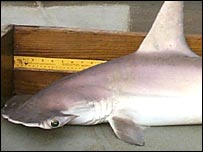
It's too late for this rare hammerhead...
but perhaps not for others.
Also in Florida news, the state fish and wildlife conservation commission has officially removed the manatee from the endangered species list, now calling it only "threatened."
Good news, you say? Well, no. The commission is stocked with cronies of Jeb Bush—no environmental governor, he—who want to make it easier for developers to build along the Florida coastline. (Yes, there is some Florida coastline left.)
In the Miami Herald, Carl Hiaasen explains....
It's too late for this rare hammerhead...
but perhaps not for others.
Also in Florida news, the state fish and wildlife conservation commission has officially removed the manatee from the endangered species list, now calling it only "threatened."
Good news, you say? Well, no. The commission is stocked with cronies of Jeb Bush—no environmental governor, he—who want to make it easier for developers to build along the Florida coastline. (Yes, there is some Florida coastline left.)
In the Miami Herald, Carl Hiaasen explains....
Sometimes a Picture Tells an Inadvertent Story
The Harvard Gazette's timeline of the Summers' presidency is both hilarious and ominous in its strenuous assertion that the Summers' years were a period of great renewal and optimism at Harvard, free of blight.
But sometimes, even the most committed propagandist inadvertently reveals a truth. Consider, for example, this photograph and caption that ran with the Gazette's compilation of Summers' greatest hits.
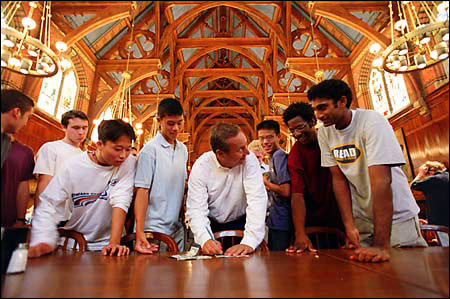
At the freshman barbeque in Annenberg Hall in September 2002,
students gather around Summers to get the former secretary of the
treasury [sic] to sign their one dollar bills.
(Staff file photo Stephanie Mitchell/Harvard News Office)
I could never figure out which was more disturbing: the fact that Harvard students were so anxious to get Summers' signature on their money, or the fact that Summers was always willing to oblige. Did no one see what unfortunate pieces of symbolism both actions were? They certainly evoked what has become all-too-important at Harvard in recent years: celebrity and money.
Harvard has many challenges in the short term. But in the long run, this may be its biggest hurdle: the fact that so many students want to go to Harvard for the most superficial of reasons.
It's fascinating that Summers, who almost surely approved the text and photos used in this Gazette story, wanted this photograph to run.
But sometimes, even the most committed propagandist inadvertently reveals a truth. Consider, for example, this photograph and caption that ran with the Gazette's compilation of Summers' greatest hits.
At the freshman barbeque in Annenberg Hall in September 2002,
students gather around Summers to get the former secretary of the
treasury [sic] to sign their one dollar bills.
(Staff file photo Stephanie Mitchell/Harvard News Office)
I could never figure out which was more disturbing: the fact that Harvard students were so anxious to get Summers' signature on their money, or the fact that Summers was always willing to oblige. Did no one see what unfortunate pieces of symbolism both actions were? They certainly evoked what has become all-too-important at Harvard in recent years: celebrity and money.
Harvard has many challenges in the short term. But in the long run, this may be its biggest hurdle: the fact that so many students want to go to Harvard for the most superficial of reasons.
It's fascinating that Summers, who almost surely approved the text and photos used in this Gazette story, wanted this photograph to run.
Friday, June 09, 2024
Larry Summers Bids Farewell
Some of you wondered why I didn't engage in a broader discussion of yesterday's Crimson, among other things. The answer is I was returning from Boston after meeting with Red Sox officials on Wednesday to talk about my work-in-progress, a book on the 1978 Yankees-Red Sox season. (I do have a job, you know.) And when I got back to Manhattan, I was glued to my computer, watching the Internet transmission of Larry Summers' farewell speech.
It was, I thought, a good speech. I've heard a couple grumbles—it was a recitation of things he's already said (largely true), he moved it inside so cameras wouldn't show him speaking to an empty Yard (understandable if true), he took credit for everything (Summers probably thinks he gets blamed for everything, so fair's fair).
But most important for both Summers and Harvard, he struck the right notes. He was gracious, not bitter; optimistic, not angry; and constructive, not critical. I have no doubt that privately Summers' thoughts are much more colorful than was his speech yesterday. But this was a formal, public occasion, and Summers handled it well. My only thought was that it was kind of anti-climactic. Part of me wanted to see Summers go out with a bang, make some news. Instead, it rates as wire copy on the New York Times website. But strategically, I think Summers made a wise choice. After all, he still has to find a job....
A number of you have asked my thoughts on the Crimson's year-end issue, in particular Javier Hernandez's investigation into the exact same thing I wrote about in Boston Magazine, the events between February 7th and February 21, the day of Summers' resignation.
The answer is that I thought Hernandez did an outstanding job—a very nicely detailed, thoroughly reported tick-tock of the end of Summers' presidency.
Here's what I learned from the piece:
—that Summers' lawyer was D.C. power-lawyer Bob Barnett, a fact I tried and failed to get but which makes perfect sense. Of course Summers would use a Washington lawyer.
—that Jamie Houghton had to take a two-year leave from the business school because of bad grades. That's interesting.
—that David Gergen feels qualified to talk about what Summers was thinking and doing during this period, even though he admits that Summers didn't talk to him during it
—that Summers was smiling on his way out the door of Mass Hall to go skiing. It's hard to know what that detail means—Summers' smiles sometimes look like grimaces, and vice-versa—but it's a nice touch.
—that Summers had drinks with his staff the afternoon of his resignation. (I would really have liked to know who that group included, and what the mood in the room was like.)
There were a few points on which I quibble slightly with Hernandez.
First, I think his description of Jamie Houghton's decision to withdraw support for Summers is too strong. Hernandez refers to it as a "Valentine's Day plan," which gives the impression of something more dramatic and more systematic than what actually happened—a gradual, reluctant changing of Houghton's mind.
Second, Hernandez suggests that Robert Reischauer and Nan Keohane were talking about a Summers' resignation as early as last fall. That's not my understanding.
Hernandez then writes:
As early as December of last year, Keohane, Reischauer, and investment manager James F. Rothenberg ’68—all appointed to the Corporation by Summers—were seriously doubting the ability of the president to continue to govern the nation’s oldest university. His presidency had begun to slip away.
I think that's too strong; I don't see any reason why, if the Kirby firing had not exploded the way it did, Summers could not have survived. Certainly the Corporation had no plans to take any kind of action until after the February 7th faculty meeting.
There are still some questions about what really happened in this period. I'd like to know exactly when, for example, Houghton gave up the ghost, and if there was any particular thing that caused him to abandon Summers. I'd also like to know the details of Summers' severance agreement. I'd like to better understand the relationship between Bob Rubin and Larry Summers; how can such an intelligent man (Rubin) get a situation so incredibly wrong? (Did Rubin really believe it when, back in 2001, he told the Corporation that Larry Summers wasn't the angry young man he used to be?) And I'd like to know if James Rothenberg's claim yesterday that Harvard raised $2.7 billion over the last five years is legit, or cooking the books.
But all told, I think that Javier and I have helped excavate much of this story. Kudos to the Crimson for its reporting....
It was, I thought, a good speech. I've heard a couple grumbles—it was a recitation of things he's already said (largely true), he moved it inside so cameras wouldn't show him speaking to an empty Yard (understandable if true), he took credit for everything (Summers probably thinks he gets blamed for everything, so fair's fair).
But most important for both Summers and Harvard, he struck the right notes. He was gracious, not bitter; optimistic, not angry; and constructive, not critical. I have no doubt that privately Summers' thoughts are much more colorful than was his speech yesterday. But this was a formal, public occasion, and Summers handled it well. My only thought was that it was kind of anti-climactic. Part of me wanted to see Summers go out with a bang, make some news. Instead, it rates as wire copy on the New York Times website. But strategically, I think Summers made a wise choice. After all, he still has to find a job....
A number of you have asked my thoughts on the Crimson's year-end issue, in particular Javier Hernandez's investigation into the exact same thing I wrote about in Boston Magazine, the events between February 7th and February 21, the day of Summers' resignation.
The answer is that I thought Hernandez did an outstanding job—a very nicely detailed, thoroughly reported tick-tock of the end of Summers' presidency.
Here's what I learned from the piece:
—that Summers' lawyer was D.C. power-lawyer Bob Barnett, a fact I tried and failed to get but which makes perfect sense. Of course Summers would use a Washington lawyer.
—that Jamie Houghton had to take a two-year leave from the business school because of bad grades. That's interesting.
—that David Gergen feels qualified to talk about what Summers was thinking and doing during this period, even though he admits that Summers didn't talk to him during it
—that Summers was smiling on his way out the door of Mass Hall to go skiing. It's hard to know what that detail means—Summers' smiles sometimes look like grimaces, and vice-versa—but it's a nice touch.
—that Summers had drinks with his staff the afternoon of his resignation. (I would really have liked to know who that group included, and what the mood in the room was like.)
There were a few points on which I quibble slightly with Hernandez.
First, I think his description of Jamie Houghton's decision to withdraw support for Summers is too strong. Hernandez refers to it as a "Valentine's Day plan," which gives the impression of something more dramatic and more systematic than what actually happened—a gradual, reluctant changing of Houghton's mind.
Second, Hernandez suggests that Robert Reischauer and Nan Keohane were talking about a Summers' resignation as early as last fall. That's not my understanding.
Hernandez then writes:
As early as December of last year, Keohane, Reischauer, and investment manager James F. Rothenberg ’68—all appointed to the Corporation by Summers—were seriously doubting the ability of the president to continue to govern the nation’s oldest university. His presidency had begun to slip away.
I think that's too strong; I don't see any reason why, if the Kirby firing had not exploded the way it did, Summers could not have survived. Certainly the Corporation had no plans to take any kind of action until after the February 7th faculty meeting.
There are still some questions about what really happened in this period. I'd like to know exactly when, for example, Houghton gave up the ghost, and if there was any particular thing that caused him to abandon Summers. I'd also like to know the details of Summers' severance agreement. I'd like to better understand the relationship between Bob Rubin and Larry Summers; how can such an intelligent man (Rubin) get a situation so incredibly wrong? (Did Rubin really believe it when, back in 2001, he told the Corporation that Larry Summers wasn't the angry young man he used to be?) And I'd like to know if James Rothenberg's claim yesterday that Harvard raised $2.7 billion over the last five years is legit, or cooking the books.
But all told, I think that Javier and I have helped excavate much of this story. Kudos to the Crimson for its reporting....
Thursday, June 08, 2024
A Variety of Odd Statements
Okay, I'll rise to the bait. I can't help but respond to Larry Summers' comments about me in the Commencement issue of the Crimson. (Isn't that what a blog is for?)
Here's what interviewer Sam Teller asked him and what Summers answered:
ST: I hate to give him the satisfaction of getting mentioned in this interview, but Richard Bradley has made a small career doing what he might call watching out for Harvard, but what in effect amounts to preying on you for controversy to sell books. He says you’ve met three times, but have never actually spoken. Do you recall ever meeting him? Can you divine the source of his vendetta against you?
LHS: Met-without-speaking is an odd concept. I’m told there are a variety of odd statements in his writings, but frankly I don’t follow them. I try not to speculate on the motives of others.
Ouch!
Let's just clarify a couple of things, though.
Met-without-speaking is an odd concept, indeed, but I think President Summers knows exactly what I was referring to: As I told Sam back when he interviewed me for "15 Questions," I have three times shaken hands with Larry Summers and introduced myself, and each time he grunted or was otherwise silent and walked away.
So it's worth noting that, in classic Washington fashion, Summers doesn't actually answer the question.
Instead, he slips in a sideways smear—"I'm told there are a variety of odd statements in his writings"—that really is beneath a Harvard president. (Even an outgoing one.) While suggesting that he hasn't read my Harvard-related work, Summers denigrates it—without actually going into specifics. (Sam, that would have been a nice follow-up.)
All I can say is that I have requested to interview President Summers quite a few times and given him ample opportunity to respond to anything I planned to write, and never once has he or anyone working for him challenged any specific point of my reporting.
But I've been critical of Summers in my book and elsewhere, so I don't really begrudge him a parting shot at me. What perturbs me more is Sam Teller's suggestion that I have a "vendetta" against Summers. Sam, that's crazy talk. In my book, this blog, and in a couple of articles I've done for Boston Magazine, I've called 'em as I saw 'em. Of course, I welcome constructive criticism, and when I make mistakes, I correct them. But time and events seem to have borne out my reporting.
As for "preying on controversy" to sell books...well, it may have worked out that Harvard Rules happened to come out during the women-in-science controversy, and has benefitted from the controversy that President Summers ignites from time to time. But I can assure you that when I began the project of writing a book about a university and its president, controversy was the farthest thing from my mind. In fact, I was very much hoping to do a book that was less controversial than my first.
As to trying to sell books...I plead guilty. Such is life.
Now, why might Sam Teller say such unkind things about me? Perhaps because he's sucking up to Summers throughout the interview. (Sample question: "How did it feel to be greeted by a throng of supportive, cheering students as you walked out of your office on the day of your resignation?" Larry King couldn't top that.)
Perhaps because I blasted him on this blog not too long ago. Not that he discloses this in the Crimson.....
Here's what interviewer Sam Teller asked him and what Summers answered:
ST: I hate to give him the satisfaction of getting mentioned in this interview, but Richard Bradley has made a small career doing what he might call watching out for Harvard, but what in effect amounts to preying on you for controversy to sell books. He says you’ve met three times, but have never actually spoken. Do you recall ever meeting him? Can you divine the source of his vendetta against you?
LHS: Met-without-speaking is an odd concept. I’m told there are a variety of odd statements in his writings, but frankly I don’t follow them. I try not to speculate on the motives of others.
Ouch!
Let's just clarify a couple of things, though.
Met-without-speaking is an odd concept, indeed, but I think President Summers knows exactly what I was referring to: As I told Sam back when he interviewed me for "15 Questions," I have three times shaken hands with Larry Summers and introduced myself, and each time he grunted or was otherwise silent and walked away.
So it's worth noting that, in classic Washington fashion, Summers doesn't actually answer the question.
Instead, he slips in a sideways smear—"I'm told there are a variety of odd statements in his writings"—that really is beneath a Harvard president. (Even an outgoing one.) While suggesting that he hasn't read my Harvard-related work, Summers denigrates it—without actually going into specifics. (Sam, that would have been a nice follow-up.)
All I can say is that I have requested to interview President Summers quite a few times and given him ample opportunity to respond to anything I planned to write, and never once has he or anyone working for him challenged any specific point of my reporting.
But I've been critical of Summers in my book and elsewhere, so I don't really begrudge him a parting shot at me. What perturbs me more is Sam Teller's suggestion that I have a "vendetta" against Summers. Sam, that's crazy talk. In my book, this blog, and in a couple of articles I've done for Boston Magazine, I've called 'em as I saw 'em. Of course, I welcome constructive criticism, and when I make mistakes, I correct them. But time and events seem to have borne out my reporting.
As for "preying on controversy" to sell books...well, it may have worked out that Harvard Rules happened to come out during the women-in-science controversy, and has benefitted from the controversy that President Summers ignites from time to time. But I can assure you that when I began the project of writing a book about a university and its president, controversy was the farthest thing from my mind. In fact, I was very much hoping to do a book that was less controversial than my first.
As to trying to sell books...I plead guilty. Such is life.
Now, why might Sam Teller say such unkind things about me? Perhaps because he's sucking up to Summers throughout the interview. (Sample question: "How did it feel to be greeted by a throng of supportive, cheering students as you walked out of your office on the day of your resignation?" Larry King couldn't top that.)
Perhaps because I blasted him on this blog not too long ago. Not that he discloses this in the Crimson.....
Wednesday, June 07, 2024
O Crimson, Where Art Thou?
Today is Class Day at Harvard—congratulations, seniors—and the Crimson celebrates by publishing another of its cranky attacks on the faculty.
The paper editorializes....
The Faculty has addressed few of the critical problems facing undergraduate education in any meaningful way, including those of curricular reform and the need for better teaching. Instead, it spent much of the year focusing on the ouster of University President Lawrence H. Summers—the most undergraduate-friendly Harvard president in recent history—while at other times it had difficulty even attaining quorums at its meetings to discuss undergraduate matters.
The editorial goes on to excoriate the faculty primarily for failing to make sufficient progress on the curricular review while devoting its energy to ousting Summers.
I know the Crimson is staffed with smart people, so I'm mystified by this argument. Can the Crimson editors not see any connection between the leadership of President Summers and the disaster that is the curricular review? Do these folks have such a short memory that they forget that, while Summers was actively directing in the review, it was an even larger failure than it is now? That it was Summers who appointed Kirby, an ineffectual dean who, for various reasons, was not up to the job of leading an academically serious curricular review? That, in working to oust Summers, the faculty was doing the most undergraduate-friendly thing it could? It will be very interesting to see the state of the review after a year of Derek Bok; I have no doubt that the comparison will be instructive.
The Crimson editors often lament the state of advising at Harvard College...do they not see that the worst department is the economics department, and that because this was a core of political support for Summers, he conspicuously failed to raise this issue with that department? (You can trust that he would have if it were classics, that's for sure.)
And do the Crimson editors not see that Summers manipulated an easily-pleased audience, mobilizing student opinion to try to shore up his support, politicizing his relationship with the student body in a way that was extremely disturbing to the faculty, which consciously resisted efforts to draw the student body into this fight?
Crimson editors, it's a fine thing that Summers visited student pizza feeds, danced at freshman parties, urged the teaching of more seminars, and wanted to improve the student social life. His push of a plan for free tuition for low-income families was important in both symbolic and practical ways. Absolutely, give him credit for these things.
But there is an inexorable connection between a dud of a curricular review and Summers' leadership. Then there's the fact of FAS deficits that will be approaching $100 million annually, in large part because of Summers' high-spending habits—and if you think this won't affect undergraduate education, you are much mistaken. The reporting of your own staff has shown that.
The Harvard faculty certainly has its shortcomings—many of which, in my opinion, are traceable to the longstanding culture of the university—and it does not explain itself well. But on this one, the Crimson is just wrong.
The paper editorializes....
The Faculty has addressed few of the critical problems facing undergraduate education in any meaningful way, including those of curricular reform and the need for better teaching. Instead, it spent much of the year focusing on the ouster of University President Lawrence H. Summers—the most undergraduate-friendly Harvard president in recent history—while at other times it had difficulty even attaining quorums at its meetings to discuss undergraduate matters.
The editorial goes on to excoriate the faculty primarily for failing to make sufficient progress on the curricular review while devoting its energy to ousting Summers.
I know the Crimson is staffed with smart people, so I'm mystified by this argument. Can the Crimson editors not see any connection between the leadership of President Summers and the disaster that is the curricular review? Do these folks have such a short memory that they forget that, while Summers was actively directing in the review, it was an even larger failure than it is now? That it was Summers who appointed Kirby, an ineffectual dean who, for various reasons, was not up to the job of leading an academically serious curricular review? That, in working to oust Summers, the faculty was doing the most undergraduate-friendly thing it could? It will be very interesting to see the state of the review after a year of Derek Bok; I have no doubt that the comparison will be instructive.
The Crimson editors often lament the state of advising at Harvard College...do they not see that the worst department is the economics department, and that because this was a core of political support for Summers, he conspicuously failed to raise this issue with that department? (You can trust that he would have if it were classics, that's for sure.)
And do the Crimson editors not see that Summers manipulated an easily-pleased audience, mobilizing student opinion to try to shore up his support, politicizing his relationship with the student body in a way that was extremely disturbing to the faculty, which consciously resisted efforts to draw the student body into this fight?
Crimson editors, it's a fine thing that Summers visited student pizza feeds, danced at freshman parties, urged the teaching of more seminars, and wanted to improve the student social life. His push of a plan for free tuition for low-income families was important in both symbolic and practical ways. Absolutely, give him credit for these things.
But there is an inexorable connection between a dud of a curricular review and Summers' leadership. Then there's the fact of FAS deficits that will be approaching $100 million annually, in large part because of Summers' high-spending habits—and if you think this won't affect undergraduate education, you are much mistaken. The reporting of your own staff has shown that.
The Harvard faculty certainly has its shortcomings—many of which, in my opinion, are traceable to the longstanding culture of the university—and it does not explain itself well. But on this one, the Crimson is just wrong.
What a Game!
The Red Sox came to the Stadium last night to try to avenge an embarrassing 13-5 defeat the night before, and thanks to my brother's generosity, I was there, seated somewhere between Rudy Giuliani and Michael Strahan. At the start of the night, you wouldn't say that the Sox were starting from a position of strength: Their pitcher, David Pauley, had just come up from the minors. After his first start, he had an ERA of 12.46. Meanwhile, he was facing Yankee sophomore Chien-Ming Wang, whose 4-something ERA wasn't terrific but who has pitched well in recent starts.
What a game it was.
Wang looked shaky at first, running his pitch count to 48 after just two innings and giving up a mammoth homer to David Ortiz in the third inning. Two terrific defensive plays by first baseman Andy Phillips—both leaping grabs of rocket line drives— probably saved more runs.
Meanwhile, Pauley was just terrific, mixing speeds, changing locations, and making the Yankee hitters look like they were facing Luis Tiant rather than a rookie fresh off the farm. Only a solo home run by Bernie Williams saved the Yankees from being shut out through six.
In the bottom of the seventh, they broke through, barely. With two outs, Miguel Cairo, filling in for the injured Derek Jeter at short, hit a little dribbler that scooted under Pauley's glove then under second baseman Mark Loretta's hand. (The ball was generously scored a hit.) Then Johnny Damon singled and rookie Melky Cabrera, playing for injured left-fielder Hideki Matsui, walked to load the bases. After David Pauley exited—this kid has a future—Jason Giambi then walked on six pitches, forcing in what would be the winning run.
But only because of an astonishing play by Cabrera in the top of the 8th. With two out, Manny Ramirez absolutely socked a ball to deep left-center—a home run in any American League park other than Yankee Stadium (assuming it didn't hit the Green Monster). But Cabrera, whose defense has been shaky, raced back to the wall, timed his leap perfectly, caught the ball behind the wall, and fell back onto the field with the ball in his glove. Ramirez, who was trotting between second and third at this point, stopped dead in his tracks, as amazed as was the rest of the Stadium. After that, Mariano Rivera came in for an easy ninth. (Well, he made it look easy.)
A tough loss for the Sox—worse than a blowout, I think—a great victory for the Yankees...but either way, a great showdown. Great pitching, incredible defense, rookies coming up big in clutch situations. Fantastic.
Jason Giambi batting in the bottom of the eighth;
Giambi would walk in the winning run.
What a game it was.
Wang looked shaky at first, running his pitch count to 48 after just two innings and giving up a mammoth homer to David Ortiz in the third inning. Two terrific defensive plays by first baseman Andy Phillips—both leaping grabs of rocket line drives— probably saved more runs.
Meanwhile, Pauley was just terrific, mixing speeds, changing locations, and making the Yankee hitters look like they were facing Luis Tiant rather than a rookie fresh off the farm. Only a solo home run by Bernie Williams saved the Yankees from being shut out through six.
In the bottom of the seventh, they broke through, barely. With two outs, Miguel Cairo, filling in for the injured Derek Jeter at short, hit a little dribbler that scooted under Pauley's glove then under second baseman Mark Loretta's hand. (The ball was generously scored a hit.) Then Johnny Damon singled and rookie Melky Cabrera, playing for injured left-fielder Hideki Matsui, walked to load the bases. After David Pauley exited—this kid has a future—Jason Giambi then walked on six pitches, forcing in what would be the winning run.
But only because of an astonishing play by Cabrera in the top of the 8th. With two out, Manny Ramirez absolutely socked a ball to deep left-center—a home run in any American League park other than Yankee Stadium (assuming it didn't hit the Green Monster). But Cabrera, whose defense has been shaky, raced back to the wall, timed his leap perfectly, caught the ball behind the wall, and fell back onto the field with the ball in his glove. Ramirez, who was trotting between second and third at this point, stopped dead in his tracks, as amazed as was the rest of the Stadium. After that, Mariano Rivera came in for an easy ninth. (Well, he made it look easy.)
A tough loss for the Sox—worse than a blowout, I think—a great victory for the Yankees...but either way, a great showdown. Great pitching, incredible defense, rookies coming up big in clutch situations. Fantastic.
Jason Giambi batting in the bottom of the eighth;
Giambi would walk in the winning run.
Tuesday, June 06, 2024
The Times Loves Michelle Wie
In fact, the newspaper loves her so much it ran five pictures of the golfer today, including one on Page One, above the fold, as well as the rather gratuitous shot below. The Times website has a slideshow featuring another half-dozen photos of Wie.
Why? Because in her attempt to make the cut for the Masters—the top 18 finishers qualified—Wie finished...59th.
One questions the news judgment....after all, this is a story about a woman who wants to play in a golf tournament that has traditionally been for men. Michelle Wie is surely an excellent golfer. But she's not exactly Rosa Parks.
Why? Because in her attempt to make the cut for the Masters—the top 18 finishers qualified—Wie finished...59th.
One questions the news judgment....after all, this is a story about a woman who wants to play in a golf tournament that has traditionally been for men. Michelle Wie is surely an excellent golfer. But she's not exactly Rosa Parks.

For a Second There, I Was Wondering....
Yesterday I received this e-mail from Citibank.....
Dear Richard Bradley:
On Friday, June 2nd you received an email regarding your Citi® / AAdvantage® MasterCard.
We recently discovered that the email we sent to you incorrectly contained the salutation
"Dear Mary Jane" rather than "Dear Richard Bradley". We apologize for the confusion
this may have caused....
Dear Richard Bradley:
On Friday, June 2nd you received an email regarding your Citi® / AAdvantage® MasterCard.
We recently discovered that the email we sent to you incorrectly contained the salutation
"Dear Mary Jane" rather than "Dear Richard Bradley". We apologize for the confusion
this may have caused....
And in Hammerhead News...
Writing in the St. Petersburg (Florida) Times, Sue Carlton agrees with me: catching and killing a hammerhead shark just to set a record is pointless slaughter.... And she notes some encouraging news: In a poll on a fishing website, 61% of respondents answered that it was "never" okay to kill a shark for the purpose of setting a record. I don't see why it isn't, oh, 98%, but 61% is a good start.
Mea Culpa
It's been pointed out to me that I erred on one point in my Boston Magazine article on Larry Summers' resignation. About two-thirds of the way through the article, I wrote that Peter Ellison had been appointed dean of the graduate school by Summers.
That's not true—it was Neil Rudenstine who appointed Ellison dean.
Not a central point of the article, but still, one hates to make any mistake, and I'm happy to correct it.
That's not true—it was Neil Rudenstine who appointed Ellison dean.
Not a central point of the article, but still, one hates to make any mistake, and I'm happy to correct it.
God Bless David Warsh
The former Boston Globe columnist and current blogger refuses to let the Andrei Shleifer scandal fade into moral vacuity, and he's written another terrific column about the choice Harvard now faces—a choice that some members of its (former?) administration seemed determined to avoid or blur for as long as possible.
Warsh writes:
How could anyone possibly read David McClintick's article in Institutional Investor and not come away thinking that Shleifer's behavior, whether it falls into the realm of criminal or civil law, has done enormous damage to Harvard (not to mention Russia)?
Warsh writes:
Within the university, the debate about what to do about Shleifer seems to have centered so far on the distinction between civil and criminal code.
Why worry about it if the government didn't have enough evidence to charge him with a crime?
If this is the litmus test for one's ability to remain a star professor on the Harvard faculty, then the university truly does believe in excellence without a soul.How could anyone possibly read David McClintick's article in Institutional Investor and not come away thinking that Shleifer's behavior, whether it falls into the realm of criminal or civil law, has done enormous damage to Harvard (not to mention Russia)?
At Harvard, Propaganda
A week or so ago, I received a fatuous publication from Harvard in the mail, something called "The Yard." After skimming through it and recognizing it as Harvard-funded agitprop, I placed it gently in the circular file next to my desk, and wondered, if only for a moment, why Harvard needed to spend perfectly good money on another extraneous publication. How many scholarships would "The Yard" (even the name is dumb) consume?
Now Zach Seward in the Wall Street Journal has answered my question. In an article titled "Colleges Want More Rah, Rah from Magazines," Seward reports that colleges across the country are getting cranky about the actual reporting done by their alumni magazines, and that Harvard has grown so disaffected with Harvard Magazine that it has created that fine publication, "The Yard."
Seward writes,
Harvard Magazine has covered Mr. Summers's downfall as aggressively as any media outlet, [blogger's lament: Hello, Zach?] opening its letters section to furious alumni and offering frank news reports on the campus row. But now university administrators, worried that the bimonthly magazine has gone over the line, have launched a new glossy publication to refocus their message to alumni. The new magazine's second issue was distributed last month, and it contains scant mention of Mr. Summers's troubles, his resignation or the crisis that has enveloped the university.
I may be old-fashioned, but still, it's useful to point out that Harvard's motto is Latin for truth. Harvard Magazine has done an excellent job of covering the Summers controversies thoroughly but fairly. Its presentation has been balanced and non-partisan. Isn't that what Harvard alumni want? This is, after all, a pretty intelligent group.
And Seward doesn't even get into the enormous pressures that editor John Rosenberg has faced in the Summers era: the way that Summers forced him to include a monthly "letter from the president," even though Summers "wrote" it once, then abandoned the project; the way that Summers threatened to cut off the magazine's use of the Harvard name and access to the alumni database. (Or so I'm told, though not by Rosenberg.) Yet you'd never get a glimpse of this behind-the-scenes pressure in the editorial tone of the magazine, which is truly a testament to its editor.
In its attack on its alumni magazine, Harvard aligns itself with other universities which have gone down the same road, such as Notre Dame and Baylor—both of which were driven by their adherence to religious dogma. Is this really a club Harvard wants to be a part of?
Well, apparently yes. Because Harvard's motivation is its allegiance to the god of money.
At Harvard, Seward writes, leading fund-raisers determined that Harvard Magazine was no longer serving their best interests, according to two individuals in the development office.
You know, when "leading fundraisers" are deciding that a magazine's quest to report the truth is not in the university's best interests, that university has truly lost its way.
Seward continues: Sarah Friedell, a spokeswoman for Harvard, says The Yard was launched "to increase efficiencies," replacing three other publications.
About which one must say two things.
First, anytime someone says something as awkward and artificial as "increase efficiencies," you know they're full of it. Second, just how many spokespeople does Harvard have? There's an easy answer: Too many.
"The Yard" is an accurate reflection of how Harvard's approach to journalists and truth grew particularly calculated, cynical and political during the Summers' era.
Now Zach Seward in the Wall Street Journal has answered my question. In an article titled "Colleges Want More Rah, Rah from Magazines," Seward reports that colleges across the country are getting cranky about the actual reporting done by their alumni magazines, and that Harvard has grown so disaffected with Harvard Magazine that it has created that fine publication, "The Yard."
Seward writes,
Harvard Magazine has covered Mr. Summers's downfall as aggressively as any media outlet, [blogger's lament: Hello, Zach?] opening its letters section to furious alumni and offering frank news reports on the campus row. But now university administrators, worried that the bimonthly magazine has gone over the line, have launched a new glossy publication to refocus their message to alumni. The new magazine's second issue was distributed last month, and it contains scant mention of Mr. Summers's troubles, his resignation or the crisis that has enveloped the university.
I may be old-fashioned, but still, it's useful to point out that Harvard's motto is Latin for truth. Harvard Magazine has done an excellent job of covering the Summers controversies thoroughly but fairly. Its presentation has been balanced and non-partisan. Isn't that what Harvard alumni want? This is, after all, a pretty intelligent group.
And Seward doesn't even get into the enormous pressures that editor John Rosenberg has faced in the Summers era: the way that Summers forced him to include a monthly "letter from the president," even though Summers "wrote" it once, then abandoned the project; the way that Summers threatened to cut off the magazine's use of the Harvard name and access to the alumni database. (Or so I'm told, though not by Rosenberg.) Yet you'd never get a glimpse of this behind-the-scenes pressure in the editorial tone of the magazine, which is truly a testament to its editor.
In its attack on its alumni magazine, Harvard aligns itself with other universities which have gone down the same road, such as Notre Dame and Baylor—both of which were driven by their adherence to religious dogma. Is this really a club Harvard wants to be a part of?
Well, apparently yes. Because Harvard's motivation is its allegiance to the god of money.
At Harvard, Seward writes, leading fund-raisers determined that Harvard Magazine was no longer serving their best interests, according to two individuals in the development office.
You know, when "leading fundraisers" are deciding that a magazine's quest to report the truth is not in the university's best interests, that university has truly lost its way.
Seward continues: Sarah Friedell, a spokeswoman for Harvard, says The Yard was launched "to increase efficiencies," replacing three other publications.
About which one must say two things.
First, anytime someone says something as awkward and artificial as "increase efficiencies," you know they're full of it. Second, just how many spokespeople does Harvard have? There's an easy answer: Too many.
"The Yard" is an accurate reflection of how Harvard's approach to journalists and truth grew particularly calculated, cynical and political during the Summers' era.
At Harvard, Things Are Getting Hot
In the Globe, Marcella Bombardieri scoops the Times—trust me on this one—and reports on those rumors about the return of Cornel West that we've all been hearing for months.
Bombardieri writes, accurately, that...
Another reason is that the charge is just so ugly, some people simply choose not to believe it, even though it's not hard to confirm and has never been denied by Summers or anyone associated with him. Bombardieri doesn't mention it, though she surely knows of it....
In any case, Skip Gates' desire to bring West back—and, from what I hear, West's understandable desire to return, thus truly sticking it to Larry Summers—put Derek Bok and Jeremy Knowles in an uncomfortable position. Bring West back, and you get racist conservatives and crotchety alumni up in arms. Reject the effort, and you have liberals and black professors mad at you.
My guess? Bok and Knowles would rather piss off conservatives than liberals and members of their own faculty....
Bombardieri writes, accurately, that...
Perhaps no other event at Harvard could serve as a greater symbolic rebuke of Summers than a decision to rehire West, a scholar of religion and political philosophy. Summers's dispute with West in 2001 produced the first major controversy of his presidency, giving him a reputation among campus critics as a bully whose approach to leadership favored attack over persuasion. Conversely, his champions saw it as evidence of a refreshing boldness lacking among most college presidents.
And as I reported in Harvard Rules, Summers later tried to spread the bogus rumor that the foundation of his disagreement with West stemmed from the fact that West had "a sexual harassment problem'—a story that you'll never see in the New York Times, because Summers was smart enough to tell it to the New York Times, at an off-the-record meeting with the editorial board.Another reason is that the charge is just so ugly, some people simply choose not to believe it, even though it's not hard to confirm and has never been denied by Summers or anyone associated with him. Bombardieri doesn't mention it, though she surely knows of it....
In any case, Skip Gates' desire to bring West back—and, from what I hear, West's understandable desire to return, thus truly sticking it to Larry Summers—put Derek Bok and Jeremy Knowles in an uncomfortable position. Bring West back, and you get racist conservatives and crotchety alumni up in arms. Reject the effort, and you have liberals and black professors mad at you.
My guess? Bok and Knowles would rather piss off conservatives than liberals and members of their own faculty....
Monday, June 05, 2024
The Rivalry Continues
The Yankees play the Red Sox at the Stadium tonight, Mike Mussina vs. Josh Beckett (fantastic!) and even though the season's only one-third over, already these games feel important. The two teams are, as usual, at the top of their division, with the Sox up by half a game. (Yesterday, they were down by half a game.) Both teams showed their quality by whupping the Detroit Tigers, who have the best record in the majors but lost five of seven in consecutive series to the Yankees and Tigers. (It would have been six of seven, were it not for an injured Mariano Rivera.)
You have to give the Sox a slight edge at this point, if only because the Yankees are so beaten up: Hideki Matsui, out with a broken wrist; Alex Rodriguez and Jason Giambi, wiped out by a nasty flu; Derek Jeter, hit by a pitch on the thumb; Gary Sheffield, out with who-knows-what's-wrong with his wrist; Bubba Crosby out with a bum hamstring; and so on. At this point in the Yankee season, who'd have thought that Melky Cabrera and Andy Phillips would be so important to the team?
I recently read Buzz Bissinger's book about Cardinals manager Tony LaRussa, Three Nights in August. It's a terrific book, but there's one point on which Bissinger reaches too far—his claim that the Cubs-Cardinals rivalry is a vastly better one than the Sox-Yankees one. Bissinger calls the Yankees-Red Sox rivalry "a tabloid-fueled soap opera about money and ego and soundbites....a pair of high-priced supermodels trying to trip each other in their stilettos in the runway."
That's nonsense. It's eloquent, but it's nonsense. Even in early June, the Yankees playing the Red Sox, with first place to the winner—that's what baseball is about.
I can't wait.....
You have to give the Sox a slight edge at this point, if only because the Yankees are so beaten up: Hideki Matsui, out with a broken wrist; Alex Rodriguez and Jason Giambi, wiped out by a nasty flu; Derek Jeter, hit by a pitch on the thumb; Gary Sheffield, out with who-knows-what's-wrong with his wrist; Bubba Crosby out with a bum hamstring; and so on. At this point in the Yankee season, who'd have thought that Melky Cabrera and Andy Phillips would be so important to the team?
I recently read Buzz Bissinger's book about Cardinals manager Tony LaRussa, Three Nights in August. It's a terrific book, but there's one point on which Bissinger reaches too far—his claim that the Cubs-Cardinals rivalry is a vastly better one than the Sox-Yankees one. Bissinger calls the Yankees-Red Sox rivalry "a tabloid-fueled soap opera about money and ego and soundbites....a pair of high-priced supermodels trying to trip each other in their stilettos in the runway."
That's nonsense. It's eloquent, but it's nonsense. Even in early June, the Yankees playing the Red Sox, with first place to the winner—that's what baseball is about.
I can't wait.....
Where are the Bodies?
That's the question David Carr asks in his Times column today, nothing that photos of the bodies of dead American soldiers in Iraq are virtually nonexistent in the U.S. media. He's right, —and his implication, that public attitudes towards the war would probably be even more negative if such photographs were published, is probably also correct.
So what explains the photo deficit? It's not what you might think—that the Bush administration has stage-managed war coverage to such an extent that it keeps such photos out of the press, or even from being taken.
Instead, the cause is apparently that, since it's so hard to stay safe in Iraq, the photos are hard to get. And two—and I suspect that this reason is more powerful than the first—the American media won't run the pictures when they do get them. It's self-censorship: They're afraid that the photos will anger readers (and advertisers), opening themselves to charges that they "don't support the troops." In that way—creating a climate in which Americans are quick to question the patriotism of those who do anything to challenge the war—the Bush administration has affected war coverage.
Ironically, today's Times also carries a story on the forensic scientists investigating mass graves in Iraq. The paper has no problem running a photograph of the skeletons of Iraquis killed by Saddam Hussein....
So what's the difference? Is it that the American military facilitated these photographs? That readers won't get offended by Iraqui skeletons as they might by pictures of dead American soldiers?
Either way, it seems to me that the lack of such photo journalism has been a great boon to the Bush Administration....and a great failure for American journalism. Where are the editors who will show some spine and run journalism that might actually make people mad?
 (Erik de Castro, the New York Times)
Iraqui skeletons in the desert outside Baghdad.
So what explains the photo deficit? It's not what you might think—that the Bush administration has stage-managed war coverage to such an extent that it keeps such photos out of the press, or even from being taken.
Instead, the cause is apparently that, since it's so hard to stay safe in Iraq, the photos are hard to get. And two—and I suspect that this reason is more powerful than the first—the American media won't run the pictures when they do get them. It's self-censorship: They're afraid that the photos will anger readers (and advertisers), opening themselves to charges that they "don't support the troops." In that way—creating a climate in which Americans are quick to question the patriotism of those who do anything to challenge the war—the Bush administration has affected war coverage.
Ironically, today's Times also carries a story on the forensic scientists investigating mass graves in Iraq. The paper has no problem running a photograph of the skeletons of Iraquis killed by Saddam Hussein....
So what's the difference? Is it that the American military facilitated these photographs? That readers won't get offended by Iraqui skeletons as they might by pictures of dead American soldiers?
Either way, it seems to me that the lack of such photo journalism has been a great boon to the Bush Administration....and a great failure for American journalism. Where are the editors who will show some spine and run journalism that might actually make people mad?
(Erik de Castro, the New York Times)Iraqui skeletons in the desert outside Baghdad.

A Home of Their Own
The Seneca, a female final club, has acquired a house in Harvard Square, making it the second women's group to find a physical space in which to meet and throw parties. The house was bought for the group by an anonymous rich person, who is leasing it to the Seneca.
Given that Harvard social life is so dominated by the men's final clubs, with their expensive and exclusive spaces in the Square, I suppose this is a good thing...though all these clubs, male and female, creep me out a bit.
In any case, here's a journalism question: How come Crimson writer Alexandra Bell doesn't bother to tell readers where the house is? After all, real estate in Harvard Square isn't easy to come by.... Did the Seneca not say? (Though surely a couple calls to local real estate agents could have provided an answer.) Or did it not want the address known? In either case, Bell should clue her readers in....
A quick look at the Seneca website informs one that the house is at 15 Mount Auburn Street, which makes it all the odder that Bell doesn't mention the address.
______________________________________________________________________________________________________________________
Whoops—because of the way I read the Crimson online, I didn't see that the paper has indeed run a graphic with a photo of the house and a map of its location. Mea culpa, and thanks to the poster who pointed this out.
Given that Harvard social life is so dominated by the men's final clubs, with their expensive and exclusive spaces in the Square, I suppose this is a good thing...though all these clubs, male and female, creep me out a bit.
In any case, here's a journalism question: How come Crimson writer Alexandra Bell doesn't bother to tell readers where the house is? After all, real estate in Harvard Square isn't easy to come by.... Did the Seneca not say? (Though surely a couple calls to local real estate agents could have provided an answer.) Or did it not want the address known? In either case, Bell should clue her readers in....
A quick look at the Seneca website informs one that the house is at 15 Mount Auburn Street, which makes it all the odder that Bell doesn't mention the address.
______________________________________________________________________________________________________________________
Whoops—because of the way I read the Crimson online, I didn't see that the paper has indeed run a graphic with a photo of the house and a map of its location. Mea culpa, and thanks to the poster who pointed this out.
Friday, June 02, 2024
Are English Academics Anti-Semitic?
I imagine that for many decades that was probably like asking whether the Pope was Catholic, but the question has resurfaced now with the decision by Britain's National Association of Teachers in Further and Higher Education to boycott Israeli academics who support their government.
The Crimson today reports on Larry Summers' charge that that move is anti-Semitic.
Though it contains quotes from Alan Dershowitz, Marty Peretz, and Randy Matory, the article doesn't add much to what the Financial Times reported yesterday. That's because Summers himself refused to comment, which is curious. Has he decided that when he has something major to say, he'll say it outside the Harvard community? Does he not feel that his remarks require further explanation?
Last time around, in September 2002, Summers leveled the charge of anti-Semitism in a Morning Prayers speech, but refused to subsequently explain his remarks further. (Although when meeting with Jewish groups, he would reiterate the charge.)
My guess is twofold: One, that Summers isn't comfortable talking about this issue spontaneously, that he needs prepared remarks to feel on solid ground. And two, he really doesn't want to be drawn into a debate on the subject; he wants his words to be, not an argument, but a pronouncement.
This episode reveals why Summers can be so frustrating. Perhaps he's right and the NATFHE move is anti-Semitic—but one can't simply just declare that and then expect everyone to go, "Oh, Larry Summers said it's anti-Semitic, 'nuff said."
As he has done on numerous prior occasions, Summers gives a soundbite to a newspaper on a subject which really deserves more serious consideration, then refuses to expand on his remarks. Why? Why not try to generate a serious discussion? Why not explain exactly why you think the NATFHE decision is anti-Semitic?
Soundbites are not the mark of a serious man. And yet, Summers is a serious man. How to reconcile these two things?
Even now, on his way out the door, the man fascinates—and bewilders.
The Crimson today reports on Larry Summers' charge that that move is anti-Semitic.
Though it contains quotes from Alan Dershowitz, Marty Peretz, and Randy Matory, the article doesn't add much to what the Financial Times reported yesterday. That's because Summers himself refused to comment, which is curious. Has he decided that when he has something major to say, he'll say it outside the Harvard community? Does he not feel that his remarks require further explanation?
Last time around, in September 2002, Summers leveled the charge of anti-Semitism in a Morning Prayers speech, but refused to subsequently explain his remarks further. (Although when meeting with Jewish groups, he would reiterate the charge.)
My guess is twofold: One, that Summers isn't comfortable talking about this issue spontaneously, that he needs prepared remarks to feel on solid ground. And two, he really doesn't want to be drawn into a debate on the subject; he wants his words to be, not an argument, but a pronouncement.
This episode reveals why Summers can be so frustrating. Perhaps he's right and the NATFHE move is anti-Semitic—but one can't simply just declare that and then expect everyone to go, "Oh, Larry Summers said it's anti-Semitic, 'nuff said."
As he has done on numerous prior occasions, Summers gives a soundbite to a newspaper on a subject which really deserves more serious consideration, then refuses to expand on his remarks. Why? Why not try to generate a serious discussion? Why not explain exactly why you think the NATFHE decision is anti-Semitic?
Soundbites are not the mark of a serious man. And yet, Summers is a serious man. How to reconcile these two things?
Even now, on his way out the door, the man fascinates—and bewilders.
Thursday, June 01, 2024
Summers Attacks British "Anti-Semitism"
Larry Summers is quoted in today's Financial Times attacking the decision by English academics to boycott Israeli academics who do not disassociate themselves from Israeli policies regarding Palestinians.
According to the Times, Summers said, “There is much that should be, indeed that must be, debated regarding Israeli policy. However, the academic boycott resolution passed by the British professors union in the way that it singles out Israel is, in my judgment, anti-Semitic in both effect and in intent.”
This is, of course, a reiteration of what Summers said in September 2002, when he criticized a petition urging American universities to divest from Israel as "anti-Semitic in effect if not intent."
The crucial difference, obviously, is that here Summers thinks the British boycott is deliberately anti-Semitic—"anti-Semitic in both effect and in intent."
According to the FT,
However, whether the boycott is intentionally anti-Semitic is another matter, and that's a strong charge to make. I'd like to hear Summers explain his position more—perhaps at Commencement. This is a man who claims not to be afraid to use the bully pulpit. Well, here's his chance....
According to the Times, Summers said, “There is much that should be, indeed that must be, debated regarding Israeli policy. However, the academic boycott resolution passed by the British professors union in the way that it singles out Israel is, in my judgment, anti-Semitic in both effect and in intent.”
This is, of course, a reiteration of what Summers said in September 2002, when he criticized a petition urging American universities to divest from Israel as "anti-Semitic in effect if not intent."
The crucial difference, obviously, is that here Summers thinks the British boycott is deliberately anti-Semitic—"anti-Semitic in both effect and in intent."
According to the FT,
Steven Rose, a neurobiologist at the Open University and a leading light in the boycott campaign, said Mr Summers’ remarks were “grotesque”.
“There is nothing anti-Semitic about putting pressure on Israeli institutions and their academic staff to fight against the illegal and anti-human rights policies of the Israeli state.”
I haven't thought about this enough—I was away when the boycott vote took place—to know precisely how I feel about the subject, but my instinctive reaction is that the move makes me uncomfortable. Boycotting academics because they refuse to renounce a point of view? That doesn't sound like the role of a professor. That sounds, in fact, deeply anti-intellectual.However, whether the boycott is intentionally anti-Semitic is another matter, and that's a strong charge to make. I'd like to hear Summers explain his position more—perhaps at Commencement. This is a man who claims not to be afraid to use the bully pulpit. Well, here's his chance....
Meanwhile, at Harvard...
...there's lots to talk about.
First, I should mention that my piece on the last days of Larry Summers is out in Boston Magazine; you can read it online here. The idea behind the story was to present a behind-the-scenes look at what really happened during the two-week period from the contentious faculty meeting of February 7th and Summers' resignation on February 21st. It's not particularly a pro- or anti-Summers piece, just an investigation into a series of events that the University would never disclose. I hoped that consideration of these events would shed new light on the various theories being bandied about on the causes of Summers' resignation. One conclusion: the argument made by some that Summers' ouster was the result of a small band of rebels at the College is completely wrong.... If you read the piece, you'll see that the president's attempts to garner support from the professional schools—and he did make them— were almost entirely unsuccessful.
(As always, I invite Alan Dershowitz to comment, although the professor, so happy to comment in forums in which the deck is stacked in his favor, has never taken me up on the offer.)
It's not an accident, by the way, that the piece is out just in time for Commencement...my editors and I didn't think that the Globe was going to do this story, so we had some time to work on it without worry of being scooped, and we all felt that the subject would be of particular interest this coming week.
Second, I gather that Jeremy Knowles has returned as dean. It is fascinating that Larry Summers, who was so obsessed with youth that he prompted serious discussion of age-discrimination lawsuits, has ceded power to a 76-year-old and a 71-year-old, and it does make one consider again the difference between "brilliance" and wisdom.
Third, Harry Lewis' book, Excellence Without A Soul, has gotten terrific reviews in the Wall Street Journal (subscriber-only) and the Boston Globe.
(Incidentally, Amazon.com must be getting pretty good with its algorithms. A search for Excellence without a Soul not only turns up that book, but also Harvard Rules and Our Underachieving Colleges, by Derek Bok.)
Am I forgetting something? As always, I'm sure you will let me know....
First, I should mention that my piece on the last days of Larry Summers is out in Boston Magazine; you can read it online here. The idea behind the story was to present a behind-the-scenes look at what really happened during the two-week period from the contentious faculty meeting of February 7th and Summers' resignation on February 21st. It's not particularly a pro- or anti-Summers piece, just an investigation into a series of events that the University would never disclose. I hoped that consideration of these events would shed new light on the various theories being bandied about on the causes of Summers' resignation. One conclusion: the argument made by some that Summers' ouster was the result of a small band of rebels at the College is completely wrong.... If you read the piece, you'll see that the president's attempts to garner support from the professional schools—and he did make them— were almost entirely unsuccessful.
(As always, I invite Alan Dershowitz to comment, although the professor, so happy to comment in forums in which the deck is stacked in his favor, has never taken me up on the offer.)
It's not an accident, by the way, that the piece is out just in time for Commencement...my editors and I didn't think that the Globe was going to do this story, so we had some time to work on it without worry of being scooped, and we all felt that the subject would be of particular interest this coming week.
Second, I gather that Jeremy Knowles has returned as dean. It is fascinating that Larry Summers, who was so obsessed with youth that he prompted serious discussion of age-discrimination lawsuits, has ceded power to a 76-year-old and a 71-year-old, and it does make one consider again the difference between "brilliance" and wisdom.
Third, Harry Lewis' book, Excellence Without A Soul, has gotten terrific reviews in the Wall Street Journal (subscriber-only) and the Boston Globe.
(Incidentally, Amazon.com must be getting pretty good with its algorithms. A search for Excellence without a Soul not only turns up that book, but also Harvard Rules and Our Underachieving Colleges, by Derek Bok.)
Am I forgetting something? As always, I'm sure you will let me know....
