The website youtube.com has it posted, but apparently a lot of bloggers aren't touching it because either they think it's racist, or they think that blogging about it will make them look racist.
What do you think?
See what you think....
Interesting—you would think that if something had happened, they would have argued that it was consensual.
Local DA Mike Nifong is unconvinced. "The statements that [the team] makes are inconsistent with the physical evidence in this case," he said Wednesday.
This is only getting to be more complicated...and meanwhile, there's more student protest, and the Duke campus has turned into a media zoo.
I don't mean to be flip, but all this negative attention at another campus is actually good news for Harvard, which has finally gotten some good press—which it deserves—for its plan to exempt families with incomes of less than $60,000 from paying tuition.
And by the way, a little media aside: Last week, when the University of Pennsylvania announced that it was going tuition-free for families with incomes up to 50k (at that point, a higher exemption than any other university), the New York Times said not a word. But Harvard makes an announcement, and predictably, a major story (see the link above). If I were Amy Gutmann, I'd be deeply irritated.
Orin writes:
It took Harvard four days to come up with its weasel words. Faculty of Arts and Sciences spokesman Bob Mitchell finally returned a call - at the direction of university spokesman Joe Wrinn. But Mitchell adamantly refused to answer, claiming it would violate university policy to say if Harvard had admitted a Taliban-type applicant.
"I can't say anything. We do not discuss applicants," Mitchell said, sounding peeved that he'd even had to return the call.
Yup, that sounds like Bob Mitchell, all right. The press secretary who never met a question, no matter how innocuous, that he didn't try to stonewall.
Here's what Mitchell should have said: "I'm sorry, but for privacy reasons I can't discuss individual applicants to Harvard. We have to make sure that people who apply here know that the process is confidential—after all, Harvard's a pretty high-profile place, and lots of reporters want to know who's trying to come here, who gets in and who doesn't. I'm sure you can respect that."But more generally, Harvard is an international institution which believes that education has the power to make the world a better place. And if there was a former member of the Taliban whose presence in this country was approved by the US government, who qualified for entrance, why shouldn't Harvard accept him? What better way is there to introduce the benefits of free speech and democracy to those who don't understand Western values?"
This is yet another example where Harvard's dogged reliance on press secretaries makes the university look arrogant, defensive and obstructionist, when it should look confident and engaged.... Bill Kirby should have just taken the phone call and answered Orin's questions. What's the worst that could happen—he could lose his job?
Gawker Stalker is not only creepy, it's dangerous, a perfect tool for some wanna-be Mark David Chapman.
Clooney's solution, e-mailed to celebrity handlers: "Flood their Web site with bogus sightings. Get your clients to get 10 friends to text in fake sightings of any number of stars. A couple hundred conflicting sightings and this Web site is worthless. No need to try to create new laws to restrict free speech. Just make them useless."
Gawker continues to defend Stalker, but the site has really done something quite remarkable: It's pushed the envelope of celebrity coverage to a point where even people who read Star and Us Weekly think it's too much.....
Peretz's article is strengthened, in my opinion, by the fact that he largely shies away from name-calling, and avoids the term "anti-Semitism" altogether. Instead, he criticizes the methodology and the conclusions generally of the Walt/Mearsheimer paper.
Here's his concluding paragraph:
Professor Walt is vacating his position as academic dean of the Kennedy School in June. Even though he decided to leave the job of his own volition some time ago, Harvard should be grateful for his departure from this seat. An academic dean is supposed to be the shepherd of his faculty's (and his students') respect for evidence and scholarship. Having traduced the rules of evidence and the spirit of scholarly inquiry, he can no longer perform this function. Regrettably, Walt will not likely suffer any crueler fate than this. He has tenure, and tenure insulates one from all kinds of infractions against truth and honor.
I disagree with that last crack about tenure, but in general, I think Peretz makes a reasonable, if angry, case.
It's time for Walt and Mearsheimer to respond. Having put this paper out there, and sparked this debate, it looks odd and irresponsible for them now to shun it.

From the Boston Globe:
Schoolchildren in Accra, Ghana, a film-toting man in Kiev, Ukraine, a young shepherd in Bqosta, Lebanon, and countless others from West Africa to Central Asia covered their eyes and watched the moon completely obscure the sun yesterday. It was the first total solar eclipse since 2003. (Photos: Aris Messinis/ AFP/ Getty Images (top), Olivier Asselin/ Associated Press (Accra), Efrem Lukatsky/ Associated Press (Kiev), Mohammed Zaatari/ Associated Press (Lebanon))
 Story
Story
There seems to be an awful lot of outrage on campus about what may have happened, including a Take Back the Night March, a flier calling on people involved to "come forward," and a group called the Concerned Citizens at Duke University, which distributed a statement saying that "the university is cultivating and sustaining a culture of privilege and silence that allows inappropriate behavior to plague the campus."
An interesting charge; I wonder what the foundation of it is. Duke is certainly a privileged place, a university that sometimes feels more like a country club. But that statement makes it sound as if the cultivation of silence began after the alleged rape...
Meanwhile, Brodhead is clearly trying to walk a line between expressing outrage and prejudging the players. "If you were at a university where the president meted out punishment based on what he reads in the newspaper, it would be a pretty dangerous place," the Times quotes him as saying.
According to the Duke Chronicle, Brodhead was accosted by a group of students who felt that the university was not taking a hard enough line. "I promise you, you will see this University respond with great and appropriate seriousness once the truth is established," Brodhead said to the group. "I want this to be resolved as quickly as you do."
That, too, is interesting: Brodhead is at least trying to turn this sad and tawdry business into a teachable moment. Let's hope it works.
Richard Brodhead is confronted by student
protesters on West Campus.
But only a few. Brodhead initiated a conversation with me about everything that had happened, and though we agreed to disagree, I appreciated the gesture and thought that he listened respectfully to my perspective.
In later years, Brodhead became the dean of Yale College, and subsequently the president of Duke. Throughout, he's handled himself with a similar sense of decency and respect for the values of a university.
So my heart goes out to Brodhead now that he's enmeshed in a hideous controversy at Duke; an African-American woman says that she was raped by three white players of the Duke lacrosse team. (Charlotte Simmons was a terrible book, but perhaps Tom Wolfe did get some things right.)
Brodhead has cancelled the rest of the team's season, which seems appropriate given the ugly circumstances of what may or may not have happened.
But you have to love the eloquence and fair-mindedness of his statement on the matter.
“In this painful period of uncertainty, it is clear to me, as it was to the players, that it would be inappropriate to resume the normal schedule of play,” Brodhead said, according to InsideHigherEd.com. “Sports have their time and place, but when an issue of this gravity is in question, it is not the time to be playing games.”
And in a statement quoted by the Times, Brodhead said: "While we await the results of the investigation, I remind everyone that under our system of law, people are presumed innocent until proven guilty. One deep value the university is committed to is protecting us all from coercion and assault. An equally central value is that we must not judge each other on the basis of opinion or strong feeling rather than evidence of actual conduct."
Responding to a question about outraged reactions to the alleged incident, Brodhead said, "How can I be surprised at the outrage? If the things alleged are verified, they're outrageous."
It is refreshing to hear simple, honest and direct speech that educates without inflaming. We should expect that from university presidents, but it doesn't always happen.
The way conservatives insist that university campuses are filled with out-of-control radicals fascinates me. There's much more to be said on the subject, and if I get the chance, I hope to do some writing about it....
Now John Wolfson's Boston magazine piece about the Harvard AIDS scandal has been nominated for a City and Regional Magazine Award in Reporting...which is, in the magazine biz, a pretty prestigious thing. That piece didn't get quite the play at Harvard that it deserved, so it's nice to see it being acknowledged elsewere.

According to Cohen, "Just as Marie came to personify all that was wrong with the aristocracy, so Hillary has come to personify all that is wrong with Bill, the Democrats, liberals, working women, independent women and women of a certain kind...."
I'll let you be the judge of that, and instead take this opportunity to make a point about image and identity in our modern world, and instead compare Hillary Clinton to Larry Summers.
Hillary Clinton has become a Rorschach test; one's opinion of her is invariably dominated by the prejudices and attitudes one brings to her consideration. She means a hundred different things to a hundred different people.
Which is to say that she has lost control of her public identity; she has lost control of her message; and, in my opinion, public people who are not clearly and solidly identified with a particular and positive image have enormous difficulty leading.
This was one problem Larry Summers had: he represented something different to every possible constituency of the university and the world outside it. Economists, conservatives, Washingtonians, Jews, alumni, internationalists, practitioners of the liberal arts, just plain liberals—every one of them saw Larry Summers differently. There was no consistent, unified image that Summers himself had largely shaped. Whereas if you asked all those people about, say, Derek Bok, they'd probably all say pretty much the same thing.
I'm not quite sure why this happened, but I think it was fatal to Summers. When everyone is imposing their own interpretation of who you are on what you do, your attempts to lead become bogged down in debates over identity and intention. It's an oddity: for a public man, Summers really is not well-known.
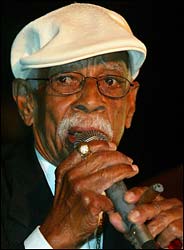
Like a number of prominent Cuban musicians, Leyva was really first noticed in this country following the release of the documentary, "Buena Vista Social Club." What a debt of thanks we owe Ry Cooder and Wim Wenders for making that film....and to Pio Leyva for the decades of music he gave the world.
Domenech is not only a plagiarist, he's also a liar. He tells the Times that he used material from P.J. O'Rourke with O'Rourke's permission. O'Rourke, it turns out, has no memory of ever meeting or talking to Domenech.
Couple points. Well, three.
First, it's always a pleasure to see smug, self-satisfied, obnoxious, Coretta Scott King-insulting conservatives take a fall.
Second, I've increasingly felt that the MSM is making a mistake by hiring extremely young people to write for them online when they'd never consider those people experienced enough to write for their dead-tree newspaper. It's a bad idea for a host of reasons, not least of which is that online writing is increasingly becoming more important than what appears in print. Certainly more widely read. So why treat it as a kind of minor-league apprenticeship for writers? Because the people doing the hiring just don't get the importance of the web.
Third, the MSM has double-standards for conservatives. The Post would never hire someone who'd written that Pat Robertson was a dickhead, which he is, but never mind. In their haste to appear balanced, the Post and other media hire people who make a name for themselves with vituperative rhetoric, and in that sense actually encourage the generation of such bile.
Over at RedState.com, Domenech's defenders have this to say: "He'll take the time to wander in the wilderness as he rightly should. He'll walk that road. The least the rest of us can do is be waiting for him at its end."
Gag me.
Brintz's essay has hit a nerve: It's been the #1 e-mailed article on the Times site for the past couple of days.
A theme from female letter writers is that while they once deserved affirmative action, boys do not, because they can not plausibly claim that they have suffered from discrimination.
Probably, but seems to me we just don't know—I haven't yet read a good explanation of just why boys are having such trouble getting into college.
Meanwhile, John Tierney weighs in on the subject with one of his typically pointless columns. Forcefully addressing the question of affirmative action for boys, Tierney writes, "After consulting with the federal Education Department, I can confidently report that this discrimination may violate the law — or then again, it may not."
Thanks, John. Appreciate that.
You probably can't read the article, because it's behind the Times' firewall. But then again, you don't really need to.

Hal the coyote is resting comfortably and apparently eating quite well....and meantime, seals have come to New York harbor. Meanwhile, Lola and Pale Male are expecting.
Sometimes, ain't life grand?
We think of the Shleifer scandal as the story of Andrei Shleifer's double-dealings in Russia and Larry Summers' attempts to protect Shleifer from any punishment, either from the federal government or from Harvard.
But Wedel, who has been writing about this scandal since at least 1998, makes another accusation that I hadn't heard before [italics added]: As Treasury secretary, "Summers helped Shleifer and Harvard gain noncompetitive government awards through arrangements that were highly unusual in foreign aid contracting at the time, according to US officials. Summers helped Shleifer and Harvard gain noncompetitive government awards through arrangements that were highly unusual in foreign aid contracting at the time, according to US officials.... The endowment funds of both Harvard and Yale gained access to valuable investments through networks inhabited by Shleifer and/or his currency-trading wife. His investments in Russia, which he does not deny, included securities, equities, oil and aluminum companies, real estate, and mutual funds -- many of the same areas in which he was being paid to provide impartial advice."
As excellent as David McClintick's article in Institutional Investor was, it sounds like the Shleifer scandal goes even deeper that McClintick portrayed it. (Which just goes to show how much timing has to do with the impact of an article; perhaps Wedel should have written something just after Bill Kirby was fired.)
I don't know how much of this Wedel covers in her book, "Collision and Collusion: The Strange Case of Western Aid to Eastern Europe..."
Anyone?

My cousin Lucy, who's a marine biologist, just sent me this photo of a 16-foot python found a few days ago in the Everglades.
Unlike coyotes, this animal probably does not belong in Central Park.
"The wrenching [of quotes] out of context is done by the hate sites, and then [the authors] cite them to the original sources, in order to disguise the fact that they've gotten them from hate sites," Dershowitz claims.
Dershowitz cites this example (and I quote from the Sun):
Under the section "Manipulating the Media," on pages 19 and 20 of the paper, Messrs. Walt and Mearsheimer write: "In his memoirs, for example, former Times executive editor Max Frankel acknowledged the impact his own pro-Israel attitude had on his editorial choices. In his words: 'I was much more deeply devoted to Israel than I dared to assert.' He goes on: 'Fortified by my knowledge of Israel and my friendships there, I myself wrote most of our Middle East commentaries. As more Arab than Jewish readers recognized, I wrote them from a pro-Israel perspective.'" The footnote cites Mr. Frankel's 560-page book, "The Times of My Life and My Life with the Times," published in 1999.
Yet the Frankel quote used by Messrs. Mearsheimer and Walt, Mr. Dershowitz said, is nearly identical to the quote used by a neo-Nazi Web site in its own take on Jewish press influence, "Jewish Influence in the Mass Media."
Dershowitz's argument is logically fallacious and intellectually indefensible.Let us say that this quote appears in three places: the original source, the Neo-Nazi site, and Mearsheimer and Walt's paper. Dershowitz assumes that W & M must have taken the quote from the web...because, apparently, two writers writing about how Israel is covered in the media would never conceive of reading a memoir by the Jewish former executive editor of the most important newspaper in the world.
"I promise you they did not read Max Frankel's whole book," the law professor said of the paper's authors. "How do I know that? We found the same exact quote on various hate sites."
That argument is so dumb, it would be laughable if it weren't wrapped in the context of a very serious accusation.
In any event, it's a safe bet that this quote has appeared in numerous places other than the memoir and neo-Nazi websites. It is, after all, a pretty provocative line—"I was much more deeply devoted to Israel than I cared to assert." It is entirely plausible that W & M would have come across this line during their research in places other than neo-Nazi websites. (I'd bet that the neo-Nazis themselves didn't read the memoir, but got the quote from other sources.)
Let us acknowledge what Dershowitz is really saying: W & M troll neo-Nazi websites. That is a hideous accusation, and if this is all the "evidence" that Dershowitz has—evidence that would surely never be allowed in a courtroom—he shouldn't make it. Because it is a short skip and a jump from saying that W & M read neo-Nazi websites to saying that they are neo-Nazis. And Dershowitz is well on the way to implying that.
I will leave it to people smarter than I to evaluate the level of scholarship in W & M's paper. But you don't have to be a legal genius to see that Alan Dershowitz's intellectual standards do not impress.
Such papers, written as part of a faculty "working paper series," usually bear the Kennedy School logo and carry a standard disclaimer saying that they do not necessarily reflect the views of the Kennedy School or of Harvard.
But at Ellwood's direction, the Kennedy School logo was removed from this paper, and a stronger disclaimer was inserted. It reads thusly:
"The two authors of this Working Paper are solely responsible for the views expressed in it. As academic institutions, Harvard University and the University of Chicago do not take positions on the scholarship of individual faculty, and htis article should not be interpreted or portrayed as reflecting the official position of either institution."
Well, Dean Ellwood, why don't you just take Professor Walt out back and shoot him?
This is not a great moment in the history of the Kennedy School. Is Walt's paper anti-Semitic? Let's put it this way: Reasonable people can disagree. I've read the paper, and I just don't think it's clear-cut at all. (If, for example, you replaced the word "Israel" with the words "Saudi Arabia," I'm not sure the paper would be anti-Arab.) There may be a case that the paper's scholarship is lackluster, but that is a different matter altogether. Professors are allowed to write bad books.
Given that this paper is clearly not the work of Louis Farrakhan, and that a credible case can be made that it is not a work of anti-Semitism, it is cowardly for the Kennedy School to hang Walt out to dry.
As Abbott Lawrence Lowell (who was, in fact, anti-Semitic) once wrote, "There is no middle ground. Either the university assumes full responsibility for permitting its professors to express certain opinions in public, or it assumes no responsibility whatever, and leaves them to be dealt with like other citizens by the public authorities according to the laws of the land."
Ellwood is trying to carve out a middle ground here—saying, in effect, well, we have to let them write this stuff, but trust me, we really don't support them—and it makes him look weak.
What's going on here? Well, apparently it's about money. David Gergen tells the New York Sun that he's been reaching out to "prominent Jewish donors"—their words, not mine—because "obviously, there are some people out there who are concerned."
Note that it isn't, say, Jewish alums in general to whom Gergen is reaching out, but Jewish donors. This isn't about the merits of Walt's paper; it's about a school with one of the smaller endowments at Harvard running scared of its donors.
The irony is that this attack on Walt and Mearsheimer only seems to bear out their paper's suggestion that critics of American foreign policy towards Israel are hastily silenced. A Harvard professor publishes a paper criticizing the power of the "Israel lobby." Prominent Jews such as Alan Dershowitz and Martin Peretz call the authors anti-Semitic. A pro-Israel, right-wing newspaper whips up a controversy. Jewish donors start making phone calls. The Kennedy School starts to distance itself from the professor. No longer welcome at Harvard, the professor leaves for a lesser institution.... (This last hasn't yet happened, but I wouldn't be surprised.)
To be fair, I don't know what else sincere critics of this paper are supposed to do; if they really believe the paper is anti-Semitic, they should certainly say so.
But this sequence of events has the unintended consequence of making Walt and Mearsheimer look more credible and less anti-Semitic.
Meanwhile, the Bush White House takes its instructions on global warming from Michael Crichton and Dick Cheney.
Well, if science doesn't convince the Bushites that global warming is real, perhaps satire will. This video of Will Ferrell doing George Bush talking about global warming is hilarious....
Remember the New York Times Magazine story a few months back about Reinhold E. Rau, a taxidermist who spent thirty years trying to breed an extinct zebra called the quagga back into existence?
Well, he died.
Nonetheless, Mr. Rau led a fascinating, whimsical, and individual life, and he devoted himself to trying to recreate something beautiful and lost. Had he succeeded, he would have been the first person ever to revive an extinct species.
Given what's going on in the environment today, the world could use more characters like Reinhold Rau. He will be missed.
Above, the quagga: Only available as an illustration, because humans killed them all.
The situation has gotten so dire that male applicants are actually benefitting from affirmative action, in which admissions officers are lowering their standards to accept men, because if they don't, their schools will start to look like women's colleges.
At Kenyon, 55% of the applicants are female, and that percentage is rising. Britz writes, "My staff and I carefully read these young women's essays about their passion for poetry, their desire to discover vaccines and their conviction that they can make the world a better place."
Doesn't that second example feel like a deliberately chosen rebuke to Larry Summers' women-in-science proposition?
Hillary Clinton's first apparent GOP opponent in her reelection campaign to the U.S. Senate dropped out, so hapless was she.
Now her second opponent, a woman named Kathleen Troia McFarland, is also proving to be a disaster; McFarland's claim to fame was that she was the highest-ranking woman at the Reagan Pentagon and helped author the Star Wars' speech.
Let us be generous and not point out that these are pretty dubious rationales for a Senate campaign. Because, as it turns out, these resume-padders aren't even true.
And the Times article linked to above doesn't even note—which it should—that Ms. McFarland has already been found to have been registered to vote at more than one location in New York, which is illegal, but has failed to vote in several recent elections....
All of which is good news if, say, Senator Clinton were planning on saving her campaign funds for a presidential race....
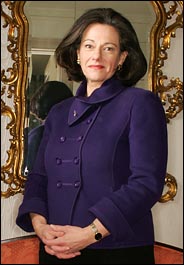
KT McFarland: Didn't write Star Wars speech, not the highest-ranking woman at the Reagan Pentagon, won't be the next senator from New York.

The coyote, named Hal by the police, is gone from Central Park. And aren't we all a little less alive as a result?
I'm tempted to say that this is a story about a new kind of journalism ethics, having to do with the rules of the blogosphere, but that wouldn't really be true...every journalist knows that you can't press together public statements like plywood and call them a quote.
I will say, however, that it's probably not a good idea to mess with one of the most powerful guys in Hollywood who once led a boycott of tabloid tv shows and just made a film about a heroic journalist.....
None of these are surprising, and all of those people have to say no in public. I wonder, though, if Amy Gutmann would really say no....except that she hasn't been in her position as president for very long, and it'd be a pretty crummy thing to leave Penn after just a few years in the top job.
Apparently some people feel this is good news for dogs in Central Park. This is silly, of course, since dogs in Central Park are generally either in an enclosed run or on a leash and, in any event, are always in proximity to humans—and coyotes are shy animals who steer clear of people.
In any case, it's my opinion that any dog small enough to make a coyote meal probably ought to be a coyote meal—this whole small dog thing has gotten way out of hand. Serve 'em up, I say.
One of these should be food for coyotes.....
Although it's probably more dangerous for the coyote than the humans.....
In my experience, most women who drink a couple of Cosmos are, basically, drunk, and some are well on their way after just one of the potent concoctions. Cosmopolitans contain quite a lot of alcohol, even though they don't taste like it, and due to their generally lesser body weight, most women are more affected by the booze than men are. That's just my anecdotal observation, but I think it's true.
And—though this part was not in my experience—it seemed to me that the result of that imbibing was that women were more likely to have casual sex they'd later regret. In other words, a show that was supposed to be all about women's sexual strength was in fact encouraging them to drink until they lost their judgment regarding matters sexual and otherwise. This did not strike me as a good thing; though you'd never have learned it from Sex in the City, the world can be a dangerous place, and men can behave badly, not least when women are drunk. In the most extreme example, I wonder if Immette St. Guillen was drinking Cosmos.
(That suggestion is certainly not to blame the poor woman for what happened to her—only the killer can be blamed for that—but to suggest that it is unwise for a 5'3" woman to be alone, drunk, in a bar at 4 A.M. Things shouldn't be that way, but they are.)
Now the University of North Carolina at Wilmington has conducted a study about men and women's drinking habits that seems to confirm my surmises. As InsideHigherEd.com reports, some college students have taken to calling fruity liquor drinks "bitch beer," meaning that those drinks have become to women what beer is to men—with a serious dose of misogyny thrown in.
Among the study's conclusions: Many women underestimate the potency of liquor-based drinks and as a result are often drunk well before the men with whom they are socializing. And what women do when they are drunk tends to differ from what men do. Many male college students reported that they needed to be drunk in order to dance; many women reported that being drunk made them more likely to have sex with men they didn't know well. (This falls into the realm of the obvious, but still, it's nice to see it confirmed.)
And many bars exploit these truisms, by, for example, letting all women in free of charge—or just letting women wearing skirts in for free.
As readers of this blog will know, I'm generally skeptical of attempts to divide men and women by character traits. But surely we can look at how they are divided by physical ones, and differing reactions to alcohol seems a worthwhile line of inquiry.
The lack of confidence of the Harvard faculty in its president was widely caricatured as stemming from a complacent faculty’s resistance to his controversial and innovative ideas, a backlash resulting from his abrasiveness, or more simply an attack by feminist harpies allied with leftist crazies. The reality is that the ideas Summers offered did not meet the Harvard standard. He expressed his “controversial” ideas as one-liners in brief talks, not in essays in which ideas struggled against contrary ideas. There was in his presidency a striking absence of the balanced, thoughtful, and informed analysis that characterizes the academy at its best. Where earlier Harvard presidents, including Summers’s immediate predecessors Derek Bok and Neil Rudenstine, wrote eloquent essays about matters they thought worthy of broad attention, Summers avoided using the written word to provide deep analysis of complex issues.
In researching and writing Harvard Rules, I spent an enormous amount of time trying to understand Larry Summers' vision for the future of the university. It was a deeply frustrating effort for much the same reasons that Lewis describes. Since Summers would not talk to me, I read and re-read all of his speeches and other statements on education, and they simply were not particularly thoughtful or nuanced. "One-liners" is an appropriate description.
This is not to say that Larry Summers did not have a thoughtful and nuanced vision of Harvard's future—just that he never put it into public words. One got the sense that Summers did not want to be pinned down; that he was in such a hurry to implement change—the change he felt Harvard needed—he wanted to skip the phases of debating that change and building consensus. So he said as little as possible—because once the words were out there, the Harvard community would have something to discuss.
Why? I would hazard a couple of reasons. Impatience is one. Arrogance is another; with a handful of exceptions, I don't think Summers felt there were many at Harvard from whom he could learn, or from whom he needed to learn.
But there's another, more subtle reason: Larry Summers avoided his weaknesses. In tennis terms, he ran around his backhand.
Summers is not a good communicator, and he has certainly never been a skilled diplomat or consensus-builder. (Just ask the finance ministers of various Asian and South American countries.) He likes vigorous questioning, led by him, and he likes to deliver monologues; but he does not like conversations, dialogues, give-and-take, or being aggressively questioned himself. Moreover, he does not like to write. University presidents often publish collections of their essays and speeches. Such a book published by Summers would be short and, given his reputation as a provocateur, surprisingly dull. (Only in response to questions does Summers truly become vivid.) And, frankly, much of it would be ghostwritten.
Summers' leadership style—his secrecy, his disinclination to reveal this thoughts and intentions, the paucity of his writings—flows directly from his avoidance of these intellectual dislikes.
How fortunes change: Ignobly removed from his job (as so many were during the Summers era), Lewis remains at Harvard, and with the high-profile publication of this book might well have a more influential voice at the university than the outgoing president.
(This is, by the way, an argument in favor of tenure.)
Today, the Crimson reports on the excerpt of that book (see below) that ran in this week's Chronicle of Higher Education.
Does anyone else get the feeling that the real debate about the state of Harvard education—not the silly curricular review, nor glib remarks about students who don't know what a chromosome is—is starting now? It'd be fascinating to see, for example, a Sanders theater forum featuring Lewis, Bill Kirby, Summers (if he'd do it), and a couple of faculty members from the curricular review.
With the departure of Larry Summers, a thousand flowers may be about to bloom....
A forceful advocate for the liberal arts, Freedman also spoke out against campus intolerance, such as the truly nasty Dartmouth Review, which had a habit of making fun of Jews, blacks, women, gays, and...well, you get the drill.
Freedman shows, I think, that a college president can be more than just a fundraiser, but can speak out on issues of public import, and do so without tearing his campus apart....
Because I am nothing if not sensitive to the suggestions of those of you good enough to visit this blog...without further ado....
Has Harvard Lost Its Way?
By HARRY R. LEWIS
Harvard strives to be the best at many things, and it often succeeds. But Harvard has protected its reputation for excellence at the expense of its sense of a larger purpose. Harvard’s leaders have allowed the university’s mission to drift from education to customer satisfaction. For them, Harvard is no longer a city upon a hill but merely a brand name.
Today’s Harvard education offers as a common thread nothing like the Puritans’ fear that their children would be left without a learned ministry, or the 19th- and early-20th-century benefactor Henry Lee Higginson’s conviction that “the health and true welfare of our University and our country go hand in hand,” or the worry of the 1945 curricular reform, General Education in a Free Society, that civilization itself might lie in the balance if Harvard did not do its job. The old ideal of a liberal education lives on in name only. No longer does Harvard teach the things that free the human mind and spirit. In 2005, after a three-year review of its curriculum, it headed toward the conclusion that its students are free agents and for the most part should study what they wish.
A liberal education in the sense Harvard now uses the term is simply an education not meant to make students employable. Undergraduate education should not be too advanced or too specialized, nor should it include courses that would be helpful in the world of business. Becoming too skilled at any one thing, so skilled that a graduate could make a living doing it, is distasteful. Students are better off being broadly educated generalists — though not much breadth can be demanded because students would resist any requirement.
Undergraduate education defined in that way allows professors to do as they wish as well. In an effort to persuade me that I should back the newly proposed, requirement-light curriculum, one professor offered that it meant we faculty members would no longer have to teach students who did not want to take our courses. But the courses from which students learn the most are often ones they would be disinclined to take without being pressed to do so. The general-education courses I took on Western philosophy stretched and rewarded me, and the core course I teach on information technology and society plays that role for my students. If professors can define their job as teaching what they wish to those who wish to be taught it, Harvard will not carry the centuries-old ideal of a liberal education forward into the next generation. It will instead indulge students’ inclinations to learn more of what they know already, while avoiding unpleasant but enlightening disagreements among professors about the relative importance of different studies. Liberal education will be reduced to an easy compromise among academics rather than a long-term commitment to the welfare of students and the society they will serve.
Even excellence assumes different meanings depending on the circumstances. No more than half the class should graduate with honors, Harvard opines, to preserve the value of the honors degree. The effect may be to make Harvard graduates, in aggregate, less well educated rather than more, but at least the news media will no longer deride us for grade inflation. The very concept of an honors program should be discarded, according to proposals afloat in late 2005. At the same time as Harvard plans to remove incentives to pursue advanced work in a field, it is proposing incentives to dilettantism, in the form of “secondary fields” in which students could earn recognition for a mere smattering of learning. In fact, stimulating Harvard’s remarkable students to do excellent work is beyond our ambitions. That lowering of expectations may reflect a reluctance of some faculty members to educate students.
Harvard teaches students but does not make them wise. They may achieve extraordinary excellence in both academic and extracurricular endeavors, but the whole educational experience does not cohere. Few could give a good answer, five or 10 years after graduation day, to the simple question: What was the most important thing Harvard taught you? Parents hope that their children will remember, in later life, lessons greater than how to parallel park or how to balance a checkbook. Like good parents, a good university should help its students understand the complexities of the human condition — or at least what others, men and women of acknowledged wisdom, have thought about the difficulties of living an examined life. A good university challenges its students to ask questions that are both disturbing and deeply important. Part of becoming a responsible adult educated in the best tradition of human thought is to come to grips, personally, with the basic questions of life.
One might argue that the great, sprawling, modern research university must be different things to different people. Perhaps, given the other demands on its faculty, the best it can hope to do educationally is to present a menu from which its multitalented, multiethnic, multicultural, multinational students can pick and choose. That cafeteria theory of education avoids the problem of valuing some things more than others, of judging that the specialties of some professors are more important for educated citizens than the specialties of others. It suggests that character and morality are not the university’s business at all.
Some of the forces that have brought universities to incoherence are societal. Universities did not create the consumer culture, but they have been overtaken by it. Universities did not become expensive by themselves, but they are subject to the same economic forces as other institutions. What universities have not done is to resist societal forces where resistance would be right and proper. The greatest universities have fared the best — they are the highest ranked and the most sought after by the customers. Sadly, although their wealth and their desirability have put them in the best position to press back against the forces that have compromised the education they offer, they have instead drifted complacently along with those forces. Harvard, as the best of them all, can push back most easily.
But the forces controlling Harvard today want it to follow the crowd. If most other universities have something, be it a simple distribution requirement for graduation or a women’s center, the new Harvard thinks they must be right. It is easier to justify doing as others do than to defend the principles behind Harvard’s uniqueness. Harvard needs the will to push back where thoughtful consideration should lead it to other choices. That will must come from everyone who is part of the Harvard family.
First, the leadership of the university. Harvard requires strong leadership. Harvard is not a direct democracy, not even a representative democracy. Decisions at Harvard cannot follow the average or the majority sentiment. Harvard needs leaders whom others will follow, not unquestioningly but with confidence and respect. But Harvard is not an autocracy either. In fact, it is more like a volunteer agency. Students at Harvard are volunteers — they would all be welcomed at other good colleges if they wanted to leave. Even though they are subject to Harvard rules and regulations while enrolled, their power of passive resistance is far stronger than the university’s power of coercion. They will study hard and do good work only if they are inspired. Every faculty member is a volunteer, too. Leading professors is, admittedly, like herding cats. They could all get jobs elsewhere at the drop of a hat. There are few effective punishments for professors, especially those with tenure, so the president and the deans cannot order them to be obedient. Almost everything professors do, they do because they have come to believe in its importance and rightness, not because someone above their pay grade tells them they should do it.
Even the support staff are volunteers. Those pushing paper can be made to do their jobs in the way that clerks everywhere are kept in line. But when they come in contact with students, they are likely to put on their human faces and to be candid about the way things work. Their loyalty is invaluable. The truth about Harvard’s attitudes, motivations, and hypocrisies travels very efficiently by word of mouth in a university, whatever the communications office may say. There is no upstairs and downstairs in a healthy college. Students talk all the time to the police officers, the medical trainers, the financial-aid officers, not to mention those with official advising and counseling roles. The employees at the bottom of the organizational tree are the ones who see students the most. They, too, are educators. They absorb the spirit of the institution and convey its values to students every day.
Most important in articulating and communicating institutional values is Harvard’s civil service. Many long-serving educational administrators have inexplicably left Harvard in recent years. The buzzwords of the new approach to such appointments include “professionalizing” the staff, bringing in “fresh ideas,” and just “shaking things up.” Reorganization is a disruptive and unending process. New organizational trees accompany reorganizations, with hierarchical, sharply defined reporting structures and new jobs to be filled by newly hired staff members. Though touted as making Harvard better, such moves often succeed only in shifting attention away from the big picture. Each new dean or administrator or vice provost assumes responsibility for some immediate task, which thereby becomes no one else’s problem.
The reorganizations have also eliminated many of those who knew how Harvard used to be. Far more significant than any structural effect has been the incalculable loss of many administrators who recognized their work as education and saw in it a high calling. They thought rigorously about the goals of a college education and how their part of Harvard might work with others to fulfill those goals. They were reflective about causes and effects, smart about students, and reluctant to risk teaching the wrong larger lesson by a quick decision that might be expedient in the short run. They were self-effacing members of a collective effort, and they provided perspective on deep and enduring problems. They were, in other words, genuine educational professionals. They left Harvard, or were forced to leave, because they did not fit into the new, retail-store university, in which orders are taken, defects are papered over to get the merchandise out the door, and the customers are sent home happy by “student-service professionals.”
Lawrence Summers was the product, not the source, of the trends that brought Harvard to its present predicament. He is an economist, who sees the actions and decisions of men and women as governed by rational choice and power, not by belief and commitment. He was hired by, and was answerable to, a governing board consisting largely of people from the world of business and finance. As a former U.S. treasury secretary, he understands the power of money to shape society. In his Washington years, he learned the ways of politics and the power of the media — and the importance of controlling information and communication, of message over substance.
Summers cultivated a reputation as a provocateur, but he avoided comment on difficult issues, such as banning military recruiters from campus, to stave off adverse publicity. The Summers administration cannot even be credited with making the university more businesslike. Summers centralized power in order to run the university more efficiently, saying: “Academic freedom is wonderful, but it really doesn’t have a place in the purchase of cement.” But the brilliant economist was a poor business manager. In the five years of his presidency, the balanced budget of the Faculty of Arts and Sciences fell to an annual deficit of $40-million — at the same time the university endowment rose by more than $8-billion. The deficit is projected to rise to $100-million within five years. Summers hired many high-priced consultants to review administrative structures, but the main result was to swell the bureaucracy of assistant provosts, vice provosts, and vice presidents; divisional deans and deputy deans; and assistant deans and associate deans. Much of the daily business of the university now becomes stalled in the bureaucratic thicket.
The vast power Summers held might have enabled him to achieve great successes. But his misfortunes arose from the impatience, harshness, thoughtlessness, and lack of candor with which he used that power. In the Harvard of President Summers, students and faculty members were like the electorate as seen from Washington, D.C. interest groups, not collections of individuals. Interest groups are given what their spokespersons say the groups want, in proportion to their size and influence. Educational pros and cons were balanced by political, not intellectual, analysis.
Summers enjoyed his celebrity; The Harvard Crimson called him a “rock-star president.” If unhappiness created public-relations problems, the president could earmark funds to buy peace. Most retellings of the tale of Summers’s remarks about women in science and engineering do not report the real source of the anger it caused. In his speech, he belittled the importance of gender discrimination as an explanation for the small number of women scientists and said he thought that “intrinsic aptitude” was a more important factor. Yet three months earlier, when a large group of women professors pointed out to him a dramatic decline in hiring of women faculty members, he offered no such theory. The faculty furor came because his speech revealed, to what he thought would be a friendly crowd, his doubt that ordinary hiring efforts would ever yield many first-class women scientists. He responded by apologizing, creating a new bureaucracy, and committing a large sum of money. The apologies and funds did not, however, erase the memory of Summers’s insincerity.
Public controversies and internal dissatisfactions marked Summers’s tenure as president, but too much has been made of his personality and his management style in explaining his downfall. Surely he was as much of a bully as a bull in a china shop, and his contempt extended not just to individuals but to entire fields of study, but none of that would have mattered if his ideas had been inspiring. Summers presented no imaginative program, envisioned no educational ideal, carried no flaming torch that students or faculty members wanted to follow. Because whatever agenda he had was advanced so ineffectively and unconvincingly, Summers will be remembered as a weak president, not a strong one.
The Faculty of Arts and Sciences resolved last March that “the faculty lacks confidence in the leadership of Lawrence H. Summers.” Coming two months after Summers’s speech on women in science, the vote has often been construed as a rebuke of his views, but the debate leading up to it raised broader issues of substance, integrity, and governance. Any motion condemning a particular action or opinion probably would have failed.
The lack of confidence of the Harvard faculty in its president was widely caricatured as stemming from a complacent faculty’s resistance to his controversial and innovative ideas, a backlash resulting from his abrasiveness, or more simply an attack by feminist harpies allied with leftist crazies. The reality is that the ideas Summers offered did not meet the Harvard standard. He expressed his “controversial” ideas as one-liners in brief talks, not in essays in which ideas struggled against contrary ideas. There was in his presidency a striking absence of the balanced, thoughtful, and informed analysis that characterizes the academy at its best. Where earlier Harvard presidents, including Summers’s immediate predecessors Derek Bok and Neil Rudenstine, wrote eloquent essays about matters they thought worthy of broad attention, Summers avoided using the written word to provide deep analysis of complex issues.
His willingness to offend made him a hero to some, inside and outside Harvard, even as it insulted others. Summers’s presidency ended, however, not because of stylistic gaffes but because of disclosures of apparent dishonesty, which tipped the views of professors who had supported him during earlier controversies. When asked in a recent faculty meeting if he had any opinion about the university’s actions in the Andrei Shleifer affair, in which the university paid millions to settle a federal lawsuit involving a fellow economist, Summers denied knowing enough to make a judgment. That provoked soft murmurs from the many professors already familiar with Harvard’s role. Discredited as a moral leader, he could no longer play the role of academic leader.
Then a few days later, Peter Ellison, the former dean of the Graduate School of Arts and Sciences, reportedthat, in response to a question in an earlier faculty meeting, the president had misrepresented his plans to change the faculty’s authority over doctoral programs. The issue, said Ellison, had become one of the president’s character, not his personality or style. A second no-confidence vote was scheduled; it would certainly have passed by a wide margin. Summers chose to offer his resignation rather than suffer that humiliation.
Lists of Summers’s achievements were quickly posted on the Harvard Web site and parroted in major newspapers, both by news reporters and opinion writers. Yet many of the successes claimed for Summers are neither his nor real. To the extent that his agenda had substance, incompetent administration and lack of sustained attention damaged it more than any faculty intransigence.
Ultimately, Summers lacked the skills needed to make significant improvements in undergraduate education. His style was portrayed as hard-nosed and data-driven, but data documenting educational problem areas had been collected and published for years. An expanded seminar program, more study abroad, and an introductory science course have been claimed as his curricular achievements, but they fit into no big educational picture and may not even be improvements. The faculty was already discussing the need for a curricular review a year before Summers became president; he deserves the credit for its official launch, but also the blame for its ham-handed management. In spite of the expectations he created when he became president, the undergraduate academic program he leaves behind may be less rigorous than the one he inherited and demand less study of science and of foreign cultures. The new financial-aid program he touted for low-income students amounted to only $2-million in a financial-aid budget of almost $85-million. Summers announced the new program in a media blitz, but credited none of the earlier work documenting the seriousness of the issue.
Planning for Harvard’s new campus across the Charles River in Allston, regularly cited as one of Summers’s greatest accomplishments, proceeded with the same disorganization as the curricular review — with multiple, poorly coordinated task forces, their work ignored when found flawed or unwelcome.
All that is to be expected in a university that orients itself toward external markers of prestige and influence. Deliberation and debate are not the currency of a university in pursuit of temporal values. Summers is a victim in this drama, not a villain — a victim not of faculty anger but of his success at the role assigned to him.
Lawrence Summers’s principal failing was not that he was too strong or too uncongenial, but that the wisdom, knowledge, and judgment he lent to faculty affairs were too feeble. In the end, professors realized that Summers was not offering leadership they could respect. The Harvard faculty would rather mind its own business than vote down the president; they did not do so for sport. The majority voted against him, and a larger majority was prepared to do it again, because his intellectual contributions as president failed to meet Harvard’s high standards and to bring honor to the institution.
What Harvard needs more than anything are ideas and idealism, and those have to be articulated from the top. With the announcement that Derek Bok will be acting president, Harvard is already restoring confidence in its leadership. While some news-media accounts have characterized Harvard professors as inmates eager to run the asylum, the serious question is about the wishes not of the professors, but of the governing board, the Harvard Corporation. In searching for Summers’s successor, it runs the risk of being distracted by superficialities — candidates’ gender, celebrity, and manners, for example. Yet it also has the opportunity to return to original principles, to think deeply about how a college fits within a research university in the 21st century, about how Harvard can do the most good for society, and about how Harvard fits within America and the world.
During most of the Summers years, the Harvard Corporation had a leadership vacuum. Its members were rarely heard from in public and rarely spoke to those who made the university run, except the president and his staff. If Harvard were a publicly held corporation in today’s climate of intensely scrutinized corporate governance, the shareholders would have been up in arms. In airing their concerns about Summers’s leadership, Harvard professors were playing the role of shareholders. In 2005 some fellows who had joined the corporation since Summers’s selection began to listen to what professors were telling them, and the corporation ultimately played its proper fiduciary role.
For Harvard to reclaim its soul, the alumni must recognize what has happened to their university. To the extent that controversies at Harvard were portrayed as a struggle between the president and the professors, the alumni stood skeptically on the sideline. They were led to see faculty members as ivory-tower snobs or social radicals; when Summers attacked Cornel West, an African-American-studies professor who wore an Afro and released a rap album, they gave the president the benefit of the doubt. But alumni who remember Harvard for the lasting values it gave them should recognize where economic and market incentives are taking their university. The alumni-elected Board of Overseers, the large if marginalized second of Harvard’s governing boards, was awakened during the Summers crisis. It must not return to functioning as the university’s cheerleaders rather than its governors.
The biggest tasks await the faculty. Every decision concerning undergraduates should be held to an educational standard. No matter what the choice, whether affecting academic programs or student life, the question should be asked: If we do this, then over the course of four years, what lessons will Harvard students learn, and will they become better educated? Only if the faculty is engaged, in small ways and large, in considering the purpose of changes can wise changes be made — changes that will make Harvard graduates both excellent and prepared to serve their roles in society.
The next Harvard president must help the faculty develop a shared sense of educational responsibility for its undergraduates. There is no better student body anywhere, and we professors are teaching them because they are the promise of the world. We must design a curriculum for those future citizens, professionals, and scholars that we ourselves respect.
We will never return to the days of General Education in a Free Society, when the faculty imagined that all students might take one course. But there is an enormous difference between that impossible unity and today’s total disunity. The faculty must find a way to set priorities for itself so that it can give some guidance to students about what educated people, civilized people, should know in the 21st century.
The faculty needs to change, too. There is a great deal of good will among professors for more attention to undergraduates, and a great many disincentives and cultural biases prevent that good will from being translated into practice. Some of the change can, with incentives from the university’s leaders, happen quickly. Departments that are famously indifferent to undergraduates can, tenure notwithstanding, undergo the same process of reorganization that is applied to other underperforming units. In the longer run, teaching should be a serious component of faculty-hiring criteria, not simply a peripheral item. Alumni, parents, students can all call for change, and governing boards can insist on it. Honest means of evaluating teaching will have to be developed, mechanisms that are as scrupulously unbiased as the rigorous system of external reviewers used to evaluate the scholarship of tenure candidates. More fundamentally, “teaching” needs to mean more than skill at lecturing and leading seminars. We must find a way to honor good character in our faculty members and to penalize acts that call a professor’s character into question. The evaluation of character is easier said than done, given the risks of bias and prejudice. But the present system so discourages any judgment of personal character that a better system would not be difficult to design.
Finally, the counseling and therapeutic services for undergraduates must share the stage with a less clinical treatment of students’ hearts and souls. There is no program for that change. Telling students to go to church is not the answer, though church is an answer for some students. Community service is also an answer for some, though it has become so professionalized and technical that many students draw more managerial than spiritual value from volunteering. The opportunity to study under exemplary visitors from the “real world” is a special privilege of Harvard students. The teaching of challenging texts, literary or philosophical, can raise in today’s students the same important and troubling questions they have raised in other readers for centuries — if they are not taught to elicit “correct” answers that will earn high grades.
None of these proposals are inimical to excellence. Excellence must remain a guiding value, but the pursuit of excellence should no longer be an excuse for ignoring everything else. Faculty members should be expected to offer some courses that span large domains of human thought. Professors, like graduates, should possess knowledge in many things as well as expertise in one.
The restoration of a true core to undergraduate education, an approach to education that will turn dependent adolescents into wise adults, circles back to the question of leadership. The university’s leaders must believe in the process of self-discovery, and they must articulate that belief. They must support and praise faculty members and coaches and deans and career counselors and therapists who recognize its importance. To that end, the leaders must themselves embody the values of self-understanding, maturity, strength of character, compassion and empathy for others, as well as scholarly excellence. Everyone in the university — parents, students, professors, and members of the governing boards — should have a say in judging whether that standard is met.
"I like to be liked, and there have been situations where the only way to make a difference is to say, Sorry, this is the way I see it," Ulrich tells the Chronicle. "People think of me as this very nice person, and they're very surprised when I stand up to them."
Not bad qualities in a dean....
(Does Mansfield really ask, ""Is it possible to teach women manliness and thus to become more assertive?" Apparently he does. Yikes.)
Marcus' conclusion: Mansfield writes that he wants to "convince skeptical readers -- above all, educated women" -- that "irrational manliness deserves to be endorsed by reason." Sorry, professor: You lose. What this country could use is a little less manliness -- and a little more of what you would describe as womanly qualities: restraint, introspection, a desire for consensus, maybe even a touch of self-doubt.
Honestly, I find this idea of characterizing various human characteristics as gender-specific pointless and, frankly, kind of dumb. But if it has to happen, I'm glad that Marcus has a little fun with it....
Citing the Undergraduate Council's proposition that students have a "right to self-determination" when it comes to deciding who they're going to live with, Kavulla writes, "From whence does this right emanate? Why has it not been discerned until now? Does this right not necessitate the reversal of randomization, that decade-old procedure by which the College rejected wealthy students’ “right” to live with one another in Eliot House and black students’ “right” to live together in Pfoho?"
You have to admit, he's got a point.
Kavulla continues, "Surely, students are overwhelmingly in favor of co-ed housing. But, frankly, why should their opinions really matter? With each matriculating freshman class, I am struck not by the maturity of these 18 year-olds, but by the youthfulness they exhibit. Many enter the gates after living under parents’ roofs and rules, and they promptly go wild."
I'm sort of sympathetic to this argument, myself, because even when I was in college, I never bought the proposition that college students are mature adults. Some were, some weren't.
(And yes, I'd surely put myself in the latter category. No mature adult would ever consume 17 shots of tequila in 90 minutes. But that's another story.)
Now, I think you can make an argument that even if you don't consider students adults, they should still be allowed to live with people of the opposite sex, on the proposition that students make all sorts of mistakes and that's how they learn.
I suspect, however, that you won't hear this argument from the supporters of multi-sex housing. The debate is really being driven, as Kavulla points out, by the "Bisexual, Gay, Lesbian, Transgender, and Supporters Alliance, some of whose members feel uncomfortable living with students of the same sex."
I find this a particularly weird argument. How can gay people argue that they should be allowed to serve with straight people in the military, but also say they shouldn't have to share a room with them at Harvard? It's kind of both or neither, don't you think?
(From today's Crimson...italics added)
Summers’ Dinner Roll Draws eBay Bids
Half-eaten piece of bread joins ranks of other autionced celebrity oddities
And so, in a feast of self-promotion, I direct you to the piece about Rudenstine I wrote for the Crimson following the women-in-science fiasco last winter.
And I quote:
Neil Rudenstine may not have had the kind of agenda that produces glowing headlines, but he did accomplish what he set out to do. And that begs the question of whether his diplomatic leadership style might not be better suited to advancing the university’s agenda than the more pugnacious style of its current president.
To be fair, President Summers’ advocates say that his bull-in-a-china-shop style is exactly what Harvard needs. The rhetoric of that argument is powerful, but the logic curious. After all, Summers has repeatedly sandbagged his own agenda by igniting pointless and distracting controversies. In other instances, such as the curricular review, President Summers’ insular leadership has probably made his work less successful rather than more. What, exactly, has Larry Summers done that Neil Rudenstine could not have also accomplished, and without the trauma?
As it searches for a new president, Harvard doesn't want another Rudenstine, and it certainly doesn't want another Summers. But the question of leadership style and its relationship to goals accomplished (or not) is certainly one the presidential search committee (who are they, by the way?) should be considering.
In my talk on Harvard last week at the Union Club, I suggested some alternatives to the left-wing faculty "coup" theory to explain Larry Summers' exit. One of them was that, however you felt about the merits of Larry Summers' arguments, Harvard was suffering from "controversy fatigue"—from Cornel West to anti-Semitism to women-in-science to Andrei Shleifer, it was just one thing after another—and that all the controversy was hurting fundraising.
Funny, isn't it? A former secretary of the treasury who's actually bad for fundraising. Now, that takes some effort.
Well. Them's fightin' words. And people are, indeed, fighting about them.
Ever-vigilant in its watch for anti-Semitism, the New York Sun editorializes that "it's not too early to suggest that it's going to be hard for Mr. Walt to maintain his credibility as a dean. We don't see it as a matter of academic freedom but simply as a matter of necessary quality control."
Huh.
This is exactly the argument made by critics of Larry Summers following the women-in-science speech, at which point the right deemed the matter a question of academic freedom. But consistency, as they say, is the hobgoblin of little minds.
(The Sun has been going off on this subject, by the way—click here to see the four articles that the Sun has run on the Walt-Mearsheimer article.)
One critic of the article, predictably enough, is Alan Dershowitz, who has also charged that anti-Semitism was a factor in Larry Summers' ouster. Dershowitz compares the article to the Protocols of the Elders of Zion, a reference that is being thrown around Harvard rather casually of late.
According to the Crimson, "Dershowitz said that he and his staff are preparing a response to the Walt and Mearsheimer article."
To which one can only say: "He and his staff"? Alan Dershowitz has a "staff"? I suppose this might explain all those books.....
I haven't yet read the entire Mearsheimer-Walt article, but they certainly predicted the uproar that would follow its publication. "No discussion of the [Israel] Lobby would be complete without an examination of one of its most powerful weapons: the charge of anti-semitism. Anyone who criticizes Israel's actions or argues that pro-Israel groups have significant influence over US Middle Eastern policy...stands a good chance of being labelled an anti-semite."
Well, read the article and see for yourself. Meantime, this is the perfect opportunity for Larry Summers to use his bully pulpit to address the matter and calm troubled waters.
Lee Bollinger has landed a $200 million gift for Columbia.....
I'm not doing the show justice, but trust me: It was a powerful and painful way to dramatize the plight of a man lying in a hospital bed, with a breathing tube shoved down his throat and a gaping bullet wound in his stomach. The episode wasn't easy to watch—it really was unsettling—and I'm sure some Sopranos viewers will lament the lack of violence and Mafia intrigue. I found it brilliant.
According to the story, "There may be political bias in the classroom, but headed in the other direction. A new study — soon to be published in PS: Political Science & Politics — finds that students are the ones with bias, attributing characteristics to their professors based on the students’ perceptions of their faculty members’ politics and how much they differ from their own."
This is, I think, an interesting and important story.....
Meanwhile, here's a somewhat more titillating one: The former top fundraiser at Truckee Meadows Community College (that would be in Reno) is suing the college's president for discrimination after she refused to get into a hot tub with him....
<
If Michael Hirsch, in his review of two books about globalization (March 5), can describe Jeff Faux as the founder of a ''labor-oriented research group,'' shouldn't Jeffry Frieden be identified as a professor at a business-oriented university? After all, Harvard, where Frieden is (in Hirsch's words) a ''political economist who specializes in international finance,'' has a business school but no labor school, and labor economists are represented sparsely on its economics and business school faculties.
HERBERT J. GANS
Manhattan
The writer is a professor of sociology at Columbia.>>

That is sort of a silly sentence, isn't it? And that's before we even get to "the great explosion of manliness." That may be the problem with choosing a subject like manliness to write about (to the extent that manliness is even a subject, which, now that I think about it, I might question): There's something so very odd about the entire project, it's hard not to write things that make one giggle.
But Mansfield gets a boost from the Times' enlightened conservative, David Brooks, who writes (and, since it's behind the TimesSelect firewall, I quote extensively):
...Harvey Mansfield's new book, "Manliness"...[is] two books in one. First, it's a subtle exploration about the virtues and vices of the thymotic urge. It's also a series of troublemaking generalizations about the differences between men and women.
"Over the next few weeks, Mansfield and his feminist critics are going to brawl — thymotically — over his assertions. I'm not as impressed by Mansfield's generalizations as he is, but he'll have one advantage: he understands the nature of thymos, which shapes this fight, and so much of our political life."
One thing about Brooks' construction annoys me: If anyone bothers to fight over "Manliness," it's not going to be Mansfield and his "feminist critics"—that's a loaded phrase intended to trivialize anyone who thinks that the book is silly. (Jut take it for granted: Conservatives never use the word "feminist" at face value.) I doubt that Walter Kirn is particularly known as a feminist, for example.
The people who have problems with Mansfield's book may just be men and women, like myself, who think that ascribing certain qualities to one gender particularly is a very difficult task, one which Mansfield has not succeeded at and may be pointless in the first place.
But the Crimson's bottom line is simply this: "We would like to remind the College administration, however, that this is our housing and not theirs. Just as their opinions on vegetarianism ought not to dictate our dining hall offerings, nor should their opinions on housing dictate our suitemates."
Well...yes and no. College is, of course, a transition phase between youth and adulthood, and the social and intellectual policies of any college constitute a guide to facilitate that passage. The analogy between vegetarianism and mixed housing is facile, as Harvard College has an interest in what goes on between roommates just as students do. It can not just assume a laissez-faire attitude towards social policy.
Let's consider one scenario: A male and female student who are best friends decide they want to room together, and get permission to do so. At some point, their friendship turns to romance, which ultimately ends badly. Later, the girl takes another lover, and when he finds out, the distraught roommate snaps and stabs her to death.
Okay, it's kind of an extreme example. But Harvard roommates have been stabbed to death before, in a not entirely dissimilar dynamic....
(And certainly one can imagine that scenario, sans violence, being quite common. Should Harvard be sanctioning the decisions of young lovers to live together in campus housing? Because in effect, that's what would be happening.)
I'm not raising this to argue against such housing—just to point out that the Harvard administration does have a real stake in this question.
I'm a little conservative on such matters, so my instinct would be that this is a problematic idea, and with some exceptions for special cases, probably a bad one. I just don't see a hugely compelling reason to invite all the potential consequences of mixed-gender housing for people who are—sorry, college students—not quite adults.
But heck, I could be wrong. Harvard students consider themselves proto-adults at an early age, so maybe they can handle such living arrangements. (Though I've never seen much evidence that Harvard students are more emotionally mature than their peers anywhere else, and sometimes I think the contrary is more likely.)
Perhaps the thing to do is try it out and see what happens.....
Although, frankly, I don't know who was really talking her up anyway....
The most plausible name I've heard tossed around is Elena Kagan.
Although perhaps the real idea is that the celebrity-obsessed will check out the site so frequently, Gawker's hit count will soar, ad rates will go up, and everyone involved will make lots of money.
I'm no Puritan about such things; I enjoy a little celebrity gossip as much as the next guy. I'm still wondering exactly what happened between Renee Zellwegger and Kenny Chesney, and I'm fascinated by reports that TomKat were secretly married on a Scientology yacht.
But instantaneous mapping of celebrities hanging out? That's just creepy. Some psycho is going to pull a Mark Chapman on one of these people...and Gawker will be partly responsible.
Proponents say that students deserve the right to choose who they wish to live with, particularly if they are gay or transgender. (How many of the latter can there be, I wonder?)
Opponents say such a policy could lead to a rise in sexual violence.
I suspect both arguments are true, but the argument for freedom of choice may have the upper hand. The higher Harvard raises its tuition—which is to say, the more the university forces students to think like consumers—the more it loses its ability to shape and control the environment in which the students live. After all, when an 18-year-old (and/or his parents) is paying you $50,000 a year, he expects certain amenities.....
What an irony that, back in the '60s, students won the fight for co-ed dorms because of their political strength, and now, forty much more conservative years later, students will likely win this fight because of their economic leverage.
Finally, while I think Arianna is a fascinating woman, and part of me admires her drive and ambition, another part of me is turned off by her self-promotion. The Huffington Post was supposed to be a community, but all too often, it's a community of one.
Now George Clooney has pointed out something Arianna's done that's a little sleazy: compiled some quotes from him to make it look as if he had written a blog item for the site. Even after he asked her to take it down, she refused.
Bizarre.
Funnily enough, it was a post I wrote about Clooney that played a large part in my disenchantment with the site. I chastised him for insulting Jack Abramoff at the Golden Globes (Clooney said something about what kind of parents would give their kid the first name "Jack" when their last named ended with "off.") That kind of insult, I said, should be beneath liberals, and anyway, it would backfire; Americans don't like Hollywood liberal celebrities making crude jokes. (Whoopi Goldberg, anyone?)
The post received more comments than anything I'd ever written for HuffPo in the past—well over 100—and honestly, about 99% of them were not just negative, but nasty. Stuff you'd never say if you actually had to say it to the subject in person.
They reflected, I thought, the increasingly belligerent tone you find on HuffPo these days....there are still good people writing smart things there, but too often, it's just soapbox ministers preaching to the converted.
_________________________________________________________________
P.S. Arianna presents her side of the story here.
Honestly, does Alan Dershowitz truly believe that free speech and civil intellectual debate were thriving under Larry Summers? If so, I recommend him to the chapter in Harvard Rules, "Silent Campus," in which I discuss the chilling effect of the Summers' presidency, the way dissent—or even the liberal exchange of ideas— at Harvard was being shut off like lights in a late-night dormitory.
But Dershowitz is hardly consistent on the issue of censorship and free speech; he has refused even to consider the possibility that President Summers' broad attack on perceived anti-Semitism at Harvard might have made some faculty (particularly junior faculty) more hesitant to speak their minds.....
The discussions apparently centered on moving the time of concentration choice from the end of freshman year to the beginning of sophomore year. There is also a proposal to create secondary concentrations that would not require the writing of a thesis. And English department chair James Engell argued that the teaching of writing and speaking deserve a larger place in the curriculum.
All of these things seem unobjectionable enough and maybe even worthwhile. But they are also underwhelming. Harvard University—probably the world's greatest arts and science's faculty—decides to revamp the architecture, the guts, of its curriculum, and the debate at faculty meetings centers on when students should choose their majors? This does not feel like a curricular review, but rather, tinkering at the margins. It is not exactly bold or profound.
I still believe that the real curricular review should start as soon as a new dean is appointed.
Sometimes one really does wish that President Bush read the newspapers.
The Union Club is a conservative place—all male, mostly older—and there were quite a few Harvard alums in attendance, so I expected a lively conversation, and we had one. My suggestion that neither Harvard nor its faculty were particularly liberal did not go over well, for example. I think you could describe the response as chuckles of disbelief.
The questions asked were mostly along these lines:
—There have been reports that the faculty rebelled because President Summers wanted them to work harder. Can you comment on them?
—What really happened between Larry Summers and Bill Kirby?
—If universities such as Harvard are facing constant pressure to expand internationally and develop science and medical facilities, what happens to small liberal arts colleges such as Williams?
—I was a supporter of President Summers until he failed to discipline either Larry Tribe for his act of plagiarism or Andrei Shleifer for his insider trading in Russia. How could he have not punished those professors?
—Why on earth did the Harvard Corporation allow the situation to go on as long as it did?
—And finally, what is the state of President Summers' marriage?
(I'll admit, that one threw me a little.)
Good questions, and a good crowd. I enjoyed it immensely.
After the talk, one man approached me and introduced himself as a Harvard alum who was significantly involved in alumni affairs. Let me tell you about my introduction to Larry Summers, he said.
The man had gone to hear Summers speak at the Harvard Club in New York in early 2002. Summers stood before a luncheon and announced that it was a pleasure to be there and that this was certainly a very impressive group.
But let me tell you, Summers said, I've gotten to know some of the students, and they are far more impressive than you are. There is just no comparison between you and the students of today.
The man telling me this story shook his head at the memory and said again, That was my introduction to Larry Summers.
Crichton, of course, is the author of thrillers such as The Andromeda Strain and Jurassic Park, but over the years, as Crowley shows, he's become increasingly anxious to get respect not just for his sales, but for his ideas. Thus, his latest book, State of Fear, is one long diatribe against people who believe that global warming exists.
What's really scary about this? Apparently President Bush summoned Crichton to the White House for an hour-long meeting, and on the subject of global warming, the two men were apparently in total agreement....
I don't mean to sound like a left-wing dreamer...but wouldn't the world be a better place if W. put as much effort into fighting global warming as he has into fighting a disastrous war in the Middle East?
No word on whether there was a scene in which they both undergo root canal without painkillers....

Now Michael Kinsley has written a parody of Greenspan's prose that is spot-on. In fact, it's so accurate, I had trouble reading to the end...and it can't be more than 500 words long.
I'll be honest, though: If I were a publisher, I'd pay a good amount of money for a book from Larry Summers. Now, there's a man who knows how to be provocative....
Summers had been invited to a dinner party by a member of the Harvard faculty. As was his wont, he dominated the conversation. But as the evening reached its closing stages, he seemed to grow bored. Clasping his hands behind his neck, he lowered his face to the table - and stayed that way....
I'd love to hear from readers on this one. First, does anyone know who hosted the dinner party in question? And second, does anyone else have a similar story about Summers' curious behavior?
I wrote about this side of Summers a bit in Harvard Rules—I described, for example, Summers falling asleep at speeches by Mikhail Gorbachev and Pervez Musharraf—and some readers thought that the material was irrelevant and/or unfair. Obviously, I disagreed: When you're in a leadership position, matters of style and manners can matter very much. In fact, the point struck me as so obvious that I was surprised anyone even argued it....
Can you imagine if the president of the United States attended a state dinner, put his head on the table, and fell asleep? They'd call in the presidential physician....
Solomon spoke with Mansfield about his new book, Manliness, which tries to define the quality of manliness and argue that it is a very good thing. Mansfield's quick definition: Manliness is "confidence in a situation of risk."
I'm not sure of the value of defining confidence as a gender-specific term, because it clearly isn't gender-specific. (Although Mansfield might disagree.) But Mansfield is so coy, it's hard to know when to take him seriously and when he's just trying to bait you.
Consider this exchange:
Were you sorry to see Harvard's outgoing president, Lawrence Summers, attacked for saying that men and women may have different mental capacities?