Consumers too are following fashion and embracing a Gothic style. They are snapping up trinkets that they would once have dismissed as perverse or subversive: silver skull cuff links, chains interlaced with black ribbon in the manner of Victorian mourning jewelry, stuffed peacocks with Swarovski crystal eyes, and, as party favors, tiny rat and chicken skeletons, recent sellouts at Barneys New York. Such fondness for Goth-tinged playthings attests to the mainstreaming of a trend that was once the exclusive domain of societal outcasts and freaks.
And what I keep thinking is what a load of crap this is.
Let's consider. If the sentence, "Consumers are snapping up tiny rat and chicken skeletons as party favors...." had appeared anywhere but the New York Times, would we not be laughing hysterically upon reading it?
Ms. La Ferla has made the classic New York style-writer mistake of using the term "consumers," by which most journalists mean "Americans," to mean "a handful of New Yorkers living in zip code 10021 with way too much money and an overweening desire to spend it on themselves."
But then, since La Ferla does not produce a single shred of evidence of this fact—doesn't bother to quote a single "consumer" about his or her love for all things Goth—how are we really to know?
I think what bothers me most about this piece is, well, two things. First, it shows all the hallmarks of bad "trend" journalism—no solid proof of anything, and a cobbling together of apparently unrelated things (e.g., the publication of Elizabeth Kostova's vampire novel, "The Historian," which was ten years in the works) to posit the existence of a mass phenomenon.
But more than that, what bothers me is the idea that something is a trend merely because top-down marketers such as fashion designers and Simon Doohan of Barneys say it is.
Goth is not just about wearing black. It's a cerebral, anti-materialistic philosophy based largely on alienation from mainstream capitalism and an existential gloom about the future of the individual. So whatever they're selling at Barneys, by definition, it can't be Goth.
Oh, and by the way—here's another Tim Burton Goth creation: Winona Ryder's anti-social misfit from 1988's Beetlejuice:

(Who? Already she fades....)
Alito is apparently nicknamed "Scalito" for his philosophical resemblance to conservative justice Anton Scalia.
His most controversial case is sure to be his opinion in the famous 1991 case, Planned Parenthood v. Casey, in which a Third Circuit panel ruled on the legality of a Pennsylvania law imposing numerous restrictions on abortion, mandating, for example, that doctors warn women of the dangers of abortion and abide by a 24-hour waiting period.
The law in question also mandated that women seeking an abortion must notify their husbands—a stipulation Alito thought legal.
As the Post puts it, Citing previous opinions of O'Connor, Alito wrote that an abortion regulation is unconstitutional only if it imposes an undue burden on a woman's access to the procedure. The spousal notification provision, he wrote, does not constitute such a burden and must therefore only meet the requirement that it be rationally related to some legitimate government purpose.
This is a tough one. If I were married and my pregnant wife got an abortion without telling me, I'd be pretty pissed. (Though I'm not sure why marriage would be the test here. If the principle involves notifying the father, who cares whether the prospective parents are married or not?)
On the other hand, I'm skeptical that marriage gives one spouse the right to veto another spouse's physical decision. What if, for example, a woman was married to an abusive husband? How, exactly, would she notify him that she wanted to terminate her pregnancy?
The Supreme Court eventually heard the case and disagreed with Alito. Sandra Day O'Connor wrote that "spousal notification requirement is . . . likely to prevent a significant number of women from obtaining an abortion,"
My prediction: There's going to be a big, ugly fight over this pick. Washington must be a grim place right now.
_________________________________________________________________
P.S. For you media-watchers, this constitutes a big scoop for the Post. The Times is embarrassingly reduced to running this AP story on its website. Times reporter David D. Kirkpatrick has an already-late piece about the looming fight over potential nominees, including Alito.
P.P.S. The Times has replaced its wire story with this one by David Kirkpatrick and Christine Hauser. Whoops! Score one for the Washington Post.
"On the runways and on screen, it's once more into the creep," EW says, which is the kind of pun that would make any self-respecting Goth turn even whiter.
(Sorry, no link—have you tried to search the EW website? Don't.)
"Embrace the Darkness," the Times chimes in, in a piece that tries to correlate the return of Goth with the macabre mood of our current culture.
Both articles point to Tim Burton's Corpse Bride and various runway fashions as examples.
(Never mind that Tim Burton has never been anything but Goth: Hello, Sleepy Hollow? Edward Scissorhands? That was 1990, people.)
The Times article, as most such trend pieces are, is inadvertently hilarious.
Ruth LaFerla writes, Consumers too are following fashion and embracing a Gothic style. They are snapping up trinkets that they would once have dismissed as perverse or subversive: silver skull cuff links, chains interlaced with black ribbon in the manner of Victorian mourning jewelry, stuffed peacocks with Swarovski crystal eyes, and, as party favors, tiny rat and chicken skeletons, recent sellouts at Barneys New York.
Such fondness for Goth-tinged playthings attests to the mainstreaming of a trend that was once the exclusive domain of societal outcasts and freaks. These days Goth is "an Upper East Side way of being edgy without actually drinking anybody's blood," said Simon Doonan, the creative director of Barneys. With a wink he added, "Who doesn't like a vaseful of ostrich feathers at the end of the day?"
Yup. I know a lot of people who are snapping up stuffed peacocks with Swarovski crystal eyes. Whatever that has to do with Goth.
Few things are more annoying than having a perfectly good alternative lifestyle coopted by the Upper East Side. Perhaps people who whistle, or pay by check. But that's about it.
Anyway, I'm skeptical. Goth has never really gone away since the 1980s—what a decade—it's just been somewhat harder to find. What's probably at work here is a Manhattan PR-ista representing a client—probably in the fashion business, perhaps Barney's—who's been peddling a "return of Goth" story timed for Halloween.
Meanwhile, both EW and the Times seem oblivious to the ongoing Goth presence in pop music. Depeche Mode's excellent new record, Playing the Angel, for example, debuted at #7 on the Billboard charts this week, #1 at iTunes. First song: "A Pain That I'm Used To." Followed by titles like "Suffer Well," "The Sinner in Me," "Damaged People," and "The Darkest Star."
Sings David Gahan, "I'm still recovering/Still getting over all the suffering..."
Now, that's Goth....
(David Gahan, of course, being DM's lead singer, the man whose veins have more holes than a shower head. Dave, we're glad you made it!)
Anyway, Happy Halloween, everyone! Feel free to cloak yourself in black, put a ton of hairspray in your hair, and spread oodles of white pancake make-up on your face. Goth has always been about rebellion, rejection of the mainstream, and maybe it's true that we need this now more than ever....because this country's in rough shape right now. And, as the Times has pointed out, we still have 39 more George Bush-months to go.
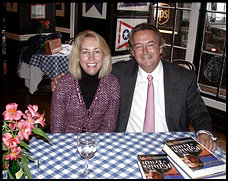
Perhaps others have seen this picture, but all I've seen—again and again—is that annoying Vanity Fair photo in which Plame/Wilson, seated next to her husband, Joe Wilson, in a convertible, hides her identity with a scarf and dark glasses.

<
But somehow, all the spectacle turns me off. Get a life, guys.
Look, I enjoy the schadenfreude as much as the next blogger. I do. I don't like the way this White House works and I'm glad to see them hoisted by their own petard. I cautiously supported the war in Iraq because I believed what the White House was saying about weapons of mass destruction there, and boy, don't I feel like a dummy now. So what goes around comes around.
Somehow, though, I don't see how all this jumping up and down on the corpse of Scooter Libby does progressives much good. The Democrats still have to propose an agenda for the future, and with the possible exception of Rahm Emanuel, I haven't heard much of that.
It's not that Patrick Fitzgerald's investigation isn't important. It is, because it opens a window into how the White House sold a war to the American people. But somehow I get the feeling the blogosphere has gone all ballistic over this episode not because of its importance, but because it's fun. Liberals don't like Karl Rove or Scooter Libby or Dick Cheney or George W., and they like to see these guys squirm.
Plus, there's an air of intrigue and drama about the whole thing. The angry husband, the victimized but still mysterious spy, the sneaky, sinister aides, the strong, silent-type prosecutor...it's entertaining! And, as my friend Neal Gabler has written, it has become the habit of Americans to impose the narrative form of movies upon real life in every possible instance. I think that's what we're doing here, in a way that either distorts the true meaning of what's going on or distracts us from other storylines that may, ultimately, be of greater importance.
So...I hereby withdraw from the great Scooter Libby blogathon. I'll weigh in from time to time, but I just can't compete. Because isn't it weird how the blogosphere has become nothing more than another self-important echo chamber...just like Washington itself?
In the first, a real estate executive was killed while rowing on the Harlem River. His scull was hit by a powerboat in the early morning light. The victim, 41-year-old Jim Rumsdorf, was probably hit head on by the powerboat. The other three rowers managed to swim to safety.
In the second accident, Newsweek editor Tom Masland was mowed down by a woman driving a 300-horsepower Volkswagen SUV as he crossed West End Avenue at 95th Street (quite close to where I live). The 55-year-old, married father of three died soon after.
One person rowing, one person walking, were killed by one person zipping along in a speedboat, by one person zipping along in a luxury SUV. Sane, solitary pleasures versus selfish ones. Two pursuits that suggest some harmony with the environment versus two that, in these days of dwindling oil, are increasingly hard to justify.
New York is a tough place for people who want to live a simpler life. (I wouldn't ride a bike on the streets here if you gave it to me.) But why is it that you never hear of a walker or a rower or a cyclist killing a speedboater or motorcyclist or SUV driver? And how come no one ever seems to care?

Takei's 68 out now, and he's been living with his boyfriend for 18 years.
Actually, Takei sounds like he's lived a pretty interesting life; from the ages of four to eight, he was interned in a Japanese-American internment camp. I didn't know that. Did you?
Well, good for Mr. Sulu to go public. I'm sure that's not easy to do at any point in one's life. Moreover, the lives of the Enterprise crew certainly were interesting, weren't they?
But George...the tux was a dead giveaway.
I am not a pundit, though sometimes l play one on this blog.
So here's one suggestion for how W. can get his presidency back on track: Immediately announce a Justice Department investigation of price-gouging by the oil industry.
Now, it's possible that in doing so, the president would alienate some of his supporters, but I would enjoy that.
No, wait, let me rephrase.
It's possible that he would alienate some of his supporters, but that could only be good for the country.
Hold on! Let me try again.
It's possible that he would alienate some of his supporters, but the vast majority of hard-working Americans would welcome the move.
(There. That's what I was trying to say.)
It's also possible that Dick Cheney would keel over of a heart attack the instant such an investigation was announced, but, well, all three of the above.
Just kidding!
Seriously, here's another suggestion for President Bush: Solicit Dick Cheney's advice about every idea you have. And then do the exact opposite of what he says. Even if it's about something important like, oh, war. Or how to talk to the press.
2) Exxon has made a $25 billion profit this year—equal to its entire earnings for 2004. No way! And the great part is that it's doing so much to deal with the whole global warming thing.
3) Scooter Libby is going to be indicted for dishing dirt in one allegedly illegal way or another. Hard to believe that anyone working for Dick Cheney would do something like that.
4) Freddy Ferrer is getting crushed by Michael Bloomberg even among the voters who ought to be his base. It's as if he hasn't even articulated a rationale for his campaign!
5) AOL has hired Dick Cheney's daughter, Mary—and she's a lesbian too! This after Cheney received a million-dollar advance to write a book about her life. I'm sure that she was hired because of her proven ability "to increase AOL's Internet audience via Web-based programming and products," as an AOL spokesperson put it.
6) There are 39 months of the Bush presidency to go. Apparently that's more than three years.
Actually, now that I think about it, I am kind of shocked by that. Doesn't it already seem as if he's been president for, like, a decade?
This is a very smart move for the Bush White House (which makes me think Miers was pushed). On a day when they're already expecting bad news from special prosecutor Patrick Fitzgerald, give the media some more bad news—a hit that the White House was going to have to take sooner or later. The weekend talk shows will be filled with chatter, as will the Sunday papers, and then, hopefully for the White House, next week is a new beginning.
That's the plan, anyway.
As I (and lots of others) predicted*, Bush is using executive privilege as an excuse. "It is clear that senators would not be satisfied until they gained access to internal documents concerning advice provided during her tenure as the White House - disclosures that would undermine a president's ability to receive candid counsel," he said in a statement.
I'm unconvinced by this argument; a White House nominee to the Supreme Court whose only real paper trail is her legal advice in the White House is an unusual, exceptional situation.
Moreover I will admit to some disappointment. First, I would have been curious to read Miers' advice to the White House, especially on war- and torture-related issues.
And wouldn't the hearings have been entertaining?
But for Miers, this is a good thing. Washington will quickly erase her, as the tide smooths over a footprint in the sand, and she can return to a job better suited to her abilities.
_________________________________________________________________
I wrote on Tuesday about the executive privilege argument: "This feels like an exit strategy. Bush can withdraw the nomination and simultaneously take the high ground, saying that he's fighting to preserve executive privilege for his successors.
"Here's a general rule that I believe about Washington: When you can imagine how a scandal will end, the very act of imagining a denouement hastens its realization."
Because while I'm glad that the White Sox won, and I'm glad that their long drought is over, let's face it: This World Series was boring.
While the White Sox played well when they had to—how about those two plays by Juan Oribe in the bottom of the ninth? Terrific.—the Astros choked. They got something like five hits in their last 60 at bats. And closer Brad Lidge is no Mariano Rivera. He singlehandedly lost three post-season games for the 'stros.
Moreover, can we all just admit one thing: The World Series is more fun when the Yankees are in it.
I know, I'm partisan. But judging from the ratings, the rest of the country would seem to agree....
(Doesn't Starr seem like a bad dream? Ugh.)
"Unlike Kenneth Starr's late, unlamented operation, neither Fitzgerald nor anyone around him leaks," Brown writes in her Washington Post column.
She continues: "It's hard not to see Fitzgerald as the possessor of authentic traditional American virtues. Fitzgerald deals in facts, and lets facts speak for themselves. Bush talks ceaselessly of faith. The prosecutor is all about substance, the president all about surface. In nominating his personal attorney to the most august thinking body in the land, the Supreme Court, the president was caught showing the dismissive view he's always held of intellectual depth and scholarly accomplishment."
Well...we shall see about this. Sometimes Tina's enthusiasm carries her away (one of the things I like about her, actually). But I do think this competence argument is really hitting home. Can this White House do anything right? It's botched the war...the budget...the weather...the environment. And Fitzgerald, by contrast, looks like a man who knows what he does well and goes about doing it.
Today should be interesting....
Apparently Brinkman went out in a small group in a small boat, despite warnings of rough seas after Hurricane Wilma. When the boat engine died, she and three others jumped overboard and tried to swim to an island. The others survived. Brinkman, the only one not wearing a wetsuit, apparently died of hypothermia. (All of them seemed to have had on BCDs, the vests to which an air tank is strapped; they float.)
Having dived in the same area, I find this incident particularly disturbing. What were they thinking? In particular, the divemaster who took them out under such conditions....and poor Ms. Brinkman, going out diving after a hurricane without even bringing a wetsuit.
It makes me appreciate the dive boat I go out on when I'm in Cozumel, which is filled with guys who really care about the safety of their divers, something that is true for most, but definitely not all, divemasters. (I'd link to it, but this is one secret that is already too widely known.)
This incident reminds me that these guys have had problems of their own lately; Cozumel was hard hit by Hurricane Wilma.
Tony, Ricardo, Cielo, Roger, Jesus, Aaron—espero que todos estan seguros, mis amigos. Can't wait to see you soon and hear Tony's ebullient, trademark phrase, preceded by his pretty-good imitation of a seal bark: "We're going diii—ving!"
But since you can't, I'll summarize: The Bush administration has succumbed to second-term blues. But all is not lost. The Bushies can regain their stride, just as Ronald Reagan did in the last quarter of his presidency, by following this advice. "Puncture the intellectual bubble of the presidency." ""Iron out the feuds and tensions." "Kick start a new policy agenda." "Repair relations with Capitol Hill."
Never mind that Brooks' memory of Reagan's last years is considerably more upbeat than the reality. (The Republicans remember Reagan through rose-colored glasses, just like he did with everything.)
But how about this? David Brooks has written an entire column about how to salvage the end of the Bush term without mentioning the word "Iraq."
This is an intellectual lapse that makes one wince for Brooks. Because let's face it: You could implement all four of Brooks' reforms, and the real cloud hanging over this administration wouldn't budge an inch.
Moreover, as soon as you enlarge the discussion to include Iraq, all of Brooks' suggestions seem, well, pretty silly. "Kick-start a new policy agenda"? Never mind that this White House is not much interested in policy, as Ron Susskind's devastating book revealed. But how much new policy can you concoct when burdened with massive debt due to a war whose costs seem only to be increasing?
And how, exactly, can the president iron out the feuds and tensions in his White House when the war with Iraq is the source of so many of them? By purging everyone associated with it? That leaves the little problem of the vice-president.
The truth that David Brooks can not even bring himself to deny is that the war is a ball and chain attached to this administration as it drags itself toward its finish line. And not even the White House seems to know how to rid itself of that weight.
Dowd's column attacked Dick Cheney, of course. But the headline was clearly a double entendre, using "dick" both in reference to Cheney's name and implying that Cheney is a dick.
Which may well be true.
Nonetheless, this kind of wordplay is beneath the New York Times. (It's more the kind of thing you find, unfortunately, in the blogosphere.) I'm sure there are plenty of reasons for folks to criticize Dick Cheney. But let's be adult about how we do it, shall we? Civility in print is always a good idea.
For what it's worth, I considered whether I'm over-sensitive to this, and whether I'm being unfair to Dowd. Nah. For one thing, the ad hominem tone is typical of her. For another, it's hard to imagine a similar headline being used about an administration official whose first name could not be turned into a crude joke. If you don't believe me, imagine an equally obnoxious headline about someone you like. It'd seem weird, wouldn't it?
(And, if one really wanted to push this, one could suggest that Dowd's issues with men, widely written about by herself and others, come to the psychological foreground in such snipes.)
This is the second time in recent days where Dowd has crossed a line beyond which other Times reporters and columnists could not go. (The first was her column about Judith Miller.)
Maureen Dowd is very talented. But her editors allow her leeway that does not help the newspaper. Someone needs to rein her in. Just because many readers might enjoy this bit of nastiness—Dick Cheney probably isn't a very popular figure among Dowd's readers— doesn't mean that it increases one's respect for the New York Times. If such snark is what you want, go read Gawker.
Moreover, the item in question was silly even by gossip column standards—even though, to be fair, Lloyd wrote about the episode, which involved a leaked e-mail, sympathetically.
(I didn't read it—I've learned not to read things about myself that I suspect will make me cranky—but some friends did, and told me about it.)
When Lloyd first e-mailed me about the item in question, I called him and said, "Lloyd, this is so silly. Who could possibly care? I'd appreciate it if you just let this go."
He said, "I don't think I can withhold this from my readers." As if they were dying for "news" about me. Although they had previously managed to get by just fine without it.
I've been mentioned in gossip items a few times over the years, and one thing that turns my stomach about the process is that I never know how to respond. When the incriminating/embarrassing matter is put to you, do you say nothing? Or try to laugh it off? Or fight back aggressively? I hate just being put in the position.
In this case, I wanted to say nothing at all. Lloyd argued that that was the wrong way to go, because a lighthearted response would make me look like a good guy with a self-deprecatory sense of humor. (Far from the truth, but there you are.) Of course, a response helps his column by creating a tit-for-tat, so the suggestion was in his self-interest. But the argument is kind of true, too. Giving a jokey comment makes you look like a good sport about it all. Even when you're fuming inside.
So I thought about it and e-mailed Lloyd an attempt at humor, which in retrospect I don't think was funny at all. I don't know if he even used it.
Anyway, I read today that Lloyd himself has been the victim of a leaked e-mail from his boss to the managing editor of People magazine. Lloyd's boss describes him as a "fucking idiot" and adds that "his page is stupid."
Ouch. Unhappy as I was to be written about by Lloyd, I wouldn't wish that on anyone, except maybe Donald Trump.
Nonetheless, in an egregious act of narcissism, I choose to believe that this is the result of karmic equalization.
Having said that, I guess the incident will give Lloyd a pretty strong case for a large golden parachute when the time comes.....
I spoke with Bono for about two hours, and came away hugely impressed. We spoke mostly about his drive for international debt relief for poor nations, and he clearly knew what he was talking about. Well, let's be honest—he knew vastly more about the issue than I did. But we also talked about the politics of being a rock star and some of the issues raised by his dual roles as activist and musician.
Bono had enormous charisma, humor and intelligence.
Also, he holds his liquor better than I do. But that is true of most adults. And many young people.
I am reminded of all this by the extensive interview Jann Wenner has done with Bono in the new Rolling Stone: This is a thoughtful and fascinating man. And inspiring. More than anyone else I can think of, Bono makes real change in Africa seem not only plausible, but mandatory.
I liked one particular answer of his, when Wenner asked if he has a "messianic complex." Bono responds: "Once you see not only the problem, but also the solution, there's no escape. You see it, you can't look away from it. I want it to feel like an adventure, not a burden. ...This is an extraordinary thing. This is not, 'Oh, my God, all the poor starving Africans with flies around their faces.' They are very noble, royal people, full of easy laughter and very innovative. This is about us, too. It's about who are we? What are our values? Do we have any? It's exciting."
And inspiring....
I'm tempted to make an Alec Baldwin joke, but you know what? He's right. Kay Bailey Hutchison is full of shit.
In fact, it strikes me that the Fitzgerald investigation seems to me a model of how a special prosecutor can actually work well. Unlike Ken Starr's office, Fitzgerald's seems to be essentially leak-proof. And whereas Starr spent millions and millions and paralyzed the government to find nothing more than a little tomfoolery, Fitzgerald is spending his money to investigate an abuse of executive branch power that helped put the country on a path to war.
Which would suggest that Republicans got it exactly wrong then...and are getting it exactly wrong now. All in pursuit of, and now defense of, power.
Which is why the GOP is in the midst of a bitter ideological civil war between those who'll do anything to hold on to power and those who believe that the party should stand for more than that.....
This isn't the first time Bush has made this case; the first related to Dick Cheney's energy policy task force. The White House fought a successful legal battle to ensure that it did not have to release the names of the oil company/Halliburton executives from whom Cheney took his marching orders.
A couple of thoughts.
First, didn't Bush think of this potential snag before he nominated Miers? Or was he expecting that the Senate would just roll over and confirm her, without asking for her White House paper trail?
Second, this feels like an exit strategy. Bush can withdraw the nomination and simultaneously take the high ground, saying that he's fighting to preserve executive privilege for his successors.
Here's a general rule that I believe about Washington: When you can imagine how a scandal will end, the very act of imagining a denouement hastens its realization.
No word on whether the victims were lap dogs.
"We're being held hostage by a rogue deer," resident Lou Pimentel told the San Jose Mercury News. Pimentel has stopped walking his Jack Russell terrier since the attacks. "I like deer. It's peaceful to know you live where deer can roam. But it's very different when you worry about your dog being killed."
Oh, yes. It is different when you worry about your dog being killed. Everything is different when you worry about your dog being killed.
State game wardens have dispatched local hunters on a search-and-deerstroy mission.
I had a discussion with a friend not too long ago about why the Plame scandal matters. Was special prosecutor Patrick Fitzgerald spending too much time, causing too much chaos, just for a little leak investigation?
My response is that this investigation matters not just because of the literal crimes that may have occurred, but because it's about the lengths that this administration went to to justify the war in Iraq. The lies surrounding what Scooter Libby and Karl Rove may or may not have known and said may, in a narrow context, be small lies. But they go to the heart of the matter: That this White House was trying to sell a war for illegitimate reasons, and it was willing to break the law and smear its critics to do so.
And now we know that the vice-president is involved. The chickens are coming home to roost.
I don't think there can be any question that this investigation matters. Who knows, now, where it will take us? I, for one, can't wait for Robert Sam Anson's biography of Dick Cheney....
After establishing Meyer's success as manager of Harvard's billions, Nocera posits this thesis: "To talk to people in both the Harvard and the Meyer camps, you come away with the feeling that Harvard is not all that terribly sorry to see him go—and that Mr. Meyer had come to feel that, if he wasn't exactly being pushed out the door, he was certainly not getting the deference or leeway he was used to."
Nocera cites two phenomena to explain the changing relationship between Meyer and Harvard. The first is the departure of some of his money managers, under the pressure of bad publicity over their salaries; the men subsequently created their own hedge funds and Meyer invested with them, which meant essentially that their salaries were no longer public and that the staff expertise at Harvard Management Corporation was diminished.
The second change was Larry Summers. To quote Nocera: "One of the raps on Mr. Summers is that he always has to be the smartest guy in any room, tossing off questions he means to be provocative, but which often have the effect of alienating the people he's questioning. And so...Mr. Summers began questioning Mr. Meyers about everything from the positions in the portfolio to its level of risk."
Equally interesting, Nocera throws Bob Rubin into the mix, saying that he too started "meddling" (as Meyer appeared to consider it) with Meyer's decisions.
Soon enough, Meyer got fed up...and now Mr. El-Erian has very large shoes to fill, with many doubts about whether he will be able to do that.
The plot thickens, eh?
I've long argued that the key to Summers' viability at Harvard is money: Are alumni giving it? Is Harvard making it?
Seem from this perspective, Summers may actually be in more trouble than he was last spring. FAS has just announced a $50 million or so annual deficit. (Could be more, could be less.) The long-awaited capital campaign is still awaited. It'll be a miracle if the performance of Harvard's endowment continues at the pace it did under Meyer.
And meanwhile, Allston is out there, waiting to suck down every available dollar Harvard throws at it....
Many people at Harvard would like to think that their, and the world's, image of the university is primarily linked to its intellectual achievements. I think it's more complicated. In recent decades, many people have formed their high estimation of Harvard, whether they realize it or not, because of the fact that it is not just smart but rich, the richest university in the world by about ten billion dollars, so rich that they've come to take this relatively modern phenomenon for granted. What many Harvard alums and the general public really cherish about Harvard is its power, and these days, the source of that power is as much financial as it is intellectual.
So what happens if, under Larry Summers, Harvard's wealth starts to flatline, or even decrease? And what happens if the departure of Jack Meyer is seen as a watershed in that development?
___________________________________________________________________
P.S. Harvard alums who want to better understand their president should know that Summers almost certainly spoke at some length—on background—for Nocera's story. (I'd bet ten percent of my personal wealth versus .o1 percent of Harvard's endowment on it.) How do I know this? First, he's quoted in a sort of oblique way saying "Jack Meyer did a great job for Harvard." Short, succinct soundbite.
But later in the piece, when Nocera discusses a new compensation strategy Summers put in place at HMC, Nocera writes, "I don't believe that Mr. Summers imposed the new system as a means of getting rid of Mr. Meyer—he simply thought it made more sense for a university endowment—but that was the inevitable result."
How does Nocera know what Summers "simply thought"? In all likelihood, because Summers told him—but in a way he hoped would obscure the extent of his cooperation with the Times reporter.
SOP in Washington: Give the complimentary soundbite on the record, then go on background to deliver the real dish. It's only less than obvious if you labor under the idealistic assumption that a university president wouldn't employ such media strategies.
Writes Lewis: "Harvard really has no money of its own. It is merely the trustee for money given or paid to it for education and research, and funds resulting from reinvestment of such gifts and payments—funds which should themselves be invested in education and research at Harvard. "
I think this argument can safely be called the traditionalist, or purist, view of Harvard's role in the world, whereas Larry Summers' decision to implement this policy reflects his expansionist perspective: Harvard as international geopolitical player, led by Summers, who used other people's money in similar ways while at the World Bank and the Treasury Department....
A tax lawyer friend of mine raises the question of whether it's even legal for a non-profit to redirect contributions in such a manner..... There's a real case to be made that it is not.
I know I shouldn't put it this way, but the catfight is turning into a three-way.....or even a foursome, if you include the interview Miller gives to the New York Post's Andrea Peyser....
Miller also clarifies her controversial decision to call Scooter Libby a "former Hill staffer," saying that " I agreed to that attribution only to hear the information. As I also stressed, Scooter Libby has never been identified in any of my stories as anything other than a 'senior Administration official.'”
If true, then Miller has a legitimate beef: the Times' tick-tock and Calame's column clearly left the impression that the wording "former Hill staffer" had gotten into the paper.
Finally, Miller accuses Calame of not giving her equal time: "While you posted Bill Keller’s sanitized, post-lawyered version of the ugly, inaccurate memo to the staff he circulated Friday, which accused me of 'misleading' an editor and being 'entangle' with I. Lewis Libby, you declined to post the answers I sent you to six questions that we touched on during our interview Thursday. Had you done so, readers could have made their own assessment of my conduct in what you headlined as “the Miller mess.”
Again, I think Miller has a point. If Miller answered his questions, why not post her answers? That's what the web is for, baby. Full disclosure. As they say in Washington, do an information dump. If the public editor won't level with readers, who will?
Miller also has a right to be outraged by Bill Keller's use of the term "entangled," which clearly suggests that she was sleeping with Scooter Libby. If Miller wasn't, then Keller not only chose his word poorly, he chose it sleazily.
Bill Keller inspires less and less confidence.
This is the third egregiously bad call by an umpire in the post-season, all of which wound up playing crucial roles in the outcomes of games.
What could be the downside of allowing instant replay review during the post-season?
After all, it's not like football, where such interruptions really disrupt the flow of the game. In baseball, taking a few moments to chat is a valued part of the game—a manager's visit to the mound, for example.
It'd be kind of fun for baseball fans to have more time during the game to review and argue about disputed calls...and no important game should be lost because of an ump's clearly mistaken call.
(Insert standard TimesSelect lack-of-link explanation here.)
Dowd cites the usual reasons, but adds one delicious detail: that as recently as last April, Miller sent her an e-mail defending Ahmad Chalabi, perhaps the world's most unreliable source. For this act of lunatic judgment alone, Miller should be fired.
Clearly, I have no desire to defend Judith Miller. But having said that, I think it's bizarre and probably inappropriate to allow one Times columnist to write a column attacking a Times reporter. (Much as I love to read a "catfight," as the New York Post put it.)
In the process, Dowd can draw on her knowledge of the paper's internal workings, and, because she's a columnist, never has to give Miller a chance to respond. It doesn't feel right. The Times should offer Judy Miller space on the editorial page to answer Dowd. But of course, then the whole thing starts to get silly...which is why the Times shouldn't have allowed Dowd to write about Miller in the first place.
Moreover, while I'm sure that Dowd genuinely believes what she wrote, and that she would never, ever be opportunistic and use the moment of Miller's weakness to pile on, let us not give her points for journalistic courage here.
Real guts would have been writing this column a year ago. Or two years ago. After all, Dowd writes that in the run-up to war, she "worried that [Miller] was playing a leading role in the dangerous echo chamber" of warmongers and their publicists. Perhaps I missed it, but I don't recall her breaking with Miller at the time.
It doesn't take much guts to come out now and say that you always thought Judy Miller was a bad reporter. What'd you do when it counted, Maureen? When you might actually have to pay an internal price at the paper in order to run a column?
A few posters on this blog have mentioned that they don't believe Judith Miller should be given the opportunity to write a book. I think this kind of criticism merits a response, and I'd like to see it addressed in the book that Miller will surely write. Can you imagine how entertaining it would be if she really decides to dish on the internal goings-on at the Times?
Which perhaps puts Dowd's column in another light. Perhaps it's nothing more than a shot across the bow....
(You know the drill by now: I'd link to it, but, blah-blah-blah, TimesSelect.)
Here's how the column is described online: "If nothing is done about the current state of affairs and the incompetence of the government, things are going to get much worse."
I think that Bob Herbert, in a burst of delightfully self-deprecatory self-parody, must have written that sentence himself. Because, after all, it's pretty much the theme of every Bob Herbert column. Or does some web editor just keep around that dummy copy to publish whenever it's Bob Herbert's time to appear in the paper?
I challenge readers to come up with their own Bob Herbert ledes....
They are more or less as follows:
1) The Times was slow to fault its, and particularly Miller's, reporting on Iraq before the war began, largely because of the Jason Blair fiascos. (Lots of fiascos going around the Times these days.)
2) Judy Miller takes "journalistic shortcuts."
3) Times editors treated Miller with kid gloves, treatment which only made the fiasco worse.
4) "The problems facing her inside and outside the newsroom will make it difficult for her to return to the paper as a reporter."
I'm underwhelmed by Calame's column, which essentially repeats everything we already knew and doesn't dig very deep.
For example, it takes Bill Keller's words about "lancing the WMD boil earlier" at face value. But as readers of the blogosphere well know, the Times did a remarkably poor job of evaluating its reportage strongly suggesting that Iraq had or was about to acquire WMDs. On a story of immense importance—whether there was reason for this country to go to war—the Times not only got the story wrong, but got it wrong in such a way that promoted war. The reporter most responsible for this was Judy Miller—and the Times' WMD mea culpa failed to address her role.
Calame also neglects to address the news, broken by Andrea Peyser in Sunday's New York Post, that Milller was allowed to read last week's tick-tock of, for lack of a cuter phrase, "Miller Time"—before publication.
Since when does the Times allow the subjects of its articles pre-publication review?
And, while this is a touchy situation, Calame lets Arthur Sulzberger, Jr., off the hook. He notes that Sulzberger strongly defended Miller. But he doesn't push the question of why, and that is something of a mystery. Folks outside the Times have known for years that Miller was trouble. And it sounds like some folks inside the Times have also known that.
So why did Pinch Sulzberger put the credibility of his newspaper at risk to stick up for a reporter whose dubious history waved more red flags than a bullfighters' school?
(Sorry.)
And here's a question I have: Judy Miller once again refused to name the editor she claims she asked for permission to pursue a story about Valerie Wilson, and who allegedly said no. Who is this mysterious editor? Washington bureau chief Jill Abramson says it wasn't she. Was it Bill Keller?
In any event, how can a newspaper possibly continue to pay a reporter who won't disclose her own discussions with the paper's editors?
To rebuild its credibility, the Times should do more than just let Judy Miller sneak away and write a book. It needs to fire her.
I'm looking forward to being 27...it seems like a nice year.
One imagines that there are other ways to spend that $7 billion which would a) make the country safer and b) avoid enormously increasing the authoritarian nature of the federal government, something Republicans used to care about, before they ran it.
Moreover, back when Bill Clinton was president, this is the kind of thing that Republicans used to call an "unfunded mandate," an order by the federal government whose cost was simply imposed upon the states. At they time, they were justifiably upset about such mandates.
Sometimes, you really do get what you ask for...
Cornell President Condemns Teaching Intelligent Design as Science
Perhaps other Ivy League presidents should follow in the lead of Cornell president Hunter R. Rawlings IIIrd....
As the Crimson puts it, "a spokesman for Summers declined to comment on the anecdote." (Is that you, John Longbrake? Are we back to the Lucie McNeil days, when the president's only spokesperson refused to allow herself to be identified?)
I'm inclined to believe this anecdote. The language sounds like Summers, and so does the opinion.
I'm equally sure that Summers could make compelling arguments to back up his conclusion.
But so much of leadership is about voice, about telling people things they don't want to hear in a way that minimizes tension, rather than exacerbating it. (And here I disagree with conservatives who seem to think that great leadership in a college president means sticking it to women, minorities, liberals, etc., by giving them a rhetorical middle-finger and then feigning shock at their outrage.)
When Summers was in Washington, he learned that he couldn't get away with this kind of remark because there were people more powerful than he who would make his life a living hell for it.
Now, he clearly doesn't feel that way; no individual is powerful enough at Harvard to challenge him, particularly not a student.
The result: a gratuitously rough remark to a student who is, after all, probably 20 years old or so.....
"It's a historic piece of legislation," Wayne LaPierre, the association's chief executive, told the New York Times. LaPierre added that the bill was the most significant victory for the gun lobby since Congress rewrote the federal gun control law in 1986. "As of Oct. 20, the Second Amendment is probably in the best shape in this country that it's been in decades."
Without addressing the merits of this law, let me just point out that it runs contrary to the most fundamental tenet of the Republican Party: federalism. Congress has passed a law overriding the laws of every state in the entire country on a subject about which there is widespread disagreement and no clear moral impetus (as with, say, civil rights law).
And, though Republicans have long decried the power of the Supreme Court to decide the law of the land, they are now trying to stack the court with judges who will support the constitutionality of the big-government laws they are passing.
Emerson said that consistency is the hobgoblin of little minds. (Emerson was more full of shit, in my opinion, than a port-a-potty at Woodstock, particularly in this blatantly self-rationalizing quote, but there you are.)
If so, then Tom DeLay is a great man. But I like to think that a little ideological consistency is actually a good thing in the long run, and that serious conservatives ought to be worried about such heavy-handed measures. If they really believe that the smaller the government the better, how do they justify such measures, other than with an "ends justifies the means" argument?
Defending his remarks, Mr. French told the New York Times, "A belligerent question deserves a belligerent answer. The answer is, They don't work hard enough. It's not a joke job. The future of the entire agency is in your hands as creative director."
After an outraged response from some of those present, French, 61, resigned his position as creative director of the advertising conglomerate, WPP Group.
Interestingly, French's remarks mirrored those of Larry Summers last winter, when he said that women didn't rise to the top levels of math and science primarily because their domestic responsibilities kept them from working the necessary hours.
But that argument was overshadowed when Summers' second argument, that women are genetically less capable at math and science than men are, caused a storm of controversy.
What's ironic about the sensitivity to this issue is that it's something lots of women would agree with—they do more at home than men do, and they pay a professional price for doing so.
The answer would seem to be getting men to accept at least an equal domestic burden.
But many women genuinely don't seem to want that; many women (along with most men) genuinely seem to believe that they are—dare I say it?—genetically more inclined to bond with their kids than men are. I've spoken to lots of moms who say that it's not a question of culture; their young children just have a stronger connection to them than they do with their fathers. And if you suggest that that bond is a social construct, these women can get very offended, and expound upon the connection between a child and the person who carried it for nine months inside her—an argument that makes some sense to me. How could a baby not have a stronger connection with that person than with a guy who just shows up in the delivery room?
Moreover, I've found that many women don't really want a man who isn't at least their professional equal. I know a couple of house husbands, and they all say that they sense a subtle disrespect from women they know, and they're not particularly welcomed among, say, groups of mothers at the playground.
So, back to Summers and French. Both men are clearly on to something; they're taking stabs at explaining an issue that affects most everyone in our society. It's just particularly sensitive for women. Why? Because, I think, the ultimate truth of this debate is that many women want it all—quantity kid time and professional succcess—but can't have it all, because, well, no one can really do that. There aren't enough hours in the day.
Whereas men don't want it all; we want to spend more time at work.
Who knows? I'm hardly an expert on this stuff. But in any case, I would propose two things: That when men try to discuss this issue, we try to do so with sensitivity, recognizing that this is, at least now, a more cutting and troublesome issue for women than it is for us.
And second, that women who believe in changing roles for their own sex are consistent and support men who try to change gender roles for themselves.....
I earlier argued that Bamberger was wrong to interject himself into the conduct of a golf tournament, and this interview does nothing to convince me that I'm wrong.
Here's Bamberger's rationale for his action, which took place on Sunday, the tournament's last day:
Saturday night literally was sleepless for me. I didn't want to insert myself into the story. On the other hand, as someone who loves golf and thinks playing by the rules is a critical element to making tournament golf work, I was worried about how I would feel if I said nothing. I had this scenario in my head: How would I feel on Monday when I looked at the newspaper and saw where she had finished, knowing that, in my mind, her position was not legitimate.
Let me admit that I'm skeptical of anyone, particularly any writer, who says "Saturday night literally was sleepless for me." I'm trying to imagine a figuratively sleepness night. Is that even possible?
More important, Bamberger says he broke journalism's rules of being a reporter, not a participant because he was worried about how he would feel.
Imagine if reporters in other sports used this rationale every time they saw a bad call. The phones of sports officials would be ringing off the hook. You know, I just had to call up about Robinson Cano being called out at first—I feel really bad about that.....
Asked his reaction when he heard that Wie was disqualified, Bamberger responds, "I felt emotionally dead. I like being in the background -- that's one reason why I'm a reporter. I knew I had influenced the outcome. But I also knew I would've been sick to my stomach if I had not said anything."
Emotionally dead? Sick to his stomach? This kind of reaction might be understandable in Anderson Cooper reporting from New Orleans, but Michael, it's just a golf tournament.
Sports Illustrated has a reporter who's clearly too close to his material, and Michelle Wie has paid an unfair price for that. The magazine should remove Bamberger from the golf beat.
That's from an Australian website.
And we wonder why Australian universities have become more popular than American ones....maybe it's because they don't have to teach nonsense?
Aren't they also words that could be used to describe the entirety of this Supreme Court nomination?
If Miers really goes through with these confirmation hearings, scheduled to start November 7th, I will be Tivo-ing them religiously. It'll be like watching a car crash in which the only person who gets hurt is an empty-headed, ill-equipped and unprepared judicial nominee.
Oh, right, and the president. And, in some way, probably the country.
Please, President Bush...do us all a favor. Put Harriet Miers out of her (and our) misery. Withdraw this nomination.
Higher-than-expected construction costs are to blame, Kirby says, even as he argues that FAS has been planning for these deficits.
Huh.
For construction overruns to run into, say, $50 million a year—higher and lower figures were guesstimated—someone really has to have been asleep at the wheel. Granted, Harvard's got a lot going on, but this isn't the Big Dig here.
Whatever the case, the idea of FAS running a deficit isn't going to make anyone feel comfortable. Harvard has made so much money, and with such apparent ease, in the last fifteen years or so, the experience of losing money is going to feel very foreign. I would be surprised if there are no administrative consequences as a result.
Especially when combined with this other headline from today's Crimson: Stalled [Curricular] Review Inches Ahead.
She's talking, of course, about the Times' long Judith Miller story, and the fact that that story seemed to raise more questions than it answers. That's a cliche, but in this case, it's really true. You can't trust the accounts of any of the players in the piece; everyone comes across as dodgy and not trustworthy. And as Brown points out: How exactly did Miller keep "kind of drifting on her own back into the national security realm"? Why was Miller apparently driving the Times' legal conduct of the episode?
"'Transparency,'" Brown writes, "turns into a combination of partial truths and morose institutional venting that makes everyone, including the readers, feel worse about themselves and the newspaper than they did before."
I agree with the first half of that sentence and part of the second. I do feel worse about the Times than I did before. Its half-assed reportage (no fault of the reporters, in this case) of its own half-assed mistakes lays bare the emperor's lack of clothing.
But I feel pretty good about myself and all the other bloggers and journalism-watchers out there; we've all held the Times' feet to the fire on this one. I can't wait to see its subsequent articles clarifying this first one. It's a grand mystery, and watching it unfold is a combination of good fun and high stakes.
I have only one caveat: We do need to remember who the ultimate bad guys are, the people who conducted a smear campaign against a CIA operative and her husband in order to spook the country into war....
(Let us pause here and reflect upon the wackiness of the world.)
It's a helluva story. As the Miami Herald puts it, "The suspect resisted arrest."
The snake was discovered by one Tommy Compton near the man's fish pond. It evaded capture and slipped into the water. Then, showing either unparalleled courage or a craven desire to show off for the TV camera crew that he had called, Compton and a friend jumped into the pool and wrestled the beast into submission. They sustained several bites in the process, but apparently—and contrary to the thoughts of at least one poster on this blog—the python bite is not venomous. Still, the experience is probably less pleasurable than, say, a love bite from Carmen Elektra.
According to one snake expert, ''Typically pythons aren't fish eaters. But you never doubt a hungry snake. They are very resourceful.''
I believe I'm going to adopt that slogan, especially when dealing with gossip columnists: Never doubt a hungry snake.
Don't you just love nature as metaphor?
The book, called ""The Impostor: How George W. Bush Bankrupted America and Betrayed the Reagan Legacy," is self-explanatory. It is also, of course, evidence of the deep split within American conservatives over the Bush presidency.
I must say, I love rubbernecking at this conservative civil war. For years, the conservatives have had it both ways, campaigning on ideals of small government and reduced federal spending even as they turn to the federal government to impose their ideological mandates on the country and the world. This implosion is long overdue. I can't even say that I give conservatives like Bartlett credit for engaging in the debate...for years, they turned a blind eye to the party's internal contradictions so as not to interrupt the party's march to power. Now that legacy of willful denial is coming home to roost.
Here's his excerpt from Miers' responses to Senate Judiciary Committee questions:
"Earlier this year, I received notice that my dues for the District of Columbia Bar were delinquent and as a result my ability to practice law in D.C. had been suspended. I immediately sent the dues in to remedy the delinquency. The nonpayment was not intentioned, and I corrected the situation upon receiving the letter."
Let's forget the obvious and pathetic embarrassment that this SCOTUS nominee had her law license suspended. Okay, sure, it happens, whatever. I'm more struck by her language: "the nonpayment was not intentioned."
Argh.
Let's see how one could phrase this clause. "I was busy, and forgot to mail the check...." Or: "I meant to pay, but I was busy approving torture in Iraq...." Or, simply: "My bad."
Instead, Miers uses that awful phrase: "The nonpayment was not intentioned."
Intentioned?
It's the same kind of passive language that she used in her letters to the Texas Bar, as pointed out by David Brooks, which, as you now know, I can not link to because of TimesSelect (speaking of awful language).
Not only is this excruciatingly bad writing—though we shouldn't downplay that in a potential Supreme Court justice—but I would argue that it's a metaphor for Miers' relationship with President Bush, and perhaps her approach to life. She's attached herself like a remora to a more powerful person. What happens next is unexpected and, well, dare I say it? Not intentioned. Maybe that's why she apparently turned down an earlier offer to be nominated to replace Sandra Day O'Connor...she never realized how far passivity could take her. But now that she's gotten used to the idea, she's willing to ride the president all the way to the Supreme Court. It is, I guess, one model for getting ahead in life....
It's kind of like the movie Underworld, which posited a long-running blood feud, heh-heh, between vampires and werewolves. (Expect Underworld II sometime next year.)
My favorite quote: "When the snake is bigger and can overpower the alligator, then the snake will win. But alligators have been known to win. And there have been ties."
Ties? Does that mean there are rematches?
And my favorite fun fact: Python-alligator fights have reportedly lasted as long as 24 hours.
I have no idea how anyone could possibly know this, given that no one seems to have actually witnessed one of these marathon duels, but since I like the fact, I choose to accept it.
I've questioned this giving for a few reasons. First, when donors give to Harvard, they're making a specific choice, and the recipient of that choice ought to respect their wishes, rather than redirecting their money to another charitable cause. Second, such giving changes the nature of the university from a place of education to a world geopolitical actor. Third, if you give for tsunamis and hurricanes, where do you draw the line? Surely the Pakistani earthquake has cost more lives and caused more devastation than Hurricane Katrina did. Fourth, such charitable gifts could be a way of influence-buying and reputation-repairing for the president of the university—any president of the university. Problem is, it's really not his money to give.
Now the Crimson has weighed in on just this question...and comes down on both sides.
This editorial argues the following:
Offering a donation matching program after these two catastrophes was the right thing for the University to do. Although Harvard’s primary mission is educational and academic, Harvard is also a community of nearly 35,000 and an employer of over 15,000, making it the fifth largest employer in all of Massachusetts, according to the Boston Business Journal. Beyond the philanthropic and noble ends of raising funds, matching donations when there is a community outcry helps build morale, which is why many businesses across the country had a similar matching program for their employees.
A dissenting column disputes that, saying: ....Matching donations for the tsunami and for Katrina have set a dangerous precedent—recently broken by Harvard’s choice not to match donations for the earthquake in Kashmir—that encourages our community to judge Harvard’s responses solely on a monetary basis. It is a slippery slope that the University must not traverse. For future disasters, Harvard should cease impersonating a charitable organization and instead focus on the unique and valuable ways it can help as an institution of higher learning.
I do not find the first argument suasive; boosting "morale" is insufficient justification for transforming the mission of the university.
But, as with the debate over the Solomon Amendment, this is another situation where President Summers should rise to explain himself. What principles underlie his thinking? Why give to tsunami and hurricane victims, but not earthquake victims? When is it appropriate to give and when not? How does this fit into his vision of Harvard in the world?
These are important questions in a debate that the president himself has ignited. He should explain himself now. After all, Pakistani president Pervez Musharraf has visited Harvard and met with Summers. What would Summers say to him now?
Because if it's sincere...I shudder to think about the fate of our young people.
Harvard students had their most successful party of the fall last night to celebrate the fact that Lamont Library is now open 24 hours a day....
I think Harvard students are great, but guys, come on—get a life.
No one has suggested that Wie intentionally did anything improper—which means that the real story here is whether the reporter's actions were appropriate. Is it within the bounds of a reporter's job to point out a suspected rule violation? The answer is no.
According to the AP story linked to above, "Michael Bamberger, a reporter for Sports Illustrated, told tour officials Sunday afternoon that he was concerned about the drop."
"Asked why he didn't bring it up before the third round ended,"—when Wie could have avoided disqualification— Bamberger said [italics added], "That didn't occur to me. I was still in my reporter's mode. I wanted to talk to her first."
As time passed, Bamberger added, "I thought about it more and was just uncomfortable that I knew something. Integrity is at the heart of the game. I don't think she cheated. I think she was just hasty."
Let's review. Bamberger stepped out of reporter mode when raising the issue with tour officials. He thinks integrity is at the heart of golf, but he doesn't think Wie cheated—so what integrity is at stake? Then, when it's too late to rectify the error, Bamberger causes Wie to be disqualified from her first pro tournament. He doesn't do it because he's reporting a story, but because he's "uncomfortable that [he] knew something."
What an unfortunate incident; Bamberger shouldn't sleep well about this one. He should publicly apologize to Wie, and Sports Illustrated should pay her the $50,000 that she lost because of Bamberger, who—not Wie—is really the one who crossed the line.
Along the way, he throws this bone to Larry Summers: " For 30 years, attention has focused on feminine equality. During that time honest discussion of innate differences has been stifled (ask Larry Summers). It's time to look at the other half."
Huh.
I'm fascinated by how conservatives have turned Summers into a free-speech martyr; they're certainly not aware of Summers' own attempts to discourage free speech at Harvard. (Zayed Yasin, anyone?)
I think Brooks fundamentally misreads what happened with Summers. No one was saying that the president of Harvard doesn't have the right to speak on any subject he wants to talk about. The frustration over Summers' remarks on women in the sciences came from the fact that, many experts in the field believed, he was speaking out of ignorance, and his opinion reflected a personal bias more than an informed opinion. Coming from the man in the highest position in the world of higher education, these things matter; the words of the president of Harvard have consequences.
The right to free speech does not deprive listeners of the ability to react with outrage...and nothing in the Summers' matter suggests that there was no "honest discussion" of the status of women in the sciences. There was a great deal of it—millions of words—and virtually all of them, except, perhaps, from Steve Pinker and the political right, felt that Summers' opinion was wrong.
So by all means, let us have open and honest discussion of all the factors that might contribute to educational differences between boys and girls. But when we start talking about innate differences—i.e., genetics—we are on volatile ground, and we need to remember that, and conduct our discussions with the nuance and sensitivity for which David Brooks is known and Larry Summers is not.
Some thoughts on the winners and losers:
Let's start with the losers, because there are more of them.
1) Bill Keller. Is there any aspect of this case that Keller did not mishandle? He didn't ask to see Miller's notes, he restrained his other reporters from investigating her case, he allowed his newspaper to be scooped by other papers...all to defend a reporter whose actions appear indefensible. After all, Miller lied to her own editors about whether she had been a recipient of the Valerie Plame leak. And, as the article makes clear, even now Miller refuses to cooperate with her own newspaper beyond the bare minimum.
This is the second instance recently in which Bill Keller went to bat for a reporter when conceding mistakes seemed the more honest course. Recently, he defended Allesandra Stanley's wacky claim that Geraldo Rivera had pushed an aid worker out of a camera shot to aid a hurricane victim—even though the video showed no such thing. Keller's response: Rivera was a "four-letter word" and the word "nudge" was meant to be figurative. Lame.
Since this type of thing does not seem to happen with male reporters and Bill Keller, one has to wonder if the gender of the reporters is not a factor in Mr. Keller's judgment....
2) Judith Miller. She claims she went to jail to protect a source...but now she can't even remember who the source is. Was it Scooter Libby who provided her with the identity whose leak was a potential violation of the law? Or did tell someone else give her the name "Valerie Flame"? She has multiple variations on Valerie Plame's name written in her notes, but she has no idea where they came from. As Mickey Kaus smartly points out, Miller claims she's won a victory for journalistic principle, but all she's done is establish that if you send a reporter to jail for a couple months, she's bound to spill the beans.
3) Floyd Abrams. I've written before regarding my low opinion of Floyd Abrams: As a First Amendment lawyer, he makes a great media whore. Nothing in this account changes that opinion. Quite the contrary. First, he appears to have badly botched negotiations with Scooter Libby's lawyer, Joseph A. Tate. (To be fair, this comes from Judith Miller's representation of what Abrams told her, and she's not the most reliable teller.) Miller writes in her account, "Mr. Libby had singed a blanket form waiver, which hsi lawyer signaled to my counsel was not really voluntary." Tate adamantly denies this, and it's unclear what signal made Abrams so sure: a special, double-secret handshake?
There is no question that once D.C. lawyer Bob Bennett got involved with the case, and Abrams was backburnered—the Times is unclear about how his status changed after Bennett got involved—things started moving, talks with Tate were reopened (after a year of silence, which appears to have astounded Tate), and Miller was soon on her way to receiving a get out of jail free card.
Abrams' own quote to the Times is highly curious. He said of his negotiations with Mr. Tate: "On more than one occasion, Mr. Tate asked me for a recitation of what Ms. Miller would say [in her potential testimony to the grand jury]. I did not provide one."
Why not? There are only two options. Miller would either testify that Libby was her source, or she wouldn't. Wouldn't that be pertinent information for Tate as he advised Libby on whether to proffer Miller a waiver of his source confidentiality? Why not tell Tate what Miller would testify to?
Consider the scenarios: If Abrams says Miller will testify that it wasn't Libby, then Tate can reaffirm the waiver with no qualms.
If Abrams says that Miller will testify that it was Libby, then Tate can be much clearer about whether Libby's waiver was really voluntary, and Miller can go to jail under much less ambiguous circumstances.
So why wouldn't Abrams spell it out?
Unless, of course, Abrams is simply lying now—that he detailed exactly what Miller would say, and he is now misleading the Times' reporters because if he were now to disclose what Miller would testify to, then he would be, in effect, outing her source.
Either way, his decision not to contact Tate for a year is bizarre. As the Times piece notes, "Mr. Bennett called Mr. Tate on Aug. 31 [2005]. Mr. Tate told Mr. Bennett that Mr. Libby had given permission to Ms. Miller to testify a year earlier. 'I called Tate and this guy could not have been clearer—"Bob, my client has given a waiver,"' Mr. Bennett said."
4) Other Times reporters. Throughout the article, other Times reporters are chafing to explore this story aggressively...and at every turn, they are thwarted, so that Bill Keller and Arthur Sulzberger (also a loser in this affair) can protect Judy Miller. Funny how, in trying to defend their paper, they wound up debasing it.
5) Scooter Libby. Miller says she can't remember if he gave her the exact name, but it's clear that he enjoyed a cozy relationship with Miller, and was willing to use that relationship to smear an administration critic. A two-hour breakfast at the St. Regis? My lord, what was going on there exactly? At the very least, the length of that breakfast shows how important trashing Joe Wilson was to the White House. Most times, the only reporter who gets two hours of a White House staffer's time is Bob Woodward.
Winners:
1) Bob Bennett. Granted, Bennett has long known how to make himself look good in the press. But there's no question he seems to have proved far more adept in this Washington maze than was Abrams. Moreover, he got special prosecutor Joseph Fitzgerald to agree to question Miller only on Scooter Libby and the Plame matter, which, now that Miller says that Plame's name may have come from someone else, looks like a significant victory.
2) Bloggers. Arianna Huffington has been particularly good on this matter...but lots of blogs have kept the heat on.
Um...that's about it for winners.
All right, we'll throw in Joe Wilson, who has long maintained that there was an orchestrated White House plan to smear his wife, and long suggested that Scooter Libby was involved, and now appears to be exactly right.
I once defended Judy Miller for what, at the time, struck me as a principled defense of journalistic privilege. It's clear to me now that that was a mistake. Judith Miller strikes me now as a propagandist more than a journalist, and the Times, which has only suffered from its association with her, should fire her.
Let us hope that the little fellow will not get too, um, consumed by his work....
The Times casts the hiring of El-Erian as a "surprising choice," noting that he's little-known around Wall Street, is not a Harvard alum, and has no experience managing a stock portfolio.
The Globe has a downright weird take*; it headlines its coverage "Harvard Will Keep Disputed Pay Policy," and buries the fact that Harvard announced Meyer's replacement four grafs into the story.
My thoughts: The Times piece does a better job of raising the right questions here. It, too, notes that El-Erian's pay package will be similar to Jack Meyer's, and points out that Yale's money manager, David Swenson—who may be even better than Meyer—was paid only about $1 million last year, a relative pittance. But Swenson is a rare breed, an extremely moral man with strong feelings about what people like him should be paid. He's an exception in the business. Harvard's still paying well below market rate.
But the Times stresses that El-Erian is a curious pick, and I think that's right. It may be a reflection of how difficult it was for Larry Summers to find someone to take this job.
(One thing neither the Times nor the Globe points out: As the Times reported some months back, Summers, Bob Rubin, and Harvard treasurer James Rothenberg had originally tried to conduct this search by themselves, then gave up and handed it off to an executive search firm. Who found El-Erian?)
I suspect Summers likes El-Erian for several reasons. First, he spent 15 years working at the International Monetary Fund, a credential Summers would value, given his own experience in international economics.
Second, El-Erian is Egyptian, was educated in England, and now works and lives in the U.S. Summers would appreciate that international experience—it fits with his globalization push.
Third, and perhaps most important, as the Times notes (but rather far down in its piece), El-Erian will have a slightly different role than Meyer did. In addition to his job at HMC, he'll be teaching at the Harvard Business School and will serve as "deputy treasurer" to the university, advising Summers on all sorts of financial matters.
It's possible to read this as an expansion of Meyer's role. I don't. It feels to me more a reduction of the autonomy that Meyer enjoyed and, by all acccounts, insisted upon, an attempt to diminish another "every tub on its own bottom" fief. Yes, Summers is bringing El-Erian into the fold...but he's doing so in a way that clearly establishes El-Erian's subordinate position.
One has to wonder if this arrangement isn't part of the reason why finding a replacement for Meyer took so long—and if Summers isn't taking a calculated risk here, hiring someone who isn't perhaps the most obvious candidate because that person will accept less autonomy than Meyer enjoyed.
But that is just speculation on my part....
__________________________________________________________________
P.S. A vigilant reader informs that the reason the Globe played the story as it did was because they had already scooped the rest of the press and broken the story on Friday morning. Good for the Globe; bad for me for missing the original story.
Why is this important?
Several reasons.
First off, it's obviously important for American colleges, which often make quite a lot of money off foreign students, especially (and obviously) those who don't require financial aid.
Second, the United States benefits immensely from the presence of foreign students. Many of them stay here and add their talents to the workforce and culture of the country. The ones who return home bring with them a greater understanding of the United States that promotes better international relations.
And third, this shift is important because it reflects how the rest of the world views the United States. It's clearly no coincidence that this student exodus has occurred during the presidency of George W. Bush and the war in Iraq. The rest of the world doesn't like us very much now, and we're going to pay the consequences of that for many years to come.
How else to explain the nonsense peddled by reporter Sara James in Women's Wear Daily?
I'll quote from James' story on the recent George event at the Kennedy School, and then correct its mistakes:
"The Daily Show" continued to be a topic of conversation at the dinner, thanks to a piece by Bradley in The Boston Globe this week. Bradley trumpeted the lingering influence of George by writing that "'The Daily Show' owes a creative debt to one magazine in particular: George."
That struck some at the dinner Tuesday night as a bid for attention, especially considering the rift Bradley's book about J.F.K. Jr., "American Son," caused with his former co-workers and the Kennedy family.
"Richard Bradley was not going to be invited by any of the George people and he was not going to be invited by any of the Harvard people," said one guest, alluding to Bradley's book about Lawrence Summers, "Harvard Rules." Even so, there was still some speculation he might show up, since, several years ago, he unexpectedly came to a lunch preceding the dedication of the John F. Kennedy Jr. Forum at the Kennedy School of Government, where Tuesday's panel was held. According to several people who were there, Bradley was encouraged to not stay for the dedication.
Okay, let the correcting begin.
My piece on George, a bid for attention? Not hardly. Frankly, attention from some of those people is the last thing I need. My editorial came out of a longstanding sense that the magazine was more influential than many people realized, a theme I argued in American Son and that, my friends will disclose, I've gassed on about for years. I'm glad that the article helped spark some conversation. That was partly my intention.
The piece was also partly inspired by the sense that no one who actually worked at George would be speaking on its behalf, and that that was a shame. I'm hardly the only one to have noticed that conspicuous absence. There's no reason, for example, that my predecessor as executive editor, Elizabeth Mitchell, couldn't have occupied a seat on that panel; Biz could have spoken eloquently about George. The omission was an insult to the staff of George. Heck, I was on a Kennedy School panel in 1999 that had nothing to do with George, and on a panel about George, they can't find someone on staff to include?
As to my lack of an invitation...there were a handful of ex-George people involved in this event, and a couple of 'em don't care for me much, and have never hesitated to say so—though almost always anonymously, as indeed they did here. I make it a point never to give an anonymous quote to the press. If you don't have the guts to put your name to something, it usually means you shouldn't say it.
Some George people wouldn't have invited me. Some would (and have told me so). They just weren't the people who controlled the invites. But everyone who worked at George knows that this myth of me against the staff (or vice-versa) is just silly. I still have plenty of friends from George, and I'm happy that most of them come from the contingent of staffers to whom my aforementioned critics would never have bothered to give the time of day.
One final thing, a line so wrong that it really is worth correcting: "Even so, there was still some speculation he might show up, since, several years ago, he unexpectedly came to a lunch preceding the dedication of the John F. Kennedy Jr. Forum at the Kennedy School of Government, where Tuesday's panel was held. According to several people who were there, Bradley was encouraged to not stay for the dedication."
This is just nuts, and if Sara James had bothered to call me—I'm in the book—I'd have told her so. (Sara James, perhaps a little time at J School for you? Apparently this isn't the only egregiously bad reporting you've done.)
First, notice the attributions James uses: "that struck some...as a bid for attention"...."said one guest"...."there was still some speculation"....."according to several people who were there".....
This is, simply, classic bad journalism. There's not one attributed quote or fact. For all anyone knows, it could very well be largely or entirely made-up.
James implies that this mysterious lunch was connected with the dedication of the John F. Kennedy Jr. Forum. It was not. The lunch in question was a reunion luncheon for Kennedy School alumni, and there were probably about 1,000 people present. Former Harvard president Derek Bok gave the keynote speech. A K-School alum invited me, and since I was then reporting a piece on the Kennedy School for Boston Magazine, I had a professional reason to attend. I was writing a book on Harvard at the time.
After the lunch, I bumped into former George publicist Lisa Dallos, who was on hand because she was attending the dedication of the JFK Jr. Forum and also because she was thinking about a mid-career change and considering the Kennedy School. We made some perfectly banal small talk. She asked if I was going to the dedication of the Forum. I said no, I thought it'd be awkward for everyone. She agreed. And that was about it.
A couple of days later, the New York Post ran a gossip item about how I was trying to crash the dedication ceremony. The source was anonymous yet obvious.
Now, another equally anonymous and erroneous item. Coincidentally, Lisa Dallos was doing PR for the event.
So let's sum up James' dubious reportage. She used blind quotes fed to her by people with an agenda. She didn't call the subject of those quotes for a comment. She indulged in lazy and misleading attribution. She bought a publicist's storyline hook, line and sinker. She didn't fact-check. And she got facts wrong.
Future subjects of Sara James' stories—and clients of Lisa Dallos—consider yourselves warned. Sara James is a sloppy reporter, and Lisa Dallos is a chronic gossip of dubious veracity.
But here's the important thing in the end, far more important than my own personal gripes: From all that I'm told, the event was a success and people enjoyed it, and of that I'm glad. The folks at George went through a lot together, and we should be proud of our work, and any occasion to remember all that was good about George is a worthwhile thing. As for the office politics—it really is time for some people to grow up and move on.
Killing Kittens, the most discreet parties for the most upmarket, young, good looking, liberated couples and single women invites you to its West End venue launch party.
Thursday 20th October
9.30pm - late
Dress code: cocktail dresses smart and masks (masks may be removed once doors close at 11pm)
Venue: revealed upon acceptance
£120 a couple/ £50 single girl - This is inclusive of entry and drinks all night
Apply: www.killingkittens.co.uk. The vetting procedure is strict and photos must be submitted.
Our West End venue in the heart of Covent Garden boasts a 30 person Jacuzzi (jacuzzi not a swimming pool...), sauna, large screen area, private rooms, DJ and bar.
Killing Kittens launched in 2002 and has since become a global phenomonome with the world’s rich and famous joining up to be part of an underground society that rivals ‘Happy Valley Kenya’, Berlin in the 30’s and Paris in the 20’s. Parties are held in private venues including St Tropez villas, Sydney penthouses and LA mansions.
Well, that is intriguing. I probably won't be in London on October 20th. But I am flattered by the suggestion that I am part of an upmarket (i.e., rich), young, good-looking and liberated couple. Oh, that it were true....
The Angels are reportedly all pissed off about a curious call by an umpire that allowed the continuation of the White Sox's ninth inning and ultimate victory.
My, what short memories they have. It was, after all, a worse call in Game Five of the division series against the Yankees that helped them get to the championship series in the first place.
Not that I'm bitter or anything.
And yes, by the way, I am a supporter of instant replay in the playoffs.... The stakes are simply too high to lose a game because of a bad call.
Somehow, I missed this column yesterday by the Miami Herald's Ana Menendez, but it is cheeky, and I do like that in a columnist.
Read for yourself....and I dare you not to laugh.
The python's arrival in South Florida has shaken things up. And that can only be a good thing. ...Take Frances, the cat. His daily routine consisted of little more than sleeping and eating.
To amuse himself, he'd sometimes drag his pampered body off his perch and head out into the woods to hunt lizards.
What was he thinking? That he could continue to gorge himself mercilessly without consequence? That his birthright included endless supplies of chopped liver from now until kingdom come?
There's a price to pay for every excess, baby.
One day Frances was in the middle of his daily routine on the Dade-Broward line. And the next day he was a bulge in the belly of a happy snake. Just as it should be.
Next up: Cat lovers hiss and claw in protest.
_________________________________________________________________
P.S. Menendez's column does inform me that pythons are excellent swimmers—having seen both Anaconda movies (I'm a fan of art films), I should have known that—and thus, we do have one more piece of evidence that the Lake Champlain monster is, in fact, a mutated Burmese python.
To my mind, all these conservative intellectual types weighing in on Miers is starting to sound like self-parody. Here's Noonan—whom I actually quite like; although we don't agree on much, she's a lovely person—recommending the best way to heal the post-Miers breach:
The White House, after the Miers withdrawal/removal/disappearance, would be well advised to call in leaders of the fractious base--with heavy initial emphasis on the Washington conservative establishment--and have some long talks about the future. It's time for the administration to reach out to wise men and women, time for Roosevelt Room gatherings of the conservative clans. Much old affection remains, and respect lingers, but a lot of damage has been done....
Ah, yes. Call in the old guard for some nice long talks. I do wonder what particular wise men and women she's referring to—James Dobson? Pat Robertson? Ralph Reed? Pat Buchanan? Are these really the Vernon Jordans and Bob Strausses of the Bush White House? Or is Noonan just inviting herself to the White House?
I appreciate that Noonan is trying to take down the rhetoric a notch or two, and for conservatives that's probably a good idea. After all, they do have to live with each other, and with the president, for three more years. But somehow I don't think that the social conservatives who are so mad about Miers are really going to take their cues from wealthy, privileged Wall Street Journal columnists.....
Here's the excerpt (italics added) from yesterday's White House press briefing.
<<[Helen Thomas]: What does the President mean by "total victory" -- that we will never leave Iraq until we have "total victory"? What does that mean?
MR. McCLELLAN: Free and democratic Iraq in the heart of the Middle East, because a free and democratic Iraq in the heart of the Middle East will be a major blow to the ambitions --
Q If they ask us to leave, then we'll leave?
MR. McCLELLAN: I'm trying to respond. A free and democratic Iraq in the heart of the broader Middle East will be a major blow to the ambitions of al Qaeda and their terrorist associates. They want to establish or impose their rule over the broader Middle East -- we saw that in the Zawahiri letter that was released earlier this week by the intelligence community.
Q They also know we invaded Iraq.
MR. McCLELLAN: Well, Helen, the President recognizes that we are engaged in a global war on terrorism. And when you're engaged in a war, it's not always pleasant, and it's certainly a last resort. But when you engage in a war, you take the fight to the enemy, you go on the offense. And that's exactly what we are doing. We are fighting them there so that we don't have to fight them here. September 11th taught us --
Q It has nothing to do with -- Iraq had nothing to do with 9/11.
MR. McCLELLAN: Well, you have a very different view of the war on terrorism, and I'm sure you're opposed to the broader war on terrorism. The President recognizes this requires a comprehensive strategy, and that this is a broad war, that it is not a law enforcement matter.
Terry.
Q On what basis do you say Helen is opposed to the broader war on terrorism?
MR. McCLELLAN: Well, she certainly expressed her concerns about Afghanistan and Iraq and going into those two countries. I think I can go back and pull up her comments over the course of the past couple of years.
Q And speak for her, which is odd.
MR. McCLELLAN: No, I said she may be, because certainly if you look at her comments over the course of the past couple of years, she's expressed her concerns --
Q I'm opposed to preemptive war, unprovoked preemptive war.
MR. McCLELLAN: -- she's expressed her concerns.>>
A bizarre exchange. Clearly, Thomas' questions over the past couple of years have gone beyond the normal softball love-bombs lobbed by the White House press corps, and sometimes they're a little cranky. But to slide in a line like "I'm sure you're opposed to the broader war on terrorism"—that's just sleazy.
"All I hear is how great you and Laura are doing. The dinner here was great—especially the speech! Keep up all the great work—Texas is blessed. I shall always treasure [a letter Bush wrote her] with great admiration, Harriet."
Here's a question to ponder: If Miers could use the word "great" in four consecutive sentences on a Hallmark card, how many times could she say "swell" in a Supreme Court ruling? Discuss.
Well, lots of places, but one of my favorites is a blog called Fishosaur, subtitled "Pictures of Huge Fish."
If that isn't weird genius, then I don't know what is.
If by now you have come to share my obsession—or you already had it—you'll want to check out Fishosaur. Today's lede story: a piece on the sex life of the giant squid. Let's just say Robert Chambers would relate....
One of them was law professor Alan Dershowitz, who said this: “We are the wealthiest university in the world. We can afford to fight bigotry in ways other universities cannot. And if we don’t take the lead, no one else will.”
Classic Dershowitz: He says something true enough, and then adds some unnecessary bit of hyperbole that just irritates.
Yes, Harvard is the world's wealthiest university, by about eleven billion dollars. And yes, Harvard can afford to fight bigotry in ways that other universities cannot.
But if Harvard doesn't take the lead, someone else will—for example, the coalition of universities called FAIR, which already has taken the lead in opposing the Solomon Amendment.
What we will assume Dershowitz is saying is that Harvard's opposition could have an impact that other universities' actions would not, and at least in public relations terms, if not in legal ones—and Dershowitz may know even more about the former than the latter—this is likely true.
That's why this quote from law student Ashley Filip is so telling: “I would like to see more of a personal stand taken by the University...just in terms of doing more to encourage discussion of the issue."
However one feels about the Solomon Amendment and military recruiting, this is exactly the kind of issue where the president of Harvard should stand up and make his feelings known—or at least take advantage of the situation to explain Harvard's stance and how it was arrived at. By all accounts, Summers was an excellent teacher, and this is a moment where he could draw upon those skills to promote education about a real-world issue.
But he has been silent, whether because he's trying to lay low or because he suspects that his feelings on military recruiting will not be popular....
In other Summers news, the president has decided to contribute to the funding of the Center for International Development, whose director recently left in protest of Summers' apparent malign neglect.
This incident reminds me of the incident detailed in Harvard Rules, in which Summers funneled a million-dollar contribution to the university to court professor Skip Gates, who was thinking of leaving after the departures of Cornel West and Anthony Appiah. Along with the $50 million diversity fund, there is a pattern here, of Summers using Harvard's money to try to buy goodwill or recover from self-inflicted wounds. It's certainly possible that these expenditures are worthwhile, but somehow the budgeting process seems a little...arbitrary, perhaps?
| ||||
The moral of the story, Capt. Cruz added, is that pythons "are eating more than they can chew."
While we respect Capt. Cruz for being about the most media-friendly police officer imaginable, we will dispute both the zoology of this statement and the metaphysical truth of it. First, though not a snake expert, I don't think snakes chew. Do they?
Second, the snakes aren't doing anything they're not supposed to. It is, as usual, the humans who are causing the problem, by purchasing snakes they ought not to and then releasing them onto the streets of Miami.
First, Ann Coulter writes a devastating column about Miers, arguing that the only sexism involved in her nomination was that of the people who nominated her.
"Miers is no more qualified to sit on the Supreme Court than I am to be a sumo wrestler," Ann writes. "The hearings aren't going to change that; they will just make it more obvious. ...I genuinely feel sorry for Miers. I'm sure she's a lovely woman, brighter than average, and well-qualified for many important jobs. Just not the job Bush has nominated her for. The terrible thing Bush has done to Miers is to force people who care about the court to say that."
Well said.
Next, David Brooks rips into Miers, dissecting the column Miers wrote as president of the Texas Bar. It is, as Brooks points out, drivel, the kind of thing any professional writer or clear thinker or just reasonably intelligent person would read with disbelief and horror.
Here's one example: "An organization must also implement programs to fulfill strategies established through its goals and mission. Methods for evaluation of these strategies are a necessity. With the framework of mission, goals, strategies, programs, and methods for evaluation in place, a meaningful budgeting process can begin."
Yikes. Methods for evaluation of this nonsense are a necessity.
And finally, The Smoking Gun, God love 'em, has posted the Miers-Bush correspondence. You have to see it to believe it. "Dear Governor GWB—You are the best governor ever—deserving of great respect!" Etc. And it's not just the words, it's the cards they're written on. Sheesh.
The more one learns about Harriet Miers, the more you have to wonder what the president was thinking (assuming that he was) when he nominated her.
And while this may be kicking a nominee when she's down, I think it's a fair question to ask why she is the White House counsel, which is a not unimportant job in and of itself. After all, the White House counsel is involved with issues like torture, war, the legality of bribing the media, the legality of leaking CIA agents' identities, and so on. These are not minor issues, and nothing in Miers' record suggests that she is competent to rule upon them.
Please, Mr. President, before this gets any uglier...withdraw the nomination, so that we can all get on with the serious business of appointing a credible Supreme Court justice.
“I think it would be great if Harvard, given its prestige in the country, were willing to take a public stand on these issues,” said Paul Butler, a Harvard alum, Vietnam vet, and chair of the Harvard Gay and Lesbian Caucus' task force on military issues.
That would, of course, be an appropriate role for President Summers. But Summers, thanks to his own troubles, has been keeping a low profile this fall. Plus, he's never shown much support for gay rights, and as I described in Harvard Rules, he's been supportive of the return of ROTC to campus as part of a wave of post-9/11 jingoism. (Sorry, patriotism.)
Plus, Summers just can't stand student activism.
I think this would be an issue where the president of Harvard could and should speak as a national leader. But Summers' core constituency outside the university, the people who helped keep him in his job last spring, are conservatives who don't think much of gays. Would Summers risk alienating them?
I doubt it. Especially not for a group—two groups, really, gays and activists—which seem to make him uncomfortable.
"WASHINGTON -- Some of the advocacy groups that are concerned about Supreme Court nominee Harriet E. Miers's lack of a record on social issues are favoring a new approach to thwarting her nomination: Asking the nominee, who has no judicial experience, complex questions about constitutional law...."
Imagine! Asking a nominee to the Supreme Court tough questions about constitutional law. The nerve.
I can't resist quoting the next paragraph:
"'We are trying to establish that there are thousands of questions that law students routinely deal with . . . and if she can't get to that level, it doesn't matter if you're for the left or the right, at that point it's a fait accompli that she is not fit for the office," said Eugene DelGaudio, president of Public Advocate, a conservative profamily group.
Note that DelGaudio is from a conservative group....
For whatever reason, opposition to this nomination is reaching a critical mass. It's time for Miers to withdraw. She seems a perfectly decent, albeit grossly sycophantic, woman. She should get out while she still has something of a reputation intact.
There is one other possibility: that Miers' opponents have set the bar so low (surely the White House counsel can handle questions routinely debated by law students...right?) that she will benefit from excessively lowered expectations. I mean, she's not a total idiot....
(If the link doesn't work, blame the Times, which has hidden it behind the TimesSelect firewall...which I thought was supposed to be only for the op-ed page, but apparently they're getting greedy. Well...greedier.)
So let me just quote a few grafs:
"As the two tell it, they were fishing for salmon near the mouth of the Ausable River, about a third of the way down the lake, when they noticed something that looked like a log floating about 100 feet from their boat. Intrigued, they trolled toward it until, to their amazement, it submerged like a submarine only to resurface about a half-hour later, and they were able to watch it for another 45 minutes.
"Neither can tell you for sure what they saw other than that it was enormous, very clearly alive and unlike anything they had ever seen, at least 15 feet long, elongated like a snake or serpent. They say it had a head shaped like a sledgehammer, produced a high bifurcated wake, lacked the familiar dorsal fins of a fish and apparently did not need to come up for air like a dolphin or whale. They reject suggestions it was something familiar - mating snakes, a giant sturgeon, large otters.
"'I'm not some guy who came fishing for a weekend and thought he saw something funny,' said Mr. Bodette. 'I've fished all over the world. I've been on this lake since I was a little kid. And I believe we saw something there that not many people have seen.'
"'I have no idea what it is. But I'm pretty certain what I saw isn't anything you'll find in any fish and wildlife books.'"
Could it be...a python?
No. It couldn't. Unless...unless...someone released a python into the wild, it somehow managed to survive the frigid temperatures of upstate New York, developed gills and learned to swim.
Hmmmm....
In any case, these two gentlemen aren't the only people who think they've seen a sea monster in Lake Champlain. The most famous evidence is a photograph taken by a woman named Sandra Mansi in 1977. As countless skeptics have pointed out, it's not really very good evidence. In fact, it's not really evidence at all. But it's fun to think about, and until someone proves me wrong, I'm going to believe that there's a wild, mutated, 15-foot-long Burmese python swimming in Lake Champlain even now...and it's hungry.
___________________________________________________________________
Meanwhile, consider this description of the real, non-mutated Burmese python I found on the web:
"Do you really want a snake that may grow more than 20 feet long or weigh 200 pounds, urinate and defecate like a horse, will live more than 25 years and for whom you will have to kill mice, rats and, eventually, rabbits (no chickens any more due to the ever increasing rate of Salmonella in the food industry)? ...At 10 feet and 40+ pounds, a 3-year old Burmese is already eating rabbits a couple of times a month and is very difficult to handle alone. You have to interact with them constantly to keep them tame - do you want a hungry, cranky 100 pound, 12 foot snake mistaking your face for prey?"
No, I do not. After all, I remember the story of a fifteen-year-old Colorado boy who, while asleep in bed, awoke to find out that his family's eleven-foot-long pet python wanted to snuggle. Not a good way to go.
Nonetheless, I feel like I was there in spirit. As the Crimson points out, "Beginning with its first cover, George courted controversy. One issue included Buffy the Vampire Slayer in a list of influential political women because of her 'girl power.'"
Well...I blush. Because it was yours truly who argued that BTVS was, in fact, an important influence for girls, presenting a radically different conception of female strength than, say, Kate Moss, or any of the forthcoming Desperate Housewives. I assigned the piece to Debbie Stoller, the editor-in-chief of the 'zine Bust, which is wildly political. Debbie knew right away what I was talking about. It's no surprise that, say, Roger Ailes wouldn't.
Why is it that cultural critics never have any problem pointing out the ways in which television and other popular media can be a bad influence on young people, but if you actually suggest that some parts of it are positive—and that either way, popular culture is inherently political—they grow skeptical?
Moreover, the political strength of non-white males in western society is almost always manifested through artistic occupations. When politics is dominated by white men, those who don't fit the bill express themselves through the arts...
Jacob (full disclosure: a college classmate and friend) writes that "there is the assumption—now almost automatic—that celebrities are public intellectuals on whatever issues they choose to take an interest in." I disagree. If anything, there's the assumption that celebrities are brain-dead, and that every word they say on an issue is pumped into their heads by some research assistant. Which may be true much of the time, but there are exceptions; Bono, whom I once interviewed, struck me as more informed about the issues he was working on than, say, the vast majority of the members of Congress.
Jacob continues: "As celebrities get more involved in political causes—and threaten to run, or actually do run for political office—politicians are acting more like celebrities." True enough—my old magazine was pointing this out a decade ago—but no harm in reiterating it. Jacob's skeptical about the phenomenon, and in some ways, I am too...but then I think about how hard it is to get the public's attention on anything of import, and I think, well, if a little celebrification is what it takes, then we can all hold our nose and live with it.
Oh dear God.
One expects a certain amount of sycophancy in politics, of course. But the relationship between Miers and the president seems forged entirely out of ass-kissing. I suppose there's a place for that...but not on the Supreme Court. We still expect more from the nation's top jurists.
This nomination is sinking because Miers has no constituency other than the president. And with his poll numbers where they are, this time, that's not going to be enough. I still haven't read the article that explains exactly how Bush decided that now was the time to nominate an unqualified crony to the Supreme Court...but I'd like to. Because this is going to hurt him at a time when he is scrambing to salvage his second term, and can't afford many more hits.
To those of us who prefer dogs, this is no great loss, and yet there is dismay in Florida, where the cat was consumed.
This is, of course, the second python with a prodigious appetite. About a week ago, another python tried to eat a Florida alligator, with dramatic results. As the AP put it, "The python blew up as it tried to swallow that alligator."
(Someone was waiting his whole career to write that line.)
I find these stories as entertaining as the next guy, or I wouldn't be blogging about them. But there is a serious point. Is it legal to sell pythons in Florida, or anywhere else? And if so, why? After all, this is an animal that can grow eight feet in a year. And when that happens, the people who buy them simply take them to a swamp somewhere and release them, where they wreak havoc on ecosystems with no natural defenses against pythons.
One wishes that the next animal to be eaten by a python is the person who bought it, because he thinks it's cool to own an animal that, it's safe to say, was never meant to be a house pet.... Why is it the instinct of some human beings to think that an animal can only be appreciated if it is captured and/or killed?
40k a year isn't really all that much, especially when you consider the enormous sums being made by people at the top of the American income scale. (It's probably closer to $50,000 a year when you throw in health insurance and other benefits.) But it's surely far above market wages for janitors in the area, and I'll bet it would make the Harvard janitors better-paid than, say, many public school teachers.
In an ideal world, janitors probably should make more than they do, and hedge fund managers should make way, way less than they do. But somehow, I don't think this organizing movement is going to catch on. Everyone's feeling cheap these days.....and Lawrence Summers has never shown himself to be either sympathetic to activism or a great supporter of intervention in the free market.
I'd be curious to know what readers think about $40,000 for janitors...particularly as compared to salaries in other low-paying fields.
Here's why they didn't deserve to lose.
1) Mike Mussina pitched far better than the stat sheet would suggest. He was victimized by what was really a three-base error when Bubba Crosby and Gary Sheffield collided in the outfield, dropping a catchable ball that led to two runs scoring. (The officials ruled it a triple.) The following inning, a weird succession of bloop hits drove him from the game.
2) In the top of the 7th, the Yankees were screwed by a hideous call. Robinson Cano ran to first base after catcher Benjamin Molina dropped the ball on a swinging third strike. The first baseman dropped Molina's throw, but the umpire ruled that Cano had strayed from the basepath. Instead of bases loaded with two outs, the inning was over. The call was wrong, and ended the Yankees' best chance to come back.
But I have to admit, there are probably more reasons why the Yankees didn't deserve to win. Let's start with the most obvious...
1) A-Rod. He hit, what, .145 for the division series? No home runs, no RBIs. For the second year in a row, A-Rod choked in the playoffs; there's just no other way to put it. The contrast between him and Jeter, who batted before A-Rod, was so stark it was embarrassing. In big games, Jeter seems to will himself to rise to the occasion; he takes his already outstanding game to a higher level. He had three hits last night, including a home run that put the game, at 5-3, within reach. He started the top of the ninth with a single, which was wasted when A-Rod promptly hit into a double-play. He was sterling in the field. (A-Rod, surprisingly, wasn't—he made a key error in Game Two, and a poor play in Game Three which led to an error by Cano.) This is why Jeter is a player for the ages, and A-Rod is, so far, just a player with great statistics.
2) The Yankee hitting generally. Gary Sheffield had three hits yesterday, but didn't have any extra-base hits during the series. Hideki Matsui stranded eight, count 'em, eight men in an 0-5 evening. Bernie Williams has aged so fast and so badly, it's tragi-comic. Jorge Posada isn't the threat he used to be. Am I wrong, or was Jeter the only Yankee who homered during the series?
3) Defense. The Yankees set the baseball record for most errors in a division series with, I think, six. That's embarrassing. They could easily have been charged with more, too, if not for some generous scoring on the aforementioned fly ball.
4) A general lack of clutch performances. Did anyone other than Jeter come up big at a critical moment? If so, I can't remember it. Maybe Rivera in Game 4, pitching two shutout innings. Al Leiter, getting a huge double play, also in Game 4. But that's about it. Randy Johnson pitched great last night, but he was horrific in Game 2.
The truth is, the Yankees went as far as they deserved to, given their level of talent. Now it's time for the off-season and some much needed rearranging. Here's my wish list.
1) Joe Torre, Mel Stottlemyre and Brian Cashman need to stay. These three are terrific executives, and getting rid of them won't help anything.
2) Getting rid of Bernie Williams, on the other hand, will help a lot. For at least the past two seasons, the Yankees have been saddled with a once-great centerfielder who morphed into the easiest out on the team. Every opposing pitcher breathes a sigh of relief when Bernie comes to the plate. He's a good guy and all, it's true. But sentiment can not rule here. It's time for Bernie to quit. The Yanks can't afford to have a center fielder who hits .249, can't throw, can't run, and can't cover much territory in the field. Plus, last night Bernie made an unforgiveable mental error, missing a hit-and-run sign with Robinson Cano on first. Cano, looking to see if Williams had made contact, was thrown out by a yard.
3) Clear out the other dead wood. Ruben Sierra, Felix Rodriguez, Scott Proctor, Tony Womack, Wayne Franklin. Tino Martinez and Tom Gordon are tougher calls, but I'd let them both leave. Tino really didn't hit this year, especially when you take away that one streak of seven homers in seven games. Tom Gordon had a terrific season, but was crummy, as he is wont to be, in the playoffs. Plus, he's 38. The Yankees need to get younger. And that includes starting to look forward to the day when Jorge Posada—whose offensive production is in decline—is no longer the catcher. I love Jorge; he's a great Yankee and a great competitor, a real team leader. But he needs to start hitting again.
4) Rebuild the team around the core of the infield: A-Rod, Jeter, Cano, Giambi and Posada. Then you have Matsui and Sheffield in the outfield. And Bubba Crosby, too; he's a young player who could really develop and could take over in right when Sheffield retires, which would probably be after next season. Did I mention that the Yankees need to get younger?
5) Sign Johnny Damon for centerfield. Also, some middle-inning, left-handed relief.
The end of this season isn't the end of the world for the Yankees. The Times would suggest that the fact of the Yankees not having won the World Series in five years in an unacceptable phenomenon to Yankee fans. That may be true for George Steinbrenner, or for some of the fans who came to New York during the Yankee boom years of the late '90s. But for those of us who've been Yankee fans for decades and remember the bad old days—Jim Mason, anyone?— we're not complaining. They field a good team every year, they're in the playoffs every year...and they've won the Series when they've deserved to. (Except maybe in 2001, when we lost a heartbreaker.) It's good for baseball when new blood does well, like the White Sox and the Astros, and true fans find solace in that, even when our team doesn't make it to the final round.
Plus, we did last longer than the Red Sox.
As far as I'm concerned, this Yankees team has already had a heck of a season, coming from an 11-19 record back in the early months to win the division (even though Boston Globe columnist Dan Shaughnessy insists on saying that the Yankees and Red Sox tied for the division, which is untrue). The Sox are gone now, and their whole team is about to fall apart; their glory days lasted one season. The Yankees will look very different next year, too, but they've got some comeback stories and some inspiring young players to give the team heart. After all the difficulties they've faced this season, they really do have reason to look forward to next year.
I hope the Yankees win tonight. But whether they do or don't, I thank them for the memories.
Tomorrow the Kennedy School is hosting a panel discussion in the John F. Kennedy Jr. Forum about George. Panelists will include Roger Ailes of Fox News, CNN's Judy Woodruff, Nation editor Katrina vanden Heuvel, and Tom Brokaw. The only person with any connection to George will be Paul Begala, who wrote the occasional speech for John Kennedy and, for a little while, wrote a monthly column on Democratic politics.
I wasn't invited to the discussion, and I'm not quite sure why. Could be because Caroline Kennedy, who is the m.c. of the occasion, has never forgiven me for writing a book about John. Could be because I wrote an article critical of the Kennedy School for Boston Magazine. Could be because I wrote a book about Harvard critical of president Larry Summers. These are the consequences of writing honestly about powerful people, and I accept them; if reporters have a problem with being, in some fundamental way, outsiders, then they shouldn't be reporters.
Still, I think it's a great shame that no one from George is participating in a discussion about the magazine's importance and influence, and so I wrote this op-ed piece for yesterday's Boston Globe. It's a little reflection on the magazine's influence on how the media covers politics (wish it could have been longer, but regardless, I'm grateful to the Globe for the opportunity). I've long felt that George was a more influential magazine than most media types were willing to admit, and this was a nice chance to say so.
The solution? Use the SUVs to kill the old people.
Because that's just what they do, very effectively, according to a new editorial in the British Medical Journal.
To quote: "Two independent trends in the developed world are likely to reverse some of the hard won improvements that have been made in road safety. One is the ageing of the population; the other the increase in the use of sports utility vehicles.... The first trend produces a growing number of vulnerable road users; the second produces a likelihood of more severe injuries when vehicles and pedestrians collide."
More: "Pedestrian protection is achieved in several ways. These include separation of vehicles from pedestrians, reduction of vehicle speeds,the development of "smart vehicles" to avoid collisions, and improved vehicle design to reduce injuries to pedestrians. The proliferation of sport utility vehicles represents a backwards step in safer vehicle design."
How long will it be until a victim of an SUV, or a victim's family, sues a carmaker for knowing that SUVs are unsafe and doing nothing to address design issues that threaten everyone not in an SUV?
To quote Martin Luther King woefully out of context, "How long? Not long."
My prayers have been answered. The Sox have been swept by the ChiSox. And the Curse is back.
The latest initiator of the Curse: Red Sox second baseman Tony Graffanino, who, at a key moment in Game Two, flubbed the easiest double play ball ever hit. (Even Bernie Williams would have to try hard to hit a double play ball that easy.) Two batters later, a three-run home run soared over the outfield wall, and the Sox were toast.
More proof of the Curse's return: The pitcher who shut down the Red Sox yesterday with the bases loaded and no outs? Orlando Hernandez...who is, of course, a former Yankee.
Still more proof: Dan Shaughnessy's massive hubris in declaring, back in June, that the Sox were going to run away with the AL East...this invited the wrath of the baseball gods, and is, more than anything else, responsible for Curse, Part II.
Granted, the Yanks are in a hole at the moment, down 2-1 to the Angels, who are very tough. Randy Johnson looked like Kevin Brown last night, and Robinson Cano is making too many rookie mistakes, leaving the bag too early on a crucial throw to second and then swinging at the first pitch to fly out with the bases loaded and two outs.
Well, it's going to be interesting. I hope the Yanks can come from behind—they've already done it once this season. But we've already won a moral victory in winning the division. And we've outlasted the Sox. Whoo-hoo! I could not ask the baseball gods for anything more...lest they think I'm greedy.
__________________________________________________________________
* Headline thanks to the New York Post....
Here's Krauthammer: "There are 1,084,504 lawyers in the United States. What distinguishes Harriet Miers from any of them, other than her connection with the president?"
Here's Kristol, in a story by Dan Balz: "The idea that one is supposed to sacrifice both intellectual distinction and philosophical clarity at the same time is just ridiculous."
Ouch!
Coupla things....
While liberals are surely enjoying watching conservatives turn on each other like a pack of starving rats, they need to be careful what they wish for. If the Miers' nomination is withdrawn, Bush will feel compelled to put up someone more hardline, in order to appease conservatives who will be feeling their oats.
Second, it occurs to me that the Republicans are doing a great job of shoring up core Democratic constituencies: first, with New Orleans, African-Americans. Now, the sight of George Will, Charles Krauthammer, Bill Kristol et al ganging up on Harriet Miers may well backfire among women.
I wrote previously that the Dems will probably oppose Miers. I think now that was wrong. They should support her as better than the alternative. In doing so, they look non-partisan when it comes to institutions that are supposed to be non-partisan, and they avoid the appearance of knee-jerk attack dogs. Plus, they stand behind a woman.
No wonder conservatives are pissed at the president....his nomination is a boon for the opposition party.
I mention this because New York mayor Michael Bloomberg has announced that a credible threat has been made against the NYC subway, and everyone's a little edgy.
I had to ride the subway myself this morning, and as I sat down with my Times and my iPod, I didn't really realize that the car I was in was largely, and unusually, empty. Then I looked a few seats to my right and saw two young Arab men sitting together, one of whom had a black cloth wrapped around his head and a small backpack on his lap, the other of whom had a newspaper open to a story about the terrorism threat.
I couldn't help it; part of me just thought, you should watch these guys. And: maybe you should move. Because after all, if one of them has a bomb, watching them isn't going to help you much.
I didn't move, and I tried not to stare at them—the poor guys were clearly aware that I and everyone else on the car were very aware of their presence. When they got off at 96th Street, I saw a woman on the platform jerk her head in alarm and watch them as they walked all the way down the platform.
It's a crummy feeling, to stare at someone and wonder if he's a terrorist, especially in a city where diversity is our pride. It's got to be an even worse feeling to be the one stared at. I wonder if the terrorists ever think about this...or care, if they do.
The result is that the faculty is expected to increase from 700 to...703, by the end of the year. One wonder if those three positions aren't being added so that Bill Kirby can avoid using the dreaded term "hiring freeze"—because as soon as you concede that, people really start to ask questions. Hello, Marcella Bombardieri?
What comes through in the Crimson piece is two things. First, the real financial situation of the university, despite the endowment surge, is murky. There's more money...but there are more expenses too. (I still think this merits more reportage.)
Second, the faculty doesn't think it's being leveled with, and doesn't trust Bill Kirby.
"...There is no evidence that she is among the leading lights of American jurisprudence, or that she possesses talents commensurate with the Supreme Court's tasks. The president's 'argument' for her amounts to: Trust me. There is no reason to...."
Will's column shows not only right-wing dissatisfaction with Miers, but also conservatives' growing frustration with Bush...the cheerleading phase is history.
MR. ROSEN: I close with a gift for you. You met this person once, I believe, but you really, I think, ought to know each other because this woman is, I think you'll have an interest in knowing her. She is one of our FOX News anchors in New York. Her name is Lauren Green. She is brilliant, she's beautiful, she's African American, she's single and she's a concert pianist in her spare time.
SECRETARY RICE: My goodness.
MR. ROSEN: And she asked me to give you her CD and I promised her that I would.
SECRETARY RICE: That's perfect.
MR. ROSEN: And here's her doing a number of different classical pieces.
SECRETARY RICE: Well, that's special.
MR. ROSEN: So there you have it.
SECRETARY RICE: Thank her very much and I look forward to seeing her sometime.
MR. ROSEN: All right. She's going to want to hear from you.
SECRETARY RICE: And maybe even playing dual piano sometime.
My goodness, indeed! Where does one start? It's pretty hard not to interpret that exchange as Rosen trying to set up Rice and Green in a love match. (If anyone can come up with another interpretation that isn't entirely wishful thinking, I'd love to hear it.)
Few things.
I couldn't care less if Rice is gay, but her party could, so let's just stop all this Rice for President talk now, shall we? Somehow I don't think the creationists are ready for a black lesbian Republican presidential candidate. (Why is it that creationists think God created everything, but gays are unnatural? Discuss.)
Second, what does it say about the cozy relationship between Fox News and the White House that one Fox anchor is trying to pimp another to the Secretary of State? I mean, Rosen describes Lauren Green to Rice as "a gift for you." (Or is he referring to the cd?)
My head is spinning....and so is the White House!

Unlike, it would seem, Professor Stephen Greenblatt, who says this of the union:
<<“All of her work is very, very acutely sensitive to aesthetic issues,” Shakespeare scholar Stephen J. Greenblatt, the Cogan University professor at Harvard, said yesterday. “She’s a marvelous close reader of poetry. There are many qualities one would associate Larry Summers with, but an acute aesthetic sensitivity is not the first one that would come to mind.”
(Blogger's note: It occurs to me that both Larry Summers and Lisa New could take that as an insult.)
“In terms of the happy conjunction of personalities that represent different interests and engagements, it’s a very nice one,” Greenblatt said of the marriage.>>
Remind me not to let Professor Greenblatt make a toast at my wedding....
There is a moral to this story, though. (There usually is.) Burmese pythons are not supposed to live in the Florida Everglades...which means that some bonehead bought one, probably illegally, then realized that it's not really such a good idea to have a Burmese python as a pet, and so dumped it in a swamp somewhere.
As Bill Maher would say, new rule: If you buy a man-eating animal because you think it's really cool, you must live with the consequences.
As New York Daily News columnist Lloyd Grove reports, the book is being sold without a proposal. "It's 'We saw you on TV, we saw you get very emotional, we love you, here's the money!'" said a publishing source.
Cooper says he's going to give some of the proceeds to charity...but still, something about this doesn't sit right. If news anchors do memoirs, they usually wait till the end of their careers, so that whatever they disclose in the books doesn't affect their appearance of objectivity.
But that value—objectivity—seems to be of diminishing importance in the news business.
And honestly, if Anderson Cooper wants to give money to charity, he could always contribute some of the proceeds from the sale of one of his multi-million dollar apartments....
I think he's got one on his hands anyway, though not necessarily from the people you'd expect.
Liberals are going to attack Miers because she looks vulnerable right out of the box, and also because her qualifications are suspect.
But more damaging to Bush, I think, is the fact that his base already doesn't like this choice. Troll the conservative websites, if you're inclined. Or consider this quote from a National Review editorial:
John Roberts was a “stealth nominee” in that he did not have declared positions on such questions as the constitutionality of affirmative action and anti-abortion laws. But Roberts possessed stellar professional qualifications, had impressed everyone who came in contact with him, had written well-reasoned judicial opinions, and had conservative legal heavyweights willing to vouch for his soundness. These things are either not present, or are present to a smaller degree, in Miers’s case. Being a Bush loyalist and friend is not a qualification for the Supreme Court.
My prediction: that in trying not to pick a fight, Bush looks weak, and therefore has invited a fight. I think he's in real trouble on this one. If I were leading the Democratic charge, I'd compare Miers to FEMA's Michael Brown—another example of cronyism in the country's most important jobs.
Mmm-hmmmm.
Me too. I'm also betting that we're going to see penny candy that costs a penny, first-class postage for a dime, and a two-bedroom Manhattan apartment with lots of closest space for around $175,000.
General Motors has pushed SUVs at terrible cost to the American environment for years now. They guzzle gas, they roll over, they make highways less safe, and they promote a culture of reckless consumption. GM is also the last automaker to invest heavily in hybrid electric engines.
And to top it off, once you remove the SUVs, there's not a car in the company that you'd actually pay to drive. Think quick: Can you even name a General Motors car?
GM is in serious trouble...and apparently it's all because the company's top executives are smoking crack.
Don't the editors of the New Jersey Record have some concern about how their editorial product is being corrupted?
Someone nip this in the bud, please....
I'm not sure what disturbs me the most about this cheap shot. The appalling reflexive cynicism? The insinuation that all American soldiers commit torture? The mindless assumption that there's something automatically wrong with joining the military—or, for that matter, with military recruiting?
It's one thing to oppose the war, or be horrified by what a handful of American soldiers and their higher-ups have done. But to smear everyone who's joined or is considering joining the Marines...that's vile. The cultural left has go to hold itself to higher standards.
A curious choice. Miers has never been a judge. And she's oldish for a nominee—60—suggesting that she wouldn't be on the court for very long, by Supreme Court standards.
Hmmmm. I wonder if Bush's two recent choices haven't been:
a) a sign of his essential moderation; he's a conservative, but not a nutjob
b) a sign of his political weakness; he can't afford to rally the Democrats and piss off the country any more than he already has
c) a sneaking suspicion that both nominees are more conservative than they're letting on
My guess: the Democrats will find Miers tough to take on, but they will anyway...and not necessarily through ideology, but because of her relative lack of experience. With all the judges in the country, why pick someone who's never served on the bench?
The Sox took two out of three from the Yanks, but all that mattered was the Yankee win on Saturday, with Randy Johnson shutting down the Sox. Both teams have vulnerabilities. The Yankees' middle-inning relief is abysmal. (Scott Proctor, Wayne Franklin, Felix Rodriguez....who are these guys?) The Sox's starting pitching is shaky. Even though David Wells and Curt Schilling pitched well, neither of them seems overwhelming. Tim Wakefield, normally so mystifying to the Yankees, got crushed on Saturday, perhaps because he was working on only three days' rest.
Now the Yanks head west to take on the Anaheim Angels, who had a winning record against them this season, while the Sox travel to Chicago to take on the White Sox. It's entirely possible that these two teams will see each other again...good as they are, the Sox just don't seem to have it this year. And the Yankees are a fragile machine. Randy Johnson has been up-and-down. Jaret Wright pretty much stinks. Mike Mussina can be great, and can be terrible. It's a curious season.
And about next year?
Well, clearly the Yankees should sign Boston centerfielder and free agent Johnny Damon...when he's healthy, Damon wreaks havoc on the basepaths. Imagine this line-up: Damon, Jeter, Rodriguez, Sheffield, Matsui, Giambi, Posada, Cano, the dh of your choice, and a healthy Jaret Wright and Carl Pavano. Sounds tough to beat, doesn't it?
First, a report that in money manager Jack Meyer's last year, the Harvard endowment has risen to $25.9 billion, a 19.2 percent increase. (Only Yale had a better rate of return, with 22%, although its endowment is a comparatively measly $15 billion.) That'll take some pressure off the need for a new capital campaign...but it will also put new pressure of FAS dean Bill Kirby to explain why he's cutting back on new faculty hiring.
Meanwhile, a student columnist trashes both the Core Curriculum and its replacement, insofar as that replacement has taken form. "Larry Summers, with his refreshingly willful behavior, was the one hope for grand vision, and he has already excused himself from the Curricular Review altogether, " writes columnist Travis R. Kavulla.
(Why is it that all Crimson writers seem to insist upon using their middle initials? It's not as if there can be that many Travis Kavulla's at Harvard.)
Coupla things.
First, it is interesting to see how Larry Summers has distanced himself from the Curricular Review. A review of his early speeches would show that he was making that review a priority; his first Commencement address laid out his vision of the review. But for a number of reasons—they're laid out in Harvard Rules—that review has stumbled towards unimpressiveness, and Summers has steadily inched away from any association with it. Now the capital campaign is allegedly focusing on Allston development because the review is such a clunker, the fundraising office doesn't trust it to inspire alumni contributions....
Second, Kavulla's column shows just how far today's students have come from those of the '60s and '70s; I'm just not sure if it's for better or worse. Whereas the students of yesteryear wanted choice and freedom, today's students want the university's firm guiding hand to tell them what's important. They don't believe that truth is relative or that the journey to knowledge matters more than the acquisition of facts. They're all business: just tell us what we need to know and get out of our way.
I don't have a dog in this hunt. But it does strike me that those two educational philosophies, paralleling as they do the politics of their periods, suggest that truth, or at least pedagogy, is indeed relative...it just depends on when you're looking at it.
