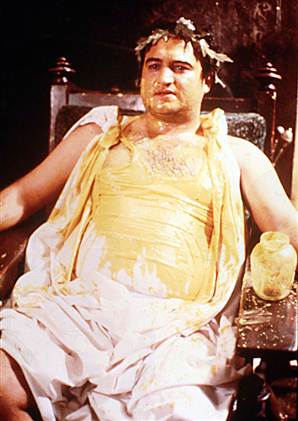
Catholics are shocked, outraged, and so on.
Actually, I think there are a lot of potentially interesting messages one could derive from such a work. A satire of Easter's weird affiliation with candy? A statement on Christians and temptation? (On priests and temptation?) A reflection on the sensuality of spirituality?
Here's my litmus test: Would Jesus be offended? Somehow, I don't think so. So if Jesus can live with it, why can't we?
Robert Sampson
Chair, Dept. of Sociology
Interests include "crime, deviance, and stigma"
(where to start?)

Michael Smith
Assoc. Dean for Comp. Sci.
and Engineering
Involved in the Center
for Research on Computation
and Society
(i.e, pro-blogger, highly qualified
to be dean)
Also: quotes Dr. Seuss on his homepage
Meantime, some new names have cropped up in the race for the deanship. To wit....and in no particular order....
Stanfield Professor of International Peace
Is interested in Brazil

Vice-provost for international affairs
Yale-educated
Recently spoke at "Harvard in Canada," following Drew Faust

Nancy Rosenblum
Chair, Department of Government
Currently working on a theoretical study of political parties
(possibly useful knowledge in an FAS dean)
James Engell
Professor of English and Comp. Lit.
Co-author, Saving Higher Education in the Age of Money
Member, every committee at Harvard
Henry Louis Gates
Director, W.E.B. DuBois Institute,
etc., etc., etc.
Yale-educated,
apparently knows a lot of people
Allan Brandt
Professor of the history of medicine at HMS
and the department of the history of science
Author, No Magic Bullet: A Social History
of Venereal Disease, also potentially useful
for an FAS dean (i.e., the spread of disease/rumor)
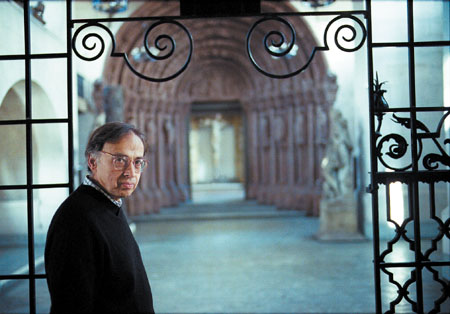
Charles Rosenberg
Professor of the History of Science
Reportedly in bed with president-elect Drew Faust
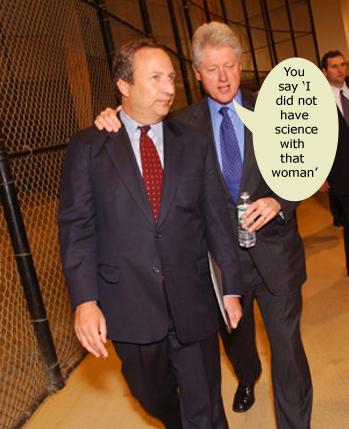
Lawrence Summers
Former Treasury secretary
University professor
(On leave, 2006-2007)
It may be the first smart thing Patrick has done since he became governor.
The Democrat has not exactly impressed to date. He's gotten mired in mini-scandals over his use of government funds to redecorate his office and his phone call to Bob Rubin on behalf of a mortgage lender on whose board he sat.
And he's also been sidetracked by his wife's serious struggle with depression.
For Patrick supporters, it's all been disheartening.
Patrick needs to remind those loyalists that, for all his problems, he could be worse; he could be...Mitt Romney. The former governor's approval ratings were in the low 30's when he left office a couple months ago.
So this move to junk Romney's ideologically-motivated restrictions on stem cell research is a smart one. It's right on policy, and it's right on politics—and it's the first thing I've seen Patrick do that suggests there's a functioning brain in his head.
Let's hope the new governor is beginning to get his sea legs....
First, it emerges that he actually knew that his top cop, the dirtball Bernie Kerik, had ties to a Mob-owned construction company before he nominated Kerik to be New York police commissioner.
Kerik would later cloak himself in glory by bedding not-yet-disgraced book publisher Judith Regan—cheating on both his wife and another mistress—in an apartment near the fallen World Trade Center that was supposed to be used for on-site workers who needed a rest. Kerik had actually solicited use of the apartment from a local real estate firm.
Later, the owner of the apartment crushed a woman to death with his Ford Expedition. What a shock! Police decided not to file charges. The driver, real estate exec Anthony Bergamo, told the cops that he couldn't see her, even though she was directly in front of him when he ran her over.
So that's one Giuliani issue. The other is that he just told the New York Times that if he were elected president, his wife would sit in on cabinet meetings. Even Bill Clinton never said that Hillary would attend cabinet meetings....
Rudi, no one's saying that your wife can't have a valuable role. But no one elected her to the White House...
Giuliani sounds like J. Howard Marshall or Jack Welch—an old man whose combination of lust for a younger woman and fear of the loss of his own virility cause them to abandon all judgment and start acting like silly old fools. Not the best quality in a president.
Is that a capital campaign I smell?
In one of the toughest pieces I've ever seen in the paper, Sam Jacobs and Javier Hernandez report that Skocpol's resignation from the GSAS deanship....
...coincided with what appeared be a wave of uncertainty about her candidacy for the deanship of the Faculty of Arts and Sciences (FAS), one of Harvard’s most powerful posts.
...In recent weeks, the prospect of Skocpol’s promotion has stirred strong opposition among professors advising President-elect Drew G. Faust in her search for a new dean of the Faculty, according to an individual close to the faculty advisory committee and a senior FAS faculty member. The criticisms of Skocpol have caused Faust herself to express skepticism, the individuals said.
Interesting. I haven't sensed this myself, but Hernandez and Jacobs are good reporters, so if they write it, I'll take them at their word.
The only quibble I would have is when they use the term "wave of uncertainty," but base this on the accounts of only two anonymous professors.
All right, not the only quibble. I also think the two overstate their case when they suggest that Skocpol is Larry Summers in a skirt.
To some, Skocpol came to mirror the controversial president that she once opposed, in equal parts praised both for her brilliance as a researcher and derided for her authoritarian and divisive approach to leading.
Judging from what I hear, I'd tone this down. "Derided" is too strong; I've never heard of anyone who doesn't respect Skocpol, and she's never invited the kind of vociferous criticism that Summers attracted. And I'm not sure that it isn't also going too far to say "authoritarian and divisive."
To me, there are two very interesting suggestions in the piece.
First, that Drew Faust has cut Skocpol loose. (Does Drew Faust have a cold streak? Discuss.)
And second, that Skocpol "is considering significant leadership positions at other universities." (Did this come from Skocpol herself? She is not quoted in the story, but neither do Jacobs and Hernandez say that she declined to comment.*) No one is irreplaceable, but her departure would be a real loss for Harvard.
Recently on this blog there was a discussion of objectivity, and I raised my doubts about its possibility. In that context, I wonder if it isn't relevant that this article was written by two men. Consider their description of Skocpol's tenure battle.
Hernandez and Jacobs characterize Skocpol's ascent at Harvard as "defined by controversy." They note that she was denied tenure in sociology, sued, and actually won when a Bok-led "investigation" found in her favor.
One could imagine this framed as a gutsy and inspiring story. It takes courage to fight a tenure fight like that. It's no fun, there are real downsides, and virtually never does the plaintiff come out a winner. More often, her career is severely damaged. Particularly when the plaintiff is a woman, she may be forever characterized as "divisive" and "headstrong," in the Crimson reporters' words. ("Headstrong" is particularly unfortunate, I think—it's insulting and probably sexist. "Oh, she's a headstrong little lady, she is...")
Might two female reporters have presented this episode differently? Couldn't Skocpol's battle also be written up as "courageous," "principled," and "valiant"? After all, Skocpol won, and how often does that happen?
Instead, Jacobs and Hernandez cite only an old quote from sociology prof Harrison White that "it was not a happy story," with absolutely no context. Did White have anything else to add? (For example: "It was not a happy story, because Skocpol was right: the sociology department did discriminate against her.") Was White involved in the tenure battle in some way? Whether he was or wasn't, we should be told that by the Crimsonites.
I'm not saying that Jacobs and Hernandez are wrong; if they report strong anti-Skocpol feeling, then it's there.
But it would be interesting to read a piece about what Skocpol has actually done as dean, before reading the "news analysis" casting doubts on her leadership style....
_________________________________________________________________________________________________________________________
*My mistake: Skocpol did decline to comment, and the article clearly says so.
This can only be seen as good news for Democrats. But it's also good news for Republicans.
The same reason for both: It's a reflection of how unhappy Republican voters are with their current choices. John McCain is being dragged into oblivion by the war; Rudy Guiliani and his wife have been married six times between them; Mitt Romney flip-flops more than a dolphin at Sea World.
In that context, Thompson is as strong as anyone.
But his entry wouldn't address the real issue: Everyone hates President Bush. And no Republican presidential candidate dares acknowledge that truism.
The GOP needs an insurgent candidate—which the party traditionally frowns upon, preferring to anoint the tried-and-true—who can position himself as reclaiming the conservative mantle. And that ain't Fred Thompson; he is an inside-the-Beltway figure if ever there was one.
So I encourage Thompson to get into the race. He won't be prepared for it, not even close, and for any devoted politics-watcher, the inevitable train wrecks are always entertaining.
While it would be premature to predict a US recession, there are now strong grounds for predicting that the US economy will slow down very significantly in 2007. Whether in retrospect 2007 will prove to have been a “pause that refreshed” a nearly decade-long expansion like the growth slowdowns in 1986 and 1995 or whether it will see the end of the expansion is not yet clear.
Tough sledding, eh?
Summers' main argument is that a number of events prophesied by economic naysayers are now coming to fruition: mortgage crises, diminished foreign lending to the U.S., lessened consumer confidence and spending. These and other phenomena could lead to "further downward pressure on investment in plant, equipment, and commercial real estate."
In other words, a recession.
Not much new there; people have been saying this for weeks if not months.
But Summers' more original point is the question of how to respond to such a potentiality—and I wonder if, as he writes, he isn't also talking about events in Cambridge.
Good economic policies operate counter-cyclically, slowing booms and mitigating downturns. It follows that when the dominant risk changes from complacency and overheating to risk aversion and economic slowdown, the orientation of policy must change as well.
Economic policymakers who seek to correct past errors by doing today what they wished they had done yesterday actually compound their errors. They are in their way as dangerous as generals fighting the last war. We do not yet know how much economic conditions will change or whether current concerns will prove transitory. But if recent developments mark a genuine change, let us hope that policymakers look forwards rather than backwards.
In warning of fighting past battles, is he talking about the economy...or is he giving advice to Harvard?
After all, the choice of Drew Faust is generally seen as a response to FAS complaints with Summers, and her leadership style is seen as a 180-degree reversal from his. As Morton and Phyllis Keller write in their history, Making Harvard Modern, the choice of each Harvard president seems to be a reaction to his (now her) predecessor. If that cycle is now coming true again, Harvard needs to be careful not to go too far.
Summers' FT column may be dryly written...but embedded within that dryness is a dramatic warning to Harvard: Don't turn your back on what I was doing. Don't fight the last war.
He's using the economy as an allegory and the FT as a Trojan horse. Clever man!
Only a few more months till Summers is back at Harvard full-time....
Skocpol was widely considered a candidate to replace Knowles, who is serving as interim dean until July 1, but her announcement suggests that she will no longer vie for that post.
Really? Why? That's an important assertion, but it lacks context and supporting evidence. Why, exactly, does the move suggest that Skocpol will no longer vie for the deanship? (After all, we can all think of a certain Harvard figure who said no to one deanship because she was interested in a bigger job.) Tell me more, Johannah.....
Who will be the next FAS dean? Here are the three candidates whose names occasionally drift downwind from Cambridge to Manhattan.....
Theda Skocpol
Gov/sociology prof
Current GSAS dean
Senior adviser at
the Radcliffe Institute
Jeremy Bloxham
Geophysicist,
computational scientist
Dean for the physical sciences
John Huth
Physicist
Chairman, Dept. of Physics
These are the names I hear. What about you?
Just to sweeten the pot a little...let me announce a contest. The first person to correctly guess (i.e., post) Drew Faust's pick for FAS dean will receive from me, in the mail, a silver pen with "Harvard" inscribed on it. (They were giving 'em away at the "Harvard in Canada" conference last weekend.) It's a lovely pen with a Yale-blue grip (I know, weird) and it comes in a nice box with a little red string around it.
Vote now! And when the time comes, e-mail me and identify yourself (we'll have to use the honor system here). I'll send you this top-quality Harvard pen, value at least ten bucks, yours free for the simple matter of being right and being first....
And don't let this stop you from voting, because as am employee of this blog, I can not enter the contest, but...my guess? Jeremy Bloxham.
It could be because your name is similar to a name on a list of suspected terrorists that the Bush administration is circulating to private businesses which, afraid of incurring a government fine for dealing with terrorists, are saying no to any potential customer who even sounds like a match.....
Has it ever occurred to the Bush administration that, in the name of protecting freedom, they are doing far more to destroy it?
Ouch.
The Boston Globe's Bob Hohler exposes the lack of diversity in Harvard's athletic hiring in today's paper, and he's right on target: There's no excuse for the sheer whiteness of the university's athletics coaching and administration.
"We're obviously disappointed that we lack significant racial diversity in the athletic department, in particular at the senior level," said James S. Hoyte, assistant to the president and associate vice president for equal-opportunity programs at Harvard. "The new president has made clear she is very concerned about seeing a more diverse senior management team throughout the university, including athletics."
When did she make that clear, I wonder? At about 4 PM yesterday?
Because chances are that diversity within the athletic administration never even crossed Faust's mind (to be fair, why would the dean of Radcliffe think about the issue?) until a reporter for the Globe dialed her number....
And here's another problem, tucked away within the story:
In the last academic year, the school reported paying its male full-time head coaches an average of $89,614, while female full-timers earned an average of $69,496.
Will Harvard's first female president address the problem of gender-related pay inequity?
Floyd A. Keith, executive director of the Black Coaches' Association, cited Harvard's historic rival, Yale University, as faring reasonably well in fostering racial diversity in its athletic department. African-Americans serve as head coaches of Yale's men's basketball team and men's and women's soccer teams, as well as holding at least one senior administration position.
....In the Ivy League, Princeton is the only other school that has no black leadership in its head coaching or administrative ranks. Princeton also is searching for a men's basketball coach.
Here's a suggestion for the Globe: a three-part series on the lack of racial diversity within the Harvard administration. Who, after all, is the highest-ranking black academic official at Harvard? You have to think about it for a while, don't you?(I think it's Evelyn Hammond, and it is slightly dismaying that the top African-American within the university administration is, basically, the diversity dean, rather than some position that has nothing to do with race...)
Drew Gilpin Faust's appointment as president of Harvard University has seriously dented the academic glass ceiling.
Well, the assumption that there is an academic glass ceiling, of course—the existence of which, given the number of female university presidents in office before Drew Faust came along, seems questionable.
And that's just the start of Drago's problematic argument, in which he alleges that the real sexism at universities pertains to adjunct faculty members.
Recall the 2005 event that triggered Faust's appointment. The university's president at the time, Larry Summers, suggested, among other claims, that relatively few young women were prepared to make the "near total commitments to their work" required of successful academics. He also suggested that men may hold a biological advantage in the pursuit of science and engineering careers. The anger generated by those comments almost certainly contributed to his resignation.
About the biological comment, yes. But Summers' remarks on the challenges of juggling work and family manifested, by his standards, Oprah-like sensitivity, and I don't recall anyone being particularly upset by them.
Drago, a professor of women's and labor studies at Penn State, has a new book coming out, Striking a Balance: Work, Family, Life, which is certainly an important topic. But he loses me when he writes,
...Norms surrounding our ideas about motherhood...[lead] us to expect women to bear and rear children, to take care of the ill, elderly, and those with disabilities, and to do so for low or no pay, and without public recognition.
Without public recognition? Really? Has there ever been a time in history when mothers were more fussed over, talked about, and self-congratulatory than they are now?
What Summers missed are [women's] sacrifices. Indeed, the way he broached the subject of family commitments represented a significant threat to the careers of female faculty members everywhere -- an accusation that women are really "just moms."
In fact, that's just not true. As I recall, Summers detailed the challenges facing women in academia, and suggested that the greatest challenge was balancing work and family. He may not have waxed empathic about the difficulties of being a mom, but that wasn't Summers' topic.
Drago's heart is in the right place, but his solution—a part-time tenure track—doesn't really address the question of how you can maintain Harvard's standards of excellence and make a balanced life viable for women (and men) who have children.
A few things about Skocpol:
1) She is generally thought to have done a good job as GSAS dean.
2) She is considered a candidate for the FAS deanship, and is said to want the job.
3) She has been GSAS dean for two years, an unusually short term.
4) She is a senior adviser in the social sciences at the Radcliffe Institute, and last week gave a talk at its annual luncheon for women faculty, hosted by Drew Faust.....
How does Skocpol's move affect the question of who Faust will chose as her FAS dean? Does it mean that she's willing to walk away from Harvard if she doesn't get the job? Or that she already has another offer? Or just that she wanted to step down and, if she didn't get the FAS post, didn't want it to look like sour grapes by resigning immediately afterward?
Got me. All I know is, the timing is curious and the plot thickens.....
I am writing to let you know that Theda Skocpol has today announced her
intention to step down as Dean of the Graduate School of Arts and
Sciences, effective at the end of this academic year. This is, of
course, unwelcome news to those of us who know first-hand of the skilled
and energetic leadership she has brought to this role, and of the many
improving initiatives that she has launched to strengthen the Graduate
School.
Since becoming Dean in July 2005, Theda has arranged for virtually all
graduate students in the humanities and the social sciences to receive
dissertation completion fellowships, she has helped to institute a new
innovation prize and seed grant program to honor and reward improvements
in graduate education, she has launched secondary fields for those in
Ph.D. programs to promote interdisciplinary research, she has created
the Graduate Policy Committee to involve faculty in the formulation of
GSAS policy, she has overseen the move of the Graduate School from
Byerly Hall to Holyoke Center, and she has encouraged coordination
amongst our science graduate programs. Her well-known zeal for
gathering and sharing data, her outreach to departments and centers, and
her gently unambiguous approach, have made the assessment and
improvement of our graduate programs and policies both more transparent
and more successful.
Most recently, Theda has served as chair the Task Force on Teaching and
Career Development, which issued in January a “Compact to Enhance
Teaching and Learning at Harvard.” She also served as a member of the
Harvard University Planning Committee for Science and Engineering. In
these, and many other ways, she has made important contributions to the
Faculty and to the University, as well as to the Graduate School.
I must now, for the benefit of my successor, begin to gather your
thoughts on the challenges and opportunities ahead for the Graduate
School, as well as your confidential suggestions of colleagues who might
succeed Theda as its dean. I trust that you’ll write to me in the
coming weeks about these matters.
With my best wishes and thanks,
Yours sincerely,
Jeremy R. Knowles
_______________________________________________________________
I'm no Katie fan, so I'm kind of enjoying this moment. But I will say that she probably did the Edwardses a favor by asking very difficult and blunt questions. (Though I agree with critics who slam her for repeatedly using the "some say" construction. It is lame.)
I do think that a big problem for Couric is the amount of botox and plastic surgery she's had in order to look wrinkle-free on hi-def TV. She can no longer move her muscles into a sympathetic expression....
The timing of this announcement is interesting: Kagan recently lost the presidency to a woman whose ability to raise large sums is uncertain.
That $25 million gift, by the way, is about 50% larger than the entire endowment of the Radcliffe Institute.*
It's possible to consider this gift as another show of support for Kagan. (The first, a week or so after Faust was named, came in the form of a party thrown by law students in her honor.)
Faust is said to have terrific relationships with Radcliffe alums, but one of the question marks about her announcement is how the mega-rich finance guys like Wasserstein will respond to her.
Rumor has it that the development folks are worried....
______________________________________________________________
* Mea culpa: A poster points out an egregious mistake on my part. The Radcliffe Institute endowment is more like $400 million; it's the annual budget that's about $15 million.
Here it is:
Econ prof Greg Mankiw
Jeffrey Nesson's cyberlaw blog
John Palfrey's Berkman Center blog
Jonathan Zittrain's blog (arguably doesn't count, as it is Oxford-branded)
Toby Stock's HLS admissions blog
The Kennedy School Library blog (last updated, last November)*
That's six. Blogs. At Harvard.
Surely there must be more. (And in fact there are.)
Just out of curiosity, I Googled "Stanford university" and "blog" and got a ton of relevant hits—and the blogs there are really interesting.
For example:
The World Association of International Studies economics blog
The Stanford University Libraries Blog
The Stanford Social Innovation Review blog
A whole bunch of blogs at Stanford's Center for Internet and Society
Lawrence Lessig's blog
The Stanford University Press blog
A whole bunch of blogs at the Stanford School of Medicine
I could go on and on, but you get the point. The institution of the blog seems to have taken deeper root at Harvard's west coast rival than it has in Cambridge.
Why are so many more people blogging at Stanford than at Harvard? Is it because Stanford appreciates the Net in a way that Harvard does not? Because Harvard's professors are older than Stanford's and don't get this newfangled technology? Is it because Harvard doesn't foster a climate where the free exchange of opinions and ideas is encouraged, but is instead discouraged and punished? Is it because Harvard's culture resists change?
Not to pat myself on the back, but why is it that the most topical blog about life at Harvard is written by someone who neither goes there nor works there?
_______________________________________________________________
* A poster informs that the Kennedy School library blog can be found here, and has been recently updated. Thanks for the info.
Elizabeth Edwards said of their choice to continue campaigning: "You have tow choices. Either your push on with your life...or you start dying."
Tough stuff.
Katie Couric did not impress so much.... She comes across as cold and callous.
To be fair, Couric lost her husband to cancer, and I highly doubt that she is insensitive to the Edwardses.
My guesses? One, she's trying to look like a serious newsperson, and show no signs of bias because of her own loss.
Two—and you can judge this one for yourself—She's had so much work done to her face that she can't actually look sympathetic.
Elizabeth Edwards, by contrast, has aged, and has wrinkles. Somehow, though, she looks much more beautiful than does Couric.....
Japan claims that its whaling is for "scientific" purposes, but has not explained what scientific knowledge is gleaned from the carcasses of over 500 whales, which are instantly carved up to be sold in Japanese supermarkets. (Under a government subsidy, by the way.)
Until Japan stops its massacres of whales and dolphins, consumers should boycott Japanese-made goods.....
It even has a link to a page featuring campus blogs....such as "A Yankee Fan Living in Boston."
Brown is following in the wake of the high-profile and highly controversial John Silber, Bombardieri points out.
See if this sounds familiar...
Brown, many observers say, is trying to be the un-Silber, transforming the university's culture so that faculty, students, and alumni feel that their opinions are heard and they have a stake in the university's future. Former president John Silber took BU to new heights of success, but was accused of sowing fear among faculty and ignoring concerns of students and alumni.
Not all professors are yet convinced, but here's one idea that a certain other university across the river might want to consider.
Under Brown, BU created a blog inviting feedback on the university's goals....
So far, I have heard of only two Harvard professors who write blogs. By contrast, when BU Today asked members of the BU community to submit nominations for best campus blogs, they got 150 nominations. What does this say about the popular willingness to speak freely at Harvard?
I feel about this the way that the Crimson feels about poor attendance at faculty meetings: There's just no excuse.
So here are some questions I'd like to hear Drew Faust's responses to:
1) As a historian, you depend on free and unfettered access to historical documents in order to pursue your scholarship. Do you support the Corporation's 50-year-rule, which keeps secret the records of the Corporation for 50 years after they are created?
2) Do you support the ouster of students from Massachusetts Hall?
3) Do you believe that blogs are an important part of creating a forum for intellectual discussion and debate at Harvard? Do you read any blogs, and if so, which ones? Would you create a blog similar to the one Robert Brown has created at Boston University? And what measures would you recommend to your incoming FAS dean to encourage Harvard faculty to write blogs of their own?
—Dashka Slater, in the first sentence of her Salon story, "It's all fun and games."

Whoops!
Here's a question: Can a Republican presidential candidate succeed when his personal life is a farce?
Maybe it's the way the Times describes the cancer as "incurable but treatable."
Maybe it's because breast cancer has struck two members of my own family, and the mother of a close friend is fighting it even now.
And maybe part of it is that the Edwards family has always struck me as particularly decent and warm and loving. They just seem like nice people, and I can't help but feel for them.
This is a family that has already endured tragedy. Let us hope they don't have to again.
The Edwardses, by the way, are the 2nd family in this presidential race in which one spouse has a very serious illness; Ann Romney has MS, and how campaigning could affect her health is a real question for the Romneys.
If there is any silver lining here, it is that perhaps these circumstances will bring some added attention to these illnesses, and maybe even introduce elements of humanity and humility into this presidential campaign.....
“It was a very plausible decision at the time, but on reconsideration I was delighted to stay,” Stone said. “You make decisions based on your latest information.”
I think you can chalk this up as a wise move on Faust's part.
In my experience, Stone has not impressed; in my dealings with him, he's been—how can I put it?—shadowy.
On the other hand, a number of people whose opinion I respect say that Stone is really talented and a huge asset to the university. They tell me that he really does excellent work with community relations and that he's a savvy adviser to the university's higher councils.
So with that in mind, I think you have to consider this a third consecutive smart personnel move by Drew Faust. The consensus opinion seems to be: Good move to keep Steve Hyman, good move to let Donella Rapier go, and Alan Stone is important to keep on to help with the transition, if not beyond.
Which indicates something interesting about Faust, I think: She doesn't feel an inherent need to "shake up" the university, which was one of Summers' mandates from the Corporation. She's making her decisions on a case-by-case basis. Smart. There's still no sign of her doing anything bold, but perhaps when the appropriate time comes, we'll see that.
And it's also possible that boldness is overrated....methodical, steady progress could be just what Harvard needs right now.
Clarification: The March 15 news analysis "With Book on Horizon, Summers Sharpens His Critiques of Harvard and its Faculty" did not completely represent the former University president's views on the undergraduate curricular review. He also said in an interview after the speech, "Much of it reflects things that were my focus during my presidency," and praised half a dozen initiatives, including faculty-student contact, the empirical reasoning requirement, the attention to pedagogy, secondary concentrations, and the emphasis on actual knowledge rather than ways of knowing.
Hmmmm. I wonder what former university president called up Seward and reamed him out?
I love that line, "Much of [the curricular review] reflects things that were my focus during the presidency," which rather conveniently ignores what a disaster the review was during Summers' presidency, and how it only began to cohere once he was gone.
I keep thinking, though, about one line in that speech, as reported by Crimsonite Zach Seward.
Pedagogy was a key theme of Summers’ speech last night. He said that while other universities constantly attempt to poach accomplished researchers from Harvard, “I can’t recall a single case when an effort was made to raid Harvard for a candidate who was an outstanding teacher.”
Summers' general point (I think): Harvard professors aren't outstanding teachers. To be fair, it could also be that universities don't hire away other universities' profs based on their teaching skills. But in the context of the news story, it sounds like Summers is saying the former.
In any case, the suggestion that Harvard profs stink at teaching is a bold claim. And while it may be broadly true—I just don't know—there is one dramatic exception: Cornel West.
You will remember West, who was summoned to Mass Hall by Summers in the fall of 2001 and asked to justify his political views, his spoken-word recordings, and more.
West was one of Harvard's most dynamic and popular teachers. But, as Summers pointed out, West hadn't written a deeply scholarly book in several years. (His recent books were more popular.)
For Princeton, that wasn't an issue. Upon hearing that West was deeply unsettled from the encounter, Princeton, which prioritizes undergraduate teaching, successfully lured him away from Harvard. Why? Because West is an inspiring presence on campus and a great teacher. (Whose CUE Guide ratings, by the way, were higher than Summers' were when he was first a Harvard professor.)
Now, I can understand why Summers would omit this glaring example, and maybe West is the exception that proves the rule.
But if Summers is really going to write a book on these issues, he needs to confront some of these contradictions. Sometimes great teachers are not great scholars—it is very rare to find someone who is both, there is only so much time in the day—and sometimes great teachers are unusual personalities.
Perhaps it is even time for Summers to admit that he was wrong about Cornel West.
Now the Boston Globe has done a piece about a Brazilian woman who is trying to make the housecleaning business more equitable.
Coincidence? Or...was this woman inspired by Drew Faust's example?
"It is too small and doesn't have enough critical mass," says Harvard College dean Dick Gross.
Huh?
The truth, of course, is that the presidency is expanding, and when bureaucrats want offices, students become expendable.
Jeremy Knowles—clever man!—tries to lay the blame for this anti-student move in Larry Summers' lap....
“I believe that if President Summers had remained in post, the intention was that Mass. Hall would have been renovated for the administration during this academic year,” Knowles said.
....but I wonder if Summers, so careful to present himself as pro-student, would have committed such a symbolic blunder.
Harvard students, I have one word for you: sit-in.
(What, did you think I was going to say "toga!"? Although, now that I think of it—a sit-in with a toga party, nonstop....)
And where does Harvard's new president stand on the abrupt termination of a grand Harvard tradition?
Al Gore has spent seven years after the White House doing good works. Assuming that Dick Cheney lasts that long, does anyone believe that he'll actually do anything socially beneficial? Or will he instead spend the rest of his days trying to justify the war he instigated?
Anyway, Mark Leibovich and Patrick Healy team up to write a nice piece on Al Gore's visit to Congress.....
Healy, you will remember, got his start covering Harvard for the Globe....
The only problem is, he seeems to have adopted that sage-but-reasonable tone of ombudsmen everywhere.
For example...in his first column, he picks a juicy topic: an article about students who participate in medical experiments, which highlighted one particularly curious example of a student forced to live in a room in Mass General for five days with "dim, unchanging light."
The ombudsman, an HLS student and former reporter named Michael Kolber, sniffs a rat .
Kolber points out that the student says he was paid $250, or $50 a day, for his participation, which is obviously absurd, if only for the reason that when you figure what it costs him to go to Harvard for five days, he (or his parents, anyway) would be losing a substantial amount of money. Which would make the student in question an idiot, who therefore could not have gotten into Harvard.
Kolber called the student, who answered evasively and then hung up the phone.
Kolber writes:
The trouble with the article is the complete credence The Crimson gave to a story that had some fairly far-fetched sounding elements. The reporter should have attempted to contact the hospital or the researcher to verify the story.
At minimum, the story should have contained some context for the experiment, perhaps a doctor discussing the potential health impacts of repeatedly being a test subject. Or, The Crimson could have discussed the review process that all experiments involving human subjects must undergo.
The reporter did none of this, nor did his editors ask him to.
Well...yes. But no. The trouble with the article is that this part of it is obviously complete bullshit. Kolber should have explicitly stated his concern that this anecdote is fraudulent. Obviously, I think it is, and I suspect he does too. Doesn't the ombudsman have the obligation to come out and say that he thinks a story is fake?
_______________________________________________________________
P.S. As a favor to the new ombudsman—because that's the kind of blogger I am— I offer this constructive suggestion: When critiquing a specific article, add the relevant hyperlink to the online version of your column so that readers can read the article in question....
In the Philippines, the United States won with relatively few casualties. A little more than three years after the start of the war, President Theodore Roosevelt could declare victory and, unlike George W. Bush, not be undercut by a continuing insurrection. America succeeded less by waging war and more by waging politics, politics that co-opted much of the Filipino population and isolated the revolutionaries. That victory offers a central lesson for our current involvement in Iraq: Counterinsurgency is less about conquest and more about persuasion.
It's a fascinating piece, and it suggests that a crucial difference between the two conflicts is the men in the Oval Office. GWB, in short, is no TR.
It also suggests at least one disturbing continuity: the use of torture. Now, we water-board. Back then, we used the "'water cure'—in which a captive was forced to drink gallons of water and then vomit it back up...."
And, of course, it raises the question of whether either war was really necessary....
I still don't think that we've yet heard the true story of what really happened with Kaavya, though.....
Faculty members are eager to ensure students are required to take their classes but show considerably less interest in encouraging quality teaching. Or at least that’s the message being sent by professors in the Faculty of Arts and Sciences (FAS), who turned out in droves to make sure their department’s classes had a place in the new general education system, but who last week failed to even show up to talk about a much heralded report on pedagogy. Such apathy from professors is appalling.
The Crimson has this partly right: Many professors probably are quick to blow off a meeting to discuss pedagogy, especially one where nothing's going to come of it.
But isn't there more to the issue? A poster on this board raised the issue that faculty meetings have become less substantive because that's the way the central administration wants it, and as a result faculty members have become less engaged, and thus more likely to skip faculty meetings.
This strikes me as a serious argument which the Crimson dismisses too hastily. (The paper seems to have an affinity for centralized power, probably because Larry Summers presented himself as a student advocate and probably because it's easier and more interesting to cover.)
Truth is that the faculty's recent assertion of power—ousting Larry Sumers— was notable not because it was representative of the course of power at Harvard, but because it was exceptional. The last half century has seen a steady decline in the power of the faculty and a growth in the power of the Harvard presidency and various anonymous bureaucrats. It's easy to bash the faculty, but the real culprit may be the increasing bureaucratization of the university....
__________________________________________________________________
* I am now bracing myself for the inevitable Crimson "how dare you say such a thing?" protests.....
According to a chart in last week's Pentagon assessment, the number of "Trained Iraqi Security Forces" now totals 328,700. A disclaimer noted that "the actual number of those present-for-duty soldiers is about one-half to two-thirds of the total due to scheduled leave, absence without leave, and attrition."
Hilarious, if it weren't so Orwellian. How can you count a soldier who's left due to "attrition"? (Apparently, without blinking an eye.) Next thing you know the Pentagon will modify that statistic to include soldiers who are, in fact, dead.
But here's a more meaningful statistic: estimates of the number of Iraqi civilians killed in the war range from 21, 000 to 60,000 to 600,000. It would seem an important number to know. Doesn't our seriousness (or lack thereof) about quantifying—and minimizing—this statistic reflect the nature of the war itself?
Ain't the Internet grand?
_______________________________________________________
P.S. What's with that weird fire warning? "Once outside, please move away from the building...."
P.P.S. Lawrence Bacow, in his introduction: "To the current generation of Harvard students, Larry was a beloved president."
And so history takes shape....
Reporter Rachel Pollack apparently came into possession of a Harvard report on a new system of advising undergraduates.
The report says advising could vary significantly between Houses, resident deans may be overburdened with other responsibilities, and the House tutoring staff might need to be reorganized.
Nothing scandalous, right? Just a little honesty about the potential liabilities of the new system.
But the Harvard administration finds the disclosure of such candor threatening....
Presented with the report in an interview with The Crimson, Associate Dean of Advising Programs Monique Rinere asked to see the original document several times, then refused to return it.
FAS spokesman Robert P. Mitchell, who was present at the interview, said at the time that Rinere had the right to keep the document because she said it originally belonged to her. According to the report, one option under consideration was to hire a new residential dean for each House assigned exclusively to first-semester sophomores. This plan was eventually abandoned, perhaps for its cost; in total, the College would pay an estimated $1 million in salaries.
Oh, dear. You people....
Okay, here's what happens now.
Dean Riners, you make a personal apology to the Crimson, saying that you were caught off-guard and you overreacted. (This is a really cool thing—it's called "the truth.")
Then you sit down and give the paper an honest interview in which you say, look, advising is a really tough challenge, everyone knows that, and we think this new program is a good approach, but we also want to be fully prepared for anything and everything that can go wrong. This report doesn't mean that those things will happen, it means that we take every possibility seriously enough to examine it in writing, because we think that's the best thing for the students.
Robert Mitchell...first, untie the knots from your tongue. Then report for your new job with Alberto Gonzalez.
Honestly, Harvard—Larry Summers is gone. (Well, kind of.) You don't have to act like this any more....
Jesus, you people are sick.
And lest you think it's just our scary brethren to the south pushing such anti-female legislation, similar laws exist in...well...other Southern states.
Pro-choice advocates often want reporters to ask anti-abortion Republicans the question, "If abortion is murder, how should women who have abortions be punished?"
Because it's a trick question and all, designed to make these candidates look heartless, which, to be sure, they generally are.
Seems to me that such laws are the answer to the question—except that they're actually trying to punish a woman before she has an abortion; to suggest that, simply for considering that option, she's a shameful person who hasn't for a second considered the implications of that decision.
Sometimes you wonder if the (almost invariably) male lawmakers pushing such legislation have actually ever spoken to a woman who's had an abortion. I know a few, and for every single one of them, it was an excruciating, agonizing decision, one that they knew would live with forever. Women making that decision casually? I'm sure they exist—statistically, they'd have to—but that has to be a tiny minority.
And then, of course, there's always the simple—but to me, incontestable—truism that if it were men who got pregnant, this wouldn't even be a discussion.
The debate about abortion isn't really a debate over human life; it's simply a fight over power, and whether men will continue to enjoy the dominion over women's bodies that they have possessed throughout history. As is usually the case with fights over power, morality is merely the wrapping paper.
Now Brad Delp, the lead singer for the band Boston, has also committed suicide. He locked himself inside his bathroom with two gas grills, apparently on but unlit. A note he left behind read, J'ai une ame solitaire. I am a lonely soul.
Lonely enough to translate, just to make sure whoever read it would know.
Lines from stories about his death are unintentionally poignant.
A lifelong Beatles fan, Delp also played with the tribute band Beatle Juice....
Why is that sad? Because for a while there back in the late '70s, Boston was huge. Founded in the mid-70s by Tom Scholz, an MIT engineering student who worked at Polaroid, the band restored the vitality of arena rock at a time when disco and punk were ascendant and rock icons like the Stones and Led Zeppelin were starting to suck. Their first album, Boston, came out in 1976 and, well, it rocked. (It also sold 17 million copies.) It is humanly impossible not to listen to Foreplay/Long Time without wanting to sing along and wave a lighter over your head. Don't tell me you don't remember.....
Well I'm takin' my time, I'm just movin' on
You'll forget about me after I've been gone
And I take what I find, I don't want no more
It's just outside of your front door
It's been such a long time....
It's easy to make fun of Boston now; they certainly had their Spinal Tappish qualities. The eponymous first album, cheesy graphics, control freak songwriter, synthesizer intros, prog rock overtones, record company lawsuits, replaced drummer, intra-band fighting.... And the scary thing is, I could go on.
But why make fun? I'd prefer to remember how great it was to hear those opening notes of Long Time, even on an eleven-year-old's clock radio, or the power chords of "More Than a Feeling".... Go back and listen to that first record. It is still surprisingly good, and far better than most of the generic corporate pop the music biz currently churns out.....
If my reading of Seward's article is correct, Summers' appearance should generate far more controversy at Harvard than at Tufts.
Seward notes that there is also a long Harvard tradition of deposed administrators taking up the role of pesky gadfly.
That may be true, though I don't know Harvard history well enough to say so. (Citing Harry Lewis hardly constitutes a long tradition, and I wonder if it wouldn't be more accurate to call this a "recent phenomenon.")
But whatever is the case with "deposed administrators" becoming gadflies, there is no precedent that I'm aware of for a former president directly criticizing the Harvard faculty.
When Derek Bok left the Harvard presidency in 1991 and took an office in the Kennedy School, he made a scrupulous point of not speaking out on current Harvard affairs. It was unfair, he thought, to his successor, to have the old president lingering on campus and making life difficult for Neil Rudenstine.
Larry Summers is clearly not going to follow that model.
As Seward tells it, Summers...
...criticized the Harvard faculty and the curricular review.
“When university faculties are unwilling to take a stand on what constitutes the undergraduate experience for students, on what, if anything, somebody needs to function in today’s world, they license a position that all ideas are equally valid,” he said.
...criticized the final General Education report, saying...
“I would have liked a somewhat better defined sense of what the crucial issues were that students needed to grapple with, and I would have welcomed a deeper commitment to faculty-student contact.”
...criticized Harvard professors' teaching ability, saying,
“I can’t recall a single case when an effort was made to raid Harvard for a candidate who was an outstanding teacher.”
Well, he does speak his mind, doesn't he? (There's more in Seward's article.) I'll have some thoughts on the specifics of Summers criticisms, but all I can say is that if this is going to be Summers' approach to his post-presidency, then look out, Drew Faust!
Things around 02138 just got a lot more interesting.
The other day, I clicked on a Times article. Above it was a banner ad for General Electric's "Ecomagination." A small frog was perched on the corner of the ad. As soon as the page filled, the frog hopped across the screen and perched on the first paragraph of editorial type. Eventually it hopped back, but still...infuriating.
You've probably seen variations on this—new pop-ups that superimpose themselves over text and won't go away till they're clicked, shadow ads that bounce back and forth across the page like the ball in Pong; ads that speak to you, not when you click on them, but when you load a page. I just saw an ad that deliberately obliterated one line of a paragraph of an article and only moved after I clicked a forward arrow on my browser.
As web ads get more aggressive and invasive, the editorial experience deteriorates. Articles are obviously harder to read; but more importantly, the distinctive and important separation between editorial and advertising becomes blurred in ways that old media types don't really get. (It's the 20-somethings who are creating these web pages, and the ads that corrupt them; the Bill Keller types are, I'm sure, clueless.) Ultimately, what we're heading toward is some Internet version of product placement, except in news articles rather than half-hour sitcoms.
So many media companies are now depending on the Web to attract readers and improve their bottom line. But this is a sure bet to scare readers away.
The review itself is pretty entertaining, especially when you consider that the writer is not known for, um, frequenting such establishments. "Great food often pops up where you least expect it," Bruni writes. I'll bet.

An employee of the
Penthouse Club.
Anyway, today the letters are in, and they range from pretty funny—one correspondent asks if they deliver—to huffing and puffing.
Here's the latter—see what you think.
To the Editor:
I write with distaste concerning Frank Bruni’s review of Robert’s Steakhouse, located in a strip bar. Stripping and the sale of sexual services arise in a world where privileged men can freely buy and sell female bodies, and where women have limited economic choices. It involves constant hustling, even in the “best” clubs.
This form of “entertainment” flourishes in the inequality of power between men and women, and sexual selling relies on women fitting themselves into the stereotypes that attract and flatter male clients.
One wonders, would Mr. Bruni be willing to sit through a minstrel show for some really good fried chicken?
Pamela Rubin
Halifax, Nova Scotia
The writer is the coordinator of the Women’s Innovative Justice Initiative.
I was all prepared to write this letter off until that last sentence when I thought, hmmm, maybe she has a point there. But then there are those people who say that stripping is an economic good for these women, free speech advocates who say it's a right, and feminists who talk about the positive power of female nudity, etc., etc.Me, I like a good steak, but I have never been to the Penthouse Club. A writer friend of mine did, once, but on an expense account. Which only goes to show that, sometimes, I wonder why I chose to write about higher education.
Anyway, it's worth checking out the letters. There's also one about whether Whole Foods is straying from its roots, which is probably important for you Cambridge folks.
Well, if you're a billionaire, nothing!
It's been eight months since Harvard donor Jeffrey Epstein was accused of the above, and according to the Palm Beach Post, for some strange reason, law enforcement types are dragging their feet.
Nearly eight months after Palm Beach tycoon Jeffrey Epstein was charged with felony solicitation of prostitution, there has been no discernible progress in his case. No witnesses deposed. No trial date set. Nothing, save for routine court hearings reset without explanation.
"Usually that would be unusual," said criminal defense attorney Glenn Mitchell, who has no involvement in the case.
One of Epstein's lawyers is, of course, Harvard's own Alan Dershowitz, one of whose first moves in the case was to attack the credibility of one of the young girls in the space by pointing out that, on her MySpace page, she admitted to smoking pot.Way to go, Dersh! Because, of course, any teenager who smokes pot is automatically a liar. Whereas billionaires who pay your exorbitant hourly fees always tell the truth.
Some observers suggest that this is all a prelude to a plea bargain in which Epstein will get counseling, which sounds like a pretty good idea, actually. But is that what would happen if you had, say, a bus driver who'd paid young girls to do the exact same thing?
Just a month ago, professors packed into University Hall to discuss the final report on general education. Yesterday, at the Faculty’s first chance to hold a formal discussion on this winter’s undergraduate-teaching report, professors addressed a half-empty room.
The Crimson op-ed page has strong feelings about attendance at faculty meetings, and this lede suggests that that feeling has carried over into the pages of the news. (Wouldn't be the first time that's happened at the Crimson.)
Nonetheless, the paper is right to suggest that the report on teaching has been "overshadowed" by recent events at Harvard, and that's too bad—its recommendation that faculty salaries be linked to the quality of their teaching would make for a radical and welcome change at the university.
The fate of this report really depends on incoming president Drew Faust, who was at the meeting yesterday.... If she decides to press for it, her support would make a huge difference. But pushing for the report might alienate some members of FAS, which is her political base. This will be an early test of Faust's willingness to challenge her most supportive constituency—and possibly to demonstrate that, as president, she won't be in anyone's pocket.
If she lets the report slide into oblivion, then those who fear an FAS run rampant will have more evidence for their argument...
...Some students said they think the new regulations have done little to change student behavior. Erin Frey ’08 said students drink just as much as they used to, but it simply takes more effort to find ways to do so.
“The amount of drinking hasn’t changed — just the amount of steps we have to go through to have a party is annoying,” she said. “[It] hasn’t changed how people drink or don’t drink.”
I know it's difficult to argue for heavy drinking on college campuses. But I will! I've always felt that excessive drinking, for most students, is a great way to get the exuberance of youth out of their system in a relatively harmless fashion. It's like burning your hand on a hot stove—once you've done it....Although it is, now that I think about it, more fun than burning your hand on a hot stove.
Plus, it creates any number of humorous memories for later life, and probably inspires warm feelings towards the university where said drinking took place, which can only be good for alumni giving.
Why do you think they have open bars at reunions?
Granted, some people get hurt drinking, and some people do stupid things. But we can't entirely legislate such behavior away, and I'm not entirely sure that we would even want to... Modern college students are automaton-esque enough as it is. Let 'em do some stupid stuff. They'll learn from it.
"As an individual, I would not want (acceptance of gay behavior) to be our policy, just like I would not want it to be our policy that if we were to find out that so-and-so was sleeping with somebody else's wife, that we would just look the other way, which we do not. We prosecute that kind of immoral behavior," he said.
Pace, a native of Brooklyn, N.Y., and a 1967 graduate of the U.S. Naval Academy, said he based his views on his upbringing.
I find this last part particularly interesting: Pace doesn't justify his feelings on grounds of public policy or anything else ostensibly rational; instead, he feels that way because of his "upbringing."
This seems a highly subjective, inherently irrational way to determine feelings about national policy that affects the security of our country.
Also interesting, there appears to be a generational shift developing between the generals like Pace, who grew up bigoted, and the current members of our armed forces.
The Washington Post reports on a new Zogby poll...
...of 545 U.S. troops who served in Iraq and Afghanistan. Three quarters said they were comfortable around gay men and lesbians; 37 percent opposed allowing gays to serve openly; 26 percent said they should be allowed, and 37 percent were unsure or neutral.Of those who said they were certain that a member of their unit was gay or lesbian, two-thirds did not believe it hurt morale.
Seventy-five percent say they are comfortable around gays and lesbians! And this is the military, not exactly a hotbed of social radicalism.
I imagine that what is happening is exactly what you'd expect to happen: That when bad guys are trying to kill you, you're all in it together, and who a person wants to sleep with is a lot less important than that person's ability save your life.
That's right—the office which is supposed to distribute news about Harvard actually promoted an article from the newspaper published by...the Harvard News Office. That's what student tuition money is paying for....
It's a wonderful example of how some parts of the university don't reflect the values of scholarship and academic inquiry upon which the university is based.
The magazine has a hideous painting of Barack Obama on the cover, and its controversial article alleges that Dick Cheney's intelligence may have been affected by his heart problems.
Gee, an article saying that Dick Cheney isn't the brightest bulb in the book. That would have been controversial, oh, back in the 2000 presidential campaign.
You know what would be controversial now? Seriously. An article, written in the context of Cheney's recent health problems, saying that it would be good for the country if Cheney died. (Bill Maher recently made pretty much this argument on his terrific HBO show.) But that would take some real guts, which TNR doesn't have.
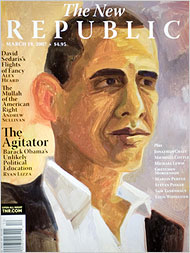
Really grabs you, doesn't it?
Oh, and the magazine has a "gentle 'gotcha'" about David Sedaris, and pieces by Michael Lewis on "a post-Katrina visit to his childhood vacation home in Mississippi" and Andrew Sullivan trashing D'Nesh D'Souza's new book, which blames the American cultural left for 9/11. Not exactly a sacred cow.
There is nothing brave about this. It's basically just the usual suspects in a slightly different wrapper.
Having said that, at least TNR is trying to do something serious. I don't think they're going about it in the right way, but at least they recognize that we are living in serious times.
The New York Post reports on an editorial meeting at the magazine, Radar, in which the conversants discuss staging a photo shoot on "homemade porn."
"It should say 'amateur' on the top," suggested one helpful staffer.
"We should definitely get models who are really hot," said another.
Another scribe proposed they use "all beautiful girls and just one really ugly guy." A voice resembling that of photo director Greg Garry supported the notion of using models instead of regular people - because "porn people are ugly. They are, like, really average."
"No, they should definitely be hot," [editor Maer] Roshan agreed, ordering someone to "look at Details. See what they're doing."
I like Maer Roshan, but honestly...who could possibly care? Radar is a magazine that reflects the shallowest aspects of our culture at a time when we want just the opposite from magazines....The football player who created the group insisted that he had no "racist intent." Not everyone agreed.
The USC players insist it was all just a misunderstanding....
The legislation would then go to the Senate.
In terms of the national consciousness, this is a very small move. In terms of national memory, it's a hugely important one.

He now admits.....
Is this the first presidential campaign when the Democrats are actually more upstanding family-values types than the Republicans? Newt's had affairs...Giuliani's had at least one...McCain has had several....
This time around, shouldn't the family-values types vote for the Dems?
It's either that or Mitt Romney...
Soon, we will get back to the highbrow stuff. Promise.
Gisele: The stork paid a visit.
—Katie Couric at the 92nd Street Y
And a good thing, too...because, for $15 million a year, those ratings aren't so great.
Such barbarism by Japanese "fishermen" stains the image—and the conscience—of a great nation.
Obama claims that he had around $100,000 to invest because of cash from a book deal, and that because the amount wasn't very large, he decided to invest in something "more high-risk."
Uh-huh. Because that's what small investors do.
"I thought about going to Warren Buffett, but I decided it would be embarrassing with only $100,000 to invest to ask for his advice," Obama quipped.
Ouch. Senator Obama—presidential-candidate Obama—might want to consider that most Americans would love to have $100,000 to invest...and that even if they did, they wouldn't exactly be able to get Warren Buffet on the line.
But here's my favorite whopper of the story:
The Senate Ethics manual has detailed rules about blind trusts and qualified blind trusts. Obama did not want to sign on to either of those options because he did not want to wash his hands of the responsibility of investments made in his name, attorney Robert Bauer said.
Oh, I see—so Obama didn't conform to Senate rules because wanted to be more ethical about his stocks. That must be why he started pushing for federal money for avian flu treatments just weeks after investing in...a company that makes avian flu treatments.
Meanwhile, TheStreet.com analyzes Obama's stock portfolio and finds that he invested in both his donors' companies at a time when they were about to receive significant infusions of cash from the federal government, much of it from no-bid contracts related to Homeland Security work. The website also reports that Obama has announced that he invested more than was originally reported—not less than $50k, but between $50 and $100k.
The plot thickens.
According to FoxNews.com,
The noises play a similarly important role during mating season when males sing long, low-pitched songs to indicate their reproductive fitness to females. Females select mates based on size and estimate that by evaluating males' songs: Larger males can take in more air and hold notes longer.
How cool is that? Pretty cool. But wait—it gets even better.
A related study, also by Scripps researchers, found that there are distinct "dialects" of whale-speak in different regions of the ocean.
In other words, whales in different parts of the globe speak different languages.
In my lifetime, I bet, we'll be able to understand what those whales are saying to each other, and maybe recreate their sounds so that we can communicate with the animals. I wonder if the first thing they'll say is, "Why do you want to kill us?" Or, perhaps, "What have you done to this planet?"
However beleaguered, Cheney will not resign over the president's refusal to take his advice. The only force that could drive him to that dramatic step would be that unshakable sense of loyalty to Bush, who desperately now needs a vice president in stable physical, emotional and political health. That is the equation you want to be watching.
I'm not so sure. Cheney's pretty damn stubborn, and he likes the perks of power. Hell, he likes power.
My guess would be that they'll have to drag him out of the Oval Office—I mean, the White House—pretty much like the horse in Animal House.
Hmmm. A total non-issue? Or the early signs of an ethically casual approach to financial matters?
On the one hand, the Cambridge parking enforcement people are from hell. On the other hand, even by Cambridge standards, 15 unpaid tickets is kind of a lot...and they were only $5 each, at the time.
As the Yale Daily News reports,
At the Feb. 21 service, a few dozen students, faculty, administrators and members of the New Haven community gathered in the Divinity School Quadrangle to reflect upon the role of Christians in a nation that, student organizers said, is increasingly secular and whose government systematically violates its citizens’ rights. In lieu of the traditional ashes that are prepared by burning palm leaves, the attendees burned copies of the Ten Commandments and the Bill of Rights and marked each other with the ashes to symbolize the abandonment of the principles set forth by the documents.
The usual suspects are up in arms.
Me, I'm glad to see any signs of spirit in this country. Four years at war now, and everyone seems more concerned with having enough money to buy flat screen TVs on which to watch American Idol.....
In December 1989, one month after the fall of the Berlin Wall, President George H. W. Bush and Mikhail Gorbachev met in Malta and, in the words of a Soviet spokesman, “buried the cold war at the bottom of the Mediterranean.”
The Russian transcript of that momentous summit was published in Moscow in 1993. Fourteen years later American historians are still waiting for their own government to release a transcript.
Fourteen years! Why, that's outrageous.Except...oh....wait...that's actually 36 years fewer than it would take to gain access to papers of the Harvard Corporation. And Harvard is a university, which theoretically believes in scholarship, free speech, access to archival materials, and so on and so on...
Well, Harvard now has an historian as president. Perhaps Drew Faust will change the Corporation's noxious 50-year-rule?
(Insert joke about résumé-padding here.)
It's going to be a nightmare to work in the Harvard admissions office in about 15 years....
The paper reports that...
Less than two months after ascending to the United States Senate, Barack Obama bought more than $50,000 worth of stock in two speculative companies whose major investors included some of his biggest political donors.
One of the donors, by the way, was one of the major backers of the Swift Boat Group, and had previously only given to Republicans. Since 2004, he has given $100, 000 to the Republican National Committee. His name is Jared Abbruzzese, and he is a subject of an FBI investigation for allegedly paying off New York senate majority leader Joseph Bruno in exchange for Bruno funnelling taxpayer money to one of Abbruzzese's companies. A quick Google search shows that Abbruzzese is not a guy any politician—especially one who prides himself on his ethics, as Obama does—should be even seen in public with.
Obama, who doesn't comment for this article—I wish he would, instead of doing the politics-as-usual move of letting his flacks deflect the heat—puts out word that he had no knowledge of the investments, which were made by a broker in the process of setting up a blind trust for the new senator.
Sorry, but that doesn't pass the smell test. In the midst of doing something whose purpose is to be ethical, what broker would make an investment in two extremely obscure companies whose major investors are donors to the senator? Obama is either hedging the truth, or he's a liar.
The Times writes, There is no evidence that any of his actions ended up benefiting either company during the roughly eight months that he owned the stocks.
But this is missing the point, which is: Were these investments supposed to be a way to funnel more cash to Obama? They wound up losing money, as such dubious schemes (cf., Whitewater) often do. But was the idea to help a young politician and father, once saddled by law school debt, worry a little less about paying his bills?
Also, as the Times points out, this is the second mini-scandal in which Obama has tried to profit off a curious arrangement with a political donor; the first involved the sale of a parcel of land to a Chicago developer who also contributed to Obama.
Mitt Romney once said that his father told him that you shouldn't go into politics if you need money—the temptation is too great, and politicians ought to be disinterested.
Well, Obama clearly needed cash. He has said that he wrote his second book, for which he got a two million-dollar advance, because he needed the money, and these investments feel like ethical compromises he made due to financial pressures.
Meanwhile, at the same time that Barack was starting to cash in, his wife Michelle got a promotion that suddenly tripled—tripled!—her salary.
Huh. Well, I'm sure that's no big deal. I know lots of people who get a promotion and a 200% raise.
One of the companies in which Obama invested was working on treatments for avian flu. Two weeks—two weeks!—after Obama bought stock in the company, he started pushing for an increase in federal financing to fight avian flu. It was, he said, "one of my many top priorities since arriving in the Senate."
If anyone can find a single mention of avian flu in Obama's 2004 campaign for the Senate, I will send you $20 right now. (Sorry, I'm cheap.)
Greater federal funding for the disease would surely have helped the company in which he'd invested, thus paying off some campaign contributors with taxpayer money—in politics, the payoff always comes with taxpayer money, and it is always in sums much greater than the bribes required to get it—while increasing the value of Obama's investments.
Sigh. The bloom is off the Obama rose for good.
Don't get me wrong; I am no fan of Larry Summers' view of women or Shelby Steele's opinion on innate ability. I do believe, however, that we should be open to having controversial speakers on this campus. The answer to these types of events is not to stop them from occurring, but to use them to stimulate a conversation. Much like a racist cartoon, divisive events can raise issues that would never have been openly discussed while also serving to show us what we will be facing when we leave this place.
"Much like a racist cartoon..."
Honestly, it's almost enough to make you feel sorry for Summers.
Will have to control myself when I see you, first the urge will be to rip your clothes off, throw you on the ground, and love the hell out of you.
—An e-mail from Air Force captain Colleen Shipman to astronaut Bill Oefelein, two of the three members of the NASA love triangle.
Make your own rocket/blast-off/orbit/ignition/reentry joke here.....
But guess which Boston Herald story and which 02138 magazine story aren't listed?
If you're interested in how the Corporation chose Drew Faust, take a look. And while you're at it, think about subscribing to the magazine. I'm biased, of course, but I think it's becoming a must-read....
Watch as Ann Coulter squirms like a cat on a hot tin roof, saying that "faggot" is not an offensive word to gays, that it's a "schoolyard taunt" she used about John Edwards because for him to argue cases in front of "illiterate juries" is "wussy" and a "sissy" thing to do—but no, "faggot" isn't offensive to gays—and that the "mainstream media" is picking on her.
Watch as the ostensibly Democratic guest, pollster Pat Caddell, appears to wake up from hibernation to say, "I love Ann," and huff, "People take all this stuff far too seriously," then lapses back into a deep sleep.
Watch as apologist Sean Hannity asks tough questions such as, "Ann, is this selective moral outrage and they're trying to use you as a fundraiser?" Or tries to contextualize Coulter's comment by pointing out that she was subsequently asked to comment on "the gay lifestyle."
Controversy, Coulter asks? What controversy? "The 7,000 people in the audience thought it was funny."
Which is probably true, and tells you a lot about the current state of conservatism.
Residents of Massachusetts, you have a problem, because if this behavior is indicative of Patrick's character—and trust me, it always is—in about three years, you're going to have some serious corruption scandals on your hands.
Whoops! Looks like I was off by about 2 years and 50 weeks. Because the Boston Globe's Frank Phillips—man, he's good—has a hot-stuff story today about Patrick's intercession on behalf of a "controversial subprime mortgage lender."
Seems Patrick, who was on the board of ACC Capital Holdings until recently—for which he was paid the remarkably generous sum of $360, 000 a year, which I'm sure had nothing to do with the fact that he was running for governor—put in a call to Citigroup's Bob Rubin vouching for the integrity and competence of current management.
In the conversation, Patrick vouched for the "current management and the character of the company," said Kyle Sullivan, his spokesman. Sullivan said Patrick told Rubin that he was serving as a personal reference for ACC as its owners pushed for the quick cash infusion from Citigroup that would stabilize their struggling lending firm.
...But the call to Rubin is highly unusual, in part because of the political sensitivity over his past involvement with the controversial mortgage lender. In addition, if a sitting governor reaches out personally to a top corporate executive, it is typically on behalf of state interests, such as a desire to preserve jobs in Massachusetts.
Patrick tells the Globe that he did not make the call in any official capacity, but as a "personal request."
About which two things must be said.
First, when you are governor and you pick up the telephone, you are calling as governor, and every person on the other end will know it.
Second, since Ameriquest, the mortgage subsidiary of ACC Capital, has a lot of business in Massachusetts, it's possible that Patrick might actually have a legitimate reason to petition for aid on their behalf. (I'm stretching, but work with me here.) So why does he say that he was calling outside of his capacity as governor?
Two points.
This business of using corporate boards as a way to funnel money to people who will be able to help your business later has become a huge problem. $360, 000 a year for a board member? Please. You're certainly not buying Patrick's wisdom, because he obviously doesn't have any.
Which brings me to my second point. I was joking, sort of, a couple weeks ago when I called Patrick an "idiot." I'm beginning to think I was right about that, too.
Oh, and is it just me, or is Bob Rubin's once-pristine reputation beginning to take a few dings?
What's really interesting is that, if I had to bet, I'd say that Rubin was the person who leaked news of the phone call to Phillips.... After all, there were only two people on that line, and you can be sure that Patrick didn't tell the Globe. Rubin must have thought that, if word of the call came out further down the line, it would make him look bad....
"I do want to point out one thing that has been driving me crazy with the media -- how they keep describing Mitt Romney's position as being pro-gays, and that's going to upset the right wingers," she said. "Well, you know, screw you! I'm not anti-gay. We're against gay marriage. I don't want gays to be discriminated against."
She added, "I don't know why all gays aren't Republican. I think we have the pro-gay positions, which is anti-crime and for tax cuts. Gays make a lot of money and they're victims of crime. No, they are! They should be with us."
So many things...I've been researching a lengthy story on Mitt Romney, and damned if I can find anything about the media describing his position as "pro-gay," unless you're talking about his support of gay rights outlined in a letter to the Log Cabin Republicans 13 years ago.
Then, this line:
We're against gay marriage. I don't want gays to be discriminated against.
I'm not sure how you can utter those two thoughts consecutively and claim to make a whit of sense. These are the words of a mind skittering about like drops of water on a sizzling griddle.
Here's the most charitable interpretation of Ann Coulter I can come up with: She is a performance artist, the right-wing equivalent of Karen Finley. And just like Finley (whom I once watched get naked, smash up a bunch of yams in a see-through plastic bag, then get in the bag—weirdly boring), once she becomes more about shock than about substance, she becomes marginalized and heads toward irrelevancy.
Drew Gilpin Faust may have scored the top job at Harvard, but she was the winner by default, according to the spring issue of 02138, a magazine targeting Crimson “influentials.”
Now that I think about it, that headline is a little dry. But the piece isn't. Take a look.
Coulter's response to criticism: C'mon, it was a joke. I would never insult gays by suggesting that they are like John Edwards. That would be mean.
On her webpage, Coulter goes further with this clever retort [note the brilliant double entendre]:
AMBULANCE CHASER GETS REAR-ENDED BY ANN COULTER* -
I'm so ashamed, I can't stop laughing!
I think the wheels have finally come off the Coulter bandwagon.....
______________________________________________________________
* Edwards used to be a trial lawyer.
Anyway, turns out that a Harvard grad named Sam Sheridan had the same idea, except he actually had the guts/requisite degree of insanity to pursue it. Now he's written a book about the process of training to learn to fight, "A Fighter's Heart."
Here's part of the book description from Amazon:
In 1999, after a series of wildly adventurous jobs around the world, Sam Sheridan found himself in Australia, loaded with cash and intent on not working until he’d spent it all. It occurred to him that, without distractions, he could finally indulge a long-dormant obsession: fighting.
And a bit more from today's Boston Globe article on Sheridan:
By the time he finished researching "A Fighter's Heart," Sheridan had logged time in Rio de Janeiro with jiujitsu champions, in Oakland, Calif., with Olympic boxing gold medalist Andre Ward , and in New York with a tai chi master. The account of his travels gradually reveals itself as a kind of spiritual quest, albeit one that came at the expense of a rearranged nose and a chronic rib cage injury.
Sounds very macho, no? And probably wholly uninteresting to women; I don't think they feel this urge to prove oneself through fighting that men do. But it's nice to see that some Harvard grads still long for a life more adventurous than deciding which investment bank to sign up with....

This despite the fact that she claimed Seligmann had a mustache, though he'd never grown one in his life.
Not to mention that Nifong didn't bother to show the alleged victim pictures of anyone who wasn't on the lacrosse team, thus fundamentally compromising the identification process....
The Boston Globe remembers Schlesinger as a public intellectual here; in the Crimson, Samuel Jacobs wrote this nice remembrance.
The crowd whoops and whistles its delight.
(Here's the video.)
Two things:
Ann Coulter has ceased to be merely irresponsible and is now, flat-out, a bigot. I know Ann and I also know that she is friends with quite a few gay people, and one gay man is one of her closest friends. Wonder how they feel about Ann's turn towards the hate?
Second, the reaction of this crowd is astonishing. They love Coulter's joke. And these are the people whose asses the Republican presidential candidates have to kiss.
No wonder the Democrats recaptured Congress in 2006.....
But I didn't see on the table perhaps the greatest baseball book of all time—Jim Bouton's Ball Four.
The narrative of Ball Four is the story of Bouton, a pitcher, and his 1969 season with the Seattle Pilots and Houston Astros. It's filled with great stories, self-deprecating humor, and savvy insights about the game of baseball as it's played both on and off the field. Bouton is a terrific storyteller, and the book is enormously fun to read.
But to really appreciate Ball Four, you have to put it in context. The book came out in 1970, a time when the sport was trying to navigate through the 1960s—and new competition from football for the hearts of America's sports fans—and was incredibly, anxiously image-conscious. Bouton's book made that job much tougher, simply because he told the truth about what the inner world of the game was really like.
In some ways, he was well-rewarded for it; the book has sold millions of copies. But in other ways, he's paid a price: He's still shunned by the baseball establishment and many of the players he wrote about. From today's perspective, it's hard to see why. But when you realize that no one wrote about this stuff before Bouton, how shocking this book must have been in its day, you can understand better the impact Ball Four had.
The funny thing about the book is, for all its associated scandal and notoriety, Ball Four is filled with a love of baseball. Bouton was essentially a whistleblower, and to my mind, that makes him more a hero than a cad. If there were more like him in baseball, would we ever have had the steroids scandal?
Sanday writes....
Leaving aside the question of whether a sexual assault took place at the party...there are some undisputed facts in the case that do not speak well for gender and racial parity in the Duke student culture.
That's a big "leaving aside."
A large group of white male students at a wealthy prestigious university that claims to teach students to respect one another didn’t give a moment’s thought to hiring two minority “exotic dancers” to perform for them. One of the women attended the historically black college on the other side of town...
Let's deconstruct that.
Sandy strongly implies here that the Duke students wanted to hire black strippers because racial dominance was a part of their sexual fantasy. There's no evidence of that, just as there's no evidence that they even knew the race of the strippers they were hiring. I'm sure they didn't know that one of the women attended the "historically black college" across town. Frankly, this is sort of a damned-if-you-do scenario; if the students had requested white strippers, they're racist. But because they hired black strippers...they're racist.
Sandy then recounts two horrific examples of women who were gang-raped after being given some kind of drug. The Duke players, she suggests, did exactly the same thing.
At the Duke lacrosse party both of the exotic dancers were given cups of “a drink” after they arrived at the house while they were in the bathroom getting ready for the strip show. Only one drank the contents. The other dancer gave the cup to her partner who began acting strangely soon after. According to the dancer who did not take the drink the accuser was sober when she arrived at the house. It was when they began their strip show that she “began having trouble,” she later told the press.
(Cups of a drink. I love it.)
This is a wildly irresponsible implication. The accounts of the two women have consistently proven notoriously unreliable and contradictory, and the alleged victim didn't need the help of the Duke players to be under the influence. Sanday doesn't have the balls to come out and say it, but her argument is this: While the Duke players might not have committed rape, they were planning it. They tried to drug the woman, she argues, and of course there would be only one reason for that.
The scenario is one of privileged males proving their manhood by staging live porno shows for one another involving a wounded young woman. She is the duck or the quail raised and put in place for the hunter.
Disgusting.
For so many reasons. But one that occurs to me is that Sanday seems to posit that these women are victims even before they arrived at the Duke party. They have no responsibility for their own actions, their own choices; because they are black and not rich, whereas the Duke players are white, with wealthy parents, they are systematically disadvantaged. Sanday ignores the individuality of people on both side of the event—the characters are only their skin color, their gender, and their economic background—and that seems to me more dehumanizing than a rape that didn't occur.
She is the duck or quail....
No. She is a very troubled young woman who sparked a racial crisis by making a false accusation of rape. Somehow, this feminist scholar seems to have forgotten that.
This is a sure sign that the hedge fund boom is over—when people from politics are getting in, then it's really all about the money and has nothing to do with intelligent investing.
Now that he's left the RNC, Melhman is promoting bipartisanship, dropping that he and Barack are friends—not a good sign for the GOP in 2008, when your party chair feels a need to demonstrate his friendship with a Democrat—and saying that we need to get back to the time "when you argued during the day and had a beer after work."
Did Melhman ever believe that while he ran the party for George Bush and Dick Cheney?
Schlesinger's death marks one more sign that the Kennedy era in America really is over.... Sometimes one forgets that Teddy Kennedy is actually alive, and Caroline Kennedy Schlossberg is more interested in being correct than being important. Bobby Kennedy, Jr., does good work, and so does documentarian Rory Kennedy, but it's not quite the same, is it?
Almost ten years ago I wrote a magazine article saying that it was time for Peretz to sell the magazine. Now that it's actually happened, I'm sad to see him go.
Let me explain why.
Some of you may know Marty; some of you may hate him. He can be a real pain in the ass, and he has no shortage of enemies. I've certainly had my differences of opinion with him: TNR's steadfast support of Joe Lieberman, for example, was probably the final sign that the magazine was no longer vital. And in the past few years, the magazine has been deadly bland and seemed to have lost its muckraking sensibilities. The times have changed; it did not.
Nonetheless, Marty gave me my first real job in journalism, and I'll always be grateful to him for that.
There's a good story about how I started work there. I applied for a position as what's called a reporter-researcher, and Marty summoned me for an interview. I was very nervous. He sat me down in his office with its view of 19th Street in downtown Washington, looked at me and said, "So, Richard, tell me: Is there anything a WASP would die for?"
Like I said, I was nervous. I hemmed and hawed. No one had ever asked me a question like that before.
So, Marty, 20 years later, here's the answer that I was too tongue-tied to produce at the time: "Yes—his family and his country, but not his God."
And as I look around the world today, I think that's about right.
Marty must have seen other nervous candidates before, because I got the job. Okay, it wasn't exactly a job; it was an internship. $200 a week from September till June, doing all the shit work that needed to be done. But I loved it. I was 22 and working closely with veteran journalists such as Fred Barnes, Michael Kinsley, Charles Krauthammer, Andrew Sullivan and Dorothy Wickenden. I learned something every day. Nor was the experience entirely intellectual. My fellow intern, Ari Posner—now a screenwriter in Los Angeles—became one of my closest friends. It was a fantastic environment in which to learn, and Marty was the guy who created it, funded it, fostered it. All my subsequent work has been informed by the climate of rigor and debate that Marty loved and encouraged.
And the best thing about it was that he wanted you to write! Partly because having the interns write saved the magazine money, sure—when we wrote a piece, we didn't get paid extra for it. But more important (I'm pretty sure) was the fact that Marty was truly egalitarian; he didn't care if a great article came from his editor or from an intern six months out of college. And if it stirred up a fight, so much the better; Marty would back you all the way.
If I'd worked at a magazine in New York at that age, I'd have been fetching coffee for the male equivalent of Anna Wintour, if there is such a creature. At The New Republic, I was only limited by my own inexperience and immaturity, which was a wonderful incentive to start leaving those things behind.
Later on, after I left TNR, Marty would help me get accepted into Harvard for graduate school (I don't know this, but I believe it), and welcomed me to the Cambridge community when I arrived. And when I was writing my book about Larry Summers' presidency, Harvard Rules, Marty agreed to talk to me, even though he was a great defender of Summers and I was not. Marty did it to try to help two friends—Summers and me. I think he was successful on both counts.
He's 68 now and says it's time for him to move on. Who am I to argue? Thirty-three years is a long time to own a magazine. Still, Marty has been important, and he will be missed. Let us hope that this departure, this passage, is just a prelude